

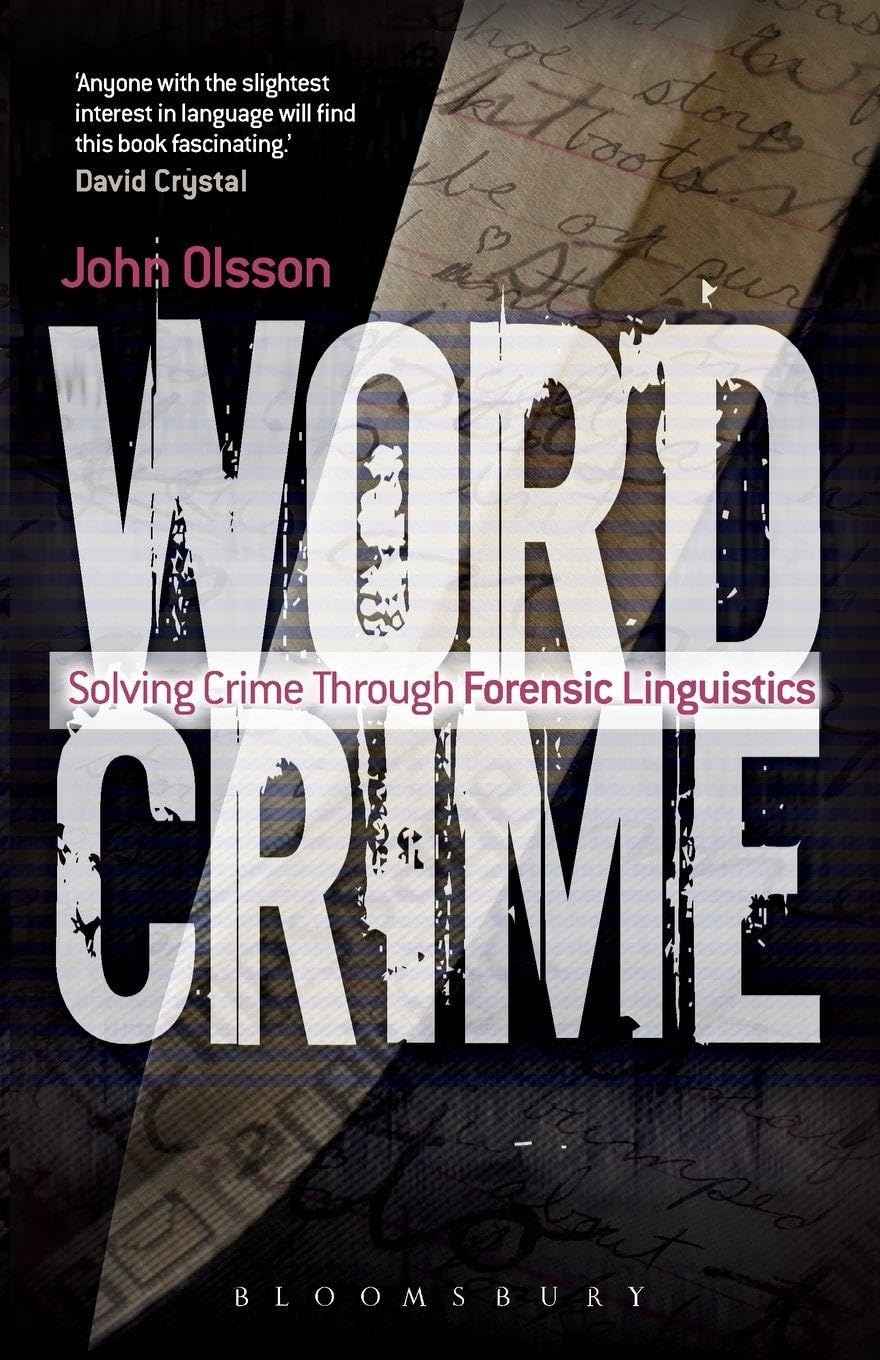
Wordcrime by John Olsson – How Language and Writing Can Help Solve Crimes
Wordcrime by John Olsson is an informative book about forensic linguistics, a field that studies how language can be used during criminal investigations and legal cases.
A threatening letter, anonymous message, email, text, confession, or recorded conversation may contain important clues. The words a person chooses, the way sentences are formed, common spelling habits, grammar patterns, and repeated expressions can sometimes help investigators understand who may have written or spoken them.
John Olsson introduces readers to this unusual connection between language, crime, and law. He explains how trained language experts examine communication and present their findings in real investigations.
The book is suitable for readers interested in true crime, criminology, law, language, investigation, and the ways experts study evidence that may not be visible at first.
When Words Become Evidence
Most people think criminal investigations depend mainly on fingerprints, DNA, security footage, or physical objects.
However, language can also provide useful information.
A criminal may send an anonymous threat, write a false statement, leave a note, or communicate through email. Even when the person tries to hide their identity, their natural writing habits may remain.
Investigators and forensic linguists may examine:
- Word choice
- Sentence structure
- Spelling habits
- Grammar patterns
- Punctuation
- Regional expressions
- Repeated phrases
- Level of formality
- Tone and style
- The way ideas are organised
These details do not always prove who wrote a message by themselves. However, they can help experts compare documents, identify patterns, exclude unlikely writers, or support other evidence.
Wordcrime explains how this careful study of language works.
What Is Forensic Linguistics?
Forensic linguistics is the study of language in legal and criminal settings.
It may involve examining written documents, spoken statements, interviews, confessions, emergency calls, court communication, threats, contracts, and anonymous messages.
A forensic linguist may help answer questions such as:
- Was this message written by the same person as another message?
- Does a confession sound natural or possibly influenced by someone else?
- What does a threatening statement actually mean?
- Can the writer’s background be estimated from their language?
- Does a document contain unusual repeated patterns?
- Is the wording clear enough to support a legal claim?
- Could a misunderstanding have been caused by language?
The field brings together linguistics, criminal investigation, law, psychology, and communication studies.
John Olsson introduces these ideas in a way that can be understood by readers who are new to the subject.
Anonymous Messages Can Reveal Hidden Clues
People who write anonymous messages often believe their identity is completely hidden.
They may change their handwriting, use a false name, create a new email account, or avoid giving personal information. However, their language may still contain familiar habits.
A person might use the same uncommon phrase in several messages. They may make the same spelling mistake, place punctuation in the same way, or use words linked to a particular job, age group, region, or education level.
Forensic linguists look for these patterns carefully.
They compare the questioned text with known writing samples. The purpose is not to guess quickly. It is to study similarities and differences in a structured way.
Wordcrime helps readers understand why even a short message may contain more information than the writer intended to reveal.
Understanding Writing Style
Every person develops certain habits when writing.
Some people use short sentences. Others write long and detailed paragraphs. Some prefer formal language, while others use casual words, shortened forms, or local expressions.
A writer may also repeat certain connecting words, greetings, endings, or punctuation marks.
These habits are sometimes called features of writing style.
In a criminal investigation, experts may compare the style of an anonymous document with letters, emails, statements, or other writing connected to a suspect.
The process must be handled carefully because people can change their writing and many language habits are shared by large groups. A responsible expert studies several features together rather than relying on one word or spelling mistake.
This makes forensic language analysis a detailed and thoughtful process.
Speech Can Also Provide Evidence
Forensic linguistics is not limited to written text.
Spoken language can also be examined.
Experts may study recorded phone calls, emergency calls, interviews, police questioning, courtroom speech, or conversations connected to an investigation.
They may listen for:
- Accent features
- Pronunciation
- Repeated expressions
- Speaking speed
- Pauses and hesitation
- Vocabulary
- Sentence patterns
- Changes in tone
- How a person responds to questions
These features may help investigators understand communication more clearly.
However, speech can change depending on stress, fear, health, location, or the person being addressed. For this reason, spoken evidence must also be studied with care.
The book introduces readers to the complexity of drawing conclusions from real communication.
Confessions and Police Interviews
Confessions can become important evidence in criminal cases, but they must be examined carefully.
A written or spoken confession may raise questions about how it was produced. Investigators may need to know whether the words sound like the suspect’s normal language or whether parts of the statement appear to come from someone else.
Language experts can examine vocabulary, sentence structure, repeated phrases, and the way information is presented.
They may also study police interviews to understand how questions were asked and how answers were recorded.
A person’s statement may change when another person summarises it, corrects it, or writes it in more formal language. This can create a difference between what was originally said and what appears in the final document.
Wordcrime shows why accurate language and careful recording are important in legal investigations.
Threats, Warnings, and Harmful Messages
Threatening communication can be difficult to interpret.
Some messages clearly describe an intended action. Others use indirect, confusing, emotional, or coded language.
Investigators may need to decide whether a statement is a real threat, an expression of anger, a joke, or something with another meaning.
Forensic linguists can study the wording, context, grammar, tone, and relationship between the people involved.
They may also compare the message with earlier communication to see whether the style is similar.
This type of analysis can help law enforcement understand the possible level of danger and decide what further investigation is needed.
The book helps readers see that meaning does not come from individual words alone. Context, intention, and the way words are used also matter.
Language in the Courtroom
Language plays an important role throughout the legal system.
Police officers ask questions. Witnesses give statements. Lawyers present arguments. Judges explain decisions. Suspects respond during interviews. Written laws and contracts must also be understood.
A small difference in wording can sometimes change the meaning of a statement.
People may also struggle with legal language because it can be formal, technical, or difficult to understand. This becomes more serious when someone speaks a different first language or has limited reading ability.
Forensic linguistics can help identify communication problems and examine whether legal language was clear, fair, and properly understood.
Wordcrime gives readers a wider view of how language affects justice, not only criminal identification.
Why Careful Analysis Matters
Language evidence can be useful, but it must not be treated as magic.
One unusual word cannot automatically identify a criminal. A spelling error does not prove authorship. Two people may use similar expressions without knowing each other.
Forensic language analysis becomes more valuable when experts examine many features, compare enough material, explain limitations, and work alongside other evidence.
This careful approach helps prevent weak or exaggerated claims.
The book encourages readers to understand both the power and the limits of linguistic evidence.
This is important because expert findings may influence serious legal decisions. Clear methods, honest explanations, and responsible conclusions are necessary.
What Readers Can Learn
Wordcrime introduces several important areas of forensic language study.
Readers can learn about:
- The basic meaning of forensic linguistics
- How writing may become legal evidence
- How anonymous documents are examined
- How language patterns can be compared
- Why spelling and grammar habits may matter
- How speech can be studied during investigations
- The role of language in confessions
- How threatening messages may be interpreted
- Why legal wording must be clear
- The limits of language-based conclusions
- How experts support criminal investigations
- The relationship between linguistics and law
The book gives readers a new way to think about everyday communication.
After reading it, an email, letter, interview, or short message may no longer appear simple. Each form of communication can contain patterns, choices, and hidden information.
Why True Crime Readers May Enjoy It
Many true crime books focus on the criminal, victim, police investigation, or final court case.
Wordcrime looks at a more specialised part of investigation.
It shows how language experts may study evidence that other people overlook. This creates a different reading experience for people who already know about fingerprints, DNA, witness statements, and crime scene evidence.
Readers can explore how a small detail in a letter or sentence may become connected to a much larger case.
The book combines language study with criminal investigation, making it useful for readers who enjoy learning how experts solve difficult problems.
Useful for Students and Researchers
Wordcrime can be valuable for students studying linguistics, criminology, law, forensic science, communication, psychology, or criminal justice.
It introduces an area that connects several academic subjects.
Linguistics students can see how language theories are used outside the classroom. Criminology students can learn about a less familiar form of evidence. Law students can understand why wording, meaning, and communication methods may affect legal cases.
Researchers may also find the book useful as an introduction to questions about authorship, legal language, interviews, and written evidence.
The book may support assignments, presentations, classroom discussions, and independent study.
Suitable for Curious General Readers
Readers do not need to be language experts to become interested in this topic.
Anyone who has wondered how investigators trace anonymous communication may find the book engaging.
It is suitable for:
- True crime readers
- Criminology students
- Law students
- Linguistics students
- Forensic science learners
- Legal professionals
- Researchers
- Teachers
- Journalists
- Crime documentary viewers
- People interested in language
- Readers curious about criminal investigations
The subject is specialised, but it relates to communication people use every day.
A Different Kind of Crime Book
Wordcrime is not simply a collection of crime stories.
Its main purpose is to explain how language can be studied as evidence.
This makes it different from books that focus only on violence, mystery, or courtroom drama. It gives readers knowledge about the tools and methods used by language specialists.
The book may change how readers think about words. A sentence can show more than its direct meaning. It can also reflect habit, background, intention, relationship, and personal style.
For readers who enjoy educational crime books, this combination of science, law, and language can be especially rewarding.
A Premium Reading Experience from Bookish Wonderland
Bookish Wonderland offers this edition for readers who value clear text, comfortable pages, and durable construction.
The crystal-clear printing helps keep detailed explanations sharp and readable. Premium eye-soothing cream paper provides a softer reading surface for long study or reading sessions.
The high-quality stitched and glue binding helps keep the pages secure during repeated use. This is useful for students, researchers, and readers who may return to important chapters for notes or reference.
Its durable construction makes the book suitable for personal libraries, classrooms, offices, study collections, and gifts.
A Thoughtful Gift for Crime and Language Enthusiasts
Wordcrime can be a suitable gift for someone who enjoys true crime but wants to explore a different side of criminal investigation.
It may also be a meaningful choice for students beginning studies in law, criminology, linguistics, criminal justice, or forensic science.
The book can be given for:
- Birthdays
- Academic achievements
- University admission
- Graduation
- Research projects
- Reading challenges
- Professional development
- Personal book collections
Its specialised subject makes it a more unusual and informative gift than a standard crime novel.
Best Sellers Rank of This Book
- #1,373,736 in Books
- #384 in Forensic Science Law
- #1,880 in Linguistics Reference
- #3,145 in Criminology (Books)
Discover the Evidence Hidden Inside Language
Wordcrime by John Olsson shows that words can do more than tell a story.
They may reveal habits, relationships, background, intention, and patterns that help experts understand a criminal case. A simple message, letter, recording, or statement can become an important part of an investigation when examined carefully.
The book offers an educational introduction to forensic linguistics and explains why language matters in criminal investigations and legal settings.
Readers interested in crime, law, communication, or human behaviour may find this book both useful and fascinating.
Order Wordcrime by John Olsson from Bookish Wonderland and explore the hidden clues that may exist inside everyday words.
If you require any customization or have any questions, please inbox us via FB or Insta.
| Primary Specification | |
| Author | John Olsson |
| Genre | True Crime, Forensic Linguistics, Criminology, Linguistics Reference |
| ISBN-13/ISSN | 978-1441193520 |
| ISBN-10 | 1441193529 |
| Publisher | Continuum |
| Publishing Date | April 12, 2012 |
| Language | English |
| Reading Age | 14+ years |
| Format | Printed book |
| Physical Specification & Quality | |
| Paper Quality | Premium eye-soothing cream paper |
| Binding Quality | High quality stitched and glue binding (for longevity) |
| Print Quality | Crystal-clear print |
| Pages | 208 pages |
| Country | United Kingdom |
| Logistics Information | |
| Weight | 213g |
| Length | 8.5 inch |
| Width | 5.6 inch |
| Height | 0.41 inch |