

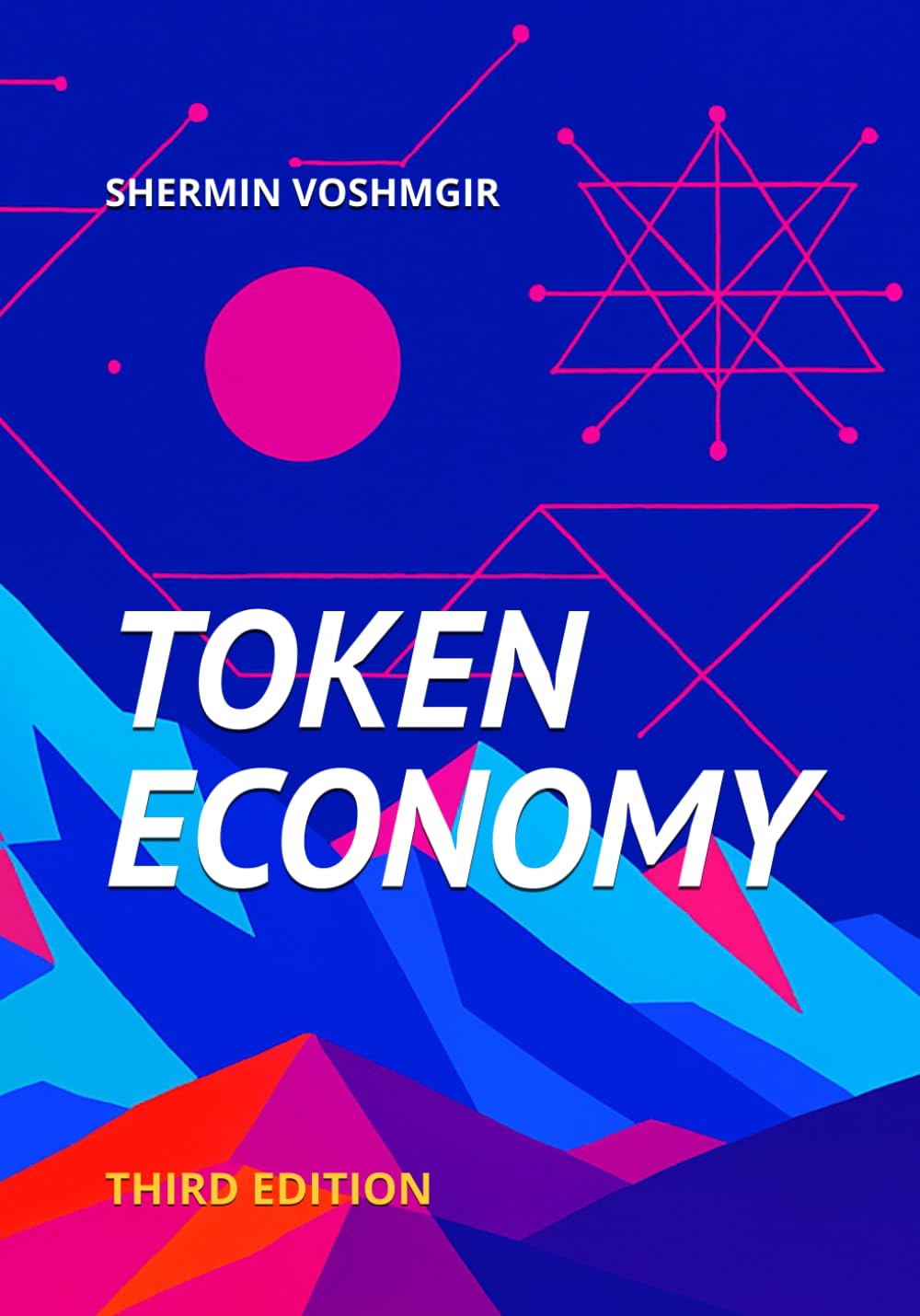
Token Economy by Shermin Voshmgir – Understand Blockchain, Crypto, Web3, and Digital Tokens
Token Economy by Shermin Voshmgir – Third Edition is a detailed but readable guide to blockchain, Bitcoin, tokens, Web3, digital money, DeFi, DAOs, and the changing digital economy.
People often hear words such as crypto, token, NFT, smart contract, stablecoin, DeFi, and Web3. These terms appear in news reports, business talks, social media posts, and online videos. However, many explanations are either too short, too technical, or focused only on making money.
This book takes a wider and more careful approach.
Shermin Voshmgir explains how blockchain networks work, why digital tokens exist, what they can represent, and how token-based systems may change finance, business, organisations, public services, and the internet.
The Third Edition was published in 2025 after a major rewrite. It includes newer examples, practical uses, expanded discussions of digital finance, and ideas about the connection between blockchain and artificial intelligence.
It is suitable for beginners who want a strong starting point and experienced readers who want to understand the deeper social, technical, political, and economic effects of Web3.
Crypto Can Feel Hard to Understand
The crypto world uses many difficult words.
People discuss wallets, mining, validators, gas fees, tokenisation, smart contracts, DeFi, NFTs, governance tokens, DAOs, and decentralisation. A beginner may read several articles and still struggle to understand how these ideas connect.
Online information can create even more confusion.
One person may describe crypto as the future of money. Another may call it a dangerous bubble. Some people focus only on token prices, while others discuss technical systems that are difficult for ordinary readers to follow.
Token Economy gives readers a more organised starting point.
Instead of teaching only how to buy or sell crypto, the book explains the systems behind it. It helps readers understand why blockchain was created, how tokens work inside a network, and why good token design is important.
The goal is to understand the bigger picture rather than follow hype.
Start with the Meaning of a Token
A token is a digital unit that can represent something inside a computer-based network.
A token may represent money, ownership, access, a voting right, a reward, a physical asset, a service, or another form of value.
Different tokens can have very different purposes.
For example, one token may be used to pay network fees. Another may give members the right to vote on decisions. A stable token may try to keep a steady value. A digital collectible may represent ownership of a unique item.
This means the word token does not describe only one type of product.
Token Economy helps readers understand that the design and purpose of a token matter more than its name.
A useful token should have a clear job inside its network. It should support the goals of the people who use it and avoid rewards that encourage harmful behaviour.
Understand Blockchain Without the Hype
A blockchain is a shared digital record.
Instead of one company keeping the only copy of the record, many computers in a network may help check, update, and protect it.
The computers follow agreed rules. When information is accepted, it becomes part of the shared record.
This can reduce the need for one central organisation to control every transaction.
However, decentralisation is not automatic.
A network may be called decentralised while a small group still controls important parts of it. Developers, large token holders, service providers, mining groups, exchanges, or infrastructure companies may hold great power.
Token Economy helps readers look beyond marketing words.
It encourages them to ask:
- Who controls the network?
- Who can change its rules?
- Who checks transactions?
- Who owns most of the tokens?
- Who provides the main technology?
- What happens when something goes wrong?
- Can ordinary users take part in decisions?
- Is the system truly decentralised?
These questions help readers judge a blockchain project more carefully.
Why Bitcoin Became Important
Bitcoin introduced a way for people to transfer digital value without depending on one bank or central payment company to approve every transaction.
Its network uses shared rules and economic rewards to help independent computers agree on the same transaction history.
Bitcoin also introduced the idea of digital scarcity.
Normal digital files can usually be copied many times. Bitcoin created a system where units could not simply be copied and spent again without the network noticing.
This made Bitcoin important as both a technical system and a form of digital asset.
Token Economy examines Bitcoin as more than a changing market price. It looks at the network, its history, its economic design, its political meaning, and the difference between its early goals and its present use.
This helps readers understand why Bitcoin continues to influence the wider crypto world.
Learn How Smart Contracts Work
A smart contract is a computer program that runs on a blockchain network.
It follows written rules and can perform an action when certain conditions are met.
For example, a smart contract may:
- Transfer a token
- Record ownership
- Release a payment
- Manage a digital loan
- Count votes
- Share rewards
- Run part of an online organisation
- Control access to a service
The word contract can sometimes be confusing.
A smart contract is not always the same as a normal legal contract. It is mainly computer code that carries out instructions.
Code can make a process faster and more automatic, but it can also contain mistakes. If a smart contract has a serious error, users may lose money or face results that were not expected.
The book helps readers understand both the value and the limits of smart contracts.
Explore the Meaning of Web3
Web3 is often described as a new form of the internet built around blockchain networks, digital ownership, and user participation.
In the present internet, large companies control many websites, platforms, accounts, and user records. People may create content and build communities without owning the platform they use.
Web3 tries to create different systems.
Users may hold digital assets in their own wallets, take part in network decisions, or move certain assets between connected services.
Tokens may be used to reward participation and organise ownership.
However, Web3 also faces important problems.
Wallets can be difficult to use. Fees may become expensive. Scams and weak projects can cause losses. Some systems that claim to be decentralised still depend on central companies.
Token Economy presents Web3 as an important but developing system rather than a perfect answer to every internet problem.
Understand Different Types of Tokens
Not every token works in the same way.
The book helps readers study tokens based on what they do rather than placing them all in one group.
A token may function as:
- A payment tool
- A network reward
- A voting right
- Proof of ownership
- Access to a product or service
- A claim connected to an asset
- A digital collectible
- A method of organising a community
- A way to support a shared goal
- A reward for providing data or equipment
Some tokens may perform more than one job.
For example, a token may be used to pay fees and vote on network changes. This can make the system useful, but it may also create conflicts.
Good token design requires careful thinking about users, rewards, supply, rules, and long-term behaviour.
Why Token Design Matters
Creating a token is easier than creating a healthy token economy.
A project may issue tokens, make strong promises, and attract buyers. However, the system can fail if its rewards encourage the wrong actions.
Users may join only to make quick money. Early buyers may hold too much control. A small group may change the rules for its own benefit. The token supply may increase too quickly and reduce value.
Token Economy explains why token design should begin with purpose.
Designers need to ask:
- What problem does the token solve?
- Why is a blockchain needed?
- Who receives the token?
- How are new tokens created?
- What gives the token a useful role?
- What behaviour does the system reward?
- Who makes important decisions?
- How can abuse be reduced?
- What happens when users leave?
- Can the system continue for many years?
A token should support a working network. It should not exist only because issuing a token is popular.
Learn About Digital Money and Stable Tokens
Cryptocurrencies can change greatly in value.
This makes some of them difficult to use for normal payments, salaries, savings, or business planning.
Stable tokens, often called stablecoins, try to keep a steadier value by connecting their price to another asset or system.
Some are connected to national currencies. Others use crypto assets, computer rules, or different forms of financial support.
Stable tokens can make digital payments and blockchain-based finance easier. They may help people transfer value quickly or use financial services without leaving a blockchain network.
However, not every stable token is equally safe.
Readers should understand:
- What supports its value
- Who controls the supporting assets
- Whether those assets are checked
- How users can exchange the token
- What happens during a crisis
- Whether one company can block transactions
- Which laws may apply
Token Economy helps readers see that the word stable does not remove financial or technical risk.
DeFi, CeFi, and Traditional Finance
DeFi means decentralised finance.
It describes financial services built mainly through blockchain networks and smart contracts. These services may include trading, lending, borrowing, payments, savings, or asset management.
CeFi means centralised finance within the crypto market.
A central company may hold user funds, manage accounts, and control the main service. Crypto exchanges and lending companies may operate in this way.
Traditional finance includes banks, payment companies, stock markets, insurance providers, and other established financial organisations.
Each system has benefits and weaknesses.
DeFi may offer open access and automatic services, but smart-contract problems can create serious losses. CeFi may be easier for beginners, but users must trust the company holding their assets. Traditional finance has legal protection and long experience but can be slow, costly, or unavailable to some people.
The book helps readers compare these systems instead of assuming that one model is always better.
NFTs Are More Than Digital Pictures
NFT stands for non-fungible token.
Non-fungible means that each item can have its own identity. One NFT may not be equal to another in the same way that one identical unit of normal currency equals another.
NFTs became widely known through digital art and collectibles. However, the basic idea can be used for other forms of ownership, proof, access, tickets, certificates, game items, or records.
The technology does not automatically prove that an item is valuable or legally owned.
Readers still need to ask:
- What does the token represent?
- Who created it?
- What rights does the buyer receive?
- Where is the related file stored?
- Can the creator change or remove anything?
- Does the token have a real use?
- Which laws protect the owner?
Token Economy places NFTs inside the wider study of tokenisation rather than treating them only as expensive online pictures.
Learn How DAOs Try to Organise People
DAO stands for decentralised autonomous organisation.
A DAO is a group that uses blockchain-based tools and tokens to help organise money, membership, voting, or shared work.
Members may submit ideas and vote on decisions. Smart contracts may help manage funds or carry out approved actions.
DAOs are sometimes presented as organisations without leaders.
In reality, their level of decentralisation can differ greatly.
A few people may control most of the tokens. Developers may hold special technical access. Many members may not vote. Important work may still depend on small teams.
The book examines DAOs as new forms of digital organisation while also studying their weaknesses.
It helps readers think about governance, responsibility, voting power, group behaviour, and the difference between written rules and real control.
Real-World Assets Can Become Tokens
Tokenisation can connect blockchain-based tokens to physical or traditional assets.
A token may represent a share of property, a financial product, a ticket, a unit of energy, a product record, or another real-world item.
This could make some assets easier to transfer, divide, or track.
However, creating a digital token does not remove the need for laws, contracts, trusted information, and real-world enforcement.
For example, a token may claim to represent part of a building. Someone must still prove that the building exists, confirm the legal ownership, maintain records, and protect the rights of token holders.
The connection between the token and the real asset must be clear.
Token Economy explains why tokenisation is not only a technical process. It also involves law, business, governance, and trust.
How Tokens Can Support Physical Networks
Some blockchain projects use tokens to encourage people to provide real equipment or services.
Users may provide internet coverage, storage space, computing power, location data, energy, or other physical resources. The network rewards them with tokens.
This model may help large systems grow without one company owning every machine.
However, the reward system must be designed carefully.
Projects need to check whether the service is real and useful. Otherwise, people may earn rewards without providing meaningful value.
The token’s market price may also become more important than the actual service.
The Third Edition discusses practical examples that help readers understand how digital rewards can connect to physical infrastructure.
Blockchain and Artificial Intelligence
Blockchain and artificial intelligence are different technologies, but they may work together in some systems.
AI tools can create, analyse, and make decisions from large amounts of data. Blockchain networks can record transactions, manage digital assets, and support shared rules.
Possible uses may include:
- Payments made by AI agents
- Records showing where data came from
- Rewards for sharing useful data
- Shared computing networks
- Digital identity systems
- Ownership records for generated work
- Automated services controlled by written rules
These ideas are still developing.
Combining two popular technologies does not automatically create a useful product. Projects must explain why each technology is needed and what problem it solves.
Token Economy introduces this connection while encouraging readers to think carefully about the design and control of these systems.
Technology Is Only One Part of the Story
Token Economy is more than a computer book.
It studies how blockchain and tokens connect with money, law, politics, organisations, society, and human behaviour.
A system can work perfectly as software but still fail because people do not trust it.
A token can be technically strong but reward harmful behaviour.
A network can claim to give power to users while allowing a small group to control all important decisions.
This wider view makes the book useful for readers outside computer science.
Business students can study new ownership systems. Finance readers can explore digital money. Law students can examine regulation. Social-science readers can study power, trust, and group behaviour.
Learn to Question Crypto Claims
The crypto industry is filled with strong promises.
Projects may claim they will replace banks, change the internet, remove middlemen, create perfect digital ownership, or give power back to users.
Some projects may build useful systems. Others may be poorly planned, highly centralised, or created mainly to attract money.
Token Economy gives readers questions they can use when studying a project:
- Is blockchain necessary?
- Does the token have a clear use?
- Who controls development?
- How are decisions made?
- Who owns most of the supply?
- Can the rules be changed?
- What risks do users face?
- What legal rights exist?
- Are rewards based on real value?
- Does the system work without rising token prices?
These questions can help readers move beyond exciting advertising and judge a project more carefully.
This Is Not a Quick Trading Guide
Token Economy does not promise fast profit.
It is not mainly a guide to choosing coins, predicting prices, or becoming rich through trading.
Its main purpose is education.
The book helps readers understand the structure of token-based systems, how blockchain networks operate, and what social and economic problems can appear.
This makes it useful for long-term learning.
Crypto markets change quickly. Individual tokens can rise, fall, disappear, or be replaced. The basic questions about network design, trust, incentives, governance, and ownership remain important.
Readers looking only for trading signals may not find that here. Readers who want deeper knowledge may find the book much more valuable.
Useful for Students and Researchers
The book can support study in several subjects.
It may be useful for students of:
- Business
- Finance
- Economics
- Information technology
- Computer science
- Law
- Political science
- Digital marketing
- Entrepreneurship
- Information systems
- Innovation management
- Social science
Students can use it to understand terms, find research topics, build presentations, and connect technology with social and economic questions.
Researchers may also use it as a starting point for studying decentralised organisations, digital finance, token design, online governance, or the changing structure of the internet.
Helpful for Founders and Business Professionals
Startup founders and business leaders may hear that they should add blockchain or create a token.
Before doing that, they need to understand whether these tools fit the business.
Token Economy can help professionals consider:
- Whether a shared network is needed
- Whether users should own digital assets
- How rewards may change behaviour
- Which legal questions may appear
- How control will be shared
- Whether the product can work without a token
- How users will understand the system
- What long-term value the network provides
This knowledge can prevent a team from using blockchain only because it sounds modern.
Technology should solve a clear problem.
Who Should Read Token Economy?
This Third Edition is a good choice for:
- Crypto beginners
- Blockchain learners
- Web3 enthusiasts
- Business and finance students
- Technology students
- Startup founders
- Entrepreneurs
- Investors seeking background knowledge
- Researchers
- Digital-policy readers
- Product designers
- Innovation professionals
- People interested in DAOs
- Readers studying digital money
- Anyone seeking knowledge beyond social media posts
Readers do not need to be programmers before starting the book.
Some sections contain detailed ideas, but the book connects technical topics with examples from money, society, organisations, and daily life.
Why This Third Edition Is Useful
The crypto and Web3 world has changed greatly since the earlier editions.
New forms of DeFi appeared. DAOs became active organisations rather than only ideas. Stable tokens became widely used. Tokenisation moved toward real financial and physical assets. Blockchain systems also began connecting with AI and infrastructure networks.
The Third Edition was rewritten to reflect this larger and more mature field.
It offers:
- Updated explanations
- Wider practical examples
- A deeper study of Bitcoin
- More discussion of digital finance
- Expanded DAO analysis
- Clearer token-design ideas
- Real-world tokenisation examples
- Discussion of blockchain and AI
- A wider view of regulation and politics
- Lessons from failed and successful systems
This makes it more than a small update to an older crypto book.
A Strong Reference for Long-Term Learning
Token Economy can be read from beginning to end, but readers may also use it as a reference.
A student may return to the chapter on Bitcoin before an exam. A founder may review token design before planning a project. A business reader may revisit DeFi while studying digital finance.
The book can be useful when:
- Preparing a class presentation
- Researching a Web3 project
- Learning crypto vocabulary
- Studying a blockchain business
- Comparing financial systems
- Exploring DAO governance
- Reviewing a token model
- Studying digital ownership
- Understanding a technology news story
- Planning further research
Readers may want to mark key sections and return to them as their knowledge grows.
A Premium Reading Copy from Bookish Wonderland
Bookish Wonderland offers this copy for readers who value comfortable pages, clear printing, and strong construction.
The premium eye-soothing cream paper provides a soft reading surface for long study sessions. Crystal-clear printing keeps technical terms, explanations, and examples sharp and easy to follow.
The high-quality stitched and glue binding helps keep the pages secure during repeated use. This is useful for students and professionals who may return to important sections many times.
The durable construction makes the book suitable for personal libraries, offices, universities, startup teams, training centres, and technology collections.
Token Economy by Shermin Voshmgir price in Bangladesh can be checked on the Bookish Wonderland product page before ordering.
A Useful Gift for Modern Learners
Token Economy can be a thoughtful gift for someone who wants to understand modern technology and finance.
It may suit:
- A university student
- A startup founder
- A crypto beginner
- A software professional
- A finance learner
- An entrepreneur
- A business teacher
- A technology researcher
- A Web3 community member
- Someone beginning a digital-economy course
It can be given for graduation, university admission, a new business project, a professional achievement, or personal learning.
Unlike a short online guide, a detailed printed book allows readers to study slowly, take notes, and return to difficult ideas.
What Books Are in the Token Economy Series by Shermin Voshmgir?:
Token Economy: Third Edition is a complete standalone volume. It is not presented as a numbered Book 1, Book 2, or Book 3 series.
- Token Economy: Third Edition by Shermin Voshmgir (Standalone complete edition)
Readers do not need another volume before starting this book. The main topics are brought together within the Third Edition.
Best Sellers Rank of This Book
- #314,492 in Books
- #39 in Cybernetics (Books)
- #82 in Bitcoin & Cryptocurrencies
- #105 in Computer Systems Analysis & Design (Books)
These ranks are shown exactly as supplied for this product and may change over time.
Build Knowledge Before Following the Next Trend
Token Economy by Shermin Voshmgir helps readers understand what exists behind the words crypto, Web3, and blockchain.
It explains that tokens are not only digital coins. They can represent rights, rewards, ownership, access, services, assets, and community decisions.
It also shows that technology alone cannot create a successful digital economy.
Every network needs clear rules. Every reward system affects human behaviour. Every claim of decentralisation should be checked. Every token linked to a real asset needs a trusted legal and business connection.
The book gives readers a way to examine these systems instead of simply believing online excitement or fear.
You can learn why Bitcoin matters, how smart contracts operate, what DAOs try to achieve, how DeFi differs from centralised finance, and why token design needs careful planning.
The Third Edition also looks at newer developments, including practical tokenisation, digital infrastructure, and the connection between blockchain and artificial intelligence.
This is a strong choice for readers who want useful knowledge rather than quick predictions.
Order Token Economy by Shermin Voshmgir – Third Edition from Bookish Wonderland and start building a clearer understanding of blockchain, tokens, Web3, and the future of the digital economy.
Fast or urgent delivery may be available in Dhaka, with cash on delivery and nationwide delivery across Bangladesh.
If you require any customization or have any questions, please inbox us via FB or Insta.
| Primary Specification | |
| Author | Shermin Voshmgir |
| Genre | Technology, Blockchain, Cryptocurrency, Web3, Digital Economy |
| ISBN-13/ISSN | 978-9899157149 |
| ISBN-10 | 9899157147 |
| Publisher | Labirinto Ecletico Unip LDA (Token Kitchen) |
| Publishing Date | April 20, 2025 |
| Edition | 3rd ed. |
| Language | English |
| Reading Age | 16 years and up |
| Format | Printed book |
| Physical Specification & Quality | |
| Paper Quality | Premium eye soothing cream paper |
| Binding Quality | High quality stitched and glue binding (for longevity) |
| Print Quality | Crystal clear print |
| Pages | 381 pages |
| Country | Portugal |
| Logistics Information | |
| Weight | 385 |
| Length | 8.5 inch |
| Width | 5.6 inch |
| Height | 0.86 inch |