

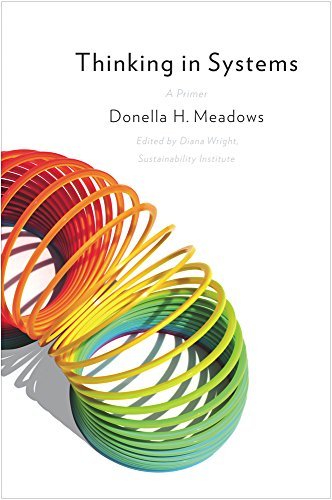
Thinking in Systems by Donella H. Meadows: A Simple Guide to Seeing the Bigger Picture
Some problems keep coming back even after we try to fix them. A business cuts costs, but service becomes worse. A city builds more roads, but traffic returns. A team works harder, yet delays grow. A person tries to save money, but small habits keep pulling the budget off track. Thinking in Systems by Donella H. Meadows explains why this happens. It teaches you to stop looking only at one event and start looking at the whole system around it.
This book is a clear introduction to systems thinking. It helps readers understand how parts connect, how one change can affect many other things, and why a quick fix can sometimes create a new problem later. The book was edited by Diana Wright and published by Chelsea Green Publishing in 2008. It is widely used as an entry point for readers who want to understand systems thinking without starting with heavy equations or technical language.
For students, business owners, managers, teachers, planners, researchers, policy readers, and anyone who likes solving problems, this book can change the way everyday situations are seen. It does not ask you to become a mathematician. It asks you to notice patterns, links, delays, causes, effects, and the hidden rules that shape what happens.
Why Some Problems Do Not Go Away
Thinking in Systems shows another way to solve difficult problems. Instead of asking only, “What happened?”, the reader learns to ask, “What is creating this pattern?” A system can be a company, a family, a market, a school, a farm, a city, an economy, or even a habit. Each system has parts that affect one another. When those links are not understood, good actions can sometimes give bad results.
This is one of the biggest values of the book. It helps you move from reacting to events toward understanding the structure behind them. The Donella Meadows Project describes the book as a primer that helps people understand systems and engage with them in meaningful ways.
Instead of fixing the same problem again and again, you begin to search for what keeps creating it. That simple change in thinking can be useful in work, study, business, planning, and daily life.
Learn to See Connections, Not Just Separate Parts
A system is more than a group of pieces. The pieces are connected. Money comes into a business and goes out. Water flows into a tank and flows out. People join a team and leave it. Goods enter a store and are sold. Information moves from one person to another. These movements change what the system can do next.
Meadows explains ideas such as stocks and flows in a practical way.
A stock is something that builds up or goes down over time. It can be money in a bank account, water in a lake, goods in a warehouse, people in a city, or trust inside a team.
A flow is what changes that stock. Income can raise savings. Spending can lower it. Hiring can raise staff numbers. People leaving can lower them.
Once you learn to see stocks and flows, many daily problems become easier to understand. You begin to notice why results do not change at once, why old choices still affect today, and why a strong system can sometimes resist a new plan.
Feedback Loops Made Easy to Understand
One of the most useful ideas in Thinking in Systems is feedback. Feedback happens when the result of an action comes back and affects what happens next.
Some feedback makes change grow.
For example, a useful product gets good reviews. Good reviews bring more buyers. More buyers create more reviews. The cycle can grow stronger.
Other feedback tries to keep things near a target.
A thermostat is a simple example. If a room becomes too cold, the heating turns on. When the room reaches the set temperature, the heating slows or stops. The system is trying to keep the room within a useful range.
Once you understand feedback loops, you begin to see why many problems repeat. You can look beyond one person or one mistake and study the cycle that keeps producing the result.
Why Delays Can Fool Us
A delay is the time between an action and its result. Delays are easy to ignore because we often want fast proof that a decision is working.
A company may train workers today, but better service may take weeks to appear. A student may study every day, but exam results come later. A new policy may take months or years to show its full effect.
If we judge too early, we may stop a good plan.
If we keep pushing too hard before the result appears, we may create too much change.
Thinking in Systems helps readers become more careful with time. It shows why systems can look quiet while change is building under the surface. This idea is especially useful for long-term planning and for any situation where action and result do not happen together.
Better Decisions Start With Better Questions
This is not a book that gives one fixed rule for every problem. Instead, it gives you a way to ask stronger questions.
- What is the goal of this system?
- What is changing over time?
- What is building up?
- What is flowing in or out?
- What feedback is making the problem grow?
- What feedback is trying to control it?
- Where is the delay?
- Who gets the information?
- What rule is shaping behavior?
- What happens if we change one part?
- Could that change create a new problem somewhere else?
These questions are simple, but they can lead to deep answers. They help readers avoid narrow thinking. They also make the book useful across many fields because the same way of thinking can be used for a business, classroom, supply chain, environmental issue, project, or personal goal.
Find the Small Changes That Can Matter Most
One of Donella Meadows’s best-known ideas is the idea of leverage points.
A leverage point is a place in a system where a change may have a larger effect than expected. The book explores how changing information, rules, goals, structures, or even the way people think about a system can produce very different results.
This does not mean every small action creates a huge result. It means some parts of a system have more power than others.
If you find the right place to act, you may get more improvement with less wasted effort.
The Donella Meadows Project preserves Meadows’s work on leverage points and systems thinking, showing how closely this idea is connected to her wider work.
A Book for Business, Study, Work, and Daily Life
Thinking in Systems is not only for scientists.
Its ideas can be used in many real situations.
A business owner can use systems thinking to understand stock problems, customer complaints, staff pressure, growth, cash flow, and repeated mistakes.
A manager can use it to see why a team keeps missing deadlines even when everyone is working hard.
A student can use it to understand how study time, sleep, practice, feedback, and stress affect learning together.
Entrepreneurs can use the ideas when studying customer behavior, pricing, team growth, supply problems, marketing results, or business expansion.
Project teams can use systems thinking to find bottlenecks, delays, weak information flow, and repeated errors.
Readers interested in sustainability can use the book to understand why environmental, social, and economic problems are often connected.
Google Books describes the title as a practical introduction that brings systems thinking into the real world and applies problem solving from personal to global levels.
What You Will Gain From Reading It
Readers can expect practical benefits such as:
- A clearer way to understand difficult problems without looking at only one cause.
- Better awareness of repeating patterns that develop over time.
- A stronger habit of checking connections before making a decision.
- A simple understanding of stocks, flows, feedback, and delays.
- More patience with long-term results that do not appear immediately.
- A better sense of where to make changes instead of pushing harder everywhere.
- A wider view of business, society, nature, organizations, and personal decisions.
- A useful set of ideas for planning, problem solving, teamwork, and learning.
The biggest benefit is a change in how you look at problems.
You begin to ask not only who caused something, but also what structure made that result likely.
That can help you make calmer, smarter, and more useful decisions.
A Premium Reading Copy From Bookish Wonderland
A useful book deserves a physical copy that feels comfortable to read and strong enough for repeated use. Bookish Wonderland prepares this edition for readers who want a clean and durable reading experience.
- Premium eye-soothing cream paper: Soft-looking pages designed for comfortable reading.
- Crystal-clear print: Sharp and readable text for a smooth reading experience.
- High-quality stitched and glue binding: Made to hold the pages firmly and support long-term use.
- Printed English book: Suitable for study, note-taking, rereading, and shelf storage.
Thinking in Systems is the kind of book many readers may want to return to.
You may want to mark an important idea, revisit a diagram, compare a chapter with a real problem, or use the book again while working on a project.
A durable physical copy makes that easier.
Why Buy Thinking in Systems From Bookish Wonderland?
Bookish Wonderland focuses on premium and durable English books for readers across the country.
You can order from Dhaka or outside Dhaka, and nationwide delivery across Bangladesh is available.
Cash on Delivery is available across Bangladesh, making it easier to order without paying online first.
Customers in Dhaka can also ask about fast or urgent delivery when they need the book quickly.
If you are searching for the Thinking in Systems by Donella H. Meadows Book price in Bangladesh, Bookish Wonderland gives you a simple way to order a readable and durable printed copy with convenient delivery support.
The aim is simple: give readers a good physical book, easy ordering, dependable delivery options, and a copy that can stay useful for years.
Who Should Read Thinking in Systems?
This book is a strong choice for:
-
Anyone who feels normal quick fixes are not enough.
You do not need advanced maths to begin.
The book is designed as a primer, so its purpose is to make systems th
- Students learning business, economics, management, environment, public policy, engineering, design, or social science.
- Entrepreneurs who want to understand why business problems repeat.
- Managers and team leaders who need better ways to study workflow and performance.
- Teachers and trainers who want a clear framework for explaining connected problems.
- Researchers and analysts who want an easy introduction before moving to deeper systems material.
- Policy and development readers who work with problems that have many causes.
- Readers interested in sustainability, climate, organizations, cities, markets, or social change.
inking easier to understand and use.
How Can This Book Help You in Real Life?
- Imagine that your business keeps running out of one popular product.
- The normal answer may be to order more.
- Systems thinking asks more questions.
- Why does the stock run out?
- Does ordering take too long?
- Does demand rise after advertisements?
- Is sales information reaching the purchasing team late?
- Does ordering too much create a different stock problem later?
- By asking about the whole system, you may find a better answer.
The same thinking can be used for personal money, study habits, work schedules, customer service, team performance, project delays, marketing, planning, and many other situations.
This is why Thinking in Systems can stay useful even after you finish reading it.
Simple Ideas With Deep Meaning
The book deals with serious ideas, but its value comes from helping the reader see them in everyday life.
A system does not have to be a giant computer network.
- Your monthly budget is a system.
- A shop is a system.
- A classroom is a system.
- A family routine is a system.
- A delivery process is a system.
- A company is a system.
- A city is a system.
Once you start seeing these connections, you may also notice that changing one part can affect another part in a way you did not expect it.
Best Sellers Rank of This Book
As supplied for this product listing:
- #1,499 in Books
- #1 in Environmental Economics (Books)
- #1 in System Theory
- #1 in Cybernetics (Books)
A Book That Can Change How You See Everyday Problems
The real power of Thinking in Systems is not that it gives you more facts to remember.
It gives you a different lens.
After reading it, you begin to look past simple blame and quick fixes. You start noticing patterns, connected causes, hidden rules, delays, and decisions that create effects somewhere else.
You may begin asking why a problem keeps returning.
You may notice that the most obvious solution is not always the strongest one.
You may start thinking about what happens next, what happens later, and what happens to other parts of the system after one change is made.
The Donella Meadows Project continues to present systems thinking as a way to understand connected challenges rather than treating each problem as isolated.
Make It Part of Your Working Library
Some books are read once and placed on a shelf.
Thinking in Systems can be more useful when you keep coming back to it.
Read it slowly.
Use a notebook.
Think about one system from your own life while reading.
It could be your study routine, your business, your family budget, a customer service process, a classroom, or a project.
- Ask what is building up.
- Ask what is flowing.
- Ask what is delayed.
- Ask what keeps repeating.
- Ask where one useful change may produce a better result.
Whether you want to improve the way you solve problems, make better business decisions, understand complex issues, or simply train yourself to see the bigger picture, Thinking in Systems by Donella H. Meadows is a practical book to keep close.
Order your copy from Bookish Wonderland and start learning how to see the links behind problems, the patterns behind events, and the better choices hidden inside the system.
If you require any customization or have any questions, please inbox us via FB or Insta.
| Primary Specification | |
| Author | Donella H. Meadows |
| Narrator | Tia Rider Sorensen |
| Editor | Peter Hasles |
| Genre | Systems Thinking, Systems Theory, Nonfiction, Business & Management, Economics, Sustainability |
| ISBN-13/ISSN | 978-1603580557 |
| ISBN-10 | 1603580557 |
| Publisher | Chelsea Green |
| Publishing Date | December 5, 2008 |
| Language | English |
| Reading Age | 16+ years |
| Format | Printed book |
| Physical Specification & Quality | |
| Paper Quality | Premium eye soothing cream paper |
| Binding Quality | High quality stitched and glue binding (for longevity) |
| Print Quality | Crystal clear print |
| Pages | 240 pages |
| Country | USA |
| Logistics Information | |
| Weight | 249 gm |
| Length | 8.5 inch |
| Width | 5.6 inch |
| Height | 0.6 inch |