

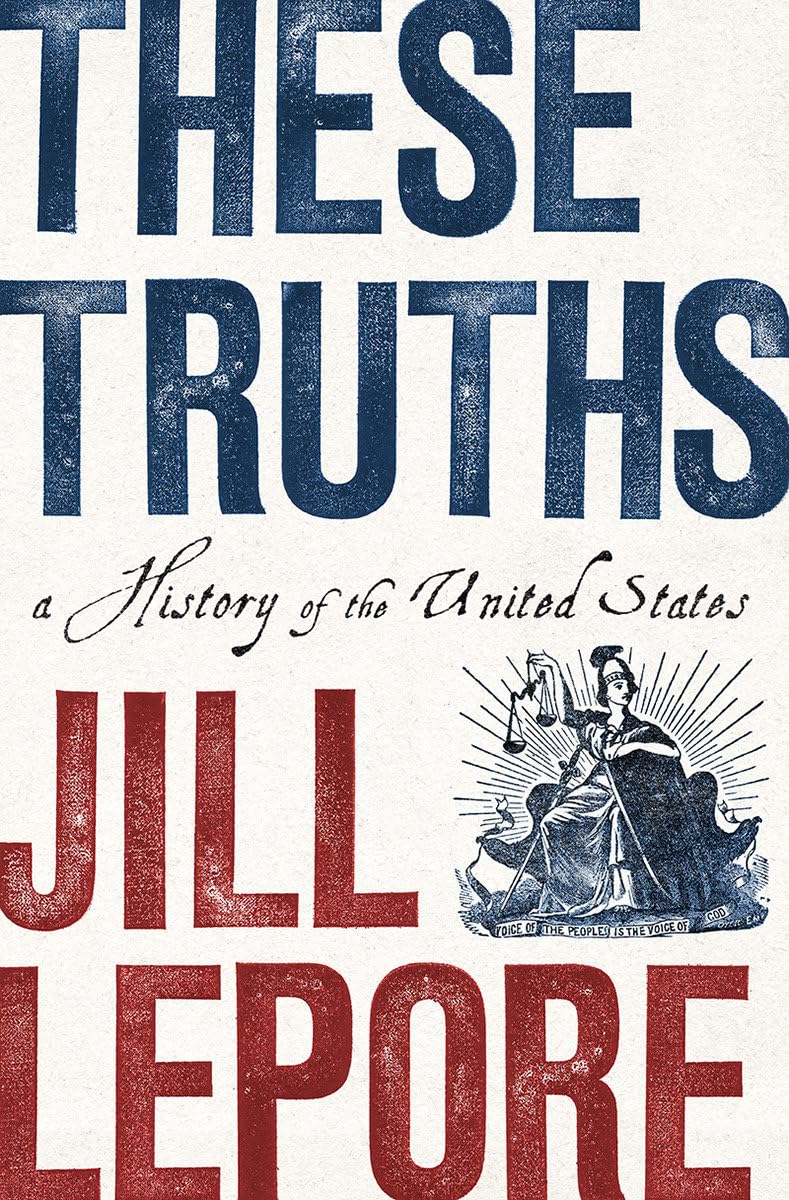
About These Truths: A History of the United States by Jill Lepore – A Clear, Powerful Journey Through America’s Past and Its Founding Ideals
These Truths: A History of the United States by Jill Lepore is a wide-ranging history of America that asks one big question: has the United States lived up to the ideas it was built on? Lepore focuses on three founding promises: political equality, natural rights, and the power of the people. She follows the country from 1492 through centuries of change, conflict, growth, and debate.
This is not a history book that only lists dates, wars, presidents, and laws. It looks at the ideas behind events and asks why they still matter. Lepore connects politics with slavery, race, citizenship, technology, media, inequality, democracy, and truth. She also shows how the country has often struggled to match its words with its actions.
A history book built around one important question
Many history books tell readers what happened. These Truths also asks what those events mean. The book begins with the ideas that helped shape the American experiment and then tests those ideas against what happened over time.
If a nation says all people have rights, what happens when slavery exists? If political equality matters, why have so many people been excluded from voting or public power? If the people are supposed to rule, what happens when information is false, media is divided, or powerful groups have more influence than others?
These questions give the book a clear purpose. Readers are not simply moving through a timeline. They are watching a long argument about what democracy should be and whether the country has reached its own goals.
From 1492 to the modern United States
Lepore begins before the founding of the United States. She looks at European arrival, Native peoples, colonization, and the forces that shaped the land before independence. From there, the book moves through the Revolution, the Constitution, slavery, the Civil War, Reconstruction, industrial growth, immigration, reform movements, world wars, civil rights, modern politics, and the digital age.
This wide span helps readers see links between different periods. A problem that looks modern may have deep roots. An argument about voting, rights, race, or citizenship may have started many generations earlier.
The book also gives readers a way to see change. Some rights expanded over time. Progress happened, but not in a straight line.
Why the three founding truths matter
At the center of the book are political equality, natural rights, and popular sovereignty.
Political equality means people should have equal standing in public life. Natural rights are rights people are believed to have simply because they are human. Popular sovereignty means political power should come from the people.
These ideas sound simple, but American history shows how difficult they have been to apply. The country declared ideals that were much larger than the reality many people lived.
Lepore uses this gap between promise and practice as one of the main ways to tell the story. That makes the book useful for readers who want more than patriotic celebration or simple criticism. It asks readers to look at the evidence and think carefully about both achievement and failure.
Slavery and inequality are central to the story
A major part of These Truths is the contradiction between freedom and slavery. The United States was founded with strong language about liberty while millions of people were enslaved.
Lepore does not treat slavery as a side topic. It is part of the political, economic, and moral history of the country. The effects of slavery continue through the Civil War, Reconstruction, segregation, voting struggles, and later arguments about race and equality.
The book also looks at other forms of exclusion and inequality. Women, Native Americans, immigrants, workers, and many other groups fought for rights and recognition. Their stories help show that American democracy was shaped not only by leaders but also by people who demanded that the country apply its ideals more fully.
Truth, evidence, and the role of information
One of the most unusual parts of the book is its focus on truth itself. Lepore pays attention to facts, evidence, newspapers, public debate, technology, polling, radio, television, and the internet.
Democracy depends on people making choices, but those choices depend on information. If citizens cannot agree on basic facts, public debate becomes harder. If information is controlled, twisted, or spread for political goals, the meaning of self-government can change.
This theme makes the book feel very relevant to modern readers. It helps explain why media history, communication, and technology belong inside political history. A voting system is important, but so is the information people receive before they vote.
Technology changes politics as well as daily life
These Truths does not treat technology as separate from history. New tools can change how people work, communicate, organize, campaign, and understand the world.
Printing, newspapers, radio, television, computers, data, and digital media all affected public life in different ways. Technology can spread knowledge quickly, but it can also spread false claims quickly. It can connect citizens, but it can also divide them into separate information worlds.
Lepore uses technological change to show that democracy is not only shaped by laws. It is also shaped by the systems people use to talk to one another.
This makes the book useful for readers who are interested in the link between history and today’s media environment.
A book that connects past and present
One reason These Truths attracts so many readers is that it does not leave history locked in the past. Lepore shows how old debates continue to shape modern politics.
Arguments about voting, citizenship, race, federal power, political parties, the press, wealth, and equality did not suddenly appear in recent years. They have long histories.
Knowing those histories can make current events easier to understand. Instead of seeing every political fight as completely new, readers can see patterns, changes, and older ideas returning in new forms.
Who should read These Truths?
This book is a strong choice for readers who want a serious but readable introduction to United States history. It can work well for university students, teachers, researchers, history lovers, book clubs, and general readers.
The book is large and detailed, so it may not be ideal for someone looking for a very short overview. But for readers who want one major volume that covers centuries while still asking clear questions, it offers strong value.
A useful book for study and discussion
Students can use These Truths as a broad reference for essays, assignments, class discussions, and research. Its main themes can help organize complex topics.
For example, a student writing about voting rights can connect early ideas of political equality with later struggles over citizenship and access to the ballot. A student studying media can follow changes from newspapers to digital communication. Someone studying slavery can see how its political effects continued long after emancipation.
Book clubs can also use the book because it gives readers many questions to discuss. Has the country moved closer to its founding ideals? Where has it failed? What role does truth play in democracy? How should citizens judge the past?
Why this Bookish Wonderland copy is made for long reading
These Truths is a substantial history book, so reading comfort and physical strength matter. Bookish Wonderland offers a premium printed copy designed for long study sessions, repeated reading, and shelf storage.
-
Premium eye-soothing cream paper gives the pages a softer look and helps make long reading more comfortable.
-
Crystal-clear print keeps names, dates, arguments, and long passages sharp and easy to follow.
-
High-quality stitched and glue binding gives the book stronger support for repeated opening and study.
-
Durable construction makes the copy suitable for students, readers, teachers, and collectors.
-
Nationwide delivery is available across Bangladesh.
-
Cash on Delivery is available across the country.
-
Delivery is available inside and outside Dhaka.
-
Fast or urgent delivery may be requested in Dhaka when available.
These Truths: A History of the United States by Jill Lepore Book price in Bangladesh
If you are checking These Truths: A History of the United States by Jill Lepore Book price in Bangladesh, Bookish Wonderland gives you a simple way to order a premium printed copy from home.
Readers in Dhaka and other parts of the country can place an order without visiting several bookstores. Cash on Delivery makes payment simple, while nationwide delivery helps students and history readers outside the capital get access to this important title.
When buying a large nonfiction book, price is only one part of the decision. Clear print, comfortable paper, and a strong binding can make a real difference because the book may be used for months or even years.
Best Sellers Rank of This Book
-
#4,845 in Books
-
#3 in United States History (Books)
-
#40 in U.S. State & Local History
-
#161 in World History (Books)
A strong choice for readers who want context
News can tell you what happened today. These Truths helps explain why today looks the way it does.
Modern arguments about democracy, inequality, voting, information, race, and political power make more sense when readers understand where those arguments came from.
The book does not tell readers that American history is only a success story or only a failure story. Instead, it shows a nation built around large promises and constant disagreement over what those promises mean.
That balance makes the book useful for readers who want context rather than slogans. It encourages careful reading, evidence, and questions.
Build a deeper understanding of American history
These Truths can become the kind of book you keep near your desk rather than hide at the back of a shelf. You can read it from beginning to end, or return to specific periods when you want background on a topic.
Students can use it for study. Teachers can use it for discussion. General readers can use it to connect current events with older debates.
The book’s biggest value is not simply the number of events it covers. Its value comes from the question running through all of them: did the nation live up to the truths it claimed at the beginning?
That question keeps the history connected and gives readers a reason to think beyond dates.
Bring this major American history book to your shelf
Order These Truths: A History of the United States by Jill Lepore from Bookish Wonderland if you want a detailed, thoughtful, and readable account of more than five centuries of American history.
Read it to understand the Revolution, slavery, democracy, civil rights, technology, media, inequality, and modern political conflict as parts of one long story. Keep it as a study reference, use it for class, or add it to a serious history collection.
For readers comparing Book price in Bangladesh, this title offers lasting value because it can support years of reading, study, and discussion.
Bookish Wonderland makes ordering easy with nationwide delivery and Cash on Delivery. Add your copy today and explore the long argument between America’s ideals and its reality.
If you require any customization or have any questions, please inbox us via FB or Insta.
| Primary Specification | |
| Author | Jill Lepore |
| Narrator | Jill Lepore |
| Genre | American History, Political History, Social History, U.S. History |
| ISBN-13/ISSN | 978-1324130765 |
| ISBN-10 | 1324130768 |
| Publisher | W. W. Norton & Company |
| Publishing Date | May 12, 2026 |
| Language | English |
| Reading Age | 16+ years |
| Format | Printed book |
| Physical Specification & Quality | |
| Paper Quality | Premium eye-soothing cream paper |
| Binding Quality | High quality stitched and glue binding (for longevity) |
| Print Quality | Crystal-clear print |
| Pages | 1040 pages |
| Country | USA |
| Logistics Information | |
| Weight | 1045g |
| Length | 8.5 inch |
| Width | 5.6 inch |
| Height | 1.7 inch |