

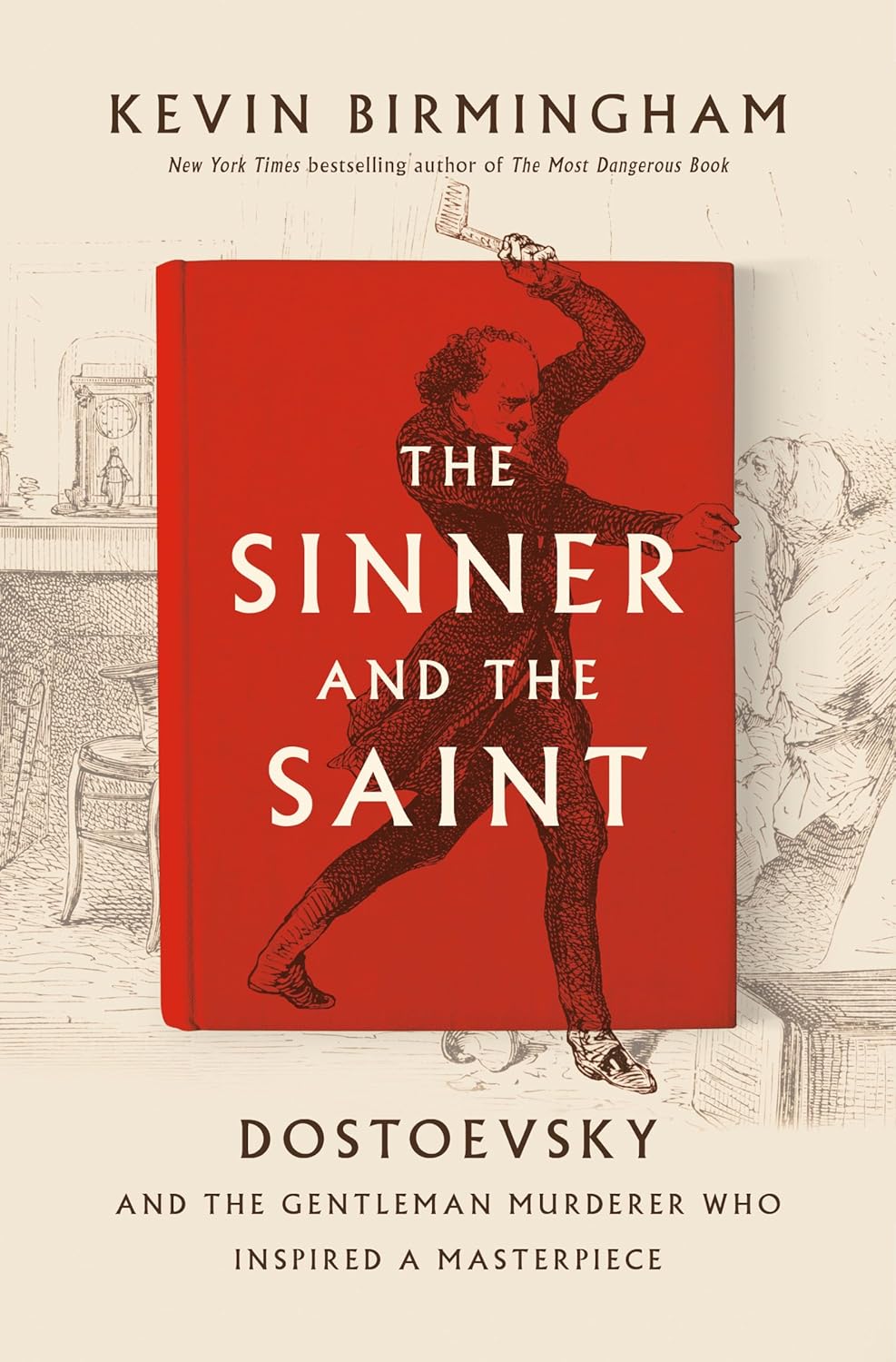
About The Sinner and the Saint by Kevin Birmingham – The True Story Behind Crime and Punishment
How did Dostoevsky create a great novel from murder?
The Sinner and the Saint by Kevin Birmingham follows the people, crimes, ideas, and personal struggles behind Crime and Punishment. At the centre are two very different men. One is Dostoevsky, the Russian writer who faced prison, exile, illness, debt, grief, and a near execution. The other is Pierre-François Lacenaire, a French poet and murderer whose trial became a public event in Paris.
Dostoevsky studied criminals closely during his years in Siberia. Later, he read about Lacenaire and became interested in a killer who could speak with charm and turn crime into a public show. From this dark material, Dostoevsky slowly shaped Rodion Raskolnikov, the troubled student at the heart of Crime and Punishment.
This is not a novel and not a simple author biography. It is literary history, true crime, biography, and a close look at how a masterpiece was made. Kevin Birmingham brings these parts together in a story filled with danger, big ideas, and human weakness.
See a famous classic with fresh eyes
Many people want to understand classic books but feel lost when they meet old politics, difficult ideas, and unfamiliar history. Crime and Punishment can feel especially hard because it asks readers to follow a murderer’s thoughts, guilt, pride, fear, and changing reasons.
The Sinner and the Saint helps open that locked world. It shows what Dostoevsky had lived through before he created Raskolnikov. It also explains the real murder case that caught his attention and the political ideas moving through Russia at the time.
Instead of giving a dry lesson, Kevin Birmingham tells the history through people and scenes. Readers see Dostoevsky facing a firing squad, living among prisoners, trying to rebuild his career, losing money at roulette, and writing while bills and deadlines close in. They also meet Lacenaire as he changes from a law student and poet into a criminal who attracts the eyes of Paris.
Dostoevsky before the masterpiece
Before Crime and Punishment made his name last for generations, Dostoevsky lived through fear and failure. As a young writer, he found success with Poor Folk. He then became involved with the Petrashevsky Circle, a group that discussed social change, books, and ideas the Russian government considered dangerous.
In 1849, Dostoevsky was arrested. After months in prison, he and other men were taken before a firing squad. They believed they were about to die. At the final moment, the sentence was changed. Dostoevsky was sent to hard labour in Siberia instead.
There he lived beside convicted criminals, including murderers. He listened to their stories and watched the strange mix of kindness, cruelty, pride, and pain inside them. This experience changed the way he understood crime. A killer was not simply a monster from a tale. A killer could be a person with feelings, reasons, lies, and deep inner conflict.
Those years helped prepare Dostoevsky to write from inside Raskolnikov’s mind. Birmingham shows how real suffering became part of great art without making that change seem quick or easy.
Meet the gentleman murderer of Paris
Pierre-François Lacenaire was educated, clever, and able to write poetry. He was also a thief and murderer. During the 1830s, his crimes, trial, and bold public manner fascinated French society.
Lacenaire did not look like the simple criminal many people expected. He dressed well, spoke clearly, and knew how to hold attention. He wrote about himself and acted as if his trial were a stage. Newspapers helped turn him into a dark public figure.
Dostoevsky found an account of Lacenaire’s case while searching for material for his journal. The French murderer offered a real example of a person who crossed moral lines and then tried to explain himself. This helped feed the questions that would later live inside Raskolnikov.
Birmingham does not present Lacenaire as the only source for Crime and Punishment. Instead, his life becomes one important thread in a much larger story.
Where true crime meets literary history
The book moves between Dostoevsky’s life, Lacenaire’s crimes, nineteenth-century politics, and the changing form of Crime and Punishment. These lines slowly meet as the famous novel moves closer to completion.
Readers learn how Dostoevsky worked through different ideas in his notebooks. Raskolnikov did not arrive fully formed. His reasons, voice, guilt, and relationships changed as the writer tested the story. Birmingham shows that a masterpiece can grow through doubt, revision, pressure, and many wrong turns.
The true-crime side gives the book tension, but the deeper subject is creation. How does a writer take real violence without simply copying it? How can fiction help readers look at a criminal without asking them to excuse the crime? Why can an invented person sometimes feel more human than the real figure who helped inspire him?
A writer racing against debt and time
Dostoevsky returned from exile determined to rebuild his life, but freedom did not bring peace. He faced family deaths, poor health, epilepsy, publishing trouble, and heavy debt. Gambling made his money problems worse.
These struggles were not separate from his writing. They shaped where, when, and how he worked. At times, he needed to write quickly because creditors and publishing deadlines were close. He also carried the memory of prison and the fear created by his mock execution.
Birmingham shows a writer who is brilliant but deeply imperfect. Dostoevsky could be generous and difficult, faithful and doubtful, hopeful and desperate. The title does not divide the story into one evil man and one holy man. The sinner and the saint can exist inside the same person.
That idea connects Dostoevsky, Lacenaire, and Raskolnikov. Human beings are rarely one simple thing. A person may want to do good and still cause harm. A person may understand moral rules and still break them. Crime and Punishment became powerful because Raskolnikov’s heart contains these fights.
What this book helps you understand
-
How Dostoevsky’s arrest and mock execution changed his view of life
-
What he learned while living among prisoners in Siberia
-
How illness, gambling, grief, and debt affected his work
-
Who Pierre-François Lacenaire was and why his case became famous
-
How real crime helped shape the character of Raskolnikov
-
How Russian politics and radical ideas entered Crime and Punishment
-
How Dostoevsky changed the story while working in his notebooks
-
Why Crime and Punishment focuses on motive, guilt, and inner conflict
-
How biography, true crime, history, and literary study can work together
-
Why the book is readable even if you have not finished the original novel
These points help readers move beyond a basic plot summary. They show the life, research, fear, and thought behind the finished classic. The book can also make a later reading of Crime and Punishment feel richer because familiar scenes gain new meaning.
Do you need to read Crime and Punishment first?
No. Kevin Birmingham gives enough explanation for readers to follow the people and ideas without knowing every part of Dostoevsky’s novel. Someone who has never read Crime and Punishment can use this book as an interesting introduction to its world.
However, the book discusses the classic’s plot, characters, development, and ending. Readers who want to avoid all spoilers may prefer to read Crime and Punishment first. Those who already know the novel can focus more closely on the links between Dostoevsky’s life, Lacenaire’s case, and Raskolnikov’s mind.
The Sinner and the Saint can therefore work in two ways. It can prepare a new reader for the classic, or it can help an experienced reader return with a deeper view. It does not replace Crime and Punishment. It opens the workshop where the novel was built.
Who will enjoy this book?
This title is a strong choice for mature readers who enjoy literary history, biography, true crime, philosophy, Russian history, and books about how writers create their work.
It may suit you if you like:
-
Crime and Punishment or other novels by Dostoevsky
-
True stories behind famous works of literature
-
Carefully researched nonfiction told with strong scenes
-
Accounts of trials, prisons, and nineteenth-century crime
-
Questions about guilt, evil, choice, and responsibility
-
Stories about writers working through pressure and failure
-
Books that connect personal lives with political history
-
Reading-group discussions with no easy answers
The subject is serious. It includes murder, execution, prison, forced labour, illness, addiction, debt, and death. It may not suit readers who want light entertainment or a simple crime story. For curious readers, however, these difficult parts lead to a thoughtful look at art and human nature.
A premium copy for focused reading
The Sinner and the Saint contains many names, events, and ideas, so a comfortable physical copy can make careful reading easier. Bookish Wonderland offers this printed English edition with features chosen for regular use.
-
Premium eye-soothing cream paper gives the pages a warm tone and feels softer to view than bright white paper.
-
Crystal-clear print keeps names, dates, and long passages sharp and readable.
-
High-quality stitched and glue binding helps keep the pages secure.
-
Durable construction supports study, note-taking, repeated reading, and sharing.
-
The printed format provides a quiet, screen-free way to focus on the book.
These qualities make the copy suitable for a personal library, university reading, a book club, or a gift. Strong binding matters when a book is opened often, while clear print and cream paper support longer reading sessions.
The Sinner and the Saint by Kevin Birmingham price in Bangladesh
Readers looking for The Sinner and the Saint by Kevin Birmingham price in Bangladesh can check the current amount on the Bookish Wonderland product page. The displayed price should be reviewed before ordering because prices and special offers may change.
Bookish Wonderland provides delivery inside Dhaka and throughout the country. Cash on Delivery is available nationwide, allowing customers to pay when the parcel arrives. Readers in Dhaka may also ask about fast or urgent delivery if the book is needed sooner.
For help with delivery, ordering, or a special request, contact Bookish Wonderland through Facebook or Instagram.
Discover the real story behind a masterpiece
Crime and Punishment did not appear from one sudden idea. It grew from a writer’s fear, suffering, reading, debts, questions, and close study of people who had killed. It also drew power from the strange public life of Lacenaire, a murderer who knew how to make society watch him.
Kevin Birmingham brings these parts together without turning them into a dry classroom lesson. He shows Dostoevsky fighting to rebuild his career and trying to understand why a person crosses the line between thought and murder. The result gives readers a new way to see both the writer and Raskolnikov.
Order The Sinner and the Saint from Bookish Wonderland today and explore the hidden history behind one of literature’s most famous novels. Cash on Delivery is available across the country, with delivery inside and outside Dhaka. Fast or urgent delivery may be requested in Dhaka. For questions or customization, message Bookish Wonderland on Facebook or Instagram.
If you require any customization or have any questions, please inbox us via FB or Insta.
| Primary Specification | |
| Author | Kevin Birmingham |
| Narrator | Robert Petkoff |
| Editor | Amanda Dewey |
| Genre | Nonfiction, biography, literary history, literary criticism and true crime |
| ISBN-13/ISSN | 978-0241962978 |
| ISBN-10 | 0141981717 |
| Publisher | Penguin Books Ltd |
| Publishing Date | November 3, 2022 |
| Language | English |
| Reading Age | 16+ |
| Format | Printed Book |
| Physical Specification & Quality | |
| Paper Quality | Premium eye-soothing cream paper |
| Binding Quality | High quality stitched and glue binding (for longevity) |
| Print Quality | Crystal-clear print |
| Pages | 432 pages |
| Country | UK |
| Logistics Information | |
| Weight | 455 gm |
| Length | 8.5 inches |
| Width | 5.6 inches |
| Height | 1.3 inch |