

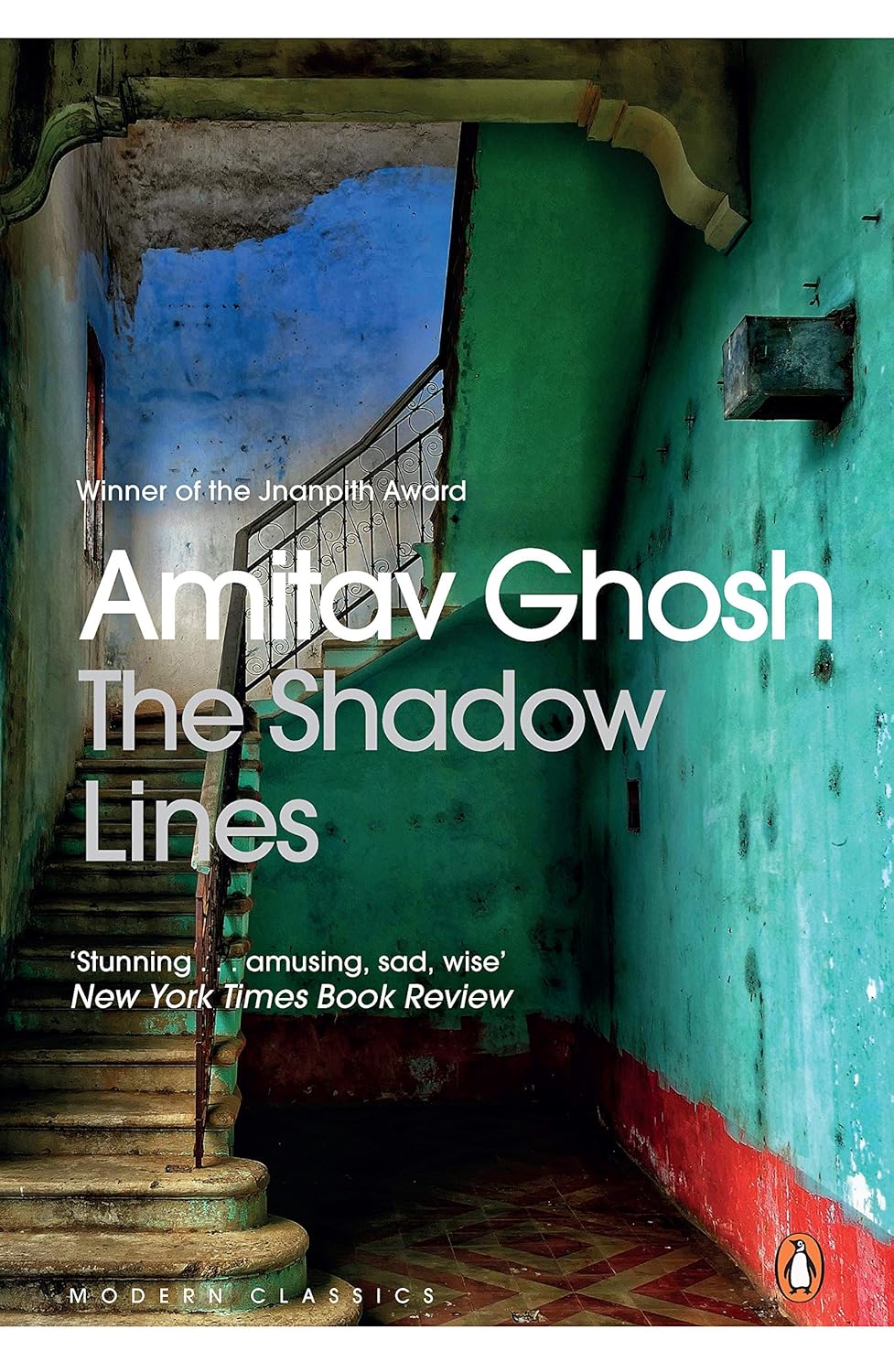
About The Shadow Lines by Amitav Ghosh – A Powerful Novel About Memory, Borders and Belonging
Some lines are drawn on maps. Some lines live only in our minds. And sometimes, a line that looks simple on paper can change the lives of millions of people.
The Shadow Lines by Amitav Ghosh is a deeply moving novel about family, memory, love, identity, borders, and the way history enters ordinary homes.
The story moves between Calcutta, Dhaka, and London. It follows an unnamed narrator who grows up listening to stories told by his family. Through these stories, he begins to understand places he has never seen, people he barely knows, and events that happened before he was old enough to understand them.
But as he grows older, memories start connecting with one another. A painful act of violence from the past slowly becomes clearer. What first seemed like separate family stories begins to form one much bigger picture.
This is not a book that simply tells you what happened. It makes you think about why people create borders, what makes a place feel like home, and whether nations can truly separate people whose memories and lives are deeply connected.
For readers who enjoy books that stay in the mind long after the final page, The Shadow Lines is one of Amitav Ghosh's most important novels.
When History Feels Too Distant, This Story Makes It Personal
A history book may tell us that a border was created, a country was divided, or a riot happened.
But numbers and dates cannot always show what those events felt like to ordinary people.
The Shadow Lines approaches history in a different way.
Amitav Ghosh brings large political events into homes, friendships, childhood memories, family arguments, journeys, and personal loss. Instead of looking only at leaders and governments, he looks at people who must live with the results of political decisions.
That is one reason the novel can feel so powerful.
You do not only read about borders. You see what borders can do to memory, family, identity, and belonging.
You do not only read about communal violence. You begin to understand how fear and hatred can suddenly change familiar streets and communities.
For anyone who finds traditional history hard to connect with, this novel offers another path. It shows history through human lives.
A Story Built From Memory
The novel is told by an unnamed narrator.
As a child, he is fascinated by Tridib, an older relative who has travelled and knows many stories. Tridib teaches him that imagination can take a person beyond the place where he physically lives.
Through stories, maps, memories, and conversations, the young narrator builds pictures of distant places in his mind.
London can feel close even when he is in India.
Dhaka can feel both familiar and strange.
The past can sometimes feel more alive than the present.
As the narrator grows older, he starts looking again at the stories he heard as a child. He remembers Tridib, his grandmother, Ila, May Price, and other people whose lives cross different countries and different periods of history.
Slowly, old memories begin to change meaning.
This way of telling the story makes The Shadow Lines different from a simple beginning-to-end novel. The story moves through time because human memory also moves through time. One small memory can suddenly bring back another event from many years earlier.
Why Are the Lines Called Shadow Lines?
The title gives us one of the biggest ideas in the novel.
Countries are divided by borders. Maps show clear lines between one nation and another.
But Amitav Ghosh asks a simple question: how real are those lines in everyday human life?
A line on a map may tell us that two people belong to different countries. Yet they may speak similar languages, share food, remember the same places, have relatives across the border, or carry the same history.
The line exists politically, but human life is much harder to divide.
That is where the idea of shadow lines becomes important.
The novel asks readers to think about the strange power we give to borders. A border may be invisible when you look at the land itself, yet it can decide where people may travel, what nation they belong to, and even who is treated as a friend or enemy.
It is a simple idea with very deep meaning.
A Novel With a Strong Connection to Dhaka
Readers in Bangladesh may find parts of The Shadow Lines especially meaningful because Dhaka is not just a distant name in this story.
It forms an important part of the family's past.
The novel explores memories connected with Dhaka before and after the Partition of 1947. It also connects personal family history with political change and communal violence in the region.
Because of this, the book can feel unusually close to South Asian readers.
Places are not shown only as points on a map. They are connected to childhood, family homes, old relationships, fear, loss, and the question of where a person truly belongs.
A place may become part of another country while still living inside someone's memory as home.
That idea runs through the novel again and again.
For readers interested in Bengal, Partition, migration, identity, or the shared history of India and Bangladesh, The Shadow Lines gives plenty to think about.
More Than a Novel About Partition
It is easy to describe The Shadow Lines as a novel about borders or Partition, but that only explains part of it.
At its heart, this is also a book about memory.
How much can we trust what we remember?
Can someone else's story become part of our own memory?
Can we feel connected to a city we have never visited?
Can a childhood memory change after we learn something new as adults?
These questions give the novel much of its emotional power.
The narrator keeps returning to the past because the past is not finished with him.
Small memories, family stories, imagined scenes, and historical events begin to overlap. Slowly, the reader understands that memory does not work like a neat timeline.
We remember pieces.
We forget pieces.
Sometimes another person's story fills the empty spaces.
Amitav Ghosh uses this simple human experience to build a rich and layered novel.
Characters Who Make Big Ideas Feel Human
The novel deals with large ideas, but it never becomes only a book of political arguments.
Its characters keep the story personal.
Tridib has a major influence on the narrator's imagination and understanding of the world.
Ila gives him another view of travel, freedom, identity, and life outside India.
The narrator's grandmother carries strong memories of Dhaka and powerful ideas about nation, home, and belonging.
May Price connects the Indian family with England and becomes important to the narrator's understanding of events from the past.
Each person sees the world differently.
That matters because the novel does not give readers one simple answer about borders, freedom, nationalism, or memory.
Instead, different characters believe different things.
Their choices, hopes, fears, and memories allow the reader to explore those ideas through real human relationships.
Why the Story Is Told Out of Order
Some readers may notice very quickly that The Shadow Lines does not move in a straight line from one year to the next.
That is intentional.
The narrator remembers one event, which leads him to another memory, which may then connect to something that happened many years earlier.
At first, this style may require a little more attention than a simple linear story.
But it also becomes one of the book's greatest strengths.
Human beings rarely remember their lives in perfect order.
A smell, place, name, photograph, or conversation can suddenly bring back something from long ago.
Ghosh makes the structure of the novel work in a similar way.
This also means the reader gradually discovers connections instead of receiving every answer immediately.
Small details that seem unimportant at first can become much more meaningful later.
The result is a novel that rewards careful reading.
A Book That Gives You Questions Instead of Easy Answers
The Shadow Lines does not tell readers exactly what to think.
Instead, it creates questions.
What makes a country real?
Is freedom simply the ability to cross a border?
Can two communities living close together suddenly become enemies?
Why can people feel deeply connected to places they have never physically seen?
How does political violence enter private family life?
And what happens when the story we believed for years turns out to be incomplete?
These questions help explain why the novel continues to be discussed by students, teachers, literary critics, and general readers.
You can finish the plot and still continue thinking about its ideas.
That makes it especially suitable for people who enjoy literary fiction with deeper meaning.
Why Students and Serious Readers Keep Coming Back to It
The Shadow Lines offers many subjects for study and discussion.
Readers interested in postcolonial literature can examine nationalism, borders, colonial history, and identity.
Students studying Partition literature can explore how historical division affects family life and memory.
Readers interested in narrative style can look at the unusual use of time, storytelling, imagination, and memory.
The novel can also lead to discussions about migration, communal violence, home, belonging, childhood, family, love, and political identity.
You do not need to be a literature student to enjoy these ideas.
The language of the story carries the reader through personal relationships first. The larger political and philosophical questions grow naturally from those relationships.
That balance makes the book useful both for academic reading and for personal reading.
What Makes This Edition Comfortable to Read
At Bookish Wonderland, the physical book is made for people who want a copy they can read, keep, underline, revisit, and place on their shelf for a long time.
-
Premium eye-soothing cream paper helps make long reading sessions more comfortable.
-
Crystal-clear printing keeps letters sharp and easy to read.
-
High-quality stitched and glue binding gives the book stronger page support and better durability.
-
A clean English text layout makes reading easier without unnecessary visual distraction.
-
The durable physical build makes the book suitable for regular reading, study, notes, and long-term shelf storage.
A thoughtful novel deserves a physical copy that you will not feel afraid to open again and again.
That is especially useful with The Shadow Lines because it is the kind of book many readers return to after finishing it once.
What You May Gain From Reading It
The strongest benefit of this book is not a simple lesson that can be written in one sentence.
It changes the way you look at familiar ideas.
After reading it, you may think differently about maps.
You may think differently about national borders.
You may notice how family stories shape what younger generations believe about the past.
You may also start questioning whether memory is something we simply keep or something we constantly rebuild.
The novel encourages empathy because the same historical event can look completely different depending on where a person stands.
It also shows that large political conflicts are never only political. They enter homes, friendships, childhoods, and private memories.
For readers who enjoy books that develop both emotional understanding and critical thinking, this is a strong choice.
Who Should Read The Shadow Lines?
This book is especially suitable for:
-
Readers who enjoy Amitav Ghosh's writing.
-
Students of English literature and postcolonial literature.
-
Readers interested in Partition and South Asian history.
-
People interested in India-Bangladesh history and cultural connections.
-
Readers who enjoy novels about memory and identity.
-
People who like serious family stories with deeper meaning.
-
Book clubs looking for a novel with many discussion topics.
-
Readers interested in nationalism, migration, borders, and belonging.
-
University students preparing essays or literary analysis.
-
Anyone looking for an important modern Indian English novel.
If you usually enjoy books that give you something to think about after you close them, The Shadow Lines deserves a place on your reading list.
A Good Choice for Study, Discussion, or Quiet Reading
You can read this novel in several ways.
Read it slowly for personal enjoyment and allow the family story to unfold.
Use it for a university literature course and make notes about memory, nationalism, Partition, and narrative structure.
Choose it for a book club and discuss how different characters understand freedom and home.
Read it alongside books about Partition to compare fiction with historical accounts.
You can also return to it after a few years. Because the novel deals so strongly with memory and changing points of view, a second reading can reveal connections you missed the first time.
That makes it much more than a one-time entertainment book.
It is a novel that can grow with the reader.
Why The Shadow Lines Still Matters
Borders have not disappeared from the world.
People still migrate.
Families still become divided between countries.
Questions about nationalism, identity, belonging, religion, memory, and political violence remain part of modern life.
That gives The Shadow Lines a lasting relevance.
Although the novel is rooted in particular moments of South Asian history, its larger questions are not limited to one country.
What happens when governments draw lines but people's lives remain connected?
Can a map change the meaning of home?
Can fear make neighbours see each other as strangers?
These ideas remain powerful because they are still recognizable today.
This is why The Shadow Lines works both as a South Asian novel and as a wider human story.
An Award-Winning Modern Classic
The Shadow Lines was first published in 1988 and later received the Sahitya Akademi Award for English in 1989.
The recognition matters, but the book's lasting value comes from something deeper: readers continue to study and discuss its ideas about memory, family, borders, nationhood, violence, and belonging.
It is also widely regarded as one of the important works in Amitav Ghosh's literary career.
For someone beginning to explore his writing, this novel offers a strong introduction to his interest in history, geography, movement, memory, and the ways individual lives are shaped by forces much larger than themselves.
Looking for The Shadow Lines by Amitav Ghosh Book Price in Bangladesh?
If you are checking the Book price in Bangladesh for The Shadow Lines by Amitav Ghosh, Bookish Wonderland gives you an easy way to order the book without searching through many different stores.
You can order from anywhere in Bangladesh, including Dhaka and areas outside Dhaka.
Cash on Delivery is available nationwide, so you can pay when your order reaches you.
Readers in Dhaka can also ask about fast or urgent delivery when available.
This makes the book easier to order whether you need it for personal reading, university study, an upcoming class, a book club, or as a thoughtful gift for another reader.
Why Order From Bookish Wonderland?
Bookish Wonderland focuses on readers who want English books that are comfortable to read and made to last.
You get:
-
Nationwide delivery across Bangladesh.
-
Cash on Delivery available across Bangladesh.
-
Delivery inside and outside Dhaka.
-
Fast or urgent delivery options in Dhaka when available.
-
Premium eye-soothing cream paper.
-
Crystal-clear printing.
-
High-quality stitched and glue binding.
-
A large collection of premium and durable English books.
-
An easy ordering process for readers across the country.
Instead of buying a copy that you may read once and forget, choose a book made for reading, studying, keeping, and returning to.
Bring One of Amitav Ghosh's Most Thought-Provoking Novels to Your Shelf
The Shadow Lines by Amitav Ghosh begins with family memories, but it grows into something much larger.
It asks why invisible borders can have such real power.
It shows how history can live inside ordinary families for many years.
It explores how stories from parents, grandparents, relatives, and friends become part of the way we understand ourselves.
Most importantly, it does all of this through a moving human story rather than turning the book into a history lesson.
If you want a novel with emotion, history, family relationships, beautiful ideas, and questions that stay with you after the final page, this is a strong book to choose.
Order The Shadow Lines by Amitav Ghosh from Bookish Wonderland today.
Cash on Delivery is available across Bangladesh, with nationwide delivery and fast delivery options in Dhaka.
Add this important modern classic to your shelf and discover why a simple line on a map can become one of the deepest questions in a person's life.
If you require any customization or have any questions, please inbox us via FB or Insta.
| Primary Specification | |
| Author | Amitav Ghosh |
| Narrator | Ranjit Madgavkar |
| Genre | Literary Fiction, Historical Fiction, Postcolonial Fiction |
| ISBN-13/ISSN | 978-0143448549 |
| ISBN-10 | 0143448544 |
| Publisher | India Penguin Modern Classics |
| Publishing Date | June 18, 2019 |
| Language | English |
| Reading Age | 16 + years |
| Format | Printed book |
| Physical Specification & Quality | |
| Paper Quality | Premium eye-soothing cream paper |
| Binding Quality | High quality stitched and glue binding (for longevity) |
| Print Quality | Crystal-clear print |
| Pages | 288 pages |
| Country | India |
| Logistics Information | |
| Weight | 297pages |
| Length | 8.5 inches |
| Width | 5.6 inches |
| Height | 1.57 inches |