

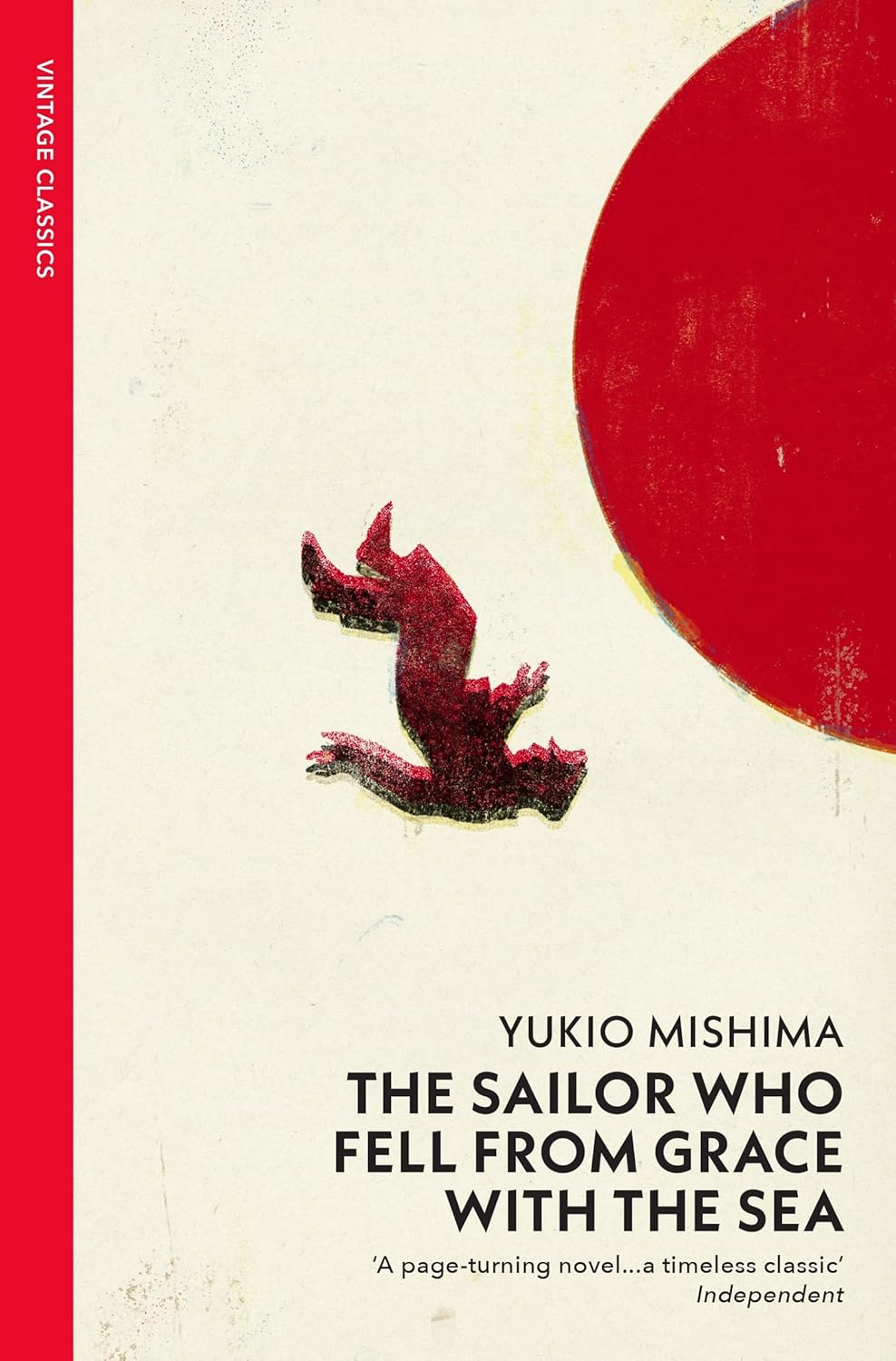
About The Sailor Who Fell from Grace with the Sea by Yukio Mishima
The Sailor Who Fell from Grace with the Sea by Yukio Mishima is a short but powerful Japanese classic about a boy, a sailor, and a dream that slowly turns dark. The story follows thirteen-year-old Noboru, who belongs to a small group of boys who believe the adult world is weak, false, and too full of soft feelings. Noboru lives with his widowed mother, Fusako. When she begins a relationship with Ryuji, a sailor, Noboru first sees him as a great man from the sea.
Ryuji seems to stand for adventure, danger, freedom, and a larger life. But things change when Ryuji starts thinking about leaving the sea and building a normal life with Fusako. It feels like a fall from greatness.
From that point, the novel becomes a tense study of youth, pride, love, cruelty, and the danger of turning ideas into hard rules. It is not a light story.
When a hero stops looking like a hero
At the start, Noboru sees Ryuji through the eyes of a young boy who wants life to feel grand and important. The sea helps create that feeling. Ryuji has spent his life sailing, so Noboru connects him with courage and glory.
The problem begins when Ryuji changes.
Ryuji is tired of waiting for some great meaning to arrive from the sea. He begins to see love, home, and family as a possible new life.
One person sees love as a reason to come home. Another sees coming home as giving up everything that once made the sailor special.
Yukio Mishima uses this simple conflict to ask difficult questions. What makes a person strong? Is a normal life a failure? Is love a form of weakness, or can it be a different kind of courage? What happens when young people judge the adult world without understanding its pain?
The book does not give easy answers.
A story that becomes darker page by page
This is not a sea adventure in the usual sense. The ship and ocean are important, but the real story happens inside the minds of the characters.
Noboru and his friends have built their own harsh way of thinking. They want to remove pity and emotion from the way they see the world. They call this kind of cold thinking “objectivity.” They believe adults are fake because adults make compromises, fall in love, change their minds, and accept ordinary life.
Their thinking grows colder, and their actions become more disturbing.
That slow change gives the novel much of its power. You can feel that something is wrong before you know exactly how far the boys may go. The danger is not created by a monster or a mystery killer. It comes from ideas, pride, group pressure, and the wish to prove that feelings do not matter.
Noboru, Ryuji, and Fusako each want something different
Noboru wants the world to match the strong ideas in his head. He wants heroes to stay heroic. He wants the sea to mean greatness.
Ryuji wants meaning too, but he is older and tired of chasing it. Life at sea once seemed to promise glory, yet that promise has not fully come true. His growing love for Fusako gives him another path.
Fusako wants love and a future. As a widow and mother, she is trying to build a life that feels full again. Her relationship with Ryuji changes the balance inside her home, especially for Noboru.
These three wishes collide.
It is not only about whether two adults will stay together. It is about what happens when one person’s hope becomes another person’s betrayal.
Why readers still discuss this Japanese classic
The Sailor Who Fell from Grace with the Sea was first published in Japanese in 1963 and has become one of Mishima’s best-known novels. The English translation is by John Nathan. Penguin describes it as a deeply unsettling story about youth and distorted ideas of masculinity.
It can be seen as a coming-of-age story, a psychological novel, a study of masculinity, a story about postwar values, or a warning about extreme ideas.
It may look like freedom, danger, greatness, escape, or a dream that no real life can fully match. Ryuji’s move away from the sea changes what he means to Noboru, and that change drives the story toward its dark end.
A short book with big themes
Some books need hundreds of pages to explore deep ideas. This one does not.
Mishima keeps the story tight and focused. The main themes include:
- Youth and the loss of innocence
- Masculinity and ideas of strength
- Love versus personal glory
- The difference between dreams and real life
- Group pressure and cruel thinking
- Family change
- Hero worship and disappointment
- The pull of the sea
- Beauty, death, and destruction
- The gap between children and adults
These themes make the book useful for personal reading, book clubs, literature classes, and readers who like discussing what a story means beneath the surface.
Is this a good first Yukio Mishima book?
Yes, it can be a strong starting point for readers who are new to Yukio Mishima.
The reason is easy to understand. The book is short, the main story is clear, and the characters are easy to identify. At the same time, the novel introduces themes that appear often in Mishima’s wider writing, including beauty, death, discipline, desire, honor, and the struggle between an ideal life and ordinary human needs.
Readers who want deeper meaning can then explore the social and cultural ideas behind it after finishing.
Penguin also includes The Sailor Who Fell from Grace with the Sea in its guide for readers deciding where to begin with Mishima’s work.
Know the tone before you start
This is an important point for buyers. The Sailor Who Fell from Grace with the Sea is not a soft or cheerful coming-of-age novel.
It includes disturbing ideas, cruelty, violence, and mature themes. The emotional tone becomes increasingly cold and tense.
Mishima is showing what can happen when people place an idea above human feeling and begin to treat compassion as weakness.
Readers who enjoy dark classics, psychological fiction, morally difficult characters, and books that create discussion are more likely to appreciate it.
A premium physical copy for focused reading
Bookish Wonderland prepares this edition for readers who want a comfortable physical reading experience. The book uses premium eye-soothing cream paper, giving the page a softer look during long reading sessions. The text is produced with crystal-clear print so words remain sharp and easy to follow.
The binding combines stitching and glue to give the book stronger page support and better longevity with normal care. This is useful for a classic you may want to read again, lend to a friend, use for study, or keep in a personal library.
When comparing Book price in Bangladesh, readers should also consider the quality of the paper, print, binding, and delivery service. A durable copy can give more value when the book is meant to stay on your shelf for years.
What makes this edition useful
- Premium eye-soothing cream paper supports comfortable reading.
- Crystal-clear text makes each page simple to follow.
- Stitched and glue binding helps keep pages secure.
- The printed format works well for note-taking, study, or quiet reading.
- Its compact story makes it suitable for weekend reading.
- It can be a thoughtful gift for a reader of Japanese or world classics.
- It is a useful addition to a personal literary fiction collection.
The value is not only in owning the story. A strong physical copy makes it easier to return to important scenes and ideas later.
Who should read this book?
This book is a good match for readers who enjoy literary fiction with a dark psychological edge. Penguin Random House officially places the title under Literary Fiction.
It may suit you if you like:
- Japanese classic literature
- Short novels with deep meaning
- Psychological and philosophical fiction
- Coming-of-age stories with a darker side
- Books about honor, masculinity, and identity
- Stories that question adult society
- Difficult moral choices
- Symbolic writing
- Literature that can lead to debate
- Classics that can be finished without reading a very long book
It can also work well for students or book clubs that want a story with clear characters but many ideas to discuss.
Because of the violence and mature subject matter, it is better suited to mature readers than young children.
A strong choice for study, discussion, or personal reading
The novel has several useful reading situations.
For personal reading, it gives you a short but intense story that can be finished faster than many classics. For a literature class, it offers themes that can support essays and discussion. For book clubs, the actions of Noboru, Ryuji, Fusako, and the boys can lead to very different opinions.
It is also useful for readers exploring translated Japanese fiction. John Nathan’s English translation brings Mishima’s story to English-language readers while keeping the novel’s sharp psychological focus.
If you collect classic literature, the book also sits well beside works that explore youth, alienation, identity, violence, or the pressure of social values.
Best Sellers Rank of This Book
- #27,829 in Books
- #222 in Teen & Young Adult Classic Literature
- #837 in Coming of Age Fiction (Books)
- #1,378 in Classic Literature & Fiction
These bestseller ranks are shown exactly as supplied for this product.
Easy ordering from Bookish Wonderland
Bookish Wonderland makes it simple to order English books without depending on international shipping.
Customers can order from Dhaka or other areas of Bangladesh. Nationwide delivery is available, and Cash on Delivery gives customers a simple payment option. Delivery is available both inside and outside Dhaka. Readers in Dhaka may also ask about fast or urgent delivery when they need the book sooner.
If you are checking The Sailor Who Fell from Grace with the Sea by Yukio Mishima price in Bangladesh, Bookish Wonderland gives you a durable printed option for reading, gifting, collecting, or study.
The store carries a large selection of premium English books, which can also help readers who want to build a wider classic literature collection over time.
Why this story deserves a place on your shelf
Some stories entertain you and then disappear from your mind. This one is built to make you think.
Noboru believes he understands strength. Ryuji believes he can leave one dream and choose another. Fusako believes a new life can begin. Each idea makes sense from one point of view, but together they create a dangerous conflict.
The novel asks what happens when people love an image more than a real person. It asks whether a hero is allowed to change. It asks whether growing up means losing something important or learning to accept that life cannot stay perfect.
Those questions keep the story alive long after its short length is finished.
For readers who want a famous Japanese novel with psychological depth, sharp tension, and serious themes, The Sailor Who Fell from Grace with the Sea by Yukio Mishima is a strong choice.
Order your copy from Bookish Wonderland and discover a classic where the sea, love, pride, and youth come together in a story that is beautiful, dark, and deeply unsettling.
If you require any customization or have any questions, please inbox us via FB or Insta.
| Primary Specification | |
| Author | Yukio Mishima |
| Translator | John Nathan |
| Genre | Literary Fiction, Japanese Classic |
| ISBN-13/ISSN | 978-0679750154 |
| ISBN-10 | 0679750150 |
| Publisher | Vintage |
| Publishing Date | May 31, 1994 |
| Language | English |
| Reading Age | 16+ |
| Format | Printed Book |
| Physical Specification & Quality | |
| Paper Quality | Premium eye-soothing cream paper |
| Binding Quality | High quality stitched and glue binding (for longevity) |
| Print Quality | Crystal-clear print |
| Pages | 192 pages |
| Country | Japan |
| Logistics Information | |
| Weight | 215g |
| Length | 8.5 inch |
| Width | 5.6 inch |
| Height | 0.51 inch |