

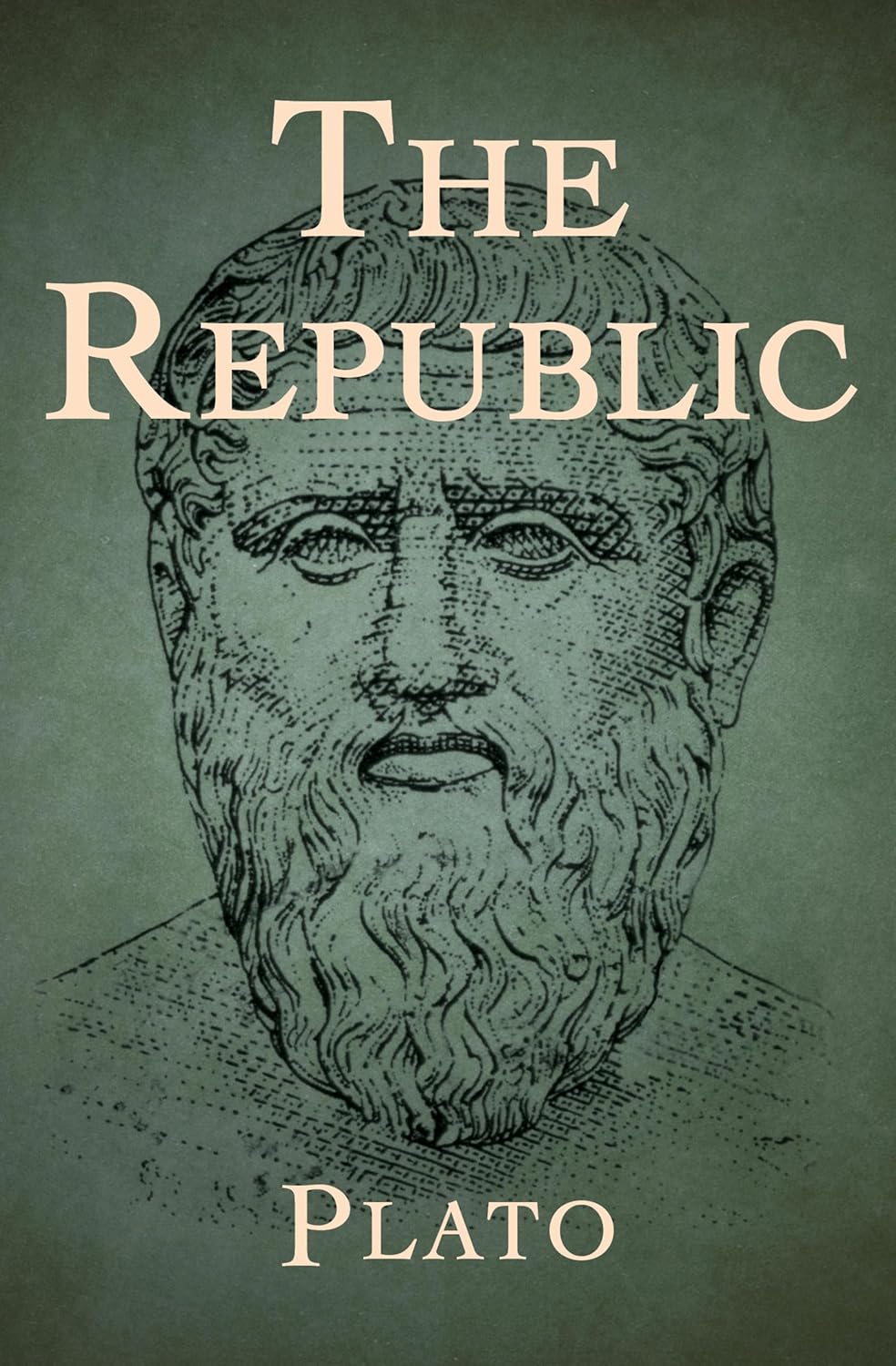
About The Republic by Plato – A Timeless Guide to Justice, Leadership, Knowledge, and the Ideal Society
The Republic by Plato asks one of the biggest questions in philosophy: Is it better to live justly than unjustly?
Plato explores this question through a dialogue in which Socrates is the central speaker. Instead of giving one quick definition of justice, Socrates and the other speakers test different ideas and imagine what a truly just city might look like. They then use that city to think about justice inside an individual person.
This simple starting question leads into much larger subjects: government, education, leadership, truth, knowledge, happiness, morality, art, democracy, tyranny, and the human soul.
For readers who want to understand the foundations of Western political philosophy, The Republic remains one of the most important places to begin.
A Big Question Made Easier Through Conversation
Many philosophy books explain ideas in a formal way. Plato uses dialogue.
Socrates talks with different people, asks questions, challenges their answers, and keeps searching when a definition does not work. This method makes the reader part of the argument.
The main problem is justice.
Is justice only something society forces people to obey? Would a person still choose to be good if nobody could see what they were doing? Does justice actually make a person happier?
These questions become especially clear in the famous story of the Ring of Gyges, where the discussion asks what someone might do if they could act without being seen or punished.
The result is a book that does not simply tell you what to think. It encourages you to examine your own ideas about right and wrong.
The Ideal City and the Human Soul
To understand justice in one person, Socrates first imagines justice on a larger scale: a city.
The dialogue builds an ideal city with different social roles and asks what each part must do for the whole community to remain ordered.
Plato then connects the city with the human soul.
Justice, in this account, is not simply following rules. It involves order and harmony, with different parts performing their proper roles instead of fighting for control. The same idea is applied both to the well-ordered city and to the well-ordered individual.
This connection between personal character and political order is one reason The Republic is both an ethics book and a political philosophy book.
It asks not only, “What government is best?” but also, “What kind of person should we become?”
Meet the Philosopher-King
One of Plato's most famous ideas is the philosopher-king.
The argument is that political power should be connected with genuine knowledge and wisdom. In the ideal city, rulers require long education and must learn to understand what is good rather than simply chase wealth, popularity, or personal power.
The Republic describes a demanding education for future philosophical rulers, including mathematics, reasoning, and dialectic before practical political responsibility.
This raises a question that still feels familiar today:
Should leaders be chosen because they are popular, wealthy, powerful, or because they understand how to govern wisely?
Plato's answer is controversial, but that is exactly why the idea remains worth studying. Readers are invited to think about leadership, expertise, responsibility, and the dangers of giving political power to people who do not understand what is truly good.
Step Inside the Allegory of the Cave
The Allegory of the Cave is probably the most famous part of The Republic.
Plato asks us to imagine people who have spent their lives facing shadows and believe those shadows are reality. If one person is freed and eventually sees what exists outside the cave, that person gains a completely different understanding of the world.
Returning to the cave creates another problem. The people who still know only shadows may reject or even attack the person trying to show them something beyond their familiar world.
The allegory raises deep questions about education, knowledge, ignorance, truth, and human resistance to unfamiliar ideas.
It also explains why philosophy, for Plato, requires more than collecting information. Learning can involve changing the way we understand reality itself.
Democracy, Tyranny, and the Problem of Political Decline
The Republic does not only describe an ideal government. It also studies different political systems and how they can become worse.
In Books VIII and IX, Socrates examines forms of political decline and links different kinds of government with different kinds of character. Democracy receives serious criticism, and tyranny appears as the extreme form of political and personal disorder.
Plato's arguments should be read in their ancient Greek context, but they continue to raise useful questions:
What happens when desire becomes more powerful than reason?
Can freedom become unstable without discipline?
What makes citizens vulnerable to bad leaders?
How does the character of individuals affect the political system they create?
These questions make the book valuable for students of politics as well as philosophy.
Education Is at the Heart of the Book
Education plays a major role throughout The Republic.
Plato is interested in how people become wise, disciplined, courageous, and capable of ruling themselves and others.
The dialogue discusses the education of guardians and future rulers, including physical training, music, poetry, mathematics, and later philosophical reasoning. It also asks difficult questions about what stories, art, and ideas should be allowed to shape young minds.
Some of Plato's proposals are deeply controversial, especially his treatment of censorship and social control.
That makes the book useful not because readers must agree with everything Plato proposes, but because it forces serious thought about the power of education.
Who should decide what children learn?
What kind of education creates good citizens?
Can education improve political leadership?
These questions remain central to debates about schools, culture, and society.
Why The Republic Still Matters
The Republic covers far more than government.
The Internet Encyclopedia of Philosophy notes that the dialogue addresses justice, happiness, education, philosophy, knowledge, reality, virtue, political systems, family, women's roles, art, and the afterlife.
That range explains why the book is studied in many different subjects.
A political science student may focus on government and leadership.
A philosophy student may focus on justice, knowledge, and reality.
A psychology-minded reader may be interested in Plato's account of the soul.
A teacher may pay attention to education.
A general reader may simply enjoy the challenge of asking whether a good life and a happy life are connected.
It is a book that can be read from several angles and revisited as your knowledge grows.
Who Should Read The Republic by Plato?
This classic is especially suitable for readers interested in:
-
Political philosophy
-
Ethics and morality
-
Western philosophy
-
Ancient Greek thought
-
Justice and law
-
Leadership and government
-
Democracy and tyranny
-
Education
-
Knowledge and truth
-
Critical thinking
-
Classical literature
-
Intellectual history
Plato was a student of Socrates and teacher of Aristotle, and The Republic is generally regarded as one of his major middle-period dialogues.
Because philosophical arguments can require slow reading, beginners may find it useful to read a few pages at a time and pause to think about each question.
Premium Quality for Study and Repeated Reading
A philosophy classic is often read differently from a fast novel. You may stop, underline an argument, return to an earlier section, or reread a passage several times.
Bookish Wonderland offers this copy with premium eye-soothing cream paper, giving readers a softer background for long study sessions.
The book also features crystal-clear print so arguments and dialogue remain clean and easy to follow.
For better durability, the copy uses high-quality stitched and glue binding, making it suitable for regular study and long-term shelf storage.
If you are comparing The Republic by Plato Book price in Bangladesh, physical reading comfort and durability are worth considering along with price.
A Classic for Students, Thinkers, and Personal Libraries
The Republic can serve many purposes.
Students can use it when studying philosophy, politics, ethics, history, or classical thought. Teachers can use it for discussions about justice and government. General readers can explore it as one of history's most influential philosophical dialogues.
It also makes a thoughtful gift for someone who enjoys serious nonfiction, political thought, or books that challenge ordinary assumptions.
Because the text contains several famous ideas in one work—the philosopher-king, the ideal city, political decline, the divided soul, and the Allegory of the Cave—it gives readers a strong foundation for understanding later debates in Western philosophy.
Best Sellers Rank of This Book
-
#330,427 in Books
-
#11 in Political Philosophy (Books)
-
#22 in History & Theory of Politics
-
#30 in Western Philosophy
Order Easily from Bookish Wonderland
Bookish Wonderland offers nationwide delivery across Bangladesh, including delivery inside and outside Dhaka. Cash on Delivery is available across Bangladesh, while customers in Dhaka can also ask about fast or urgent delivery options when available.
Whether you need The Republic for academic study, personal learning, gifting, or your philosophy collection, you can order a premium printed copy designed for comfortable reading and long-term use.
If you require any customization or have any questions, please inbox us via FB or Insta.
| Primary Specification | |
| Author | Plato |
| Narrator | AI Voice Bob |
| Genre | Political Philosophy, Ethics, Ancient Greek Philosophy, Metaphysics, Epistemology, Philosophy of Education |
| ISBN-13/ISSN | 978-0008480080 |
| ISBN-10 | 0008480087 |
| Publisher | HarperPress |
| Publishing Date | January 25, 2022 |
| Language | English |
| Reading Age | 15+ years |
| Format | Printed book |
| Physical Specification & Quality | |
| Paper Quality | Premium eye-soothing cream paper |
| Binding Quality | High quality stitched and glue binding (for longevity) |
| Print Quality | Crystal-clear print |
| Pages | 432 pages |
| Country | Greece |
| Logistics Information | |
| Weight | 437g |
| Length | 8.5 inch |
| Width | 5.6 inch |
| Height | 1.06 inch |