

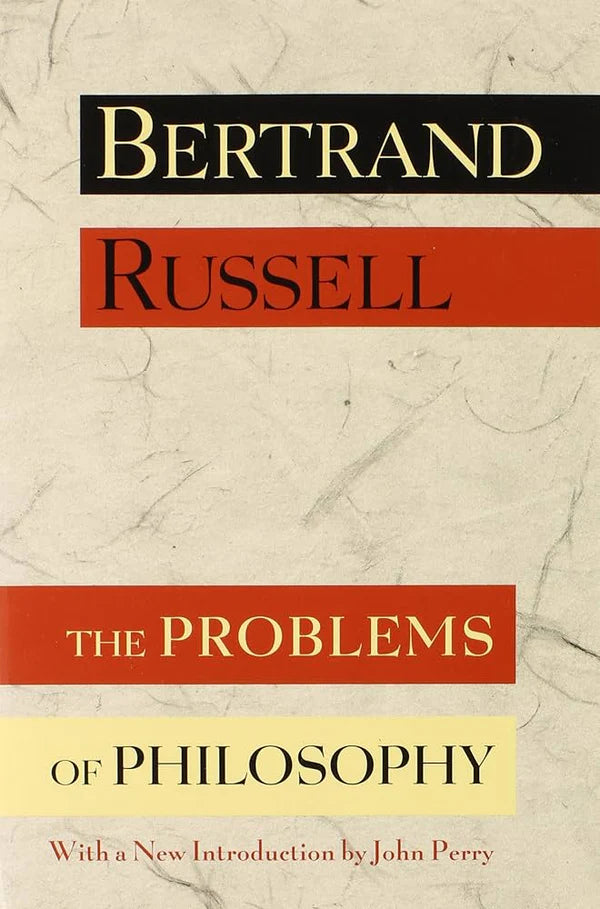
About The Problems of Philosophy by Bertrand Russell – A Clear Introduction to Knowledge, Reality, and Critical Thinking
The Problems of Philosophy by Bertrand Russell begins with questions that may sound simple but become much deeper when we think carefully about them.
How do we know the things around us are real? Can we trust what we see and feel? What is knowledge? How can we know whether an idea is true or false?
Bertrand Russell uses these questions to introduce readers to some of the most important problems in Western philosophy. First published in 1912, the book gives special attention to the theory of knowledge and explains how philosophers examine beliefs that people normally accept without questioning. Russell wanted the book to give a short and constructive introduction rather than cover every philosophical topic.
It is a classic for readers who want to learn how philosophical thinking works without beginning with a very large history of philosophy.
When Everyday Things Become Big Questions
Most of us look at a table, chair, book, or tree and simply believe it is there.
Russell asks us to look again.
Is the object exactly the way it appears to us? Its color may look different under another light. Its shape may appear different from another position. Two people can receive different impressions from the same object.
This leads Russell into the difference between appearance and reality.
The book begins by asking whether any knowledge can be so certain that a reasonable person cannot doubt it. From there, Russell examines matter, perception, and the way our minds understand the world outside us.
The result is not a book telling you what to believe. Instead, it teaches you to examine why you believe something and whether your reasons are strong enough.
A Simple Way Into Difficult Philosophy
Philosophy can feel difficult when readers meet long technical terms before understanding the basic questions.
The Problems of Philosophy offers a more focused starting point.
Russell organizes the book into 15 chapters covering subjects such as appearance and reality, the existence of matter, idealism, induction, knowledge, universals, truth and falsehood, probable opinion, the limits of philosophical knowledge, and the value of philosophy. )
Instead of trying to explain the whole history of philosophy, he concentrates mainly on problems connected with knowledge.
This makes the book valuable for students, new philosophy readers, and anyone interested in questions about how the human mind can know anything about the world.
Knowledge by Acquaintance and Knowledge by Description
One of the best-known ideas discussed in the book is Russell's distinction between knowledge by acquaintance and knowledge by description.
Knowledge by acquaintance involves something we experience directly. Knowledge by description involves knowing something through facts, information, or descriptions rather than direct experience.
Russell uses this distinction as part of a larger discussion about how knowledge works and how we connect our experiences with things outside our immediate awareness. The topic is important enough to receive its own chapter in the book.
For readers studying epistemology, logic, philosophy, or critical thinking, this section provides a useful introduction to questions that continue to matter in philosophical study.
Why Should We Trust Patterns?
Russell also explores induction.
Imagine that something has happened in the same way many times. We naturally expect it to happen that way again.
But why?
Past experience can show us what happened before, but does that automatically prove what will happen tomorrow?
Russell examines this problem as part of the question of how we form general beliefs from experience. He also considers general principles and asks how some kinds of knowledge can appear to go beyond what we directly observe.
These questions make the book useful beyond formal philosophy classes. They encourage readers to examine assumptions, evidence, predictions, and the reasons behind their everyday beliefs.
Truth, Error, and What We Think We Know
People can believe something strongly and still be wrong.
That creates another important philosophical problem: what makes something true?
Russell devotes chapters to truth and falsehood, followed by knowledge, error, and probable opinion.
This part of the book asks readers to think about the difference between having a belief and actually having knowledge.
It is especially relevant for anyone interested in reasoning and critical thought. Instead of accepting confidence as proof, philosophy asks whether a belief has good support.
That habit can help readers become more careful when judging arguments, claims, and ideas.
Philosophy Does Not Promise Easy Answers
One of the most valuable lessons in the book is that philosophy does not always give final answers.
Russell openly discusses the limits of philosophical knowledge.
Some philosophical questions remain difficult because they cannot be settled in the same way as a simple mathematical calculation or scientific measurement. But Russell argues that this uncertainty does not make philosophy useless.
Instead, philosophy helps us see possibilities we may never have considered.
In his final chapter, Russell argues that philosophical thinking can free the mind from narrow habits and unquestioned certainty. It can keep alive a sense of wonder by making familiar things appear strange and worth examining again.
That is one reason the book has remained important for readers interested in philosophical thinking.
Who Should Read The Problems of Philosophy?
This book can be useful for:
-
Students beginning philosophy
-
Readers interested in epistemology
-
People studying metaphysics
-
Critical-thinking learners
-
University and college students
-
Readers interested in logic and reasoning
-
Anyone curious about truth and knowledge
-
Readers exploring classic Western philosophy
-
Teachers building a philosophy collection
-
People who enjoy questioning everyday assumptions
Project Gutenberg classifies the work under theory of knowledge, metaphysics, and introductions to philosophy and estimates its language at roughly a 10th- to 12th-grade reading level.
The ideas are serious, but patient readers can approach the chapters one at a time instead of trying to understand everything immediately.
A Book That Rewards Slow Reading
The Problems of Philosophy is not the kind of book you need to rush through.
A short chapter can give you several ideas to think about afterward. You may want to stop, ask whether you agree with Russell, and then return to the argument.
That makes it useful for study sessions, personal reading, philosophy discussions, note-taking, or rereading.
Readers can also use individual chapters when studying specific subjects such as induction, idealism, universals, truth, or knowledge.
Russell even ends the book with recommendations for readers who want to continue studying major philosophers such as Plato, Descartes, Spinoza, Leibniz, Berkeley, Hume, and Kant.
Premium Reading Quality from Bookish Wonderland
A philosophy book often needs careful reading, highlighting, revisiting earlier ideas, and long periods of concentration.
Bookish Wonderland offers this copy with premium eye-soothing cream paper, giving readers a softer page background for comfortable study and reading.
The text comes with crystal-clear printing, helping important terms and detailed arguments remain sharp and easy to follow.
The book also uses high-quality stitched and glue binding, designed to provide stronger support and better longevity during repeated use.
If you are comparing The Problems of Philosophy by Bertrand Russell Book price in Bangladesh, consider the physical reading quality as well as the selling price. A durable copy is useful for a classic you may return to many times.
A Valuable Addition to a Study Shelf
This title can fit naturally into a personal library, academic reading collection, philosophy shelf, or student study setup.
It can also make a thoughtful gift for someone interested in philosophy, logic, reasoning, knowledge, or intellectual history.
Because the book focuses on fundamental questions rather than temporary trends, readers can return to it at different stages of their studies and notice new parts of Russell's arguments.
The work has also entered the public domain in the United States, and Project Gutenberg continues to make its text available as a classic philosophical work.
Best Sellers Rank of This Book
-
#54,169 in Books
-
#83 in Modern Western Philosophy
-
#88 in Philosophy Metaphysics
Easy Ordering Across Bangladesh
Bookish Wonderland makes it easier to add important English philosophy books to your collection.
Customers can order with nationwide delivery across Bangladesh, including addresses inside and outside Dhaka. Cash on Delivery is available across Bangladesh, while readers in Dhaka can also ask about fast or urgent delivery options when available.
Whether you need the book for university study, personal learning, critical-thinking practice, or your home library, Bookish Wonderland provides a premium printed copy made for comfortable reading and long-term use.
If you require any customization or have any questions, please inbox us via FB or Insta.
| Primary Specification | |
| Author | Russell Bertrand |
| Narrator | Joe Rupe |
| Genre | Philosophy, Epistemology, Metaphysics, Western Philosophy, Critical Thinking |
| ISBN-13/ISSN | 978-1614274865 |
| ISBN-10 | 161427486X |
| Publisher | Martino Fine Books |
| Publishing Date | September 11, 2013 |
| Language | English |
| Reading Age | 15+ years |
| Format | Printed book |
| Physical Specification & Quality | |
| Paper Quality | Premium eye-soothing cream paper |
| Binding Quality | High quality stitched and glue binding (for longevity) |
| Print Quality | Crystal-clear print |
| Pages | 168 pages |
| Country | USA |
| Logistics Information | |
| Weight | 173g |
| Length | 8.5 inch |
| Width | 5.6 inch |
| Height | 0.42 inch |