

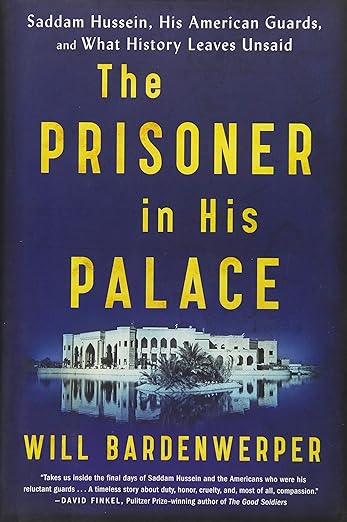
About The Prisoner in His Palace by Will Bardenwerper – Saddam Hussein’s Final Months Through the Eyes of His American Guards
The Prisoner in His Palace by Will Bardenwerper takes readers inside one of the strangest assignments of the Iraq War. In 2006, twelve young American soldiers were given a job they had never expected: guard Saddam Hussein during the final months before his execution.
These soldiers did not meet Saddam only as the dictator seen in news reports. They saw him every day as a prisoner. They brought him meals, watched over him, moved him to and from court, spoke with him, and saw how he behaved when cameras were gone.
The soldiers knew Saddam was responsible for terrible crimes. The book does not excuse those crimes. Yet the guards also saw an older prisoner who could joke, talk about family, show kindness, and face death with surprising calm.
That conflict sits at the heart of this powerful work of narrative nonfiction.
When the Enemy Becomes a Person
It is easy to think about war in simple terms: one side is good and the other is bad. This book shows why real life can feel much harder.
The twelve guards knew Saddam as a feared former ruler. But living near him made him impossible to see only as a symbol. He became a person they spoke to every day.
That did not make them forget his past. Instead, it made them ask harder questions.
Can a cruel person also show kindness? Can a soldier feel compassion for someone guilty of terrible acts? Can you do your duty while also feeling uncomfortable about what is happening around you?
These questions give the story much of its emotional power.
Saddam Hussein Without the Simple Picture
Will Bardenwerper shows more than one side of Saddam Hussein.
There is the dictator linked to torture, murder, fear, and political violence. There is also the prisoner who talks with his guards, remembers his family, jokes, prays, and prepares for death.
The publisher describes this contrast as two sides existing in the same person: the brutal ruler responsible for terrible acts and the thoughtful prisoner his American guards encountered during his final months.
Seeing these sides together is disturbing because it challenges the idea that evil always looks evil every moment of the day.
The book never asks readers to forget Saddam’s crimes. Instead, it asks them to face a difficult truth: people who do terrible things can still show ordinary human qualities.
The Twelve American Guards Matter Just as Much
Although Saddam is at the center of the story, The Prisoner in His Palace is also about the young American soldiers assigned to protect him.
Many had expected a very different experience when they were sent to Iraq. Their unusual duty placed them close to one of the most famous prisoners in the world.
Over time, some formed a complicated bond with him. They listened to his stories, learned his habits, and became part of the small world around his final months. Contemporary reviews noted how this closeness changed the soldiers’ understanding of their prisoner and affected some of them long after the assignment.
The assignment raises another question: what happens to soldiers when duty puts them in a morally difficult position?
Inside Saddam Hussein’s Final Months
Readers know how Saddam Hussein’s life ended, so the tension comes from watching the path toward that result.
The guards move Saddam between detention and his trial. They watch his public behavior and see a different private side. They also become aware that an execution is coming closer.
Bardenwerper builds the narrative from firsthand accounts involving American guards, government officials, interrogators, scholars, lawyers, family members, and victims.
Because of that wide research base, the book goes beyond a few prison conversations. It connects those moments with Saddam’s rule, the Iraq War, his trial, and the people affected by his actions.
For readers who enjoy history told through real people rather than only dates and political events, this approach makes the book easier to enter.
A Book About War, Duty, and Conscience
One of the strongest ideas in the book is the difference between doing a job and feeling comfortable about it.
The guards perform their duty, but close contact with Saddam makes some of them examine what justice, punishment, dignity, compassion, and military duty mean.
The result is not a book that tells readers what to think. Instead, it presents a situation where several difficult truths can exist together.
Saddam can be responsible for brutal crimes and still be treated as a human prisoner.
Soldiers can perform their duty and still carry difficult memories afterward.
An execution can follow a legal process while people close to it may still feel troubled by what they witnessed.
Those questions make this book useful far beyond military history.
Why Will Bardenwerper Is Well Placed to Tell This Story
Will Bardenwerper brings military and government experience to the subject.
Simon & Schuster states that he served as an Airborne Ranger-qualified infantry officer in Iraq, received a Combat Infantryman’s Badge and Bronze Star, and later worked at the Pentagon as a Presidential Management Fellow.
That background helps him explain military life in a direct, story-driven way while keeping attention on people, decisions, and consequences.
The Prisoner in His Palace was Bardenwerper’s first book and was published by Scribner. The trade paperback edition listed by Simon & Schuster contains 272 pages.
This focused length can appeal to readers who want a detailed true story without starting an extremely long military-history book.
Who Should Read The Prisoner in His Palace?
This book is a strong choice for readers interested in:
-
Iraq War history
-
Saddam Hussein
-
Military nonfiction
-
Modern Middle Eastern history
-
Political history
-
War ethics
-
Leadership and power
-
Military psychology
-
Human behavior
-
Firsthand historical accounts
-
Narrative journalism
-
Questions about justice and punishment
It also works well for university students, history readers, military readers, book clubs, and people who enjoy true stories that raise difficult moral questions.
You do not need to be an expert on the Iraq War before reading it. The story focuses strongly on people and their experiences, making a complicated historical subject easier to approach.
A Premium Copy for Serious Reading
Bookish Wonderland offers The Prisoner in His Palace by Will Bardenwerper as a premium printed reading copy for customers who want a physical book that feels comfortable and lasts well.
The copy uses premium eye-soothing cream paper, which gives the pages a softer look during longer reading sessions. Crystal-clear print keeps names, dates, conversations, and historical details easy to follow.
The book also uses high-quality stitched and glue binding, providing stronger page support for regular reading and long-term shelf storage.
These features make the copy suitable for personal study, university reading, gifting, or building a history and nonfiction collection.
When checking the Book price in Bangladesh for The Prisoner in His Palace by Will Bardenwerper, it is useful to compare not only the selling price but also the paper, printing, and binding quality of the physical copy.
Best Sellers Rank of This Book
-
#1,041,907 in Books
-
#155 in Iraq History (Books)
-
#188 in Iraq War Biographies
-
#299 in Iraq War History (Books)
Easy Ordering Across Bangladesh
Bookish Wonderland makes it simple to order this title from anywhere in the country.
Nationwide delivery is available across Bangladesh, including both inside and outside Dhaka. Cash on Delivery is available across Bangladesh, allowing customers to pay when their book arrives.
Readers in Dhaka can also ask about fast or urgent delivery options when available.
Whether you are buying the book for personal reading, academic study, a history collection, or as a gift for someone interested in military affairs, you can order without needing to visit a physical bookstore.
If you require any customization or have any questions, please inbox us via FB or Insta.
| Primary Specification | |
| Author | Will Bardenwerper |
| Narrator | Danny Campbell |
| Genre | Military History, Iraq War History, Political History, Biography, Narrative Nonfiction |
| ISBN-13/ISSN | 978-1501117848 |
| ISBN-10 | 150111784X |
| Publisher | Scribner |
| Publishing Date | October 2, 2018 |
| Language | English |
| Reading Age | 16+ years |
| Format | Printed book |
| Physical Specification & Quality | |
| Paper Quality | Premium eye-soothing cream paper |
| Binding Quality | High quality stitched and glue binding (for longevity) |
| Print Quality | Crystal-clear print |
| Pages | 272 pages |
| Country | USA |
| Logistics Information | |
| Weight | 277g |
| Length | 8.5 inch |
| Width | 5.6 inch |
| Height | 0.7 inch |