

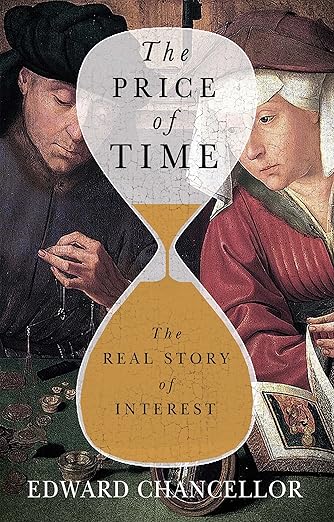
About The Price of Time by Edward Chancellor: The Real Story of Interest – How Interest Shapes Money, Markets, and Our Future
The Price of Time: The Real Story of Interest by Edward Chancellor is a wide-ranging nonfiction book about one of the most important ideas in money: interest. Interest may look like a small number on a bank loan, savings account, bond, or mortgage, but Chancellor shows how it can shape the whole economy.
He takes readers through thousands of years of history to explain why people charge interest, why societies have argued about it, and what can happen when borrowing becomes very cheap. The journey begins in ancient Mesopotamia and moves through debates about usury, market booms, banking crises, and the modern age of central banks.
Instead of treating interest as a dry number, the book presents it as the price people pay to use money over time. That simple idea opens a bigger story about saving, debt, investment, risk, housing, business, and financial bubbles.
Why does the price of borrowing matter so much?
Many people hear news about interest rates but do not know why a small change can affect homes, businesses, savings, stock markets, and government debt. This book connects those pieces.
Chancellor argues that interest is an important signal. When rates stay too low for too long, borrowing can become very cheap. That may encourage more debt, higher asset prices, weak investment choices, and greater financial risk. His main concern is that extremely low or negative rates can change how people value time, money, and future returns.
A financial history that reaches back thousands of years
One of the book’s biggest strengths is its long view. Chancellor starts with early lending in ancient Mesopotamia and follows the changing role of interest through different cultures and economic systems.
He discusses moral arguments about usury, the growth of modern finance, famous credit experiments, John Law’s Mississippi scheme, and later financial booms. This long timeline shows that arguments about debt and interest are not new.
Is charging interest fair? How high should rates be? What happens when credit is too easy? Can governments control the cost of money without creating new problems?
By placing modern finance beside older examples, Chancellor gives readers a useful way to see today’s interest-rate debates as part of a much longer story.
Understand the force behind saving, borrowing, and investing
Interest affects everyday life even when we do not notice it. It influences the price of loans, the return on savings, the value of future income, and the choices made by businesses and investors.
The book explains why rates affect where money goes. Very cheap borrowing may encourage people to take bigger risks or pay more for assets. Higher borrowing costs can slow spending and investment. Savers and borrowers can also experience the same rate very differently.
Chancellor focuses strongly on the ultra-low interest-rate period after the global financial crisis. He argues that policies designed to support economies also created costs, including distorted asset prices and poor capital allocation.
This is Chancellor’s argument rather than a view shared by every economist. That makes the book useful for readers who want to study a clear position and compare it with other ideas about monetary policy.
Why business, finance, and economics readers may enjoy it
You do not need to work at a bank to find this book useful. Interest rates touch many parts of modern life.
Business students can better understand why the cost of money matters for investment and company decisions. Investors can gain historical context for bonds, bubbles, asset prices, and risk. Economics readers can explore debates about inflation, debt, monetary policy, and central banks.
It can also help general readers who often see terms such as low rates, negative rates, easy money, credit boom, inflation, or capital allocation in the news but want to understand how those ideas connect.
The book asks readers to look beyond the headline rate and think about the wider effects that may follow.
Not a get-rich-quick finance book
The Price of Time is not a guide to choosing stocks, becoming rich quickly, or making short-term trades. Its value comes from history, economic ideas, and argument.
Chancellor uses past events to build a case about the role of interest in a financial system. This makes the book a better fit for readers who enjoy understanding why markets behave as they do.
These ideas make it suitable for university study, finance discussions, professional reading, book clubs, and personal learning. It gives readers historical context rather than promising simple answers or instant financial success.
A premium printed copy for serious reading
A detailed economics book can require long reading sessions, so physical comfort matters. Bookish Wonderland offers this printed copy with features made for regular use.
-
Premium eye-soothing cream paper gives the pages a softer look for comfortable reading.
-
Crystal-clear print keeps headings, numbers, and text sharp and easy to follow.
-
High-quality stitched and glue binding gives the book stronger support for repeated reading and better longevity.
These features make the copy useful for students who take notes, professionals who return to important sections, and readers who want a durable nonfiction book for their shelf.
Who should read The Price of Time?
This book is a strong match for readers interested in economics, banking, investing, financial history, monetary policy, inflation, debt, and markets.
It may be especially useful for BBA, finance, economics, and business students who want to connect classroom ideas with long-term history. Entrepreneurs and business owners may also value the discussion because borrowing costs and access to capital can affect real business decisions.
If you enjoy books that explain how one economic idea can influence governments, companies, investors, and ordinary people, The Price of Time offers a detailed journey through that subject.
Buying The Price of Time in Bangladesh
Readers searching for The Price of Time by Edward Chancellor price in Bangladesh can order a premium printed copy from Bookish Wonderland. If you compare Book price in Bangladesh before buying international nonfiction, this gives you a convenient local option.
Nationwide delivery is available across Bangladesh, including inside and outside Dhaka. Cash on Delivery is available across the country. Customers in Dhaka can also ask about fast or urgent delivery.
The book can be ordered for personal study, university work, business learning, gifting, or building a finance and economics collection.
Best Sellers Rank of This Book
-
#98,716 in Books
-
#1 in Economic Inflation
-
#4 in Financial Interest
-
#49 in Economic History (Books)
Why add this book to your shelf?
The Price of Time turns a subject that can sound technical into a story about people, choices, power, and the future. It shows why interest is more than a bank percentage and why the cost of money can change the way an economy behaves.
Chancellor’s long historical view connects ancient lending, moral debates, financial bubbles, central banks, modern debt, and ultra-low rates. You do not have to agree with every conclusion to gain value from the argument. The book gives readers a clear framework for thinking about why interest exists and what may happen when its price is pushed too far.
For anyone who wants to understand money beyond daily headlines, this book can change how they look at borrowing, saving, investment, and financial policy.
If you require any customization or have any questions, please inbox us via FB or Insta.
| Primary Specification | |
| Author | Edward Chancellor |
| Narrator | Luis Soto |
| Genre | Economics, Finance, Economic History, Business & Economics. |
| ISBN-13/ISSN | 978-0802161789 |
| ISBN-10 | 0802161782 |
| Publisher | Atlantic Monthly Press |
| Publishing Date | March 3, 2026 |
| Language | English |
| Reading Age | 16+ years |
| Format | Printed Book |
| Physical Specification & Quality | |
| Paper Quality | Premium eye-soothing cream paper |
| Binding Quality | High quality stitched and glue binding (for longevity) |
| Print Quality | Crystal-clear print |
| Pages | 448 pages |
| Country | UK |
| Logistics Information | |
| Weight | 453g |
| Length | 8.5 inch |
| Width | 5.6 inch |
| Height | 1.09 inch |