

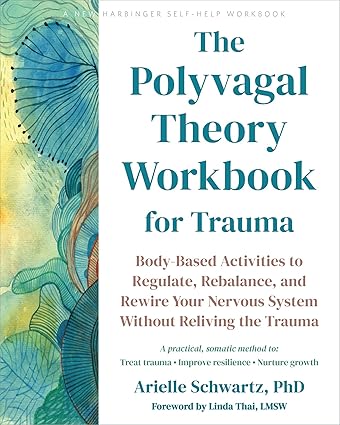
About The Polyvagal Theory Workbook for Trauma by Arielle Schwartz PhD – Practical Body-Based Tools for Calm and Resilience
The Polyvagal Theory Workbook for Trauma by Arielle Schwartz PhD is a self-help workbook for people who want to understand how stress and trauma can affect the body and nervous system. Instead of focusing only on thoughts, the book teaches readers to notice body signals, understand patterns of activation and shutdown, and practice simple exercises designed to support greater calm, connection, and resilience. New Harbinger describes the workbook as an evidence-informed, body-based resource that introduces polyvagal theory, the vagus nerve, rhythmic movement, EMDR-informed exercises, tapping, conscious breathing, mindful movement, self-reflection, and journaling. The paperback edition was published in April 2025 and contains 184 pages. It also includes a foreword by trauma therapist Linda Thai. For readers who like practical exercises instead of theory alone, this workbook gives clear activities that can be tried slowly and revisited over time.
When Your Body Feels Stuck in Stress
Stress does not always feel like a thought. It can show up as a racing heart, tight muscles, shallow breathing, restlessness, numbness, tiredness, irritation, or a strong wish to escape. After difficult life events, some people may notice that ordinary situations feel harder than they used to. A meeting, conversation, crowded place, or quiet night can sometimes bring strong body reactions.
This workbook starts from the idea that trauma can affect both mind and body. Schwartz guides readers to notice these reactions without judging themselves. The goal is not to force a person to tell every painful detail again. Instead, the exercises are designed to help readers understand their nervous-system responses and build skills for returning toward a greater sense of safety and balance. New Harbinger specifically presents the book as an option for learning body-based practices without requiring readers to relive traumatic experiences in the workbook.
Understand What Your Nervous System Is Doing
One of the most useful parts of the book is its simple introduction to the nervous system. Readers learn how the body can move through different states depending on whether it senses safety, danger, or overwhelm. The book uses polyvagal theory as a framework for explaining these shifts and for helping readers recognize their own patterns.
You do not need a psychology degree to use the workbook. The material is written for general readers and supported by exercises that turn ideas into personal observation. You may notice what happens to your breathing when you are worried, how your body feels when you are calm, or what situations make you want to fight, run away, freeze, or disconnect. Becoming more aware of these patterns can make body reactions feel less confusing and can give you a clearer starting point for practicing regulation.
Learn Through Practice, Not Theory Alone
This is a workbook, so the value comes from doing the activities rather than only reading the pages. Schwartz includes body-based practices such as rhythmic movement, conscious breathing, mindful movement, tapping, and EMDR-informed exercises. The book also uses self-reflection and journaling prompts to help readers connect the exercises with their own experiences.
That structure makes the book suitable for slow, active reading. You might read a few pages, try one practice, then stop and notice how you feel. Another day, you can return to a journal prompt or repeat an exercise that felt useful. There is no need to race through the entire book. In fact, a workbook like this can be more useful when it becomes a tool you return to.
Who May Find This Workbook Helpful?
This book may appeal to adults interested in trauma recovery, nervous-system regulation, somatic psychology, polyvagal theory, mindfulness, and body-based self-help. It may also interest therapists, counselors, psychology students, coaches, yoga teachers, and other professionals who want to understand Schwartz’s practical approach, although professional use should remain within each person’s training and scope.
The workbook is especially suited to readers who want activities they can practice rather than a book built only around explanation. It can also work well for people who already know some of Schwartz’s earlier books and want a resource focused specifically on polyvagal ideas and body regulation. Because trauma can be complex and deeply personal, readers experiencing severe or worsening symptoms should use self-help resources as support, not as a replacement for qualified mental-health or medical care.
What Makes Arielle Schwartz’s Approach Different?
Arielle Schwartz, PhD, is a licensed clinical psychologist, certified complex trauma professional, EMDR consultant, and yoga teacher. She has written several books about trauma recovery and teaches mind-body approaches related to polyvagal theory. Her background helps explain why this workbook combines psychological education with breathing, movement, body awareness, and reflective exercises.
The book does not ask readers to rely on one single technique. Instead, it brings several practices together around the goal of noticing nervous-system states and building greater flexibility in how the body responds. This can make the workbook attractive to readers who have found purely intellectual self-help difficult to apply. The focus stays practical: learn a concept, notice what happens in your body, try an exercise, and reflect.
Important Context About Polyvagal Theory
Polyvagal theory is influential in trauma therapy and body-based mental-health work, but some of its specific biological and evolutionary claims remain debated in scientific literature. A 2026 expert critique argued that major physiological parts of the theory are not supported by current evidence, while Stephen Porges published a response disputing that conclusion and arguing that the critique misrepresents the theory. Readers should therefore treat the workbook as a practical resource built around a particular therapeutic framework, not as proof that every scientific claim connected with polyvagal theory is settled.
That does not mean the practices in the book are automatically without value. Slow breathing, mindful movement, grounding, reflection, and other regulation skills are used in many therapeutic and wellness settings. The useful question for a reader is whether a practice feels safe, appropriate, and helpful. If an exercise increases distress, stop and seek support when needed. This balanced approach lets readers benefit from practical tools while keeping realistic expectations about what a workbook can and cannot do.
Easy Ways to Use the Workbook
You can use the book in short sessions. Read one section, try one exercise, and give yourself time to notice the result. Keep a pencil nearby for prompts and notes. If a practice feels useful, mark the page so you can find it again quickly.
Another option is to build a simple weekly routine. Choose one body-awareness exercise, one breathing or movement practice, and one journal prompt. Repeat them for several days before deciding whether they help. Readers who work with a therapist may also choose to discuss selected exercises with that professional, especially when a topic brings up strong feelings. The workbook is designed to be interactive, so small, steady practice is more important than finishing quickly. Use the pace that feels manageable instead of turning recovery into another task you must complete perfectly.
Features That Support Active Reading
Bookish Wonderland offers this title as a comfortable printed copy for readers who plan to write, reflect, and return to exercises. The book uses premium eye-soothing cream paper, giving the pages a softer look during longer reading sessions. Crystal-clear printing helps instructions, prompts, and body-based exercises remain easy to follow.
The copy also uses high-quality stitched and glue binding for longevity. That is useful for a workbook because readers may open the same pages repeatedly, write notes, revisit exercises, and move back and forth between sections. Rather than treating the book as something to read once and leave on a shelf, you can use it as an ongoing practice guide. Its workbook format makes physical durability especially important for readers who plan to work through the material over weeks or months.
What You Can Gain From Working Through It
A realistic benefit of this book is greater awareness. You may learn to identify signs of activation, shutdown, tension, or settling earlier than before. You may also discover which simple practices help you feel more grounded or connected in everyday life.
The workbook can give you a language for talking about body reactions that previously felt confusing. It may also help you build a more organized set of coping tools, rather than searching for a new technique every time stress rises. The aim is not to promise that trauma disappears after a few exercises. Recovery can be complicated, and different people need different levels of support. The value of the workbook is that it gives structured activities, reflection questions, and repeatable practices that can become part of a wider approach to wellbeing and professional care when needed.
The Polyvagal Theory Workbook for Trauma by Arielle Schwartz PhD Book Price in Bangladesh
If you are searching for The Polyvagal Theory Workbook for Trauma by Arielle Schwartz PhD Book price in Bangladesh, Bookish Wonderland offers a convenient way to order a printed copy. This title can be useful for readers building a personal collection around psychology, trauma recovery, nervous-system regulation, mindfulness, and practical self-help.
Bookish Wonderland provides nationwide delivery across Bangladesh, with service both inside and outside Dhaka. Cash on Delivery is available across the country. Customers in Dhaka can also ask about fast or urgent delivery when they need the book sooner. For the current price, stock status, and delivery charge, check the latest Bookish Wonderland product listing before ordering, because availability and pricing can change.
Best Sellers Rank of This Book
The Best Sellers Rank information below is kept exactly as supplied for this product listing:
- #15,435 in Books
- #14 in Trauma Psychology (Books)
- #53 in Popular Neuropsychology
- #62 in Post-Traumatic Stress
These rankings can change over time, so they should be treated as the rank information supplied for this listing rather than permanent positions.
Why Order This Workbook From Bookish Wonderland?
A workbook is most useful when it is easy to read, easy to return to, and comfortable to use. Bookish Wonderland combines a quality-focused printed copy with practical ordering options for readers across the country.
This title can fit into a personal self-help library, a psychology reading list, a therapist’s professional bookshelf, or a student’s collection of trauma and nervous-system resources. Because the exercises are designed for active use, the book is something you can keep nearby rather than simply finish and forget.
Bookish Wonderland also offers a large collection of premium and durable English books, nationwide delivery, Cash on Delivery, and delivery both inside and outside Dhaka. Fast or urgent delivery options are available in Dhaka when needed, making it easier to get the book when timing matters.
Start With One Small Practice
The Polyvagal Theory Workbook for Trauma does not ask you to master everything at once. Its strength is in small, repeatable practices that help you become more aware of your body and learn different ways to respond to stress. You can begin with one page, one breath, one movement, or one journal prompt.
The book is best approached with patience. Some exercises may feel useful immediately, while others may not fit you. Choose what feels safe and manageable. If you are already working with a mental-health professional, the workbook can also give you ideas to discuss together.
For readers who want an active, body-focused resource rather than another self-help book made only of advice, this workbook offers a structured place to begin.
If you require any customization or have any questions, please inbox us via FB or Insta.
| Primary Specification | |
| Author | Arielle Schwartz PhD |
| Narrator | Arielle Schwartz |
| Editor | M. C. Calvi |
| Genre | Trauma Psychology, Self-Help, Psychology, Somatic Therapy, Mind-Body Healing, Mental Health, Neuroscience, Personal Development, Stress Management, Wellness |
| ISBN-13/ISSN | 978-1648484162 |
| ISBN-10 | 1648484166 |
| Publisher | New Harbinger Publications |
| Publishing Date | April 1, 2025 |
| Language | English |
| Reading Age | 18+ |
| Format | Printed Book |
| Physical Specification & Quality | |
| Paper Quality | Premium eye-soothing cream paper |
| Binding Quality | High quality stitched and glue binding (for longevity) |
| Print Quality | Crystal-clear print |
| Pages | 184 pages |
| Country | USA |
| Logistics Information | |
| Weight | 218 gm |
| Length | 8.5 inches |
| Width | 5.6 inches |
| Height | 7.99 inches |