

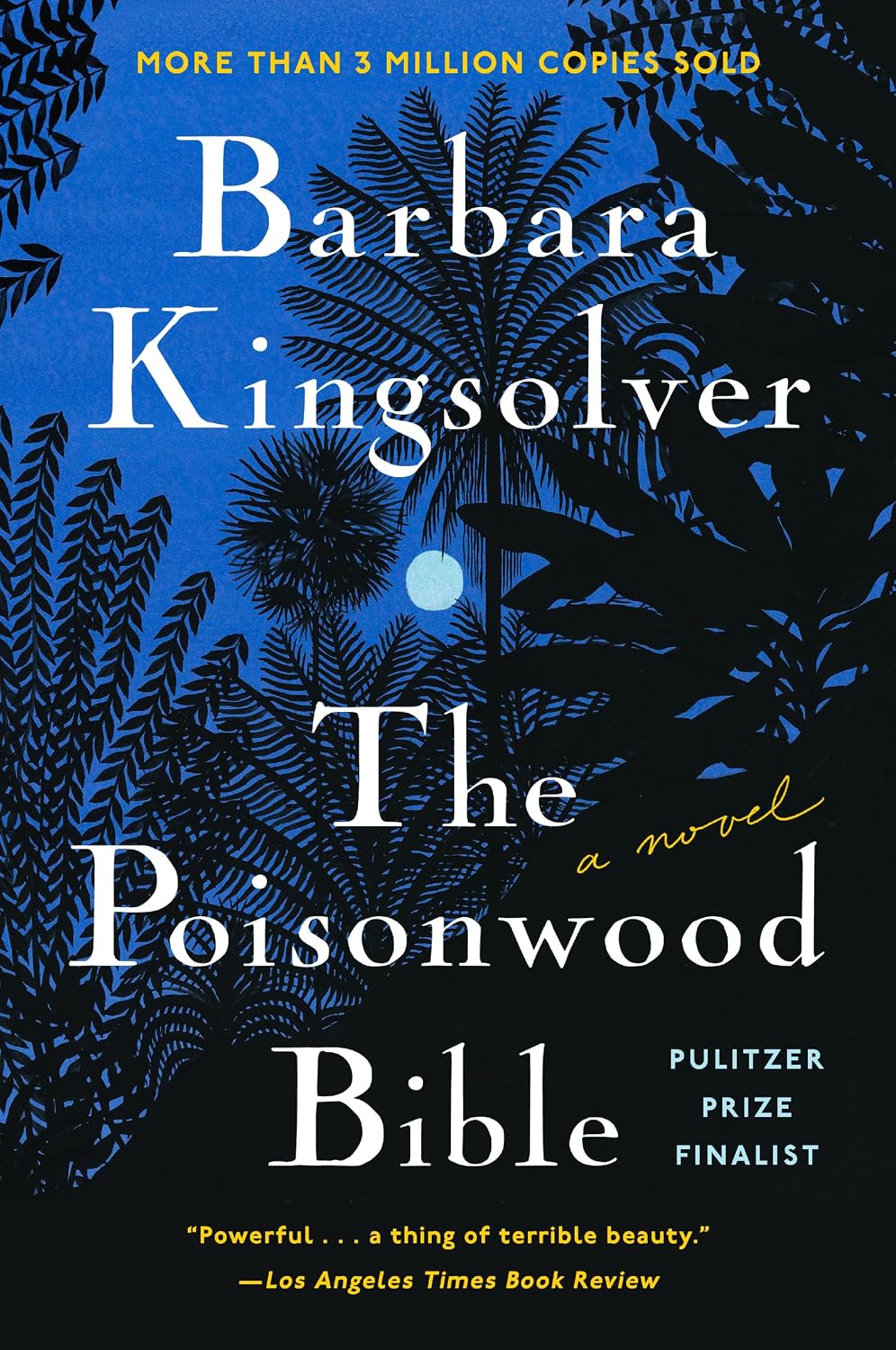
About The Poisonwood Bible by Barbara Kingsolver—A Powerful Story of Family, Faith, and Change
What happens when a family enters a new land but refuses to understand its people? The Poisonwood Bible by Barbara Kingsolver gives a deep and moving answer.
In 1959, Baptist preacher Nathan Price takes his wife and four daughters from Georgia, USA, to a small village in the Belgian Congo. He believes he has come to help. He brings his faith, his rules, and his strong ideas. But he does not listen to the people around him. He does not try to learn how they live. Soon, his mission begins to hurt the very family he wants to lead.
The story is told by Nathan’s wife, Orleanna, and their four daughters: Rachel, Leah, Adah, and Ruth May. Each one sees the same events in a different way. Their voices help the reader understand fear, love, pride, guilt, hope, and survival.
This is not only a book about one family. It is also a story about power, colonial rule, freedom, religion, and the harm people can cause when they think only their own way is right.
A Family Looking for Hope in the Wrong Way
Nathan Price believes that he knows what is best for everyone. He expects his family to follow him without asking questions. He also expects the people of the Congo to accept his faith and way of life.
The problem is simple but dangerous: Nathan speaks, yet he does not listen.
He tries to grow American plants without first learning about the local soil. He teaches without learning the local language well. He judges village customs before he understands why they exist. Even when people warn him, he refuses to change.
His wife and daughters soon learn that good plans can fail when they are mixed with pride. They must find their own ways to live in a place that feels strange, hot, beautiful, and unsafe. As the Congo moves toward freedom from Belgian rule, the Price family also begins to break away from Nathan’s control.
For readers who are tired of flat stories with simple heroes and villains, this novel offers something richer. It asks you to look at a hard event from more than one side. It does not give quick or easy answers. Instead, it helps you see how one choice can affect a family, a village, and even a country for many years.
Enter the Congo Through Five Different Voices
One of the best parts of The Poisonwood Bible is the way Barbara Kingsolver tells the story. Nathan does not narrate any chapter. Readers see him only through the eyes of his wife and daughters.
Orleanna is a mother carrying deep fear and regret. She thinks about the choices that brought her children to the Congo. She also thinks about the times she stayed silent when she wanted to act.
Rachel, the oldest daughter, misses the comfort of American life. She cares about clothes, beauty, and getting back to the life she knows. Her voice can be funny, selfish, and very honest.
Leah begins the story as a girl who greatly admires her father. She wants to help him and earn his praise. As she learns more about the Congo and its people, she starts to question what she once believed.
Adah is Leah’s twin. She speaks very little at first, but her mind is always active. She enjoys words, secret meanings, and ideas that can be read in more than one way. Her chapters invite readers to slow down and notice how language can shape truth.
Ruth May is the youngest child. She sees the village with the open eyes of a child. She makes friends more easily because she does not carry all the same ideas as the adults.
These five voices keep the long story fresh. Each new chapter changes the way you understand the family.
A Rich Story Without a Simple Hero
The Price family arrives in the Congo with food, clothes, tools, garden seeds, and many ideas from home. They soon learn that the things they brought do not always work in a different place.
The climate is different. The land is different. The food is different. The language is different. The village has its own wisdom, rules, dangers, and ways of solving problems. Nathan sees these differences as things that must be changed. His family slowly learns that they must change themselves.
Around them, the Belgian Congo is moving toward independence. This large change brings hope, fear, political struggle, and violence. Barbara Kingsolver connects these public events with the private life of the Price family. A father tries to control his home while foreign powers try to control a nation. Both forms of control leave pain behind.
Yet the book is not only dark. It is full of sharp words, family memories, natural beauty, small acts of care, and moments of courage. The daughters grow into very different women. Their choices show that people can respond to the same pain in many ways.
Some try to escape it. Some study it. Some fight against it. Some build a new life from it. These different paths make the novel feel real and human.
Why the Title Matters
The title points to one of the book’s central ideas: a small mistake in language can change a whole message.
Nathan wants to speak to the village in Kikongo, but he does not understand the language well enough. He believes that he is sharing a holy and precious message. His wrong use of a word can give the message a very different meaning connected to the poisonwood plant.
This mistake is more than a language problem. It shows Nathan’s larger failure. He wants to teach before he has learned. He wants people to trust him before he has shown respect for their language and culture.
The title reminds readers that words carry history and meaning. We cannot truly speak to people if we never listen to them.
This idea is useful far beyond the story. It can help readers think about family talks, teaching, leadership, religion, travel, and work. Good aims are not enough. People must also show care, patience, and respect.
Big Ideas Told Through One Family
The Poisonwood Bible explores faith, but it does not give a simple answer about religion. It shows how faith may offer hope to one person while being used as a tool of control by another. The book invites readers to think about the difference between true care and blind pride.
It also looks at colonialism. Foreign people enter another land, take power, and claim that they know what is best. The novel shows how this attitude can harm a nation and how the same attitude can harm a home.
Guilt is another key part of the story. Several characters look back and ask what they should have done. Could they have acted sooner? Could they have protected someone? Can they ever repair the harm? These questions give the novel strong emotional weight.
Nature is also important. Plants, rain, insects, animals, rivers, heat, and soil are not just part of the background. They shape what the family can and cannot do. The natural world does not follow Nathan’s plans. It forces the family to face the limits of their knowledge.
At its heart, the book is about change. A family enters the Congo believing it will change other people. In the end, the Congo changes every member of that family.
Why Readers Remember This Novel
This book can stay in your mind long after you finish it because it gives each main woman a clear and special voice. You may feel close to one sister at first and then understand another sister better later.
The novel can help readers:
-
See how the same event may look different to different people
-
Think more deeply about faith, power, race, family, and freedom
-
Understand why listening is an important part of helping
-
Learn about the difficult time around Congolese independence
-
Notice how pride can turn a good aim into harm
-
Explore the long effects of fear, loss, and guilt
-
Build stronger reading and thinking skills
-
Find rich topics for essays, class talks, and book-club meetings
The story also rewards a second reading. On the first read, you may focus on what happens to the Price family. On another read, you may notice more links between the family’s choices and the political history around them. You may also find new meaning in repeated words, images, plants, animals, and memories.
A Strong Choice for Many Kinds of Readers
This novel is a great choice for readers who enjoy literary fiction with deep characters and real history. It is also good for people who like family stories told across many years.
Readers of historical fiction may enjoy the political setting and the way real events affect daily life. Readers of family drama may connect with the changing bond between Orleanna and her daughters. Students may find useful ideas about voice, symbols, power, religion, colonialism, gender, guilt, and identity.
Book clubs can use the novel to talk about difficult but important questions. Does a good aim excuse a harmful act? When should a person stop obeying someone? Can people fully leave their past behind? What does real help look like? Who has the right to tell another country or culture how to live?
It can also be a meaningful gift for a reader who enjoyed Half of a Yellow Sun, Things Fall Apart, Homegoing, Pachinko, or other novels that connect private family life with large changes in history.
This is a long and serious book, so it is best for mature teens and adults who are ready for a slow, rich reading journey.
Know the Mood Before You Start
The Poisonwood Bible contains painful subjects. These include strict religious control, racism, colonial harm, family abuse, illness, death, political violence, grief, and danger involving children.
The writing can also be dense in some parts. The voices and wordplay may require more care than a fast thriller. However, patient readers are rewarded with a detailed world and characters who grow in powerful ways.
This is not a light romance or a simple adventure. It is an emotional family story that asks hard questions. Readers who want depth, history, and strong ideas are more likely to enjoy it.
Made for Comfortable and Lasting Reading
A long novel deserves a copy that feels good to hold and can stay strong through many reading sessions. Bookish Wonderland offers a reader-friendly copy with:
-
Premium eye-soothing cream paper for comfortable reading
-
Crystal-clear printing for sharp and clean text
-
High-quality stitched and glue binding for better longevity
-
A durable form suitable for careful rereading
-
An attractive copy for a personal shelf or book collection
Cream pages can feel softer on the eyes than very bright white paper, especially during long reading sessions. Clear print helps readers follow the changing narrators without added strain. The firm binding supports regular use and makes the book suitable for students, book clubs, and readers who like to mark important lines with removable notes.
Ways to Enjoy and Use This Book
Read a few chapters at a time and pay attention to the name of each narrator. Each woman has her own speaking style, values, and blind spots. Keeping a small list of the family members can make the first part easier to follow.
Students can use the book for work on narrative voice, historical fiction, postcolonial literature, family power, symbolism, and character growth. It also offers many strong points for essays and presentations.
Book clubs can divide the novel into weekly parts. At each meeting, members can compare the sisters and discuss how their views change. This method gives the book’s large ideas enough time to grow.
You can also read it as a personal journey. Mark places where a character learns, refuses to learn, stays silent, or finally takes action. These moments can lead to useful thoughts about your own life and choices.
It is also a thoughtful gift for a teacher, literature student, serious fiction reader, or Barbara Kingsolver fan.
Best Sellers Rank of This Book
Using the ranking information supplied for this product listing:
-
9,423 in Books
-
38 in Multigenerational Fiction (Books)
-
#107 in Historical Fiction (Books)
-
#128 in Literary Fiction (Books)
Online sales ranks can change over time as customer activity changes.
A Celebrated Work of Modern Fiction
The Poisonwood Bible was first published in 1998. It became a 1999 Pulitzer Prize finalist in Fiction and was also selected for Oprah’s Book Club. These honours show the wide impact the novel has had on readers and critics.
The praise is easy to understand. Barbara Kingsolver combines a family story with questions about politics, religion, race, duty, and regret. She does not treat history like a dry list of dates. She shows how large political choices enter kitchens, homes, marriages, childhoods, and memories.
The author also did wide research into the political, social, and natural history of Africa and the Congo. This care helps the world of the story feel full and detailed. Still, the novel remains fiction rather than a history textbook. It should inspire further learning, not replace factual historical study.
Why Order from Bookish Wonderland?
Bookish Wonderland brings readers a large collection of premium and durable English books. You can choose a meaningful title without worrying about finding a comfortable reading copy.
Customers can enjoy:
-
Nationwide home delivery
-
Delivery inside and outside Dhaka
-
Cash on Delivery across the country
-
Fast or urgent delivery options in Dhaka
-
Reader-friendly paper and clear printing
-
Strong binding made for long-term use
-
Support through Facebook or Instagram for questions
To see the current book price in Bangladesh for The Poisonwood Bible by Barbara Kingsolver, check the price shown on this product page. The listed amount is the best source because prices, stock, editions, and offers may change.
Bring Home a Story You Will Keep Thinking About
Some novels entertain you for a day. Others change the way you see families, nations, faith, and responsibility. The Poisonwood Bible belongs to the second group.
It begins with one family carrying too many things into a land they do not understand. It grows into a powerful story about what happens when pride blocks care and when silence allows harm to continue. Through Orleanna and her four daughters, you will see love tested, trust broken, beliefs changed, and new lives built from loss.
If you want a novel with unforgettable voices, real historical weight, deep family conflict, and ideas worth discussing, this is a strong choice.
For customization, stock questions, or delivery help, inbox Bookish Wonderland through Facebook or Instagram.
| Primary Specification | |
| Author | Barbara Kingsolver |
| Narrator | Dean Robertson |
| Editor | Elliott Beard |
| Genre | Literary Fiction, Historical Fiction, Family Saga, Political Fiction, Postcolonial Literature, and Domestic Fiction. |
| ISBN-13/ISSN | 978-0060786502 |
| ISBN-10 | 0060175400 |
| Publisher | Harper Perennial Modern Classics |
| Publishing Date | May 31, 2005 |
| Edition | First Edition |
| Language | English |
| Reading Age | 14+ |
| Format | Printed Book |
| Physical Specification & Quality | |
| Paper Quality | Premium eye-soothing cream paper |
| Binding Quality | High quality stitched and glue binding (for longevity) |
| Print Quality | Crystal-clear print |
| Pages | 545 pages |
| Country | USA |
| Logistics Information | |
| Weight | 568 gm |
| Length | 8.5 inches |
| Width | 5.6 inches |
| Height | 5.2 inches |