

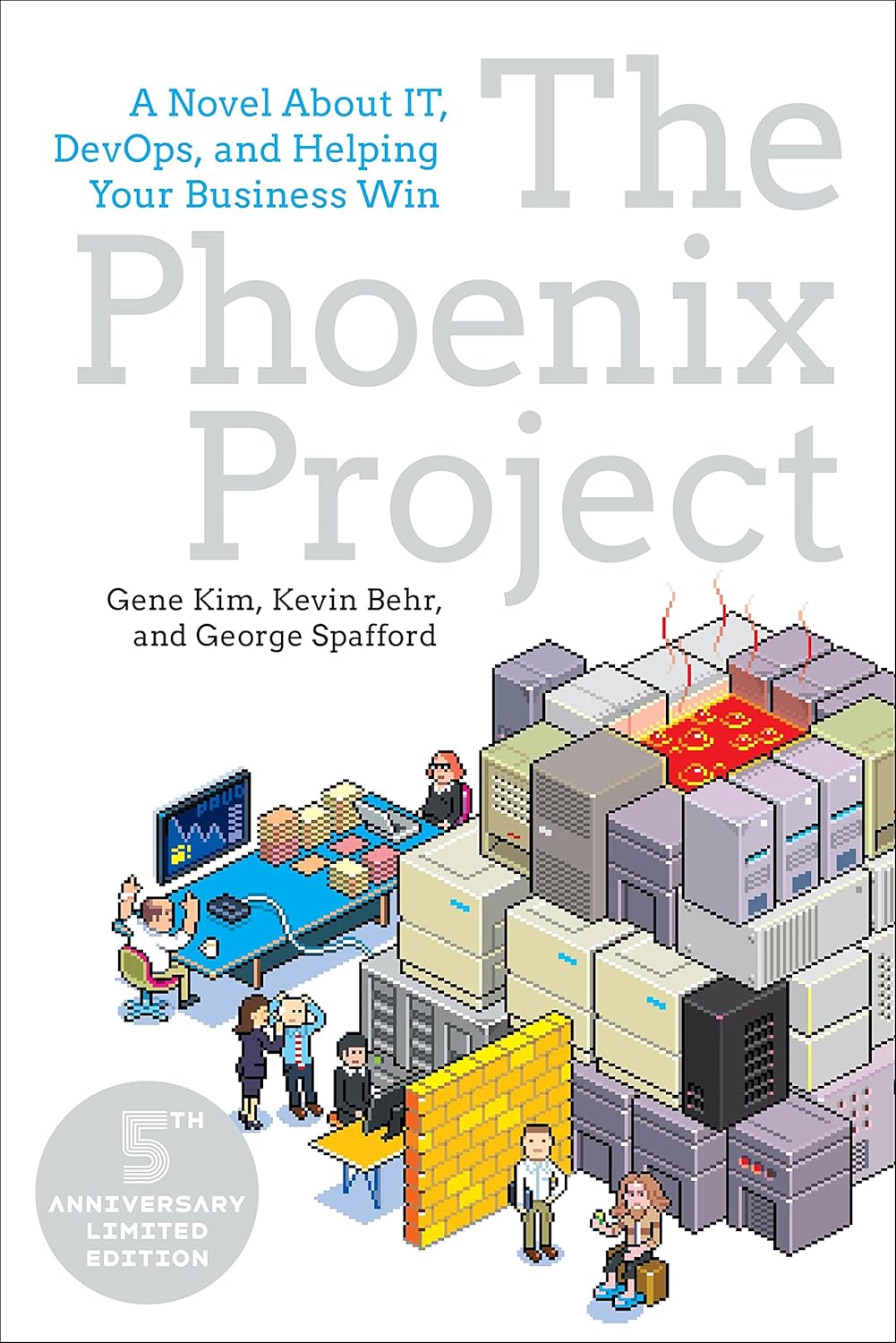
About The Phoenix Project by Gene Kim, Kevin Behr & George Spafford – A Fast Business Novel About DevOps, IT Problems and Better Teamwork
The Phoenix Project by Gene Kim, Kevin Behr and George Spafford is a business novel about what happens when an IT department is overloaded, projects are late, systems keep failing, and the whole company is running out of patience. Instead of teaching DevOps through a dry manual, the authors turn the ideas into a story.
Bill Palmer is an IT manager at Parts Unlimited. One day, he is suddenly given a much bigger job. The company’s most important technology project, called Phoenix, is far behind schedule and far over budget. The CEO gives Bill a hard deadline: fix the situation in ninety days or the IT department may be outsourced.
Bill soon sees that the problem is not one bad employee or one broken server. Work is stuck everywhere. People are doing too many tasks at once. Important work gets interrupted by emergencies. Teams do not share information. Changes create new failures. Everyone is busy, but the company is still moving slowly.
With help from Erik, a future board member with unusual ideas, Bill begins to see IT work in a new way.
A business crisis that feels familiar to many IT teams
The story begins with pressure.
Projects are late. Production systems fail. Business teams are angry. Security work is delayed. Developers want to release new features, while operations teams are trying to keep systems stable. Every department seems to have urgent work, and every urgent request pushes something else aside.
The basic problem is simple: too much work is entering the system, but the system cannot finish it fast enough.
More tasks create more waiting. More waiting creates more stress. More stress creates more mistakes.
The Phoenix Project shows why busy does not always mean productive
A person can be busy all day and still fail to complete the most important task.
One of the key ideas in the novel is that organizations must understand where work is getting stuck. If one person, team, or system becomes a bottleneck, sending even more work toward that point makes the delay worse.
Bill slowly learns to identify constraints and protect them from unnecessary interruptions.
This idea comes from the Theory of Constraints and from lessons used in manufacturing.
Code, tickets, change requests, incidents, security work, and business projects may look different from factory materials, but they still move through a system.
This is one of the main benefits of the book: it helps readers see work as a connected process instead of a collection of separate tasks.
The Three Ways make DevOps easier to understand
The Phoenix Project introduces the idea of the Three Ways, which later became closely linked with DevOps thinking.
The First Way focuses on flow. Work should move from development toward operations and finally to the customer as smoothly as possible. Teams need to see where delays happen and reduce unnecessary waiting.
The Second Way focuses on feedback. When something goes wrong, teams need fast information so they can learn and respond. Slow feedback allows small mistakes to grow into bigger problems.
The Third Way focuses on learning and experimentation. Teams improve when they are allowed to test ideas, learn from failure, and build better habits over time.
Readers see what happens when feedback is missing, when work queues grow, and when teams cannot learn because they are always fighting fires.
Why unplanned work can destroy a good schedule
One of the most useful lessons in The Phoenix Project is about unplanned work.
A team may create a careful plan for the week. Then a server fails. A customer issue appears. A security problem becomes urgent. Suddenly, the planned work is pushed aside.
The book treats unplanned work as real work that must be measured and understood.
This matters because emergency work can consume the same people needed for important projects.
The novel helps managers see that better planning is not only about making longer task lists. It is about controlling how much work enters the system and protecting teams from constant interruption.
Dev and Ops work better when they stop acting like separate worlds
Developers are often judged by how quickly they create new features. Operations teams are judged by stability and uptime.
Development may think operations is too slow. Operations may think development creates risky changes. Business leaders may become frustrated with both.
The Phoenix Project shows why this conflict is harmful. The company needs both speed and stability. New features have little value if systems keep failing, while perfect stability has little value if the business cannot change.
DevOps tries to improve this relationship by creating shared responsibility, better communication, automation, faster feedback, and more reliable delivery.
The story makes this idea human. Readers see the frustration, blame, and confusion that appear when teams work in silos.
The four types of work help leaders see what is really happening
The publisher highlights the four types of work as one of the important lessons of the book.
The novel helps readers think about business projects, internal IT projects, changes, and unplanned work as different demands on the same limited system.
This gives managers a clearer view of capacity.
A team cannot keep accepting new projects forever without affecting delivery time. A large amount of unplanned work may be a sign of deeper problems. Too many changes can increase risk. Internal work may be delayed even when it is needed to keep systems healthy.
By naming these types of work, leaders can ask better questions.
What work is most important? What work can wait? Where is the bottleneck? Which tasks create value? Which tasks are creating risk? How much capacity is being lost to emergencies?
These questions turn a busy workplace into something that can be studied and improved.
Erik changes the way Bill looks at IT
Erik is one of the most memorable characters in the book.
He does not simply give Bill a list of answers. Instead, he asks questions and makes Bill look at the company from another angle. He compares IT work with manufacturing and introduces ideas about flow, constraints, work in process, feedback, and continuous improvement.
At first, some of these lessons feel strange to Bill. Over time, they begin to explain why the organization keeps failing.
Erik’s role makes the book easier to read because the reader learns alongside Bill. You do not need to know DevOps before starting. Bill himself has to discover why the old way of working is not enough.
The story explains technical ideas without feeling like a textbook
The Phoenix Project is often recommended because it teaches through a business story.
There are meetings, failures, deadlines, angry managers, difficult decisions, production incidents, and people trying to protect their teams. These scenes give the ideas a real setting.
Instead of reading a chapter called “How to Manage Constraints,” you see Bill discover a constraint and deal with the damage around it.
Instead of reading only a definition of feedback, you see what happens when people do not get important information quickly enough.
This format can help readers who struggle with traditional management books. The lessons are attached to characters and events, which makes them easier to remember.
What makes The Phoenix Project useful
The book combines business storytelling with practical DevOps ideas.
Key strengths include:
- A fast business story built around a failing IT organization.
- Clear explanations of DevOps ideas through real workplace problems.
- The Three Ways presented in an easy, memorable form.
- Practical lessons about bottlenecks, flow, feedback, and work in process.
- A strong explanation of why unplanned work can damage delivery.
- Examples of conflict between development, operations, security, and business teams.
- Lessons based on the Theory of Constraints and Lean thinking.
- Useful ideas for managers, engineers, developers, operations teams, and executives.
- A story that shows why technology work is directly connected to business results.
- A simple way to understand why improving the whole system matters more than making one person work faster.
Who should read The Phoenix Project?
This book is a strong choice for software developers, system administrators, DevOps engineers, SRE teams, IT managers, project managers, security professionals, product leaders, and business executives.
It is especially useful for people who work in organizations where projects are always late, emergencies are common, teams blame each other, or important work gets stuck.
Students of computer science, software engineering, information systems, and business may also find it helpful because it connects technical work with management ideas.
You do not need to be a programmer to understand the story. The main problems are about work, communication, priorities, systems, and leadership.
Useful for teams, training and workplace discussion
The Phoenix Project can be read alone, but it is also useful as a team discussion book.
A technology team can read it together and compare Parts Unlimited with its own workplace. Managers can ask where their bottlenecks are. Developers and operations teams can discuss how work moves between them. Security teams can think about when controls enter the process.
The book can also support DevOps training because it gives people a shared story before they move into deeper technical practices.
A useful question after each section is simple: where do we see this problem in our own organization?
That question can turn reading into action.
A premium reading copy from Bookish Wonderland
A practical business book is often read more than once, especially when readers want to return to a lesson or discuss it with a team. Bookish Wonderland offers a reader-friendly copy with premium eye-soothing cream paper, crystal-clear print, and high-quality stitched plus glue binding for better longevity.
The cream paper supports comfortable reading, while the clear printing keeps business terms and normal text easy to follow. The durable binding is suitable for regular use, study, and repeated reference.
For readers comparing the Book price in Bangladesh for The Phoenix Project by Gene Kim, Kevin Behr & George Spafford, Bookish Wonderland offers a convenient local option for ordering this influential DevOps business novel.
Nationwide delivery is available across Bangladesh, including inside and outside Dhaka. Cash on delivery is available, and fast or urgent delivery options may also be available in Dhaka.
Updated editions keep the core lesson relevant
The Phoenix Project was originally published on January 10, 2013. IT Revolution lists a fourth edition published on September 3, 2024.
The core challenge remains familiar: businesses depend on technology, but technology teams can become trapped by too much work, weak communication, slow feedback, and constant emergencies.
That is why the book still matters. Tools change quickly, but flow, teamwork, priorities, constraints, and learning remain important.
Start seeing IT work as one connected system
The Phoenix Project by Gene Kim, Kevin Behr & George Spafford shows that many technology problems are not caused by lazy people or a lack of effort. Often, the real problem is the system of work itself.
Bill learns that adding pressure does not automatically create speed. He must reduce work in process, protect bottlenecks, improve feedback, control unplanned work, and help teams understand that IT exists to support business value.
If you want to understand DevOps without beginning with a dense technical manual, this novel is a strong choice. It gives you characters, problems, and decisions that make the ideas easier to remember.
Order The Phoenix Project by Gene Kim, Kevin Behr & George Spafford from Bookish Wonderland and discover a practical story about better flow, stronger teamwork, faster learning, and how technology teams can help a business win.
If you require any customization or have any questions, please inbox us via FB or Insta.
| Primary Specification | |
| Author | Gene Kim, Kevin Behr, George Spafford |
| Narrator | Chris Ruen |
| Editor | Abbey Gaterud |
| Genre | Business & Economics, Information Technology, DevOps, Technology Management, Operations Management |
| ISBN-13/ISSN | 978-1950508945 |
| ISBN-10 | 1950508943 |
| Publisher | IT Revolution |
| Publishing Date | September 3, 2024 |
| Edition | 4th |
| Language | English |
| Reading Age | 18+ |
| Format | Printed book |
| Physical Specification & Quality | |
| Paper Quality | Premium eye-soothing cream paper |
| Binding Quality | High quality stitched and glue binding (for longevity) |
| Print Quality | Crystal-clear print |
| Pages | 352 pages |
| Country | USA |
| Logistics Information | |
| Weight | 372 gm |
| Length | 8.5 inches |
| Width | 5.6 inches |
| Height | 0.78 inch |