

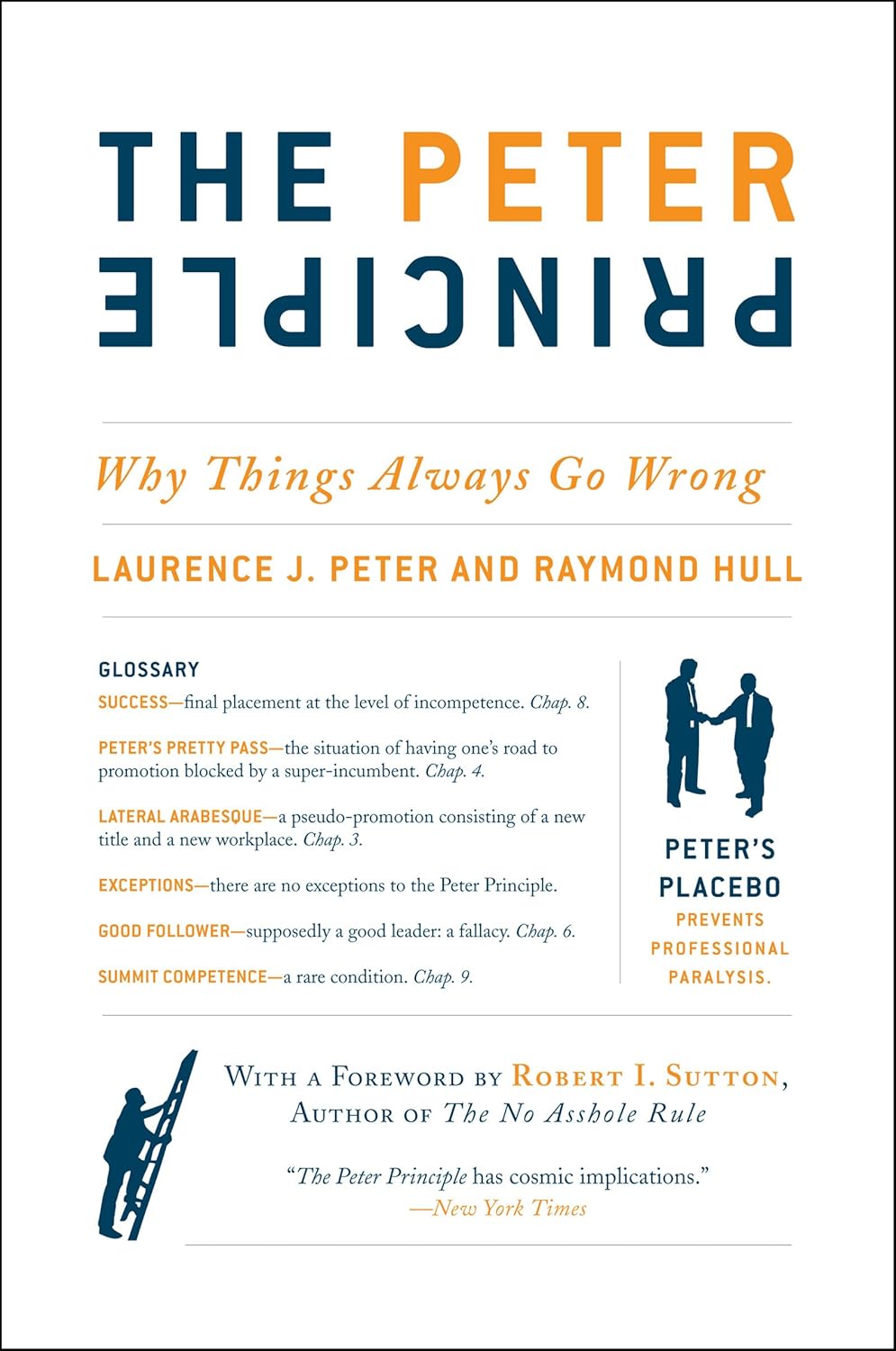
About The Peter Principle: Why Things Always Go Wrong by Dr Laurence J. Peter & Raymond Hull – A Sharp, Funny Guide to Promotions, Management and Workplace Incompetence
The Peter Principle: Why Things Always Go Wrong by Dr Laurence J. Peter and Raymond Hull is a classic business and management book built around one simple idea: in a hierarchy, people tend to be promoted until they reach a job they are no longer good at. A worker may be excellent at one role, receive a promotion because of that success, and then discover that the new role needs a very different set of skills. If the person keeps being promoted on past performance instead of future fit, the process can eventually place them at what the authors call their “level of incompetence.”
For managers, employees, students, entrepreneurs, and anyone who has ever wondered why talented people sometimes struggle after promotion, this book offers a clever way to look at organizations.
The central idea is simple enough to remember forever
Imagine a brilliant salesperson.
They understand customers, close difficult deals, and always reach their targets. Because they perform so well, the company promotes them to sales manager.
Now the job is different. Instead of selling, the person must coach other people, plan schedules, handle conflict, evaluate performance, and make decisions for a whole team.
Being a great salesperson does not automatically make someone a great manager.
If the company judges promotion only by success in the current role, it may keep moving people upward without asking whether they have the skills required for the next role.
That is the basic logic behind the Peter Principle.
The idea is funny because readers can recognize it. It is also useful because it asks organizations to separate two questions: Is this person excellent at the job they have now? And is this person ready for the job above it?
Those are not always the same question.
Promotion can reward the wrong skill
Many workplaces treat promotion as the natural reward for strong performance.
A skilled engineer may become responsible for managing people. A strong teacher may become an administrator. A talented designer may become a department head. A careful accountant may become an executive.
The new job may require leadership, communication, delegation, planning, politics, or judgment rather than the technical skill that earned the promotion.
Peter and Hull use this gap to explain why organizations can slowly fill senior positions with people who were good at earlier jobs but less effective in their current ones.
The book encourages readers to think about promotion as job matching, not simply as a prize.
That lesson remains useful because career growth is still often measured by moving upward, even when a person's strongest work may happen in a specialist role.
A hierarchy can hide problems for a long time
Organizations often have many levels.
When someone reaches a role they cannot perform well, the problem may not immediately look dramatic. Meetings still happen. Emails are still sent. Reports are still produced. The person may appear very busy.
The authors use humor to show how activity can sometimes hide a lack of useful results.
A manager may protect themselves with rules, paperwork, vague language, or endless process. Another employee may become obsessed with small details because larger decisions are harder. Someone else may rely on status instead of skill.
The book gives comic names and examples to patterns like these.
The satire makes the reading lively, but the larger point is serious. A workplace should not assume that position, title, or seniority proves competence.
Readers are encouraged to look at what work actually needs to be done and whether the person in the role can do it well.
The book is satire, but the workplace question is real
The Peter Principle is written with jokes, exaggeration, invented examples, and a mock-scientific tone.
Peter and Hull present “hierarchiology” almost like a new academic science. This style is part of the fun.
The book is not a modern data-driven management textbook, and readers should not treat every comic rule as a proven law that always applies.
Still, the central observation became famous because people recognized something true inside the joke.
Promotion systems can fail when they look backward instead of forward. A person can deserve recognition without being suitable for a very different job. A hierarchy can create incentives that push people away from the work they do best.
Reading the book today works best when the humor and the management lesson are kept together.
The Peter Principle changes how you look at career growth
Many people are taught that a successful career always means getting a bigger title.
The book makes that assumption worth questioning.
What if a person loves technical work but hates managing people? What if someone is excellent as a specialist but becomes unhappy in an executive role? What if a promotion gives more status but removes the work that made the person successful?
These questions matter for employees as much as employers.
A promotion can be good, but only when the new job fits the person's strengths, interests, and ability to learn.
The Peter Principle therefore offers a useful personal lesson: do not accept every upward move automatically. Understand what the new role actually requires.
Career growth can also mean deeper expertise, better pay, more interesting work, or greater influence without becoming a manager.
Managers can learn to promote more carefully
The book is especially useful for people who make hiring and promotion decisions.
Before promoting someone, a manager can ask what skills made the employee successful and whether those same skills matter in the next position.
If the new role requires different abilities, the company can provide training, mentoring, trial responsibilities, or another way to test fit before making the move permanent.
Organizations can also create strong career paths for specialists so that talented employees do not need to become managers simply to earn more recognition or money.
These are modern ways to respond to the problem the book describes.
The lesson is not that promotion is bad. The lesson is that promotion should be based on the demands of the new role, not only on performance in the old one.
What makes The Peter Principle worth reading
The book remains useful because it gives a memorable name to a workplace pattern many people have seen.
Key reasons to read it include:
- A simple explanation of why successful employees can struggle after promotion.
- A classic management concept that entered everyday business language.
- Humorous examples that make organizational problems easier to remember.
- A useful way to think about job fit, leadership, and career growth.
- Questions that managers can apply when choosing people for higher roles.
- A reminder that technical skill and management skill are not identical.
- Ideas that can help employees think carefully before accepting a promotion.
- A satirical look at bureaucracy, hierarchy, titles, and workplace behavior.
- Short, approachable writing rather than a heavy academic management textbook.
- A concept that remains widely discussed decades after the book first appeared.
Who should read this book?
The Peter Principle is a strong choice for managers, team leaders, business owners, entrepreneurs, HR professionals, university students, office workers, and anyone interested in organizational behavior.
It can be especially useful for people who have recently been promoted or are thinking about moving into management.
Students of business and management can read it as a famous piece of organizational thought, while experienced professionals may enjoy comparing its examples with situations they have seen at work.
The book can also work well in a team discussion because nearly everyone can think of examples of poor job fit, unclear promotion systems, or talented employees placed in roles that do not suit them.
Readers should remember that the book uses satire and broad generalization. It is best used as a tool for thinking, not as a rule for judging every individual manager.
First published in 1969 and still widely reprinted
The Peter Principle first appeared in 1969 and became a major bestseller.
The original William Morrow edition is cataloged at 179 pages. Later HarperCollins editions are commonly listed at 192 pages, and a fortieth-anniversary edition includes a foreword by management scholar Robert I. Sutton.
Page count and cover design can therefore differ by edition.
The correct co-author credit is Raymond Hull. Some listings or typed references may contain spelling errors, but established catalog records identify the authors as Laurence J. Peter and Raymond Hull.
A premium reading copy from Bookish Wonderland
A practical business classic is useful when it can be read, marked, discussed, and returned to over time.
Bookish Wonderland offers a reader-friendly copy with premium eye-soothing cream paper, crystal-clear print, and high-quality stitched plus glue binding for better longevity. The cream paper supports comfortable reading, while the clean print keeps the book's examples and management ideas easy to follow.
For readers comparing the Book price in Bangladesh for The Peter Principle: Why Things Always Go Wrong by Dr Laurence J. Peter & Raymond Hull, Bookish Wonderland offers a convenient local option for ordering this classic management title.
Nationwide delivery is available across Bangladesh, including inside and outside Dhaka. Cash on delivery is available, and fast or urgent delivery options may also be available in Dhaka.
A classic idea that can improve modern promotion decisions
The Peter Principle survives because the mistake it describes is easy to repeat.
Organizations want to reward strong workers. Employees want career growth. Promotion seems like the obvious answer.
But a better system asks what the next job requires before deciding who should fill it.
That small change can protect both the organization and the employee. It can reduce the chance that a talented specialist becomes an unhappy manager, while helping companies identify people who truly have the skills needed at the next level.
The book also reminds readers that competence is not a permanent label. A person can be excellent in one role, weak in another, and strong again after training or a change of position.
That is a more useful way to think about work than simply dividing people into competent and incompetent.
Read the business classic that gave a workplace problem its name
The Peter Principle: Why Things Always Go Wrong by Dr Laurence J. Peter and Raymond Hull is funny, sharp, and easy to recognize in real life.
Its famous principle asks readers to notice what happens when organizations reward performance by moving people into jobs that require completely different skills.
Behind the jokes is a practical lesson about promotion, leadership, job fit, training, and career design.
If you have ever watched a brilliant employee become a struggling manager, wondered why senior positions sometimes seem badly filled, or questioned whether your own next promotion is truly the right move, this book gives you a memorable framework for thinking about the problem.
Order The Peter Principle by Dr Laurence J. Peter & Raymond Hull from Bookish Wonderland and explore a management classic that can change the way you think about hierarchy, promotion, competence, leadership, and success at work.
If you require any customization or have any questions, please inbox us via FB or Insta.
| Primary Specification | |
| Author | Dr. Laurence J. Peter & Raymond Hull |
| Genre | Business, Management, Organizational Psychology, Satire |
| ISBN-13/ISSN | 978-1788166058 |
| ISBN-10 | 1788166051 |
| Publisher | Profile Books |
| Publishing Date | October 1, 2020 |
| Language | English |
| Reading Age | 18+ |
| Format | Printed book |
| Physical Specification & Quality | |
| Paper Quality | Premium eye-soothing cream paper |
| Binding Quality | High quality stitched and glue binding (for longevity) |
| Print Quality | Crystal-clear print |
| Pages | 192 pages |
| Country | USA |
| Logistics Information | |
| Weight | 212 gm |
| Length | 8.5 inches |
| Width | 5.6 inches |
| Height | 0.51 inch |