

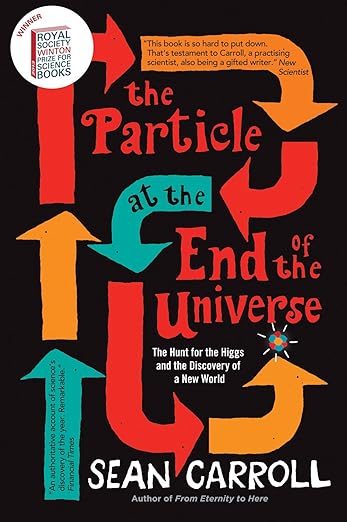
About The Particle at the End of the Universe by Sean Carroll
What is the universe made of, and how did scientists find a particle too small to see? The Particle at the End of the Universe by Sean Carroll answers these questions through the remarkable story behind the Higgs boson and the Large Hadron Collider.
This popular science book takes readers inside one of the most important scientific discoveries of modern times. It explains why researchers spent decades searching for the Higgs boson, how the world’s largest particle accelerator helped reveal it, and what the discovery means for our understanding of nature.
Sean Carroll turns difficult ideas into an exciting human story. Alongside particles, fields, and experiments, readers meet the people, teamwork, risks, and big questions behind the search.
The Tiny Particle That Changed Modern Physics
For many years, scientists believed that a particle linked to the Higgs field should exist. Finding it would help confirm an important explanation for how certain fundamental particles gain mass.
The problem was that this particle was extremely difficult to detect. Researchers needed powerful machines, careful experiments, and enormous amounts of data to find convincing evidence.
The Higgs boson became one of the biggest missing pieces in modern particle physics. Its discovery helped scientists test the ideas that explain how the smallest parts of nature behave.
This book shows why the search mattered and why the answer was worth years of effort.
What Is the Higgs Boson in Simple Words?
The Higgs boson is a particle connected to the Higgs field, an invisible field that exists throughout the universe. Some fundamental particles gain mass through their interaction with this field.
Discovering the Higgs boson gave scientists strong evidence that the Higgs field and its related mechanism are real. This helped fill an important gap in the Standard Model, the framework physicists use to describe many fundamental particles and forces.
The book explains these ideas using clear examples and an engaging narrative. Readers do not need to arrive with expert knowledge to understand why the discovery mattered.
An Important Detail About Where Mass Comes From
The Higgs field helps explain the masses of certain fundamental particles, including electrons and quarks. However, it is not accurate to say that the Higgs boson directly creates every kind of mass.
Much of the mass of protons and neutrons comes from the energy associated with the strong interaction inside them. Understanding this difference helps readers avoid a common misunderstanding about the discovery.
Carroll’s story opens the door to a bigger idea: nature does not have one simple answer for every question. Different parts of the universe follow connected rules that scientists must study with care.
Inside the World’s Largest Particle Accelerator
The Large Hadron Collider, often called the LHC, is a huge scientific machine operated by CERN near Geneva. Its circular tunnel runs for about 27 kilometers beneath the border between France and Switzerland.
Inside the machine, particles move close to the speed of light before being brought into collision. These collisions allow scientists to study the smaller particles and signals produced by the impact.
The machine does not work like a simple camera taking a clear picture. Researchers must examine vast amounts of information and look for patterns that reveal what happened.
The book shows how engineers, physicists, and research teams worked together to turn this extraordinary machine into a tool for discovery.
The Day Scientists Announced a Historic Discovery
On July 4, 2012, the ATLAS and CMS experiments at CERN announced evidence of a new particle consistent with the Higgs boson.
The announcement followed years of planning, testing, and international cooperation. It gave researchers important support for a theory that had shaped particle physics for decades.
Carroll explains why the discovery mattered to scientists and why people outside laboratories should care. The event was not simply about finding one unusual particle. It showed how human curiosity, patient work, and shared knowledge can reveal hidden parts of the natural world.
Science Is Also a Story About People
Behind every major experiment are people with hopes, disagreements, creative ideas, and long working days. This book explores the human side of modern research rather than treating science as a list of cold facts.
Large scientific projects require money, support, planning, and cooperation between institutions and countries. Different teams must solve difficult problems while dealing with pressure and uncertainty.
Readers discover how big ideas move from theory to experiment. They also see why progress depends on engineers, researchers, support staff, and many other people working together.
This human element makes the story interesting even for readers who have never studied physics.
Reading the book also shows why scientific results require patience. Researchers cannot announce an exciting idea and expect everyone to believe it. They must collect evidence, check their methods, compare results, and allow other experts to test their conclusions. This process helps explain why the Higgs discovery mattered so much. It was not only an interesting theory. It became a powerful example of how questions, teamwork, and evidence can move human understanding forward.
When Physics Feels Too Difficult to Understand
Many people hear words like boson, quantum field, and particle collider and assume the subject is beyond them. News reports often mention these terms without explaining the ideas behind them.
The Particle at the End of the Universe offers a more welcoming way into the subject. Carroll starts with real questions and builds the story around why scientists asked them.
The book still discusses challenging ideas, but readers do not need an advanced degree to follow its main message. Curiosity, patience, and a willingness to explore are enough to begin.
If science classes once felt confusing, this book can help replace fear with interest.
What the Standard Model Helps Explain
The Standard Model is a scientific framework used to describe fundamental particles and three major forces: the electromagnetic, weak, and strong interactions.
The Higgs boson plays an important part in this framework because its discovery supported the mechanism through which certain particles acquire mass.
However, the Standard Model does not answer every question. Gravity is not included in the same framework, and scientists continue to investigate mysteries such as dark matter.
This book helps readers understand why one discovery can be both a major achievement and the beginning of new questions.
Why People Call It the God Particle
The Higgs boson is sometimes called the God particle in popular media. This nickname helped attract attention, but it does not mean that the particle is religious or that scientists discovered a creator.
The real subject is physics: how fields, particles, and natural forces behave. Carroll explains the scientific importance of the Higgs without depending on a misleading nickname.
Readers who have heard the phrase but never understood it will finally have useful context.
What You Will Learn From This Book
- Why scientists searched for the Higgs boson for decades.
- How the Higgs field relates to the masses of certain fundamental particles.
- What happens inside the Large Hadron Collider.
- How CERN’s ATLAS and CMS experiments identified important evidence.
- Why the Standard Model matters to modern physics.
- How international research teams manage complex scientific projects.
- Why questions about dark matter and the universe remain open.
- How scientific discoveries move from bold ideas to tested evidence.
Together, these topics create a clear picture of how researchers explore the smallest building blocks of nature.
An Award-Winning Science Book Worth Reading
The Particle at the End of the Universe won the 2013 Royal Society Winton Prize for Science Books. This award recognized its success in explaining an important scientific story to a wider audience.
The book combines careful research with an engaging style. It does not simply announce that a discovery happened. It explains the long search, the people involved, and the questions that made the result meaningful.
For readers choosing their first particle physics book, this recognition adds confidence that the subject is presented with both knowledge and care.
Who Should Read The Particle at the End of the Universe?
This book suits curious adults, older students, teachers, and readers who enjoy learning how the universe works. It is especially useful for people interested in physics, astronomy, scientific research, and major discoveries.
University students may appreciate the background behind ideas they encounter in class. School students with a strong interest in science can use the book to explore the wider story behind particle physics.
It is also a good choice for readers who enjoy nonfiction that combines real events with clear explanation. You do not need to be a scientist to care about how people discover nature’s hidden rules.
A Useful Companion for Students and Teachers
Physics textbooks often focus on definitions, equations, and exam topics. This book adds the story behind the science, helping readers understand why researchers asked these questions in the first place.
Students can use it as background reading when exploring atoms, particles, fields, and scientific experiments. Teachers may find helpful examples for explaining why the Higgs discovery became an important moment in modern research.
The book should not replace a formal textbook when detailed calculations are needed. Its strength lies in building understanding, curiosity, and a clearer view of how science develops.
A Thoughtful Gift for Curious Minds
The Particle at the End of the Universe makes a meaningful gift for science lovers, physics students, teachers, and readers who enjoy big questions.
Its subject connects the tiniest particles with the wider story of the universe. That combination makes the book suitable for birthdays, academic milestones, and thoughtful surprises for anyone interested in discovery.
Because the book stands alone, the reader does not need another volume to understand its central story. It can be enjoyed independently and kept as a useful addition to a personal science collection.
A Premium Printed Edition Built for Lasting Use
Bookish Wonderland offers a premium printed edition prepared for comfortable reading and long-term durability.
- Premium eye-soothing cream paper provides a gentle and pleasant page color.
- Crystal-clear print keeps scientific terms and explanations easy to read.
- High-quality stitched and glue binding helps the pages remain secure over time.
These features make the book suitable for regular reading, revisiting important sections, and keeping on a study shelf.
Best Sellers Rank of This Book
- #1,806,417 in Books
- #24 in Particle Physics
- #39 in Atomic & Nuclear Physics
- #787 in Scientific Research
Order Easily From Anywhere in Bangladesh
Want to check the Book price in Bangladesh for The Particle at the End of the Universe by Sean Carroll? Bookish Wonderland makes it easy to order this award-winning science book from your preferred location.
Delivery is available inside Dhaka and across Bangladesh. Cash on delivery is offered nationwide, giving customers a simple way to pay when their book arrives.
Readers in Dhaka can also ask about fast or urgent delivery. Bookish Wonderland offers a large collection of English books for students, curious readers, and science lovers.
Discover the Story Behind One of Science’s Biggest Questions
The Higgs boson was not found through luck. Its discovery came from years of careful thought, difficult experiments, and people willing to keep asking questions.
The Particle at the End of the Universe by Sean Carroll brings that remarkable journey within reach. Order your copy from Bookish Wonderland and explore how one tiny particle helped scientists understand nature more deeply.
If you require any customization or have any questions, please inbox us via FB or Insta.
| Primary Specification | |
| Author | Sean Carroll |
| Narrator | Jonathan Hogan |
| Editor | Stephen Morrow |
| Genre | Popular Science, Particle Physics, Physics, Cosmology, History of Science |
| ISBN-13/ISSN | 978-1786076069 |
| ISBN-10 | 1786076063 |
| Publisher | Oneworld Publications |
| Publishing Date | August 1, 2019 |
| Language | English |
| Reading Age | 18+ |
| Format | Printed Book |
| Physical Specification & Quality | |
| Paper Quality | Premium eye-soothing cream paper |
| Binding Quality | High quality stitched and glue binding (for longevity) |
| Print Quality | Crystal-clear print |
| Pages | 352 pages |
| Country | United States |
| Logistics Information | |
| Weight | 361g |
| Length | 8.5 inch |
| Width | 5.6 inch |
| Height | 1 inch |