

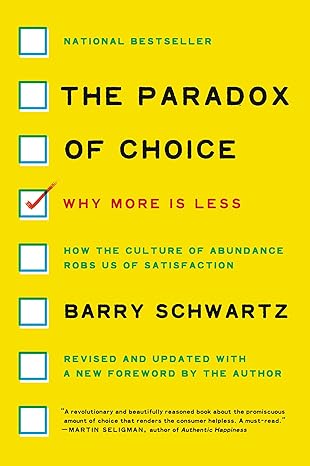
About The Paradox of Choice by Barry Schwartz
The Paradox of Choice by Barry Schwartz asks a question that sounds simple but can change how you live: if having choices is good, why can having too many choices feel so bad? From picking a phone to choosing a job, modern life gives us more options than ever. Yet more options do not always bring more peace, freedom, or joy.
Barry Schwartz explains why a long list of choices can leave us tired, unsure, and afraid of picking the wrong thing. His book, also known as The Paradox of Choice: Why More Is Less, helps readers see the hidden cost of trying to find the best option every time. It shows how simpler rules, clear limits, and realistic hopes can make daily choices feel easier.
This is a nonfiction book for students, workers, business owners, parents, and anyone who feels lost in a sea of options. It does not ask you to give up freedom. It helps you use freedom with more care, so you can spend less time comparing and enjoy living.
Why Having More Options Can Feel Harder
Imagine going to a shop to buy one pair of shoes. If there are three pairs, you can compare them and choose. If there are fifty pairs, every choice may bring a new doubt. Is another pair better? Is the price fair? Should you search another store? A small task becomes a large mental job.
This is the heart of the book. Choice can be helpful, but too much choice can become heavy. When options seem endless, people may delay decisions, feel less sure, or worry about what they did not pick. Even after buying something useful, they may keep asking if a better option was hiding somewhere else.
The idea does not mean every large selection is bad. The effect depends on the task, the person, and how clear the options are. Still, Schwartz gives you a useful way to notice when freedom stops feeling like help and starts feeling like pressure.
Meet the Two Ways People Make Choices
One of the book’s best-known ideas is the difference between maximizers and satisficers. A maximizer wants to find the very best option. They may read every review, compare every feature, check every shop, and still feel unsure. The search can take a lot of time and energy.
A satisficer sets clear needs and chooses an option that meets them well. This does not mean accepting poor quality or giving up on good results. It means knowing what matters, finding a choice that fits, and then moving forward without hunting forever.
Think about buying a phone in Bangladesh. You may need a good battery, a fair price, and a clear camera. Once you find a phone that meets those needs, you can stop. You do not need to study every phone on the market. The book helps you see why a good choice can be more useful than an endless search for a perfect one.
The Hidden Cost of Chasing the Perfect Answer
Trying to make the best decision sounds wise. Yet the search can take time, sleep, focus, and peace. When you spend hours comparing similar options, the extra effort may not improve your life by much. The lost time might matter more than the tiny gain.
The book also explains why high hopes can make a good result feel weak. If you expect one choice to solve every problem, flaws may feel like failure. A useful job, a nice meal, or a strong product can seem less satisfying simply because you imagined something perfect.
Why Regret Can Follow Even a Good Decision
Every choice closes the door on other paths. If you choose one university, you do not attend the others. If you buy one laptop, you leave the other models behind. It is easy to imagine that the option you did not choose would have been better.
This feeling is often linked to missed chances and regret. The more options you can picture, the more ways your mind can question your final choice. You may remember the good parts of the rejected options while forgetting their weak points.
The Paradox of Choice helps you step back from this habit. A decision does not need to be perfect to be right for your needs. By judging a choice against your own goals, rather than against every path you did not take, you can build a calmer relationship with everyday decisions.
How Comparison Can Steal Your Peace
It is easy to feel happy with your new phone until someone shows you a newer model. A good job may seem less exciting when a friend earns more. A lovely home can feel small after looking at endless photos online.
The book explores how comparison can change the way people feel about their own lives. When we keep measuring our choices against someone else’s result, we may forget the needs and values that shaped our own decision. What suited another person may not suit us at all.
Schwartz invites readers to pay attention to this pressure. A better question is not always, “Is my choice the best in the world?” It may be, “Does this choice work well for my life?” That change can make room for more gratitude and less needless doubt.
Simple Steps That Make Decisions Easier
The book offers practical ways to reduce the weight of too many options. Start by deciding which choices truly matter. A major health, money, or career decision may need careful thought. A small daily purchase may not deserve hours of searching.
Set a few clear rules before you begin. Choose a budget. Pick the features you need. Limit the number of shops, pages, or reviews you will check. Once an option meets your main needs, give yourself permission to stop.
You can also keep useful routines. Eat a familiar breakfast, plan your week early, or make a short list before shopping. These small habits leave more attention for the choices that deserve it.
The goal is not to avoid every decision. It is to use your time and energy with care. The book gives readers a practical path toward choosing well without turning each choice into a test of perfection.
Useful for Students Choosing Their Future
Students face hard choices about subjects, universities, skills, careers, and study plans. Each path can seem important, and advice often comes from many directions. Family, friends, teachers, and social media may all suggest different answers.
This book can help students build a clearer way to think. Instead of trying to find one perfect future, they can list their goals, compare a small number of strong options, and choose a path that fits their present needs.
A student in Dhaka may be choosing between several degree programs or training courses. The ideas in this book can help narrow the list and reduce the fear of missing out. It is not a promise that every decision will be easy. It is a reminder that a clear, thoughtful choice can be enough.
Helpful for Work, Business, and Marketing
The Paradox of Choice is useful for people who study customer behavior, marketing, sales, or product design. A business may think that offering more products is always better. Yet a crowded menu, a confusing website, or too many similar plans can make customers feel lost.
Schwartz’s ideas encourage businesses to think about clarity. Helpful filters, simple categories, clear product details, and a small set of strong choices can guide customers. The aim is not to hide options. It is to present them in a way that people can understand.
Business owners in Bangladesh can apply this idea to online stores, service packages, restaurant menus, and social media offers. When customers can find what matters quickly, they may feel more confident about the next step. The book gives a useful lens for understanding why a simple buying experience can be valuable.
What Makes Barry Schwartz Worth Reading
Barry Schwartz is an American psychologist whose work brings together psychology, human behavior, and everyday life. His writing asks readers to look again at a common belief: that more freedom must always mean more options.
Rather than using only abstract ideas, he connects the subject to choices people face at shops, at work, at home, and in their plans for the future. This makes the book useful even if you have never studied psychology or marketing.
The book also leaves room for balance. Having options can be important and helpful. The challenge is knowing when a wide selection supports a good decision and when it creates confusion. Readers who want a thoughtful look at modern life can find ideas here that stay useful long after the final page.
A Premium Book That Feels Good to Read
Bookish Wonderland offers this title in a premium physical format made for comfortable reading and lasting use. The pages feature eye-soothing cream paper, which feels gentle during long reading sessions. Crystal-clear printing keeps the words sharp and easy to follow.
The book also uses high-quality stitched and glue binding. This strong build helps the pages stay secure as you read, take notes, return to key ideas, and keep the book on your shelf. Together, these details make the copy suitable for a home library, a study desk, or a thoughtful gift.
Who Will Get the Most from This Book?
This book is a strong choice for readers interested in psychology, self-improvement, consumer behavior, decision-making, and modern culture. It can also help entrepreneurs, teachers, managers, marketers, and university students who want to understand why people hesitate when faced with many options.
It works well as a personal growth read, a business discussion book, or a gift for someone who often overthinks. Readers can move through it at their own pace, mark useful ideas, and return to the parts that fit a current problem.
The book is not a medical treatment, and no single idea can solve every life problem. Its value lies in offering a clear way to think about choice, expectations, and satisfaction. If you often feel stuck between good options, this book may help you see your next step more clearly.
Best Sellers Rank of This Book
- #27,444 in Books
- #30 in Marketing & Consumer Behavior
- #39 in Social Work (Books)
- #40 in Cultural Anthropology (Books)
Order from Bookish Wonderland Across Bangladesh
Bookish Wonderland makes it easy to order English books from anywhere in Bangladesh. Delivery is available inside Dhaka and to locations outside Dhaka. Cash on delivery is available nationwide, so customers can pay when the order arrives.
If you need the book quickly, ask about fast or urgent delivery within Dhaka before placing your order. Check the current product listing for the latest price and delivery details. For questions, help, or customization requests, contact Bookish Wonderland through Facebook or Instagram.
Choose Less Stress and More Clarity Today
The Paradox of Choice by Barry Schwartz can change the way you look at shopping, work, study, and daily life. It shows why more options do not always create more happiness and why a good choice can be enough.
Add this thoughtful book to your collection and explore a simpler way to make decisions. Order your copy from Bookish Wonderland today, choose your preferred delivery option, and take the first step toward a calmer, clearer relationship with choice.
If you require any customization or have any questions, please inbox us via FB or Insta.
| Primary Specification | |
| Author | Barry Schwartz |
| Narrator | Ken Kliban |
| Genre | Psychology, Social Psychology, Decision-Making, Consumer Behavior, Self-Help |
| ISBN-13/ISSN | 978-0062449924 |
| ISBN-10 | 0062449923 |
| Publisher | Ecco |
| Publishing Date | May 17, 2016 |
| Edition | Revised |
| Language | English |
| Reading Age | 16+ |
| Format | Printed book |
| Physical Specification & Quality | |
| Paper Quality | Premium eye-soothing cream paper |
| Binding Quality | High quality stitched and glue binding (for longevity) |
| Print Quality | Crystal-clear print |
| Pages | 304 pages |
| Country | United States |
| Logistics Information | |
| Weight | 311g |
| Length | 8.5 inch |
| Width | 5.6 inch |
| Height | 0.68 inch |