

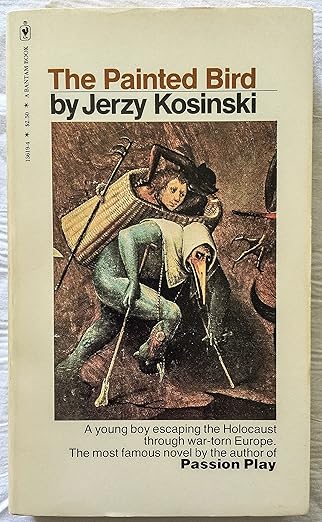
About The Painted Bird by Jerzy Kosinski – A Harrowing WWII Novel of Survival, Cruelty and Lost Innocence
Some war novels show battles between armies. The Painted Bird by Jerzy Kosinski looks at war through the eyes of a child who has almost no power to protect himself.
First published in 1965, this dark literary novel follows a young boy separated from his parents during World War II. He is sent away because his family believes it may keep him safe. Instead, he becomes trapped in a frightening journey through isolated villages in Eastern Europe.
He is alone, different from the people around him, and often treated with fear and suspicion.
As he moves from one place to another, he sees how quickly ordinary life can turn cruel when war, hate, fear, and superstition take control.
This is not an easy novel, but that is part of its power.
A child alone in a world shaped by fear
The boy begins his journey without understanding the full danger around him.
His parents are gone. The adults who might protect him disappear, fail him, or become threats themselves. He must learn how to survive without knowing whom he can trust.
Because of his dark hair, dark eyes, and appearance, villagers often believe he is Jewish or Romani. In Nazi-occupied Eastern Europe, that suspicion alone can place his life in danger.
He moves from home to home and village to village.
Sometimes someone gives him shelter.
At other times, he faces cruelty.
Each new place teaches him something about fear, power, violence, and survival.
The story becomes a picture of what can happen when a child is forced to grow up in a world where kindness cannot be taken for granted.
Why the story feels so disturbing
The Painted Bird is famous partly because it does not hide the ugliness of its world.
The novel contains extreme violence, abuse, cruelty, sexual violence, suffering, animal harm, and scenes involving a child in danger. It is intended for mature readers and can be emotionally difficult.
Kosinski uses these experiences to explore a larger question:
What happens to innocence when a person sees too much cruelty?
The boy begins as someone searching for safety. As the story continues, the things he witnesses affect the way he understands people and himself.
Violence becomes more than something happening around him. It begins shaping his idea of how the world works.
That makes the novel as psychological as it is historical.
The meaning behind the painted bird
The title comes from one of the novel's most memorable images.
A bird is captured and painted in bright colors before being released back into its flock. Because it now looks different, the other birds attack it.
The image reflects the boy's own position.
He is human like everyone around him, yet small differences make people treat him as an outsider.
That idea reaches beyond one child or one war.
The painted bird becomes a symbol of what can happen when a group decides that someone who looks or seems different no longer belongs.
It gives the novel a powerful theme of prejudice, exclusion, identity, and violence.
A World War II novel without a traditional battlefield
Readers should not expect a normal military story.
The boy is not following soldiers through major battles. Much of the novel takes place in poor rural communities affected by occupation, fear, superstition, and social collapse.
War is often present indirectly.
Its power can be seen in hunger, persecution, soldiers, broken families, and the way normal rules of life begin to disappear.
This gives the book a different view of World War II.
Instead of asking who will win a battle, the novel asks how an individual survives when the world around him becomes unsafe.
A story about human cruelty and human choice
The people the boy meets are not all the same.
Some are violent.
Some are frightened.
Some use power against weaker people.
Others offer moments of care or protection.
This contrast matters because The Painted Bird is not only asking whether people can be cruel.
It asks why they become cruel, what fear does to communities, and whether compassion can survive when violence becomes normal.
That makes the novel useful for readers interested in psychology, morality, history, prejudice, and the darker sides of human behavior.
More literary than a normal war thriller
The book does not depend on one central mystery or a fast action plot.
Its structure follows the boy through a series of experiences and encounters.
Each episode adds something to his understanding of the world.
For this reason, The Painted Bird is usually approached as literary fiction rather than a conventional war thriller.
The writing focuses on images, symbols, moral questions, and the psychological effects of violence.
Readers who enjoy difficult books that create discussion may find more here than readers looking only for entertainment.
Who should read The Painted Bird?
This novel may suit readers interested in:
-
World War II historical fiction
-
Holocaust-era literature
-
Literary fiction
-
Dark historical novels
-
Stories about survival
-
Books about prejudice and exclusion
-
Psychological fiction
-
War and its effect on civilians
-
Morally challenging literature
-
Stories about lost innocence
-
Twentieth-century classics
-
Books that encourage serious discussion
It can also work well for university readers, literature students, book clubs, and people exploring major postwar fiction.
Because of its disturbing content, it is better suited to mature readers.
A book that has remained controversial
The Painted Bird has attracted debate for decades.
Readers have discussed its extreme violence, its relationship to history, and how closely its fictional events should be connected to Kosinski's own wartime experiences.
The safest way to approach it is as a novel, not as a literal memoir.
Its power comes from the fictional journey and the questions it raises about war, identity, cruelty, survival, and the treatment of outsiders.
You do not need to agree with every part of the book to find it worth discussing.
For many readers, the discomfort is part of what makes the novel memorable.
Why readers still return to it
The book was written decades ago, but its central ideas remain easy to understand.
People can still be rejected because they look different.
Fear can still turn groups against outsiders.
Children can still suffer because of wars they did not create.
And people still have to decide whether they will follow cruelty or resist it.
These ideas give The Painted Bird a life beyond its World War II setting.
It is difficult, bleak, and often painful, but it asks questions that are larger than one time or place.
A premium physical copy for serious reading
Bookish Wonderland offers this edition for readers who want a physical copy made for comfortable and repeated reading.
The book features premium eye-soothing cream paper, providing a softer page background during longer reading sessions.
Its crystal-clear printing keeps the text sharp and easy to follow.
For stronger page holding, the copy uses high-quality stitched and glue binding, helping improve durability when the book is read, studied, or kept in a personal collection.
These features make it suitable for personal reading, academic use, gifting to mature readers, or adding to a shelf of twentieth-century classics.
Best Sellers Rank of This Book
-
#118,516 in Books
-
#681 in Classic American Literature
-
#783 in Historical World War II & Holocaust Fiction
-
#787 in World War II Historical Fiction
A powerful choice for readers who want challenging fiction
This is not the kind of book most people read for comfort.
It is for readers willing to enter a brutal fictional world and think about what they see there.
The boy's journey raises questions about innocence, belonging, prejudice, survival, and what happens when society stops protecting its weakest people.
Some scenes may be difficult to forget.
That is exactly why the novel continues to create strong reactions years after publication.
If you prefer serious literary fiction that asks uncomfortable questions rather than giving easy answers, The Painted Bird deserves consideration.
Order The Painted Bird from Bookish Wonderland
If you are searching for The Painted Bird by Jerzy Kosinski book price in Bangladesh, check the current Bookish Wonderland product page for the latest price and stock status.
Bookish Wonderland offers nationwide delivery across Bangladesh, including delivery inside and outside Dhaka. Cash on Delivery is available across the country.
Customers in Dhaka can also ask about fast or urgent delivery when they need the book sooner.
Whether you are buying it for study, exploring World War II literature, or building a collection of major twentieth-century novels, this edition gives you a durable physical copy of one of modern literature's darkest and most debated works.
If you require any customization or have any questions, please inbox us via FB or Insta.
| Primary Specification | |
| Author | Jerzy Kosinski |
| Narrator | Fred Berman, Michael Aronov |
| Genre | Literary Fiction, Historical Fiction, War Fiction, Holocaust-Era Fiction, Psychological Fiction |
| ISBN-13/ISSN | 978-0802134226 |
| ISBN-10 | 080213422X |
| Publisher | Grove Press |
| Publishing Date | August 9, 1995 |
| Language | English |
| Reading Age | 14+ years |
| Format | Printed book |
| Physical Specification & Quality | |
| Paper Quality | Premium eye-soothing cream paper |
| Binding Quality | High quality stitched and glue binding (for longevity) |
| Print Quality | Crystal-clear print |
| Pages | 256 pages |
| Country | USA |
| Logistics Information | |
| Weight | 261g |
| Length | 8.5 inch |
| Width | 5.6 inch |
| Height | 0.8 inch |