

About The Order of Things by Michel Foucault: A Clear Look at Knowledge, History, Language, and Human Life
Imagine opening an old book about plants, money, or words. You might wonder why people ever believed the ideas inside it.
Michel Foucault asks a harder question: what if our own way of sorting the world also comes from rules we rarely notice?
The Order of Things by Michel Foucault looks at how people decide what counts as knowledge. It asks why certain ideas feel true in one age, then seem unusual in another. It also shows how ways of thinking shape subjects such as language, nature, money, and human life.
This is not a story with a hero chasing clues. The mystery is much closer to home. It is the hidden order behind the things we learn, trust, and repeat every day.
A Book That Looks Beneath the Facts We Take for Granted
Most of us grow up thinking knowledge simply gets better as time passes. Old ideas disappear. New facts replace them. The line seems clear and easy.
Foucault asks us to look again.
He suggests that people in different periods do not just give different answers. They may also ask different questions, use different labels, and follow different rules about what makes sense.
Think about a school bag. One child might sort its items by color. Another might sort them by size. A third might separate school supplies from snacks. The same things remain inside, but the order changes with the rule used.
Foucault applies a much bigger version of this idea to the history of knowledge. He studies how whole societies sort information and how those systems change.
The full title is The Order of Things: An Archaeology of the Human Sciences. Here, archaeology means digging through layers of thought, not digging in the ground. Foucault wants to find the old rules beneath the knowledge people once treated as natural.
It Begins With a Painting That Raises More Questions Than Answers
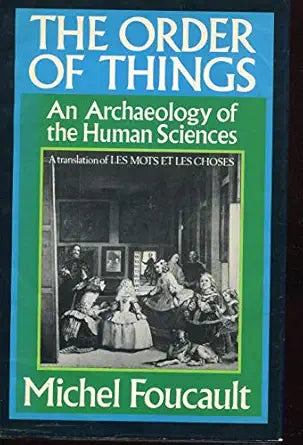
One of the book’s best-known sections looks at Las Meninas, a painting by Diego Velázquez.
At first, it may seem odd to begin a book about knowledge with a painting. But the picture raises useful questions. Who is looking? Who is being seen? What is inside the picture, and what stands outside it?
Foucault uses these questions to explore how a period presents the world to itself. The painting becomes a way to think about seeing, showing, and understanding.
That opening matters because the book keeps returning to the gap between things and the ways people describe them. We do not simply look at the world without any frame. Our ideas, words, and habits help decide what we notice.
For readers who enjoy art, this section gives the book an unusual starting point. For readers who do not usually study paintings, it offers a new reason to slow down and look closely.
Why Words Never Just Sit Quietly on a Page
Language seems simple when we use it every day. We see a thing, give it a name, and move on.
Foucault shows why the link between words and things is not always that easy.
People in different periods have understood language in different ways. They have asked different questions about how words relate to objects, how grammar works, and how meaning changes over time.
The book follows these shifts and connects them to wider changes in thought. When ideas about language change, ideas about knowledge can change with them.
This makes the book valuable for readers of English literature, language studies, translation, history, and communication. It helps explain why the words used to describe a person, event, or group can shape what others believe about it.
Even a simple label can open one way of seeing while closing another. Once you notice that, everyday language starts to feel less fixed and more interesting.
How Plants, Animals, and Nature Found New Places
The Order of Things also looks at how people studied living things.
There were periods when scholars focused strongly on placing plants and animals into clear groups. They compared visible features and tried to build ordered systems.
Later, new questions gained importance. Instead of only asking where a living thing belonged in a chart, thinkers also examined life, structure, and change.
Foucault uses this shift to show that a field does not grow only by collecting more facts. It can also change when people begin using a new set of questions.
For a student, this offers a useful reminder. A subject is not just a list of answers to memorize. It also has a history, a method, and a set of choices about what deserves attention.
If you have ever wondered why school subjects are divided in certain ways, this part of the book gives you plenty to think about.
What Money and Work Reveal About Human Thought
Money may seem far away from language and nature. Foucault places them together because each field shows how knowledge can change.
He follows older discussions about wealth, trade, value, and exchange. He then considers the rise of modern ways of thinking about labor and the economy.
This does not turn the book into a simple business guide. It asks a deeper question: why do some ideas about value make sense in one period but not in another?
A student of business or economics may find this useful because it shows that familiar terms have a past. The way people define work, price, and value is tied to larger ways of understanding society.
Reading these sections can make everyday questions feel richer. Who decides what counts as useful work? Why do certain forms of value receive more attention than others? What changes when a society begins asking new questions?
The Strange Idea That the Modern Human Subject Has a History
One of Foucault’s most challenging claims concerns the modern idea of the human being as an object of study.
He does not mean people suddenly appeared in recent history. Human beings obviously existed long before modern science.
His point is that the modern habit of studying the human being through linked fields of knowledge has its own history. The person who works, speaks, lives, and becomes a subject of study is understood through ideas that developed within particular periods.
That argument can feel surprising because we often assume our way of understanding human life is simply natural.
Foucault asks whether it is more recent, and less permanent, than we think.
This question gives the book much of its lasting force. It encourages readers to think about how people become categories, how institutions study them, and how knowledge shapes the picture a society has of itself.
What Foucault Means by Hidden Rules
You may come across the word episteme when reading about this book.
In simple terms, an episteme is the wider pattern of thought that shapes what people in a certain period can treat as sensible knowledge.
Think of it as a set of background rules. Most people do not write those rules down before they start speaking or studying. Yet the rules still help decide which questions seem normal and which answers seem possible.
Foucault compares different historical periods to show how these background patterns can shift.
The point is not that every person in an age thinks exactly alike. The point is that people often share deeper habits of thought without fully noticing them.
Once you understand this idea, the book becomes easier to follow. You can keep asking: what background rule is shaping this way of seeing the world?
A Good Choice for Readers Who Want More Than Quick Answers
This book suits readers who enjoy asking why familiar ideas became familiar in the first place.
It can help students working with philosophy, sociology, history, anthropology, literature, art, language, and cultural studies. Teachers and researchers may also value it when exploring how knowledge changes across time.
Readers outside academic life can enjoy it too, especially if they like books that connect different subjects. You do not need to agree with every claim to gain something from its questions.
Still, this is serious philosophy. Some passages are dense, and some ideas need a second reading. Taking it slowly, noting unfamiliar words, and reading one section at a time can make the experience more rewarding.
It is best suited to older teens, university students, and adults who are ready for a challenging nonfiction book.
Small Questions You May Start Asking After Reading
Why are some ideas called normal while others are treated as strange?
Why do school subjects have the borders they have?
Why do experts classify people, words, and living things in certain ways?
What makes a claim sound scientific in one period but doubtful in another?
Why do we trust some labels without asking where they came from?
These questions do not stay inside a classroom. They can follow you into news stories, family talks, university lessons, workplace discussions, and everyday choices.
That is part of the book’s appeal. It does not simply hand you a set of facts. It changes the kinds of questions you may bring to the facts already around you.
A Premium Copy Made for Careful Reading
A thoughtful book deserves a copy that feels good to read and strong enough to keep.
Bookish Wonderland offers this premium edition with eye-soothing cream paper, crystal-clear printing, and high-quality stitched and glue binding.
The cream pages provide a comfortable reading surface during longer study sessions. The clean print helps you follow detailed arguments without struggling to make out the words. The strong binding helps the pages stay secure through repeated reading, note-checking, and regular use.
Together, these features make the book suitable for your study desk, personal shelf, classroom preparation, or a gift for someone who enjoys serious ideas.
How This Book Fits Into Everyday Study
You can read a chapter before a university discussion and use its ideas to frame better questions.
You can keep it nearby while working on an essay about language, history, culture, or the human sciences.
You can also read it slowly at home, marking the sections that change how you think about ordinary things.
For a reading group, the book offers plenty to discuss because readers may respond differently to the same argument. One person may focus on language. Another may care more about art, science, or the idea of human identity.
That range helps the book stay useful beyond a single class or assignment.
Best Sellers Rank of This Book
- #2,253,549 in Books
- #71 in Modern Western Philosophy
- #4,608 in History (Books)
- #5,346 in Cultural Anthropology (Books)
Why This Book Is Worth Reading
Foucault asks a simple question: why do people accept certain ideas as facts without questioning them? His answer takes you through history, language, science, and the many ways people have tried to make sense of the world.
Some parts take time to understand, but that is what makes the book worth returning to. Each chapter gives you something new to think about.
If you are looking for The Order of Things by Michel Foucault Book price in Bangladesh, you can order your copy from Bookish Wonderland. Delivery is available across the country, with Cash on Delivery nationwide and urgent delivery options in Dhaka.
If you require any customization or have any questions, please inbox us via FB or Insta.
| Primary Specification | |
| Author | Michel Foucault |
| Narrator | James Gillies |
| Genre | Philosophy, intellectual history, social theory, epistemology and cultural studies |
| ISBN-13/ISSN | 978-0394719351 |
| ISBN-10 | 0394719352 |
| Publisher | Vintage |
| Publishing Date | August 12, 1973 |
| Edition | 1st |
| Language | English |
| Reading Age | 18+ |
| Format | Printed Book |
| Physical Specification & Quality | |
| Paper Quality | Premium eye-soothing cream paper |
| Binding Quality | High quality stitched and glue binding (for longevity) |
| Print Quality | Crystal-clear print |
| Pages | 387 pages |
| Country | France |
| Logistics Information | |
| Weight | 407 gm |
| Length | 8.5 inches |
| Width | 5.6 inches |
| Height | 0.83 inch |