

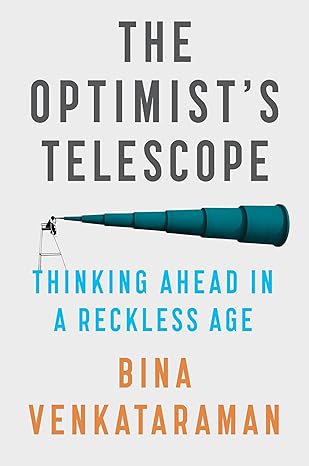
About The Optimist's Telescope by Bina Venkataraman: A Hopeful Guide to Better Choices and a Safer Future
What if many of tomorrow's problems begin with the small choices we make today?
We save money later. We put off a health check. We ignore a warning because life already feels busy. A business follows quick profit and forgets what it needs next year. A town waits until a storm arrives before making a plan.
The Optimist's Telescope by Bina Venkataraman asks a simple question: why do people find it so hard to think ahead, even when the future matters deeply?
The answer is not that people are careless by nature. Often, daily pressure, quick rewards, and the world around us push us to focus only on the present. This book shows that we can learn another way.
With true stories, useful research, and a hopeful voice, Bina Venkataraman explains how people, families, businesses, and whole communities can make wiser choices for the years ahead.
A book that helps you look beyond today
The full title is The Optimist's Telescope: Thinking Ahead in a Reckless Age. It is a nonfiction book about planning ahead, making good choices, and understanding how today's actions shape tomorrow.
The book moves between personal life and larger world problems. One moment, you may think about your own money, health, work, or family. The next, you may see how the same habits affect public health, business growth, and the natural world.
Its main message is easy to understand: the future is not something we should notice only after a problem becomes too large to fix.
Looking ahead does not mean knowing everything that will happen. It means paying attention, asking better questions, and taking useful action while there is still time.
Why planning ahead can feel so hard
Most people know that saving money is useful. Most people know that health matters. Most people also know that clean air, safe homes, and strong schools help future families.
Still, the next day can feel more real than the next year.
A quick reward is easy to see. A better future can feel far away. Busy schedules, sudden costs, and daily stress make long plans harder to follow.
The Optimist's Telescope does not shame readers for these struggles. It explains why they happen and shows how people can build better habits and systems.
Instead of saying that everyone must simply try harder, the book asks how we can make wise choices easier. That change in thinking gives the book its value.
True stories make big ideas easy to follow
Bina Venkataraman uses real examples from history and modern life. She looks at ancient Pompeii and modern Fukushima to show what can happen when danger is ignored or plans are too weak.
The book also discusses public health, climate risks, business choices, and the harm that can follow when people care only about quick results.
These stories give each idea a human side. They show that poor planning is not just a problem for leaders or large companies. It can touch ordinary homes, local jobs, family health, and the places where people live.
At the same time, the book is not built only around fear. Its examples also make room for hope, care, and better ways to act.
What makes this book different from simple advice books
Many books about success tell readers to set goals, stay focused, and work harder. Those ideas can help, but they do not explain why whole groups keep making choices that hurt their future.
This book looks deeper.
It brings together ideas from psychology, biology, economics, and history. It shows how habits, culture, rewards, and shared rules can guide the choices people make.
That wider view matters because a person does not make every decision alone. Family needs, work demands, public rules, and social pressure all play a part.
The Optimist's Telescope helps readers see those links clearly. It offers a thoughtful look at personal choices while also asking how society can protect what matters for the next generation.
Meet the writer behind the book
Bina Venkataraman is a journalist and writer who has worked on science, public policy, and climate change. She also served as an adviser on climate change innovation during the Obama administration.
Her background gives the book a useful mix of research and real experience. She has seen how leaders, businesses, and communities respond when long-term risks are hard to understand or easy to ignore.
Rather than writing only for experts, she uses reported stories and clear examples to help general readers follow the ideas.
The book was also named one of NPR's best books of 2019. That recognition reflects the interest it received from readers and reviewers looking for thoughtful nonfiction about the future.
How its ideas fit everyday life
You do not need to run a company or work in government to find value here.
A student can think about study habits and the value of learning step by step. A parent can reflect on family choices that support a child's future. A worker can consider whether daily habits build skills that remain useful over time.
A small business owner may ask whether quick sales are worth more than customer trust. A teacher may find new ways to discuss responsibility and shared goals. A community leader may think about early action before small local problems grow.
The book encourages one useful habit: pause and ask what a choice might mean later.
That question is simple, but its answer can change how you spend money, use time, treat your health, and plan for people who depend on you. Even small changes today can support better choices tomorrow.
Why hope matters when the future feels uncertain
The word optimist in the title does not mean pretending that every problem will disappear.
Here, hope means believing that thoughtful action can make a difference. It means seeing that people can learn, work together, and improve the rules that guide their choices.
The future may feel too large to control. Climate change, health risks, and money worries can leave people feeling tired or helpless. This book offers another view: while nobody can solve everything alone, useful action still matters.
That hopeful approach gives the book a warm human purpose. It asks what kind of world we want to leave behind and what small steps can help us move toward it.
A strong choice for curious nonfiction readers
This book is a good match for readers who enjoy psychology, science, economics, social issues, history, and thoughtful books about the future.
It may also appeal to students, teachers, parents, business owners, public service workers, and anyone who wants to make more careful choices.
If you like books that connect personal habits with real problems in society, this one offers plenty to think about.
It can suit a quiet reading weekend, a class discussion, a book club meeting, or a thoughtful gift for someone who enjoys learning. Readers interested in climate change and public health may also value its broader look at prevention and shared care.
You do not need special training to begin. The ideas ask for attention, but the real-life examples help make difficult topics easier to understand.
Why the message feels close to home
Big ideas about the future can seem distant until you connect them with familiar choices. Think about saving for school fees, keeping emergency money aside, caring for older family members, or helping a young person learn a useful skill.
Each choice asks you to give some thought to a day that has not arrived yet.
The same idea can guide a neighborhood preparing for heavy rain, a shop owner building honest customer relationships, or a family making careful health decisions. Planning ahead does not always require a large budget. Often, it begins with asking what could happen and what can be done early.
That is why this book feels useful beyond one country or one kind of reader. Its larger examples lead back to questions many people already face at home.
You may not agree with every idea, and the book cannot predict your future. What it can offer is a clearer way to think about time, risk, care, and the lasting effects of ordinary decisions.
A premium copy made for comfortable reading
Bookish Wonderland offers this title as a premium printed English book for readers who care about both content and physical quality.
The pages use premium, eye-soothing cream paper that feels comfortable during longer reading sessions. Crystal-clear printing keeps the words sharp and easy to follow. High-quality stitched and glue binding helps the book stay firm through repeated reading and regular shelf use.
Together, these details create a copy you can read, lend, revisit, and keep in your collection. It is a practical choice for readers who want a durable book instead of a copy that feels weak after a few uses.
What kind of book is The Optimist's Telescope?
This is a standalone nonfiction book. It is not a novel, and it does not follow a group of fictional characters through an invented story.
Its subjects include future planning, human behavior, science, economics, public health, climate change, and social responsibility.
Because it combines several fields, different readers may connect with different parts. One reader may focus on money and business. Another may care most about family decisions, environmental risks, or the habits that shape public life.
There is no earlier volume to read first, and no later series book is needed to understand its ideas. You can start with this book and receive the full discussion in one complete work.
Questions this book may leave you thinking about
Why do people wait until a problem becomes urgent before taking action?
Why do quick rewards often feel stronger than lasting benefits?
Can families and communities build habits that protect their future?
How can a business make wise plans without ignoring the needs of today?
What do old disasters teach us about risks that people can see but fail to address?
How can one person care about future generations without feeling overwhelmed?
These questions give the book its pull. You may begin reading to learn about planning and finish with a new way to think about the choices around you.
Why this book can stay with you after the final page
Some books give you a useful idea for one afternoon. Others change the questions you ask in everyday life.
The Optimist's Telescope belongs to the second group because its subject appears almost everywhere. Every family makes plans. Every business faces choices. Every community must decide what to protect and what to improve.
The book reminds readers that the future grows from decisions that may look small at first. A habit, a rule, a warning, or a shared promise can carry effects much further than expected.
That makes the reading experience both personal and wider than personal life. It encourages you to think about your own path while also noticing the people who will live with today's choices later.
Best seller rank of this book
- #443,432 in Books
- #98 in Engineering Patents & Inventions
- #768 in Economic History (Books)
- #952 in Technology (Books)
If you require any customization or have any questions, please inbox us via FB or Insta.
| Primary Specification | |
| Author | Bina Venkataraman |
| Narrator | Bina Venkataraman |
| Genre | Nonfiction, behavioral science, psychology, economics, technology and future studies |
| ISBN-13/ISSN | 978-0735219489 |
| ISBN-10 | 0735219486 |
| Publisher | Riverhead Books |
| Publishing Date | August 25, 2020 |
| Language | English |
| Reading Age | 16+ |
| Format | Printed Book |
| Physical Specification & Quality | |
| Paper Quality | Premium eye-soothing cream paper |
| Binding Quality | High quality stitched and glue binding (for longevity) |
| Print Quality | Crystal-clear print |
| Pages | 336 pages |
| Country | USA |
| Logistics Information | |
| Weight | 364 gm |
| Length | 8.5 inches |
| Width | 5.6 inches |
| Height | 0.87 inch |