

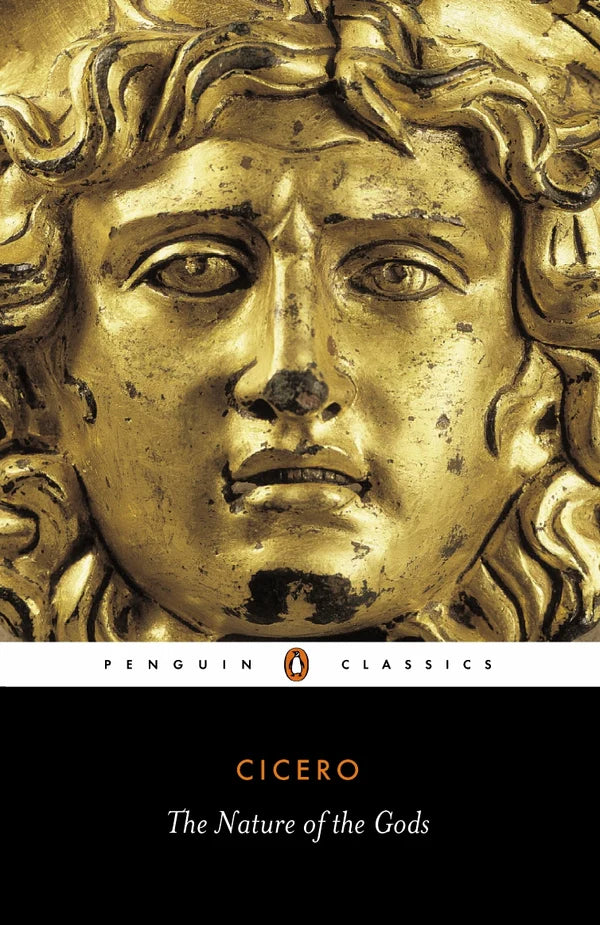
About The Nature of the Gods by Marcus Tullius Cicero
Do gods exist? If they do, what are they like? Did they make the world, and do they care about human life? These questions may sound modern, but people were debating them more than two thousand years ago. The Nature of the Gods by Marcus Tullius Cicero brings several ancient answers together in one sharp and thoughtful conversation.
This is not a book that orders you to accept one belief. Cicero lets different speakers explain their views and challenge one another. An Epicurean, a Stoic, and an Academic sceptic discuss divine life, the design of the universe, fate, worship, human reason, and the problem of suffering. The reader is invited to listen, compare, and think.
The result is one of the most important surviving works about ancient Greek and Roman ideas of religion. It helps readers understand how educated Romans examined belief through argument. It also shows that hard questions about faith and evidence have a very long history.
When Big Questions Have No Easy Answer
Many books about religion begin with a fixed truth. Many books about philosophy can feel cold or difficult. Cicero takes another path. He presents the subject as a live discussion between people who disagree but know how to explain their reasons.
That form solves a common problem for new philosophy readers. Instead of meeting a long list of ideas with no human voice, you hear each position spoken and tested. One person builds an argument. Another asks where it is weak. A third offers a different view. The ideas become easier to follow because they move through conversation.
You do not have to choose a side before you begin. You can read with belief, doubt, or simple interest. The purpose is not to tell you what to think. It is to help you notice how people support a claim, question an answer, and live with uncertainty.
A Conversation in Ancient Rome
Cicero places the dialogue at the home of Gaius Cotta, a Roman priest and follower of Academic scepticism. Gaius Velleius speaks for Epicurean thought. Quintus Lucilius Balbus presents the Stoic view. Cicero enters mainly as a listener and narrator.
The speakers are not random names. Each represents a major school of thought from the ancient world. Their different views allow Cicero to place strong arguments side by side. The conversation stays polite, yet the criticism can be direct and powerful.
This structure matters because Cicero does not simply mock one side. He gives each school room to speak. Readers see that serious people can begin with different beliefs, use reason, and still reach opposite answers. That lesson remains useful in classrooms, homes, and public debate today.
The Epicurean View of Happy Gods
In the first book, Velleius explains the Epicurean position. Epicureans do not simply say that no gods exist. Their gods are perfect, blessed, and free from trouble. Because perfect happiness cannot include work, anger, worry, or control, the gods do not create or manage the world.
This view removes fear from religion. Human beings should not imagine that every storm, illness, or failure is a punishment from heaven. The gods do not watch daily acts or change events for personal reasons. Nature works through natural causes rather than constant divine action.
Velleius also attacks other ideas about the gods. He questions stories that give divine beings human weakness, strong emotion, or endless work. His argument asks a simple but difficult question: if a god is perfect, why would that god need to make, rule, punish, or repair anything?
Cotta then challenges the Epicurean case. He asks whether beings who do nothing can truly be called divine and whether the Epicurean description has enough proof. By placing the claim and criticism together, Cicero makes the reader examine both the freedom and the weakness of this view.
The Stoic World of Order and Purpose
The second book gives Balbus a long turn to explain Stoic theology. His view is very different. The order of nature, the movement of the heavens, the gifts of the earth, and the powers of living things point toward divine reason. The universe is not a lucky accident. It is an ordered whole shaped and guided by intelligence.
Balbus connects the divine with nature itself. The world is alive with reason and held together by purpose. Human beings can notice this order because they also share in reason. For the Stoics, studying the world can lead the mind toward belief in providence.
He speaks about the stars, seasons, animals, plants, and the useful parts of the human body. These examples support an early form of an argument from design. If a house shows the work of a builder, Balbus asks, should the far greater order of the universe not show a guiding mind?
This part may appeal to readers interested in natural theology, intelligent design, or the link between science and belief. Even when modern readers reject some ancient facts, they can still study the form of the argument: order exists, order needs an explanation, and reason may point beyond chance.
The Sceptic Tests Every Claim
In the third book, Cotta turns his questions toward the Stoic position. He does not have to prove that no gods exist. As an Academic sceptic, his work is to test whether Balbus has truly proved his case.
Cotta challenges claims drawn from popular stories, signs, nature, and providence. If the gods guide the world for human good, why do foolish or cruel people sometimes succeed? Why do good people suffer? Why is human reason used for harm as well as wisdom? These questions move the discussion toward the lasting problem of evil.
Parts of the third book have been lost, so the surviving text is not fully complete. Even so, its challenge is clear. A beautiful world may inspire belief, but beauty alone does not answer every case of pain, injustice, or disaster.
Cicero does not end with a loud final victory. His closing words suggest that the Stoic case seemed more likely to him, while Velleius preferred Cotta’s criticism. This quiet ending protects the open nature of the dialogue. The reader must continue thinking after the speakers leave.
Questions That Still Matter Today
The ancient language and examples belong to Rome, but the central questions remain alive. People still ask whether the universe has a maker, whether nature shows purpose, whether divine beings act in history, and whether suffering can fit with good divine rule.
- Do gods exist? The speakers ask what evidence can support belief.
- What is divine perfection? They debate whether a perfect god acts or remains completely at peace.
- Was the world designed? Natural order becomes evidence for one side and a target for another.
- Does providence guide life? The dialogue asks whether divine care reaches the world and individual people.
- Why does suffering exist? Pain and injustice test claims about wise and good divine power.
- Can reason settle religion? Each speaker uses logic, yet agreement remains difficult.
- What should people worship? Ideas about gods affect prayer, duty, fear, and public religion.
- How should we handle doubt? Cotta shows that careful questioning is not the same as careless denial.
These questions make the book valuable for philosophy, theology, religious studies, classics, intellectual history, and anyone interested in respectful disagreement.
Philosophy as a Skill, Not Only a Subject
Reading this dialogue does more than teach old beliefs. It trains the mind to follow an argument. You learn to ask what a speaker is claiming, what evidence is offered, what hidden idea supports the claim, and how an opponent answers.
This skill can help far beyond religion. It is useful when reading news, hearing a public speech, discussing ethics, or making a personal decision. A confident voice is not always correct. A weak answer does not automatically make the opposite side true. Cicero teaches readers to slow down and test each step.
The dialogue also models a form of disagreement that many people need today. The speakers do not agree, but they remain part of one conversation. They allow each view to be heard before answering it. Readers can learn that strong debate does not require insult.
Who Will Enjoy The Nature of the Gods?
This book is a strong choice for readers of ancient philosophy, Roman history, theology, religious thought, scepticism, and classical literature. It can also suit students beginning a course on philosophy of religion or the ancient world.
Readers who enjoy Plato’s dialogues, Stoic books, Epicurean ideas, or debates about belief may find much to explore. It is especially useful for someone who wants to understand competing ancient views instead of reading only one school.
The work requires attention. It is not a fast novel with action and suspense. Some old scientific examples are no longer accepted, and translation style can vary between editions. Yet the clear dialogue form gives patient readers a strong guide through the main ideas.
It is also a thoughtful bridge between ancient history and modern debate. A reader does not need to agree with Cicero or any speaker to gain value. The reward comes from seeing how each position is built, challenged, defended, and left open for further thought long after the final page.
A Better Way to Read This Classic
Read one viewpoint at a time. After Velleius speaks, write his main claim in one sentence. Do the same for Balbus and Cotta. Then note the strongest reason and the strongest weakness you found in each position.
You can also keep four questions beside you: What are the gods? Do they act? Is the world designed? How does suffering fit? These questions create a simple map through the longer arguments.
For group reading, let different people defend each school, even if they do not personally agree with it. This helps everyone understand an argument before judging it. The book works well for personal study, university discussion, debate practice, journaling, or a thoughtful gift for a curious reader.
A Premium Copy Made for Careful Thought
Bookish Wonderland offers an English copy prepared for comfortable and lasting reading. Premium eye-soothing cream paper gives the text a soft background, while crystal-clear printing helps readers follow each speaker and argument without strain.
High-quality stitched and glue binding keeps the pages secure through notes, repeated study, and group discussion. The durable build makes this classical work a useful addition to a shelf of philosophy, history, religion, or world literature.
Order Easily from Anywhere in Bangladesh
Bookish Wonderland delivers inside Dhaka and across the country. Cash on Delivery is available nationwide, allowing you to pay when your order arrives. Customers in Dhaka may request fast or urgent delivery when service is available for their location.
If you are comparing the Book price in Bangladesh, The Nature of the Gods by Marcus Tullius Cicero offers lasting value as both a classic text and a guide to careful reasoning. Order it for study, personal growth, classroom use, or a reader who loves questions with no easy answers.
Best Sellers Rank of This Book
- #844,533 in Books
- #1,412 in Ancient Greek & Roman Philosophy
- #1,904 in Religion & Philosophy (Books)
- #2,038 in Religious Philosophy (Books)
Join a Debate That Has Lasted for Centuries
The Nature of the Gods does not ask you to leave your beliefs at the door. It asks you to examine them with care. Cicero gives each side a voice, lets reason meet doubt, and leaves space for your own judgment.
Bring home The Nature of the Gods by Marcus Tullius Cicero from Bookish Wonderland today. Read it to understand ancient thought, strengthen your reasoning, and discover why questions about the divine still hold the human mind.
If you require any customization or have any questions, please inbox us via FB or Insta.
| Primary Specification | |
| Author | Marcus Tullius Cicero |
| Translator | H. C. P. McGregor |
| Narrator | George Easton |
| Genre | Ancient Roman philosophy, philosophy of religion, theology, classical literature, religious philosophy, scepticism |
| ISBN-13/ISSN | 978-0140442656 |
| ISBN-10 | 0140442650 |
| Publisher | Penguin Classics |
| Publishing Date | October 30, 1972 |
| Edition | Later Printing |
| Language | English |
| Reading Age | 18+ |
| Format | Printed book |
| Physical Specification & Quality | |
| Paper Quality | Premium eye-soothing cream paper |
| Binding Quality | High quality stitched and glue binding (for longevity) |
| Print Quality | Crystal-clear print |
| Pages | 288 pages |
| Country | Italy |
| Logistics Information | |
| Weight | 294g |
| Length | 8.5 inch |
| Width | 5.6 inch |
| Height | 0.67 inch |