

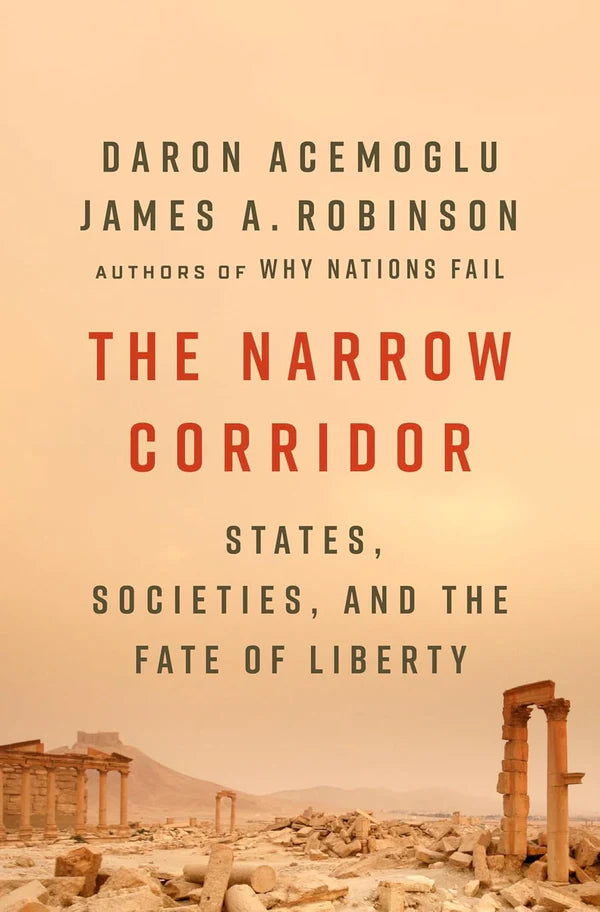
About The Narrow Corridor by Daron Acemoglu and James A. Robinson
Why are some people free while others live under fear, weak laws, or powerful rulers? The Narrow Corridor by Daron Acemoglu and James A. Robinson gives a clear and bold answer. Liberty does not appear simply because a country becomes rich, holds an election, or writes good laws. Freedom grows when the power of the state and the power of society remain in balance.
The authors describe this balance as a narrow corridor. Outside it, one side becomes too strong. A powerful state can control people and take away their rights. A very weak state may fail to protect people, enforce laws, or provide basic services. Inside the corridor, the state has enough strength to serve the public, while citizens have enough strength to watch, question, and limit it.
Using stories from different countries and periods of history, the book explains why freedom is never automatic. It must be built, protected, and renewed. This important work is ideal for readers of politics, economics, history, law, public policy, and social science who want to understand how free societies rise, struggle, and sometimes fall.
Why Freedom Is Hard to Build
People often hear that democracy, elections, or economic growth will naturally create freedom. Yet the world gives many examples where these things exist and ordinary people still have little power. Some governments are strong but unfair. Others are too weak to stop violence, corruption, or private groups from controlling daily life.
The Narrow Corridor helps solve this puzzle by looking beyond simple labels. Instead of asking only whether a country is democratic, the authors ask who can use power, who can challenge it, and whether public institutions work for citizens. This makes the book useful for understanding both old empires and modern nations.
The central idea is easy to remember. Liberty needs a capable state, but that state must be controlled by an active society. People need laws, courts, security, roads, schools, and public services. They also need the freedom to organize, speak, protest, vote, and demand better action. If either side loses its strength, liberty can leave the corridor.
This framework gives readers a practical way to compare countries without pretending every nation follows the same path.
The State Must Be Strong but Limited
A state is more than a government leader. It includes the institutions that make laws, collect taxes, keep order, provide services, and settle disputes. When these institutions are weak, powerful families, armed groups, local bosses, or criminal networks may fill the space. Ordinary people can then face danger without reliable protection.
However, greater state power does not always bring greater freedom. A government with no real limits can watch, silence, punish, or exploit its citizens. It may provide order while removing choice. The book calls attention to this difficult truth: people need the state, but they also need protection from it.
Acemoglu and Robinson show why freedom cannot rest on the goodwill of one wise ruler. Leaders change, and unchecked power creates strong reasons for abuse. Lasting liberty needs institutions and citizens that can hold authority accountable. Courts, laws, public groups, free discussion, and shared action all matter because they make power answerable.
The result is not a call for the smallest government or the biggest government. It is a call for a capable government that remains open to public challenge.
Society Has Work to Do
The book does not treat citizens as quiet receivers of freedom. Society must be active. People, communities, unions, associations, journalists, campaigners, and other groups help limit state power and push institutions to serve a wider public.
This does not mean that every protest produces freedom or that society always acts fairly. Social rules can also create control. Customs, status systems, and powerful groups may restrict women, minorities, workers, or people born into a lower position. A society can be strong while many individuals remain unfree.
The real challenge is to build broad participation. Citizens must be able to question both government power and unfair power inside society. This makes liberty a continuing process rather than a prize won once. Each new public service or state power can create a need for new forms of public oversight.
Readers may find this idea demanding, but it is also hopeful. It means history is not controlled only by presidents, kings, or wealthy people. Organized citizens can change institutions, widen rights, and bring the state back toward balance.
What Is the Narrow Corridor?
The narrow corridor is the space where a strong state and a strong society develop together. It is narrow because reaching and staying inside it is difficult. Countries enter through different struggles, and no nation is guaranteed a permanent place.
The authors use the image of a “Red Queen” to explain the movement required. In the story behind this image, a person must keep running just to stay in the same place. In politics, the state grows more capable while society grows more able to watch and challenge it. Both sides keep moving. This competition can protect freedom when neither side fully defeats the other.
That idea explains why liberty requires daily care. New technology, security threats, economic change, and social conflict can shift the balance. A system that worked in the past may fail if citizens stop taking part or if state institutions become weak.
The corridor is therefore not one fixed set of Western rules. It is a relationship between public authority and social power. Different societies may build that relationship in different ways.
Three Paths a Country Can Take
The authors use memorable forms of the ancient creature called Leviathan to describe different political conditions.
- A Despotic Leviathan appears when the state becomes powerful but society cannot control it. The government may create order, yet citizens have little protection from authority.
- An Absent Leviathan appears when the state lacks the power to enforce laws or provide basic safety. Local powers and social customs can dominate people instead.
- A Shackled Leviathan appears when the state is capable but held within limits by an active society. This balance opens space for liberty.
These ideas help readers understand why simply weakening a government may not make people free. It can create a dangerous space where other powerful actors take control. They also explain why building a strong government without strong public oversight can lead to oppression.
The model is valuable because it connects political power with daily life. Freedom is not only a legal word. It affects whether people can work, move, speak, create, own property, receive fair treatment, and live without fear.
Clear Ideas for a Complex World
This is a serious book, but its main argument is easy to follow. The repeated ideas of the corridor, Leviathan, and the Red Queen give readers simple tools for remembering a complex theory. You can use these tools while reading the news, studying history, or thinking about your own country.
The book is detailed and contains many examples, so it is best read in parts rather than rushed. You do not need an economics degree. Basic interest in government and society is enough. Some chapters may introduce unfamiliar places or events, but the authors return to the same central question: how can people gain a state strong enough to help them without allowing it to dominate them?
This balance makes the book useful across several fields. Economics students can study how institutions affect development. Law students can think about rights and enforcement. Political science readers can examine state capacity and public action. Business readers can better understand why stable institutions matter for markets and investment.
What You Can Learn from This Book
The Narrow Corridor offers more than facts about governments. It gives you a way to think.
- Understand why elections alone may not protect liberty.
- See the difference between a capable state and an unchecked state.
- Learn why weak government can leave people under private or social control.
- Explore how citizens and institutions can limit each other in useful ways.
- Compare political systems using one clear framework.
- Recognize why freedom can move backward as well as forward.
- Connect history, economics, law, and public policy.
These lessons can improve classroom work, public discussion, research, and everyday understanding of world events. The book does not tell readers what political opinion to hold. It provides a model that can be questioned, tested, and compared with real cases.
A Strong Choice for Curious Readers
This book is especially suitable for university students, teachers, researchers, civil-service candidates, policy professionals, journalists, lawyers, economists, and readers interested in how nations work. It can also support book clubs that enjoy serious nonfiction and open debate.
Read it if you liked Why Nations Fail and want to explore the authors’ ideas about institutions and power more deeply. The Narrow Corridor stands on its own, so reading their earlier work is not required. It is not part of an official series and does not end with a fictional cliffhanger.
The book is also useful when you feel that political arguments are too simple. Claims such as “more government is always better” or “less government always creates freedom” cannot explain every case. This work gives you a more careful middle view, showing that both state strength and public control are necessary.
Because the content is detailed, mature readers will gain the most from it. Reading with a notebook can help you track key examples and terms.
Premium Quality for Long Reading Sessions
Bookish Wonderland offers a premium copy made for readers who want comfort and durability. The pages use premium eye-soothing cream paper, giving the text a soft background that feels pleasant during long study sessions. Crystal-clear printing keeps letters, headings, and detailed passages sharp and easy to read.
High-quality stitched and glue binding holds the pages securely and supports repeated use. This matters for a substantial nonfiction book that you may underline, revisit, or keep for future study. The durable physical build makes it suitable for a home library, academic shelf, office collection, or thoughtful gift.
Easy Ordering Across Bangladesh
Readers searching for The Narrow Corridor by Daron Acemoglu and James A. Robinson Book price in Bangladesh can order conveniently from Bookish Wonderland. The store provides delivery inside Dhaka and outside Dhaka, reaching readers nationwide.
Cash on Delivery is available across Bangladesh, allowing you to pay when the book reaches your address. Customers in Dhaka can also request a fast or urgent delivery option when the book is needed quickly. This is helpful for an upcoming class, exam, presentation, discussion, or gift.
With a large collection of premium and durable English books, Bookish Wonderland makes serious international nonfiction easier to access. Choose your delivery option, confirm the order, and prepare to explore one of the most important questions in political life: how can a society build power without losing freedom?
Best Sellers Rank of This Book
- #38,325 in Books
- #4 in Public Finance (Books)
- #12 in Non-US Legal Systems (Books)
- #13 in Caribbean & Latin American Politics
Bring a Better Understanding of Liberty Home
The Narrow Corridor changes the way you look at freedom. It shows that liberty is neither a gift from a leader nor a natural result of progress. It grows when citizens and the state keep each other moving, capable, and accountable. That balance is difficult, but it can be created and defended.
Choose this book for a lasting, useful guide to liberty, institutions, public power, and the role of active citizens.
Order The Narrow Corridor by Daron Acemoglu and James A. Robinson from Bookish Wonderland today. Read it slowly, test its ideas against the world around you, and discover why the path to liberty is narrow—but never closed.
If you require any customization or have any questions, please inbox us via FB or Insta.
| Primary Specification | |
| Author | Daron Acemoglu and James A. Robinson |
| Narrator | Stephen Graybill |
| Genre | Political Science, Political Economy, Comparative Politics, Economic History, Public Policy, History |
| ISBN-13/ISSN | 978-0735224407 |
| ISBN-10 | 0735224404 |
| Publisher | Penguin Publishing Group |
| Publishing Date | September 22, 2020 |
| Language | English |
| Reading Age | 16+ |
| Format | Printed book |
| Physical Specification & Quality | |
| Paper Quality | Premium eye-soothing cream paper |
| Binding Quality | High quality stitched and glue binding (for longevity) |
| Print Quality | Crystal-clear print |
| Pages | 576 pages |
| Country | United States |
| Logistics Information | |
| Weight | 582g |
| Length | 8.5 inch |
| Width | 5.6 inch |
| Height | 1.3 inch |