

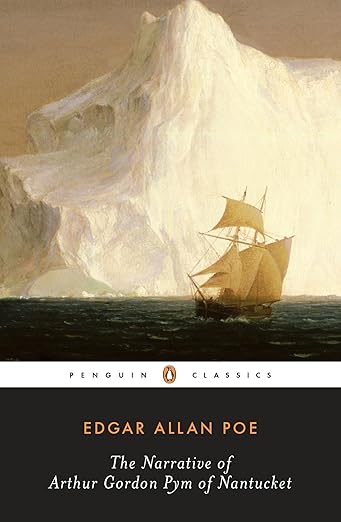
About The Narrative of Arthur Gordon Pym of Nantucket by Edgar Allan Poe
Begin a sea journey filled with terror, survival, and mystery.
Arthur Gordon Pym hides aboard the ship Grampus with help from his friend Augustus. His plan sounds exciting, but the dark hold becomes a trap. Above him, violence breaks out among the crew. When Pym finally reaches the deck, he must fight to survive a ship ruled by fear. The danger grows through storms, starvation, and terrible choices before another vessel carries him toward unknown waters.
Poe mixes sea adventure with horror, suspense, survival, and strange exploration. Written like a true travel record, the novel makes its wild events feel close and real. Readers who enjoy classic fiction, mysterious voyages, psychological fear, and unsettling endings will find a story that is bold, unusual, and difficult to forget.
A Dream of Adventure Turns into a Nightmare
Pym is young, curious, and drawn to the sea. He wants the freedom and excitement of a voyage, even when the people around him know how dangerous the ocean can be. His early choices bring quick lessons. The sea is not a clean picture of blue water and bright skies. It is a place where one mistake can lead to thirst, darkness, injury, or death.
His secret place aboard the Grampus becomes one of the most frightening parts of the story. Hidden below deck with limited food, water, and light, Pym waits for Augustus to return. Time passes. The air grows worse, his supplies fail, and he cannot understand what is happening above. The reader shares his confusion because Poe gives only the information Pym can sense.
This tight view creates strong suspense. A sound may mean rescue or danger. A message may offer hope but remain hard to understand. The dark space turns a simple hiding plan into a test of the mind. Anyone who enjoys closed-room fear, survival stories, or slow-building tension will feel the pressure of these pages.
Mutiny Changes Everything
When violence takes control of the ship, the voyage becomes a fight between small groups of desperate people. Trust is rare. Plans must be made quickly, and even a clever choice can fail. Poe uses the mutiny to show how order can disappear when fear and greed become stronger than duty.
Pym is not presented as a perfect hero. He is brave at times, frightened at others, and often pushed forward by events he cannot control. His survival depends on friends, quick thinking, luck, and the ability to act when every option is dangerous. This human weakness makes the adventure more intense.
The ship itself begins to feel like a dark world cut off from normal life. There is no easy help beyond the horizon. Every person aboard matters, and every loss makes survival harder. Poe turns the open sea into a prison without walls, creating fear through isolation rather than a familiar haunted house.
Survival at Its Most Extreme
The novel does not soften the physical cost of disaster. Pym and the remaining sailors face storms, damaged vessels, thirst, starvation, exhaustion, and the horror of waiting without knowing whether rescue will come. Their bodies weaken as hope becomes harder to hold.
These scenes are among the book’s darkest. They include death and cannibalism, so this classic is better suited to mature readers who can handle disturbing material. Poe uses these events to ask what people may do when normal rules collapse and survival becomes the only goal.
The tension comes from more than violence. A distant sail, a strange smell, a piece of food, or a sign of land can change the meaning of an entire day. Small details carry great weight because the characters have almost nothing. The story makes readers feel how quickly comfort can disappear and how powerful a little hope can become.
A Voyage Beyond Familiar Maps
After the worst dangers at sea, the story does not settle into safety. Pym joins another voyage and travels farther south. The new journey brings rare animals, unusual seas, distant islands, and people whose world appears unfamiliar to the visitors.
Poe wrote during a time when large parts of the Antarctic region remained unknown to many readers. He uses that blank space to mix imagined geography with travel writing. The result feels like an old explorer’s report that slowly moves beyond what can be explained.
The farther Pym travels, the less certain the world becomes. Natural details sit beside impossible signs. The landscape, water, colours, and weather create questions that the novel does not fully answer. This movement from practical sailing danger to dreamlike mystery gives the book its special shape.
Readers who love lost lands, polar exploration, strange islands, and stories that move toward the edge of reality will enjoy this change. The final sections do not behave like a simple adventure. They invite wonder, fear, and many different ideas.
Why the Story Feels Like a True Record
Poe presents Pym’s tale as if the traveler himself wrote it. The first-person voice includes sailing details, positions, supplies, routes, and observations. These facts give the story the sound of a journal or report, even when the events become shocking or impossible.
This method makes readers question where truth ends and invention begins. Pym speaks with confidence, but he cannot always understand what he sees. His account may be exact in one moment and confused in the next. That uncertainty adds another layer of suspense.
Modern readers may notice that the pace changes. Some passages move quickly through danger, while others pause for long descriptions. These slower details are part of the book’s false-document style. They make the voyage feel recorded rather than simply told.
If you enjoy found documents, ship logs, first-person mysteries, or narrators facing events beyond their understanding, Poe’s approach offers a rich early example. It also rewards readers who like to look for clues hidden inside descriptions.
Horror Without an Ordinary Monster
The fear in this book does not depend on one villain. It comes from darkness, hunger, the sea, human violence, strange places, and the feeling that nature may contain secrets people cannot understand. Each stage creates a different kind of danger.
At first, Pym fears being discovered in hiding. Later, he fears violent sailors, death at sea, and the loss of food and water. Farther south, fear changes again. It becomes a response to unusual sights, unfamiliar people, and a world that seems to follow unknown rules.
This variety keeps the story unpredictable. Readers cannot depend on one clear enemy or expect each problem to end in the same way. The sea may rescue a person from one danger and carry him directly toward another.
Poe is famous for dark rooms, guilty minds, and supernatural terror, but this novel shows how well he can use a huge open setting. The empty ocean feels as close and frightening as any locked chamber.
An Ending That Refuses Easy Answers
The final journey is one reason readers continue to discuss the novel. As Pym moves deeper into the unknown south, the world becomes quieter, stranger, and more dreamlike. Signs appear without full explanation, and the story reaches a sudden, powerful stopping point.
Readers hoping for every mystery to be solved may find the ending frustrating. Readers who enjoy open endings may find it unforgettable. Poe leaves space for many readings involving fear, discovery, race, nature, knowledge, and the limits of human understanding.
The ending also changes how earlier events feel. What seemed like a rough sea adventure becomes part of a larger movement toward something that cannot be easily named. This is a book that can lead to debate long after it is closed.
For a book club or class, the final pages offer strong questions. Is Pym moving toward truth, danger, death, or another world? Which details should be trusted? Why does the story stop where it does? Different readers may reach very different answers.
Who Will Enjoy This Book?
This novel is a strong choice for readers who enjoy:
- Classic American literature with a dark mood.
- Sea stories filled with storms, mutiny, and survival.
- Horror that grows through fear and isolation.
- Exploration stories set near unknown lands.
- First-person accounts that blur fact and fiction.
- Open endings that invite discussion and interpretation.
- Edgar Allan Poe’s strange and imaginative writing.
It can work well for mature teenagers, university students, teachers, classic-book collectors, and adult readers. Because it contains violence, death, racism, and cannibalism, it may not suit young or sensitive readers. Historical views and language in the novel reflect the nineteenth century and can feel offensive today.
More Than a Simple Sea Adventure
Some classic books feel distant because readers struggle to see why the story matters. This novel solves that problem with immediate danger. A hidden passenger, a violent mutiny, a broken ship, and a journey toward an unknown region give the reader clear reasons to continue.
At the same time, the book offers more than action. It asks why people seek danger, how fear changes judgment, and what happens when familiar rules disappear. It explores the thin line between curiosity and self-destruction. Pym repeatedly survives, yet each escape carries him farther from safety.
The story can be read simply for its frightening events or studied for its symbols and historical ideas. That double value makes it useful for both private reading and academic discussion. It is the kind of classic that can feel different when read again later.
A Premium Copy Made to Last
Bookish Wonderland offers a premium copy for readers who want a comfortable and durable physical book. Premium eye-soothing cream paper gives the pages a soft background, helping reduce harsh glare during longer reading sessions. Crystal-clear printing keeps Poe’s detailed descriptions sharp and easy to follow.
High-quality stitched and glue binding keeps the pages secure through repeated reading. This strong construction makes the book suitable for a personal library, literature class, reading group, or classic collection. Its quality also makes it a thoughtful gift for a Poe fan or adventure reader.
Order Easily Across Bangladesh
Readers checking The Narrative of Arthur Gordon Pym of Nantucket by Edgar Allan Poe Book price in Bangladesh can order conveniently from Bookish Wonderland. Delivery is available inside Dhaka and outside Dhaka, reaching book lovers nationwide.
Cash on Delivery is available across Bangladesh, allowing you to pay when the order arrives. Customers in Dhaka may also request fast or urgent delivery when the book is needed for a class, examination, gift, or reading event.
Bookish Wonderland brings together a large collection of premium and durable English books with easy ordering. Choose this classic for yourself or surprise someone who loves dark fiction, ocean adventures, and mysteries that stay open in the mind.
Best Sellers Rank of This Book
- #175,149 in Books
- #287 in Sea Stories
- #628 in Teen & Young Adult Classic Literature
- #789 in Classic American Literature
Begin the Voyage Today
Few journeys move from youthful excitement to pure terror as boldly as this one. Edgar Allan Poe takes a simple wish for adventure and carries it through darkness, violence, hunger, strange lands, and a final mystery that has fascinated readers for generations.
Choose The Narrative of Arthur Gordon Pym of Nantucket if you want a classic that feels dangerous, unusual, and alive. Read it for the sea adventure, stay for the growing horror, and finish with questions you will want to discuss. It offers both a gripping story and a doorway into Poe’s larger world of fear and imagination.
Add this premium edition to your shelf today. Open the first page, enter the hidden hold of the Grampus, and follow Arthur Gordon Pym toward a place where maps, reason, and safety begin to disappear.
If you require any customization or have any questions, please inbox us via FB or Insta.
| Primary Specification | |
| Author | Edgar Allan Poe |
| Narrator | John L. Chatty |
| Editor | Richard Kopley |
| Genre | Sea Adventure, Gothic Horror, Survival Fiction, Mystery, Classic American Literature, Early Science Fiction |
| ISBN-13/ISSN | 978-0140437485 |
| ISBN-10 | 0140437487 |
| Publisher | Penguin Classics |
| Publishing Date | June 1, 1999 |
| Language | English |
| Reading Age | 16+ |
| Format | Printed book |
| Physical Specification & Quality | |
| Paper Quality | Premium eye-soothing cream paper |
| Binding Quality | High quality stitched and glue binding (for longevity) |
| Print Quality | Crystal-clear print |
| Pages | 288 pages |
| Country | United States |
| Logistics Information | |
| Weight | 294g |
| Length | 8.5 inch |
| Width | 5.6 inch |
| Height | 5.12 inch |