

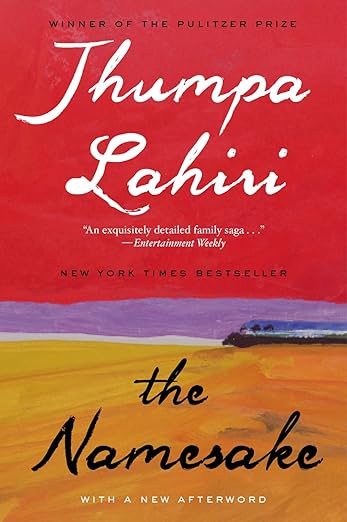
About The Namesake by Jhumpa Lahiri
The Namesake by Jhumpa Lahiri is a warm, thoughtful novel about family, identity, love and the meaning of home. It follows the Ganguli family as they build a new life in the United States after leaving Calcutta. Ashoke and Ashima Ganguli settle in Massachusetts after an arranged marriage. Their son is given the unusual name Gogol, a name connected to a hidden event in his father’s past. As Gogol grows, he struggles with his name, his Bengali roots and his wish to live like other young Americans.
First published in 2003, the novel follows two generations of a Bengali American family. It explores the pull between old traditions and a new culture while showing how parents and children can understand home in very different ways.
This is not a loud or action-filled book. Its power comes from small moments: a family meal, a trip home, a name spoken with love, a quiet loss, or a truth understood too late. Jhumpa Lahiri writes about ordinary life with deep care. By the end, Gogol’s name is no longer just a burden. It becomes a doorway to his father, his family and the part of himself he once tried to leave behind.
Why Does Gogol Dislike His Name?
A name may look like a small thing, but it can hold a whole life inside it. Gogol Ganguli grows up with a Russian first name, Bengali parents and an American childhood. He feels that the name makes him different. It is hard to explain, easy for others to question and tied to a writer he does not yet understand.
As Gogol gets older, he wants to control how people see him. He begins using the name Nikhil, hoping it will help him become a more confident and independent person. Yet changing a name does not remove the feelings under it. He still carries his family history, his parents’ hopes and his own uncertainty.
Many readers know this feeling even if they have never changed their names. We may try to hide our background, habits or family story because we want to fit in. The Namesake shows that becoming yourself is not as simple as rejecting where you came from. Gogol must first learn why his name was chosen before he can understand what it truly means.
A Family Living Between Two Worlds
Ashoke and Ashima arrive in America with memories, customs and hopes from Bengal. Ashoke is ready to build a new life, while Ashima misses her family and the familiar world she left behind. She must face a new country, pregnancy and motherhood without the support system she once knew.
Their children, Gogol and Sonia, have a different experience. They are born and raised in America. English, American schools and Western habits are part of their daily lives. India is important to them, but it can sometimes feel like a place connected to family visits rather than their main home.
This difference creates a quiet distance between the parents and children. Ashoke and Ashima want to protect their culture. Gogol wants the freedom to decide who he will become. Neither side is shown as completely right or wrong. Lahiri lets readers understand both.
That balance gives the story its heart. Parents may give up comfort, language and closeness to create better lives for their children. Children may love their parents deeply while still feeling limited by family expectations. The Namesake makes both truths easy to see.
The Secret Behind Gogol’s Name
Gogol believes his name is simply an odd choice made by his parents. He does not know that it carries one of the most important memories of Ashoke’s life.
Before moving to America, Ashoke survived a terrible train accident in India. At the time, he had been reading the work of Russian writer Nikolai Gogol. Ashoke believed the book helped rescuers notice that he was still alive. Years later, when the expected letter containing his baby’s official name fails to arrive, Ashoke chooses Gogol as a temporary name. The temporary choice becomes permanent.
This hidden story changes the meaning of the name. To Gogol, it once represented embarrassment. To Ashoke, it represents survival, gratitude and the chance to begin again.
The book gently asks an important question: How well do we know our parents? We often see them only as mothers or fathers. We may not know who they were before us, what they lost, what frightened them or which moments changed their lives. Gogol’s journey becomes more emotional when he begins to understand the man behind his father’s quiet nature.
More Than an Immigrant Story
The Namesake is often called an immigrant novel, and that is true. It explores migration, cultural change, homesickness and the pressure to fit into a new society. However, its meaning reaches much further.
This is also a coming-of-age story. Readers watch Gogol grow from a child into an adult. He studies, chooses a career, falls in love, makes mistakes and faces loss. Each stage teaches him something new about himself.
It is also a family story. Ashima slowly builds a community and learns how to live between India and America. Ashoke remains quietly connected to the past while moving forward. Sonia finds her own path, and Gogol learns that freedom does not mean living without roots.
Above all, it is a story about belonging. A person can belong to more than one place. Home may be a country, a house, a language, a meal, a person or even a memory. Lahiri does not give a simple answer. Instead, she shows how the meaning of home changes as people grow.
Love, Relationships and Self-Discovery
Gogol’s romantic relationships are an important part of his search for identity. Through love, he tries different versions of himself.
With Maxine, he enters a wealthy American family that seems relaxed and free. Their home offers a life very different from the Ganguli household. Gogol enjoys the ease of this new world, but the relationship also creates distance between him and his own family.
Later, his relationship with Moushumi connects him with someone who understands Bengali family expectations. At first, this shared background appears to offer comfort. Yet having the same cultural roots does not guarantee that two people want the same life.
These relationships are not included only to add romance. They show how Gogol keeps searching for a place where he can feel whole. He learns that another person cannot solve every question about identity. Love can offer comfort, but self-understanding must also come from within.
Readers who enjoy quiet, realistic relationships will find much to think about here. The emotions feel human because the characters are imperfect. They love, disappoint, forgive, hide and change.
A Clear and Gentle Writing Style
Jhumpa Lahiri’s writing is calm, clean and full of feeling. She does not need difficult language or dramatic speeches to make an event powerful. Her strength lies in careful detail.
A meal can show the distance between two cultures. A family visit can reveal love and discomfort at the same time. An empty room can hold grief. A name can carry a history that no one else knows.
The story covers around three decades and moves between countries, homes and generations. Even with this wide time span, it remains focused on personal moments and emotional detail.
This style makes The Namesake suitable for both personal reading and study. A general reader can enjoy the story without needing special knowledge. Students can examine themes such as immigration, identity, naming, family duty, cultural conflict and generational change.
The language is easy to follow, but the ideas stay in the mind. This is the kind of novel that may feel even more meaningful after you finish it.
What You Receive from Bookish Wonderland
A beautiful story deserves a physical copy that feels comfortable in your hands. Bookish Wonderland prepares this edition for readers who care about clear text, strong construction and enjoyable paper.
-
Premium eye-soothing cream paper: The soft cream shade reduces the harsh brightness found on plain white pages and supports comfortable reading.
-
Crystal-clear print: Sharp, clean letters make every sentence easy to follow without faded or unclear text.
-
Stitched and glue binding: This combined binding gives the book added strength and helps keep its pages secure through repeated reading.
-
Comfortable English text: The readable layout allows students, regular readers and book lovers to enjoy the story smoothly.
-
Durable shelf value: With sensible care, this copy can remain part of your home, study or personal collection for years.
The physical features are presented once so you can quickly understand what you are buying. The result is a dependable reading copy made for both daily use and long-term keeping.
How This Book Can Help a Reader
Some readers want a story that helps them understand people, not just pass the time. The Namesake offers that experience.
It can help readers see why parents may hold tightly to customs after moving away from home. Those customs are not always simple rules. They may be links to people, places and memories left behind.
The novel can also help parents understand children raised in another culture. Gogol does not reject his family because he has no love for them. He wants the freedom to define himself, yet he does not fully understand what he may lose.
For young adults, the book provides a patient look at identity. You do not need to choose only one part of yourself. Growth may begin when you stop seeing your background as a problem and start understanding its meaning.
For older readers, the novel offers a moving picture of parenthood, change and time. Children grow, homes change, relationships shift and family stories become clearer only after certain moments have passed.
Who Should Read The Namesake?
This novel is a strong choice for many kinds of readers.
-
Readers interested in Bengali, Indian and American cultural experiences
-
Students studying identity, migration or multicultural literature
-
People who have moved away from their birthplace
-
Children of immigrant families who understand life between cultures
-
Readers who enjoy emotional family stories
-
Fans of quiet literary fiction with realistic characters
-
Anyone who has questioned the meaning of home or belonging
-
Readers who enjoy books about parents, children and generational differences
-
Book clubs looking for thoughtful topics to discuss
-
People who prefer character growth over fast action
The story contains mature emotional subjects, relationships, loss and some sexual content. It is generally better suited to older teenagers and adult readers.
A Meaningful Choice for Students and Book Clubs
The Namesake gives students many clear topics for essays, presentations and class discussion. Readers can study why Gogol changes his name, how Ashima’s idea of home develops, and why Ashoke keeps the full story behind the name private for so long.
A class can compare the experiences of the parents with those of their American-born children. Readers can also discuss whether Gogol’s new name truly changes him or only changes how he presents himself.
Book clubs may enjoy talking about which character changes the most, whether Gogol understands his parents in time, and how grief affects his view of family. The novel also invites discussion about arranged marriage, romantic freedom, cultural duty and personal choice.
Because the story does not force one simple lesson, different readers may understand it in different ways. That makes it especially rewarding for group discussion. Each person can bring their own experience of family, naming and belonging to the conversation.
A Thoughtful Gift for Someone Special
The Namesake makes a meaningful gift for a reader who enjoys stories with lasting emotional value. It is especially suitable for students, university readers, literature lovers and anyone living far from home.
It can also be a thoughtful gift for someone beginning a new life in another city or country. The novel understands the excitement and sadness that can exist together when a person leaves one home to build another.
For children of immigrant parents, the story may feel deeply familiar. For readers without that experience, it offers a gentle way to understand it.
This is not a book that depends on short-lived trends. Its questions remain important: Where do we belong? How do our parents shape us? Can we escape our history? What makes a name meaningful? Because these questions are universal, the novel can stay relevant on a reader’s shelf for many years.
Best Sellers Rank of This Book
-
#2,763 in Books
-
#6 in Historical Fiction Short Stories & Anthologies
-
#22 in Asian American & Pacific Islander Literature (Books)
-
#32 in Multicultural & Interracial Romance (Books)
Find The Namesake Book Price in Bangladesh
Readers searching for The Namesake by Jhumpa Lahiri Book price in Bangladesh can order conveniently from Bookish Wonderland. You can receive the book inside Dhaka or anywhere else in the country through nationwide delivery.
Cash on Delivery is available, allowing you to place your order without needing to complete an online payment first. Customers in Dhaka may also ask about fast or urgent delivery when the service is available for their location.
Bookish Wonderland keeps a large collection of premium and durable English books for readers who want good stories in comfortable physical form. Whether you need this novel for study, a book-club meeting, a personal collection or a meaningful gift, ordering is simple.
Bring Home a Story You Will Remember
Some novels entertain you for a few hours. Others help you see family, home and identity in a new way. The Namesake belongs to the second kind.
Gogol’s journey begins with discomfort over an unusual name, but it grows into a moving search for meaning. Through him, readers see how easy it is to misunderstand the love hidden inside a parent’s choices. They also see that accepting the past does not mean giving up freedom. It can give a person a stronger place from which to move forward.
Jhumpa Lahiri turns one family’s story into something wide and deeply human. Her characters cross borders, enter new homes, form relationships and face loss, yet their greatest journeys happen inside themselves.
Add The Namesake by Jhumpa Lahiri to your collection today and discover why this quiet family novel continues to speak to readers across cultures and generations.
If you require any customization or have any questions, please inbox us via FB or Insta.
| Primary Specification | |
| Author | Jhumpa Lahiri |
| Narrator | Sarita Choudhury |
| Editor | Janet Silver |
| Genre | Literary fiction, immigrant fiction, domestic fiction, coming-of-age fiction, multicultural fiction, family saga |
| ISBN-13/ISSN | 978-0358062684 |
| ISBN-10 | 0358062683 |
| Publisher | Mariner Books Classics |
| Publishing Date | June 4, 2019 |
| Language | English |
| Reading Age | 16+ |
| Format | Printed book |
| Physical Specification & Quality | |
| Paper Quality | Premium eye-soothing cream paper |
| Binding Quality | High quality stitched and glue binding (for longevity) |
| Print Quality | Crystal-clear print |
| Pages | 336 pages |
| Country | United States |
| Logistics Information | |
| Weight | 342g |
| Length | 8.5 inch |
| Width | 5.6 inch |
| Height | 0.81 inch |