

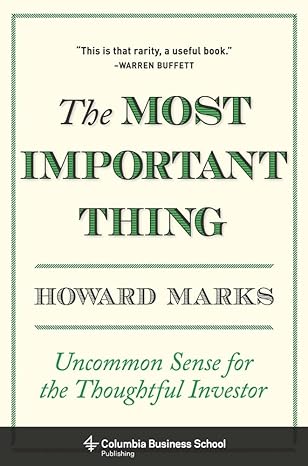
About The Most Important Thing by Howard Marks—Clear Lessons on Risk, Value, and Smarter Investing
Many people enter the market by asking one question: which share will rise next? Howard Marks asks readers to begin somewhere else. What is the asset worth? What price are you paying? What could go wrong? How much risk are you taking to earn a possible return?
The Most Important Thing by Howard Marks brings together lessons formed during decades of professional investing. Marks does not offer a magic formula, a list of hot shares, or a promise of fast wealth. He explains how a careful investor thinks when facts are unclear and the future cannot be known.
When market tips create false confidence
New investors can find endless tips online. One person says to buy quickly. Another says a market fall is coming. A rising price can make a weak asset look safe, while a falling price can make a sound asset look frightening. Following every loud voice often leads to confusion.
Marks offers a calmer solution. Build a way of thinking before making a decision. Study value, risk, market mood, and the place of luck. Accept that even a strong idea can have a bad result and that a weak choice can look clever for a while.
Learn second-level thinking
One of the book's best-known ideas is second-level thinking. First-level thinking sees good news and says, “This is a good company, so I should buy its shares.” Second-level thinking goes further. It asks whether everyone already knows the good news, whether the current price is too high, and what other investors expect.
This matters because an attractive company is not always an attractive investment. If its price already assumes perfect growth, even a small disappointment may hurt. A troubled company may offer value if the price is low enough and its problems are less serious than the market believes.
Price and value are not the same
Price is what the market asks today. Value is what an asset may truly be worth based on its income, strength, prospects, and risks. The two can move together, but they are not the same thing. Popularity can push price above value, while fear can pull it below value.
Marks teaches readers to focus on this relationship. Buying a fine asset at a foolish price can produce a poor result. Buying with a margin for error gives the investor more protection if the future is less bright than expected.
This idea makes patience important. You do not have to buy simply because the market is open. Sometimes the sensible action is to wait until the price offers better value. The book helps readers see waiting as an active decision rather than a sign that they have no plan.
Risk is more than a moving price
Many finance lessons describe risk through price movement. Marks places more attention on the chance of losing money and on the danger of outcomes that cannot be fully predicted. An investment may look calm before a hidden weakness becomes clear. Another may move sharply in price without causing a permanent loss to a patient owner.
The book separates recognising risk from controlling it. A strong investor must first notice where risk is building. High prices, easy money, weak rules, and wide confidence can make the market look safe at the very time when caution is most useful.
Risk control does not mean avoiding every risk. Without risk, there may be little chance of return. The aim is to take risk with care, understand what may be lost, and avoid situations where one mistake can cause lasting damage. This is one of the book's most practical lessons.
Markets move through cycles
Economies, credit, company profits, and investor feelings move in cycles. Good times make people hopeful. Hope leads to easier lending and higher prices. When conditions turn, fear can replace hope just as quickly. The market may move too far in both directions.
Marks compares this behaviour to a pendulum. It swings between greed and fear, trust and doubt, easy credit and tight credit. It rarely stays at a calm middle point for long. No one can know the exact day when the direction will change, but investors can learn to notice where the pendulum may stand.
Understanding cycles can protect readers from believing that current conditions will last forever. Strong markets do not remove risk. Weak markets do not remove opportunity. A sense of where we are can guide how bold or careful an investor should be, even when perfect timing is impossible.
Think differently without being different for show
Contrarian investing means being willing to stand away from the crowd. It does not mean doing the opposite of everyone at all times. The crowd can be right, and a lonely opinion can still be wrong. The useful question is whether popular belief has pushed price too far.
Marks explains why bargains often appear when an asset is uncomfortable to own. Bad news, fear, neglect, or forced selling may lower the price. Yet a low price alone does not create value. The investor must still study the asset and decide whether the possible reward fairly covers the risk.
This lesson asks for both courage and humility. Courage helps you act when others are afraid. Humility reminds you that your view may be mistaken. Holding both ideas together is harder than simply following a crowd or rejecting it.
Patience can be a real advantage
Markets often make people feel that they must act now. Prices move, news arrives, and other people seem to be earning money. This pressure can turn activity into a habit. Marks presents patient opportunism as a stronger choice.
A patient investor prepares before the opportunity arrives. They study, keep resources available, and wait for the odds to improve. When fear creates a strong bargain, they are ready to act. When prices offer little value, they do not force a decision just to feel busy.
This idea can help beginners who confuse frequent trading with skill. More action does not always mean more progress. Fees, mistakes, and emotion can grow with every unnecessary move. The book shows why discipline sometimes appears as action and sometimes as the decision to do nothing.
Defence matters as much as attack
Investors naturally think about gains. Marks also asks them to think about survival. Defensive investing places great weight on avoiding permanent loss, preparing for bad outcomes, and leaving a margin for error.
This does not mean choosing only the safest-looking asset. It means knowing what kind of mistake a portfolio can survive. A plan that works only when every forecast is correct is fragile. A plan with room for surprise is stronger.
Luck deserves a place in the story
A good result does not always prove that a decision was wise. A poor result does not always prove that the thinking was foolish. Chance affects markets, and the same choice can lead to different results under different conditions.
Marks asks readers to judge both the process and the outcome. Did the investor study the facts, consider risk, and pay a sensible price? Or did luck hide a weak decision? This question can prevent success from becoming pride and failure from becoming useless shame.
Knowing what you do not know is part of the same lesson. Forecasts have limits. The future can surprise experts as well as beginners. A thoughtful investor respects those limits and builds a plan that does not depend on perfect knowledge.
What you will learn from the book
- How second-level thinking goes beyond an easy market opinion
- Why a good asset can become a poor buy at the wrong price
- How to recognise, understand, and control investment risk
- Why markets, credit, and investor feelings move in cycles
- When contrarian thinking may reveal a real bargain
- Why patience and preparation can create an advantage
- How defensive investing can help protect capital
- Why luck, uncertainty, and humility belong in every review
- A complete investment framework with no numbered sequel required
These ideas are connected. Marks does not name one single rule as the answer. He shows that successful investing requires attention to many “most important” things at once.
Who should read this investment classic?
This book suits new investors who want strong foundations before choosing individual assets. It also suits experienced investors who want to review their habits, risk limits, and reactions to market mood. Finance students, analysts, portfolio managers, business owners, and readers interested in value investing can all find useful questions here.
The writing is clear, but some ideas become richer with market experience. A beginner can still follow the main lessons by taking one chapter at a time and looking up unfamiliar terms. Experienced readers may recognise past mistakes in Marks's examples and use the book to improve their process.
This is an educational book, not personal financial advice. It cannot know your income, goals, debts, time horizon, or ability to accept loss. Use it to strengthen your thinking, then make financial choices with research and suitable professional help when needed.
A quality copy for notes and rereading
Bookish Wonderland offers a reading copy made for long-term study. Premium eye-soothing cream paper supports comfortable reading. Crystal-clear printing keeps charts, terms, and paragraphs easy to follow. High-quality stitched and glue binding helps the pages remain secure through repeated use.
Keep it near your desk, add page tabs, underline a useful warning, or revisit a chapter before reviewing your investment plan. It can also be a thoughtful gift for a finance student, business reader, or investor who values careful decisions over market noise.
Quick answers before you order
Is this book suitable for beginners? Yes. Its main ideas are clear, though new investors may need to check a few finance terms.
Does it recommend specific shares? No. It teaches an investment philosophy and decision process rather than giving a current list of assets to buy.
Will it guarantee better returns? No. No book can guarantee market results. This title helps readers think about value, risk, cycles, and mistakes.
Is it useful outside investing? Yes. Its lessons on uncertainty, patience, downside protection, and decision quality can support business and personal choices.
Find the current price and delivery details
Looking for The Most Important Thing by Howard Marks price in Bangladesh? Check the current amount on the Bookish Wonderland product page before ordering. This will show the latest store price and any available offer.
Cash on Delivery is available across the country, with delivery inside and outside Dhaka. Fast or urgent delivery may be requested within Dhaka. Message the store first to confirm whether urgent delivery is possible for your location and required time.
For questions about the copy or any customization request, contact Bookish Wonderland through Facebook or Instagram. The team can help before you place the order.
Build a calmer investment mindset
Order The Most Important Thing from Bookish Wonderland and learn why good investing depends on more than finding a popular asset. Howard Marks helps readers slow down, examine price, respect risk, recognise cycles, and wait for better odds.
Read it before making your next plan, keep it close during a noisy market, or gift it to someone beginning a finance journey. The book will not remove uncertainty, but it can help you meet uncertainty with better questions, stronger discipline, and a clearer mind.
If you require any customization or have any questions, please inbox us via FB or Insta.
| Primary Specification | |
| Author | Howard Marks |
| Narrator | John FitzGibbon |
| Genre | Business, finance, investing and value investing |
| ISBN-13/ISSN | 978-9353022792 |
| ISBN-10 | 9353022797 |
| Publisher | Harper Collins India |
| Publishing Date | August 25, 2018 |
| Language | English |
| Reading Age | 16 years and above |
| Format | Printed Book |
| Physical Specification & Quality | |
| Paper Quality | Premium eye-soothing cream paper |
| Binding Quality | High quality stitched and glue binding (for longevity) |
| Print Quality | Crystal-clear print |
| Pages | 194 pages |
| Country | USA |
| Logistics Information | |
| Weight | 218 gm |
| Length | 8.5 inches |
| Width | 5.6 inches |
| Height | 0.79 inch |