

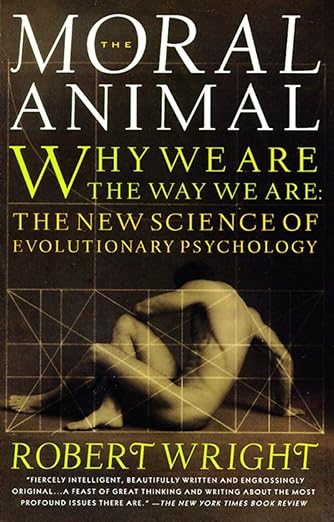
About The Moral Animal: Why We Are the Way We Are by Robert Wright—Evolution, Love, and Morality Explained
Why do people fall in love, feel jealous, help friends, fight for status, protect family, and sometimes hide the truth even from themselves? The Moral Animal by Robert Wright looks for answers in evolution. It asks how natural selection may have shaped parts of the human mind long before modern life began.
Wright brings science into everyday situations. He studies romance, marriage, parents, children, brothers, sisters, friends, rivals, work, religion, and moral judgment. His main idea is not that genes control every choice. It is that the mind may carry old tendencies that still guide feelings and behaviour today.
When human behaviour makes no sense
People often say one thing and do another. We may believe we are being fair while giving ourselves a hidden advantage. We may help someone from real care, yet also gain trust, support, or a good name. Simple labels such as “good” and “bad” do not always explain these mixed motives.
Wright offers another way to look. He asks what kinds of feelings and habits may have helped human ancestors survive, form bonds, raise children, and pass on their genes. This does not make every action wise or kind. It gives readers a deeper question to ask before judging behaviour.
The result is not a neat rulebook. It is a lens. Readers can use it to notice patterns in family life, friendship, love, competition, and public behaviour. Even when you disagree with a claim, the book gives you something clear to test and discuss.
Evolution reaches beyond the body
Natural selection is often taught through bodies: a bird's beak, an animal's colour, or a plant that survives dry land. Evolutionary psychology asks whether mental traits were also shaped over time. Fear, attraction, loyalty, anger, and social awareness may have helped people handle repeated problems in older environments.
Wright introduces this idea through stories and research rather than only through technical language. He explains why certain emotions may feel natural and powerful even when they create trouble in modern life. A tendency that once helped survival or reproduction may not always lead to happiness now.
The book does not say that culture is unimportant. Human behaviour develops through biology, learning, family, history, and social rules. Evolutionary ideas provide one part of the picture. Readers should treat them as explanations to examine, not as an excuse to reduce every person to a gene.
Charles Darwin becomes part of the story
Wright uses the life of Charles Darwin as a thread through the book. Darwin is not presented only as a scientist with a famous theory. Readers also meet him as a young man, husband, father, friend, worker, and person seeking a place in society.
His marriage, family life, career, doubts, delays, and personal choices become examples for the questions the book asks. Wright looks at Darwin through ideas that grew from Darwin's own work. This gives the science a human face and keeps the book from feeling like a long list of studies.
The approach also adds a playful layer. Darwin could explain natural selection, but he did not stand outside human nature. Like everyone else, he had desires, fears, loyalties, and blind spots. His story helps readers see that a theory about humanity also applies to the person who helped begin it.
Love and attraction under a new light
The book's early chapters explore sex, romance, attraction, marriage, and different mating interests. Wright asks why men and women may sometimes face different pressures and why love can mix deep feeling with conflict, jealousy, or fear of loss.
These chapters are among the book's most discussed parts. Some readers find the evolutionary view revealing. Others may think certain claims place too much weight on biology or use broad groups where individual lives are more varied. Reading with care is important.
Wright's argument does not mean every man or woman behaves in one fixed way. A general pattern cannot predict one person. Culture, values, experience, and choice still matter. The useful part is the question: could some strong romantic feelings have older functions that people do not clearly see? That question opens a fresh way to study love without pretending love is simple.
The mind may hide its own motives
One of the book's most striking themes is self-deception. If people can persuade themselves that their motives are pure, they may persuade others more easily. The person who appears fully certain may be more convincing than someone who knows they are acting for personal gain.
Wright explores how the mind can build a kind story about its own choices. We remember facts that support us, forget what makes us look unfair, and judge another person's mistake more harshly than our own. This does not always happen on purpose.
The idea can be uncomfortable, which is part of its value. It turns the book back toward the reader. Instead of using evolution only to explain other people, you must ask what your own mind may be hiding. That habit can support humility, careful thought, and better moral discussion.
Does evolution make morality meaningless?
If moral feelings were shaped by natural selection, does that mean kindness and justice are not real? Wright does not stop with a dark picture of selfish genes. He asks whether understanding our inherited biases can help people act more fairly.
A key point is that explanation is not approval. Showing why jealousy, aggression, or unfairness may have developed does not make those actions right. Nature contains many things people wisely choose to resist. We still need ethics, laws, care, and reason.
The book invites readers to separate what is natural from what is good. That difference is vital. Biology may help explain an impulse, but it does not decide what we should do. By seeing the pull toward self-interest and self-deception, people may become better prepared to question it.
A book to read with an open and careful mind
The Moral Animal first appeared in the 1990s, when evolutionary psychology was becoming widely known. The field has continued to grow, change, and face debate.
This does not make the book useless. It makes critical reading important. Ask what evidence supports each claim. Notice when Wright describes a broad trend rather than a rule. Compare his view with work from biology, psychology, anthropology, history, and gender studies.
The best use of the book is not to treat every argument as final. Use it as a strong, readable entry into major questions. Let it sharpen your curiosity, then keep learning. A book can be valuable because it opens a debate, not only because it closes one.
What you will explore inside
- Natural selection and the possible roots of human behaviour
- Sex, attraction, romance, marriage, and jealousy
- Parents, children, siblings, care, and family conflict
- Friendship, loyalty, fairness, and reciprocal help
- Social status, ambition, rivalry, and group life
- Deception, self-deception, conscience, and moral judgment
- Charles Darwin's life used as a continuing human example
- The difference between explaining an impulse and approving it
- A complete standalone work with no earlier volume required
These topics make the book useful across psychology, biology, ethics, sociology, anthropology, and philosophy. They also create many questions for a classroom or reading group.
Who will enjoy this book?
Choose this title if you enjoy popular science that connects large theories to daily life. It suits readers interested in evolution, psychology, relationships, human behaviour, morality, social life, or Charles Darwin.
Students and teachers can use it to begin discussion about nature and culture. Book clubs can compare which arguments feel convincing and which feel too broad. Writers may find new ways to think about character motives, while readers interested in ethics can study the gap between natural impulses and moral choices.
The book includes adult discussion of sex, mating, infidelity, jealousy, family conflict, social prejudice, and religion. It is better suited to mature teenagers and adults than young children. Readers should also remember that it presents an argument from evolutionary psychology, not a personal diagnosis or a final answer for every human action.
Read it slowly and test each idea
This is not a book to rush. Read one chapter, then look for the idea in ordinary life. Ask whether the example truly fits or whether another explanation works better. Keep notes on claims you accept, question, or want to research.
The book works especially well beside a psychology course, an evolution class, a debate on ethics, or a study of human relationships. It can also be read alone during a quiet weekend when you want a demanding nonfiction book that still tells human stories.
Discuss it with someone whose views differ from yours. The subject can lead to strong reactions, especially around gender, family, and morality. A careful conversation can reveal where evidence ends, where values begin, and how personal experience shapes the way each reader responds.
A durable copy for a long, thoughtful read
Bookish Wonderland offers a reading copy made for regular study. Premium eye-soothing cream paper supports comfortable reading across longer chapters. Crystal-clear printing keeps each line and reference easy to follow. High-quality stitched and glue binding helps the pages remain secure through repeated reading.
Use page tabs for key themes, underline a claim you want to test, or keep notes beside the text. The copy also makes a thoughtful gift for a psychology student, science reader, teacher, or anyone who enjoys difficult questions about human nature.
Quick answers before ordering
Is The Moral Animal a novel? No. It is a nonfiction book about evolutionary psychology and human behaviour.
Is it only about morality? No. It also covers love, sex, family, friendship, status, self-deception, and Darwin's life.
Does the book say genes control everything? No. It explores evolved tendencies, but individual behaviour is also shaped by culture, learning, conditions, and choice.
Is every claim settled science? No. The book is influential and thought-provoking, but parts of evolutionary psychology remain debated.
Do I need a science degree? No. Wright writes for general readers, though the long book rewards patient and active reading.
Check the latest price and delivery details
Looking for The Moral Animal by Robert Wright price in Bangladesh? Check the current amount on the Bookish Wonderland product page before ordering. You will see the latest store price and any offer available at that time.
Cash on Delivery is available across the country, with delivery inside and outside Dhaka. Fast or urgent delivery may be requested within Dhaka. Contact the store first to confirm whether urgent delivery is possible for your area and preferred time.
For questions about the reading copy or any customization request, message Bookish Wonderland through Facebook or Instagram. The team can help before you place your order.
Look at human nature from a new angle
Order The Moral Animal from Bookish Wonderland and explore why love, loyalty, rivalry, status, and morality may have deeper roots than they first appear to have. Robert Wright offers no simple picture of humanity. He gives readers a bold lens and many questions worth carrying beyond the last page.
Read it for study, discussion, or personal curiosity. Keep what the evidence supports, question what feels too broad, and use the book to look at both other people and your own motives with greater care.
If you require any customization or have any questions, please inbox us via FB or Insta.
| Primary Specification | |
| Author | Robert Wright |
| Narrator | Greg Thornton |
| Genre | Evolutionary psychology, popular science, biology and social science |
| ISBN-13/ISSN | 978-0679763994 |
| ISBN-10 | 0679763996 |
| Publisher | Vintage |
| Publishing Date | August 29, 1995 |
| Language | English |
| Reading Age | 14 years and above |
| Format | Printed Book |
| Physical Specification & Quality | |
| Paper Quality | Premium eye-soothing cream paper |
| Binding Quality | High quality stitched and glue binding (for longevity) |
| Print Quality | Crystal-clear print |
| Pages | 496 pages |
| Country | USA |
| Logistics Information | |
| Weight | 422 gm |
| Length | 8.5 inches |
| Width | 5.6 inches |
| Height | 0.98 inch |