

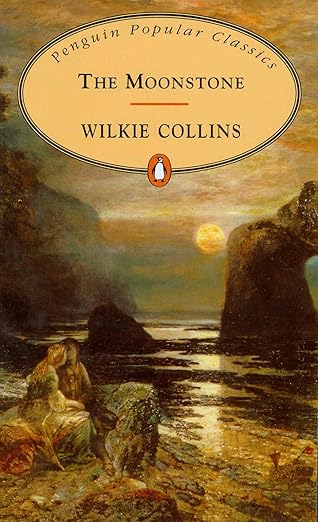
About The Moonstone by Wilkie Collins—A Stolen Diamond, a Country House, and a Mystery That Changed Crime Fiction
Rachel Verinder is turning eighteen. Among her gifts is the Moonstone, a large yellow diamond taken from India years earlier. The jewel is beautiful, valuable, and tied to a troubling past. Rachel wears it at her birthday dinner, where family members, guests, and servants all have a chance to see it.
The next morning, the diamond is gone.
The doors appear secure. The house is full of secrets. People who seemed calm begin to act strangely, and every new clue creates another question. Who entered Rachel's room? Why does she refuse to help the investigation? Is the diamond truly cursed, or are human greed and fear enough to explain what happened?
The Moonstone by Wilkie Collins begins with a simple theft and grows into a clever story of suspicion, love, loss, and hidden motives.
When an old classic feels hard to begin
Some readers avoid Victorian novels because they expect slow pages, heavy language, and little action. The Moonstone offers a much livelier path into classic fiction. Its mystery gives every chapter a clear purpose: find the diamond and understand what happened that night.
Wilkie Collins keeps the reader moving through new voices, fresh clues, wrong turns, and surprising details. The language comes from another time, but the central questions are easy to follow. A valuable object has vanished. Several people could have taken it. The detective must separate truth from appearance.
If you want to read a classic but need a strong plot to hold your attention, this is an excellent choice. It combines the depth of Victorian fiction with many features now familiar in modern crime stories.
Meet Rachel Verinder
Rachel stands at the centre of the mystery, yet she does not explain herself easily. The stolen diamond belongs to her, but her behaviour confuses the people trying to help. She can be proud, private, loving, angry, and brave, sometimes within the same part of the story.
Her silence creates tension. Readers may think they understand her, then a new narrator changes the picture. Collins does not turn Rachel into a helpless person waiting for men to solve her problem. Her choices matter, and her feelings shape the investigation.
Through Rachel, the novel asks how well people truly know someone they love. A strange action may look like guilt, fear, loyalty, or pain depending on who tells the story. This uncertainty makes her more than the owner of a missing jewel. She becomes one of the book's deepest mysteries.
Sergeant Cuff arrives at the house
Sergeant Cuff is one of the early memorable detectives in English fiction. He is calm, sharp, and willing to notice what other people ignore. While local officers focus on quick answers, Cuff watches behaviour, studies small marks, and asks careful questions.
He also has an unexpected love of roses. This quiet interest makes him feel like a person rather than a simple machine for solving crimes. His calm manner can be amusing, but it should not be mistaken for weakness. When Cuff forms a view, he follows it even if the household dislikes what he suggests.
Modern readers will recognise parts of later fictional detectives in him: the unusual habits, the careful eye, and the ability to see meaning in an ordinary clue. At the same time, the book allows Cuff to make judgments that readers must examine rather than accept without thought.
Every narrator holds a different piece
The story is told by several people who witnessed different parts of the case. Each person writes in a distinct voice. Gabriel Betteredge, the old family servant, is loyal, funny, and deeply attached to his favourite book, Robinson Crusoe. Other narrators bring very different habits, beliefs, and limits.
This form makes the reader part of the investigation. One narrator may describe a person warmly while another sees the same person with doubt. A detail left out in one account may return later and change its meaning. No single voice knows everything.
The changing narrators also add humour and character. Some are proud, some dramatic, some strict, and some more interested in themselves than in the truth. Their weaknesses make their accounts entertaining, but they also remind readers to ask whether every witness is fully reliable.
Clues, red herrings, and a closed house
The Moonstone uses many tools that later became common in detective fiction. There is a country house, a limited group of suspects, a skilled investigator, physical clues, witness statements, misleading signs, and a crime that appears impossible.
Collins gives readers enough information to think along with the investigation. A stain, a sound, a missing item, an unusual action, or a remembered conversation may matter. Yet the story also places convincing false paths in front of you. A clue can be real while the first meaning attached to it is wrong.
The pleasure comes from looking back and seeing how carefully the answer was prepared. The final explanation is surprising, but it grows from details already inside the story. Readers who enjoy fair mysteries, where attention is rewarded, will find much to examine.
The Shivering Sand adds a darker mood
Near the house lies the Shivering Sand, a dangerous stretch of ground that seems to move and breathe. It gives the novel a dark, almost Gothic feeling. The place becomes closely linked with Rosanna Spearman, a servant whose past and private pain make her an easy target for suspicion.
Rosanna is one of the book's most moving figures. Other characters often judge her by her class, appearance, and earlier life. The reader slowly sees how little the household understands her. Her story brings sadness and human cost into what could otherwise be only a clever puzzle.
Through Rosanna, the novel shows how an investigation can hurt the powerless. Suspicion does not fall equally on everyone. A person with less money or respect may be judged quickly, while a wealthy person receives more care. That unfairness still feels familiar today.
The diamond carries a colonial history
The Moonstone is not simply a costly jewel. It was taken from India during British military violence and brought into an English family. Its arrival in Rachel's home carries the history of theft, empire, and possession with it.
Three Indian men follow the stone and seek its return. The novel often views them through the fearful language of Victorian England, and some descriptions reflect stereotypes of that period. Modern readers should approach these parts critically. At the same time, the story makes clear that the diamond did not honestly belong to the English people who claimed it.
This background gives the mystery a wider meaning. The crime inside the country house begins with an older crime committed abroad. The question is not only who stole the diamond from Rachel. It is also who had the right to own it in the first place.
Opium, memory, and the limits of knowledge
Opium plays an important role in the mystery, though explaining exactly how would spoil the discovery. Wilkie Collins knew the drug personally because he used laudanum for pain. In the novel, altered awareness raises questions about memory, action, and responsibility.
Can a person do something without understanding it? Can the mind hide an event from itself? How can an investigator rebuild a truth when the main witness does not remember? These questions give the book a strange psychological edge.
The use of experiment and medical thought also adds another side to the investigation. Sergeant Cuff's police work is important, but the full answer requires more than one type of knowledge. Observation, testimony, science, and reconstruction must work together before the night of the theft becomes clear.
Why this book matters to mystery readers
The Moonstone was published in 1868 and is widely recognised as one of the earliest major detective novels in English. Other detective stories appeared before it, so calling it the single first example is debated. Its influence, however, is easy to see.
The country-house setting, strange detective, group of suspects, false clues, several witnesses, and final reconstruction all became lasting parts of crime fiction. Readers of Agatha Christie, Arthur Conan Doyle, Dorothy L. Sayers, and modern locked-room mysteries may recognise the shape.
The book also belongs to the Victorian sensation tradition, which brought crime, secrets, disputed identity, and danger into respectable homes. It gives readers both literary history and a story that still works as a mystery. You can study its influence while also enjoying the chase for the missing diamond.
Who will enjoy The Moonstone?
Choose this book if you enjoy classic mysteries, Victorian fiction, country-house crime, family secrets, and stories told through several voices. It is a strong pick for readers who want to explore the roots of modern detective fiction.
Students can study its narration, clues, social class, gender roles, and view of British empire. Book clubs can debate which narrator feels most trustworthy and whether the ending explains every moral question as neatly as it explains the crime.
The novel is long, so it suits readers who enjoy a slow build with a strong reward. It includes death, suicide, drug use, colonial violence, and period stereotypes about Indian characters. Mature teenagers and adults are the best audience. Readers can enjoy the mystery while still questioning the attitudes of the time.
A reading copy made to last
Bookish Wonderland offers a comfortable copy for a long classic. Premium eye-soothing cream paper supports extended reading without harsh white glare. Crystal-clear printing keeps the older text easy to follow. High-quality stitched and glue binding helps the pages stay secure through repeated reading.
Use page tabs for clues, underline a sharp line, or keep the book ready for class. It also makes a thoughtful gift for a mystery lover, literature student, teacher, or reader building a shelf of influential English classics.
Quick answers before ordering
Is The Moonstone a detective novel? Yes. It is one of the earliest major English detective novels and helped shape later crime fiction.
What is stolen? A large yellow diamond known as the Moonstone disappears after Rachel Verinder's eighteenth-birthday dinner.
Is the story hard to follow? The cast is large, but the mystery and separate narrator sections provide a clear path.
Does it have supernatural events? A curse surrounds the diamond, but the investigation seeks evidence and rational explanations.
Is it part of a series? No. The Moonstone tells a complete standalone story.
Check the price and delivery information
Looking for The Moonstone by Wilkie Collins price in Bangladesh? Check the current amount on the Bookish Wonderland product page before ordering. This shows the latest store price and any offer available at that time.
Cash on Delivery is available across the country, with delivery inside and outside Dhaka. Fast or urgent delivery may be requested within Dhaka. Contact the store first to confirm whether urgent delivery is possible for your location and preferred time.
For questions about the copy or any customization request, message Bookish Wonderland through Facebook or Instagram. The team can help before you place the order.
Let the investigation begin
Order The Moonstone from Bookish Wonderland and enter a house where a missing diamond turns family, guests, and servants into suspects. Follow Sergeant Cuff, compare every account, and test your answer against one of literature's most carefully built mysteries.
Read it for the puzzle, the characters, or its place in crime-fiction history. Once the Moonstone vanishes, it becomes very difficult to leave the case unsolved.
If you require any customization or have any questions, please inbox us via FB or Insta.
| Primary Specification | |
| Author | Wilkie Collins |
| Narrator | David Thorn |
| Genre | Detective fiction, mystery and Victorian sensation fiction |
| ISBN-13/ISSN | 978-0140623871 |
| ISBN-10 | 0140623876 |
| Publisher | Penguin Classics |
| Publishing Date | January 1, 2007 |
| Language | English |
| Reading Age | 14+ |
| Format | Printed Book |
| Physical Specification & Quality | |
| Paper Quality | Premium eye-soothing cream paper |
| Binding Quality | High quality stitched and glue binding (for longevity) |
| Print Quality | Crystal-clear print |
| Pages | 464 pages |
| Country | UK |
| Logistics Information | |
| Weight | 489 gm |
| Length | 8.5 inches |
| Width | 5.6 inches |
| Height | 1.18 inch |