

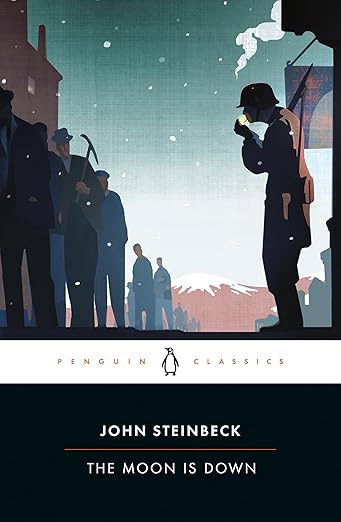
About The Moon Is Down by John Steinbeck—A Short Wartime Novel About Freedom, Fear, and Quiet Resistance
A small town is taken. Soldiers enter the streets, control the coal mine, and place armed guards around the town. The invaders expect the local people to follow orders.
They soon learn how wrong they are.
Mayor Orden is asked to help the occupying army control his neighbours. Colonel Lanser, the enemy commander, wants the town to stay calm so coal can keep moving. Yet the people do not see their mayor as a ruler who can command their hearts. They are free people, even when soldiers stand outside their doors.
The Moon Is Down by John Steinbeck follows what happens when fear slowly turns into anger, small acts become open resistance, and an army discovers that land can be taken more easily than the human wish for freedom.
A classic that gets to the point
Some readers want to try John Steinbeck but feel unsure about starting a long classic. This book offers an easier way in. It is short, focused, and built around a clear struggle. The chapters move quickly, the cast is easy to remember, and much of the story comes through direct talk between the characters.
The simple style does not mean the ideas are small. Steinbeck asks what makes people brave, why force cannot create true loyalty, and how ordinary neighbours respond when their choices are taken away. He also looks at the soldiers. Some follow orders without doubt, while others begin to feel lonely, afraid, and trapped by the system they serve.
For readers who usually find war fiction too full of dates and battle details, this novel offers a more human path. It shows the war through homes, streets, work, food, silence, grief, and daily choices.
Mayor Orden stands with his people
Mayor Orden is not shown as a grand hero with special power. He is an ordinary leader chosen by the people. He knows their habits, listens to their feelings, and understands that his place depends on their trust.
When Colonel Lanser asks him to make the town obey, Orden faces a hard choice. Helping the soldiers might reduce danger for a short time, but it would also make him a tool of the occupation. Refusing may bring pain to him and others. He cannot promise safety, and he cannot control every act of anger.
His strength comes from knowing what leadership means. He does not own the people, so he cannot give their freedom away. Through Orden, the book shows that courage is not the absence of fear. Courage can be a person speaking clearly while knowing that the cost may be high.
Colonel Lanser knows occupation will fail
Colonel Lanser leads the invading soldiers. He has lived through earlier wars and understands more than the younger officers around him. He knows that an army may capture buildings, roads, and mines without truly defeating the people who live there.
Lanser is calm and experienced, but he still carries out cruel orders. This makes him more complex than a simple storybook villain. He can see the danger ahead, yet he remains part of the force causing it. His knowledge does not free him from responsibility.
The talks between Lanser and Orden give the novel much of its power. One man speaks for military control. The other speaks for people who refuse to let control enter their minds. Neither man can easily leave his role. Their quiet meetings can feel as tense as a battle because every polite sentence hides a fight over fear, duty, and freedom.
The town changes after one violent moment
At first, the townspeople are shocked and unsure. They do not yet know how to answer armed soldiers. Then Alex Morden, a local worker, is ordered to labour at the mine. A violent clash follows, and an officer is killed. The occupation answers with a trial and a harsh punishment.
This event changes the mood of the town. The people see that the new rulers will use law only to protect their own power. Silence no longer feels like safety. Grief moves from one home to many others, and anger begins to connect neighbours who had been standing alone.
Steinbeck does not make resistance look easy or clean. People can be frightened, unsure, or full of pain. Yet each unfair act gives the town another reason not to accept the invaders. The soldiers can demand work, but they cannot make the work honest or willing.
Quiet resistance can become stronger than weapons
The people do not have a large army. Their strength grows through shared purpose. They delay work, damage what the occupiers need, pass information, and refuse to act as though the occupation is normal. Help from outside gives them new tools, but their deepest power comes from deciding together that they will not freely serve the invaders.
The novel shows how resistance can begin in very small ways. A cold look, an unanswered question, a broken machine, or a hidden message can tell the enemy that control is incomplete. One act may seem weak alone. Many acts can make occupation costly and uncertain.
This part of the story still feels meaningful because it is about more than one war. It asks what people may do when open speech is punished and power demands obedience. Steinbeck's answer is hopeful without pretending that hope removes danger.
The invaders and the occupied are both seen closely
Many war stories show one side as fully human and the other as faceless. Steinbeck takes a different path. He lets readers see the fears and weak points of the enemy officers as well as the courage and pain of the town.
This choice caused debate when the book first appeared. Some readers thought showing the enemy's emotions made the invaders seem too gentle. The novel's deeper point is not that both sides are equal. One side has entered another people's home and taken away their freedom. Instead, the book shows that an unfair system can use ordinary people to do cruel things.
Seeing the soldiers closely also makes their failure clearer. They are not strong machines. They become tired, homesick, doubtful, and frightened. Their weapons cannot solve the human problem created by occupation. Readers are invited to understand their minds without excusing their actions.
Why the book mattered during the Second World War
First published in 1942, the novel was written while much of Europe lived under Nazi occupation. The town and the invading army are not formally named in the story, but the setting strongly points to occupied Norway and the enemy force represents Nazi Germany.
The book became more than a story sold in ordinary shops. Secret translations and copies moved through occupied European countries, where readers treated it as a message of hope and resistance. Its simple idea was powerful: people may be beaten, watched, and punished, but that does not mean they have accepted defeat.
This history gives modern readers two experiences at once. The book is a clear wartime novel about one town, and it is also a real example of literature used against oppression. Its past adds weight to every scene in which a frightened person chooses not to surrender inside.
What makes this edition useful
- A short and complete wartime story in one volume
- Clear scenes that are easy to follow and discuss
- Memorable characters on both sides of the occupation
- Strong themes of freedom, leadership, fear, loyalty, and resistance
- A useful text for students of literature, history, politics, and war writing
- A moving choice for readers who prefer human stories over battle reports
- A standalone novel that needs no earlier or later book
The story is serious, but its short length makes it easier to fit into a busy reading plan. You can finish it quickly and still have many questions to think about afterward.
Who should read The Moon Is Down?
This book is a strong choice for readers who enjoy historical fiction, political fiction, war literature, short classics, and stories about moral courage. Readers of Animal Farm, Night, All the Light We Cannot See, or other books about power and resistance may find its ideas especially interesting, though its style and story are different.
It suits mature teenagers and adults. Teachers may choose it for talks about propaganda, democracy, occupation, leadership, or the role of art during war. Book clubs can discuss Mayor Orden and Colonel Lanser, the choices made by ordinary citizens, and whether understanding an enemy is the same as forgiving one.
The novel includes execution, death, military occupation, betrayal, threats, and grief. These subjects are serious, but the writing is not built around graphic violence. Readers who want a hopeful book should know that its hope comes through hardship rather than an easy or cheerful story.
A comfortable copy for study and rereading
Bookish Wonderland offers a reader-friendly copy made for regular use. Premium eye-soothing cream paper helps reduce harsh glare during longer reading sessions. Crystal-clear printing keeps the words sharp and easy to see. High-quality stitched and glue binding helps the pages remain secure through study, note-taking, and repeated reading.
This practical build makes the book suitable for a personal shelf, classroom work, book-club use, or gifting. Add page tabs to mark key talks, underline ideas about freedom, or return to Mayor Orden's strongest moments whenever you need them.
Quick answers before you order
Is The Moon Is Down based on a true story? It is fiction, not a record of one real town. Its unnamed setting was shaped by the Nazi occupation of Norway and other occupied parts of Europe.
Is it a long novel? No. It is commonly described as a short novel or novella, though page counts differ by edition.
Does it focus on battles? No. Most of the story focuses on occupation, daily fear, moral choices, and resistance inside a town.
Is the language difficult? Steinbeck uses a direct style with much dialogue, making it more approachable than many longer classics.
Is it part of a series? No. The story begins and ends in one standalone volume.
Check the current price and delivery options
Looking for The Moon Is Down by John Steinbeck price in Bangladesh? Check the amount shown on the Bookish Wonderland product page before ordering. This gives you the latest store price and any offer available at that time.
Cash on Delivery is available across the country, with delivery inside and outside Dhaka. Fast or urgent delivery may be requested within Dhaka. Contact the store before confirming your order to learn whether urgent delivery is available for your area and preferred time.
For questions about the reading copy or any customization request, message Bookish Wonderland through Facebook or Instagram. The team can help you before you buy.
Bring this story of courage to your shelf
Order The Moon Is Down from Bookish Wonderland and enter a town where freedom survives even after soldiers take control of the streets. Meet Mayor Orden, Colonel Lanser, Molly Morden, and ordinary neighbours whose choices turn fear into resistance.
Read it for Steinbeck's clear writing, its place in wartime history, or its lasting message about power. Share it with a student, discuss it with friends, or keep it beside other modern classics. This small book asks a large question: what can an army truly conquer when people refuse to give away their will?
If you require any customization or have any questions, please inbox us via FB or Insta.
| Primary Specification | |
| Author | John Steinbeck |
| Narrator | George Guidall |
| Genre | War fiction, political fiction and historical fiction |
| ISBN-13/ISSN | 978-0140187465 |
| ISBN-10 | 0140187464 |
| Publisher | Penguin Classics |
| Publishing Date | November 1, 1995 |
| Edition | First Edition |
| Language | English |
| Reading Age | 13+ |
| Format | Printed Book |
| Physical Specification & Quality | |
| Paper Quality | Premium eye-soothing cream paper |
| Binding Quality | High quality stitched and glue binding (for longevity) |
| Print Quality | Crystal-clear print |
| Pages | 144 pages |
| Country | USA |
| Logistics Information | |
| Weight | 165 gm |
| Length | 8.5 inches |
| Width | 5.6 inches |
| Height | 0.38 inch |