

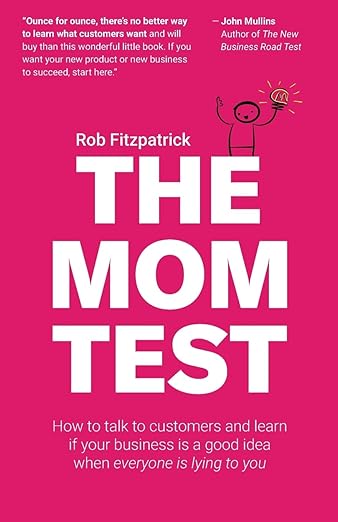
About The Mom Test by Rob Fitzpatrick—A Practical Guide to Better Customer Talks and Smarter Business Ideas
You share an idea with a friend. They smile and say it sounds great. A possible customer says they would probably buy it. You feel excited, spend months building the product, and then nobody pays.
The problem may not be your effort. It may be the questions you asked.
People often try to be kind. They give praise, make hopeful guesses, and avoid hurting your feelings. Those answers sound useful, but they do not prove that a real problem exists. They also do not prove that anyone will spend money, time, or effort on your solution.
The Mom Test by Rob Fitzpatrick shows how to learn from customers without asking them to judge your idea. Instead of seeking approval, you ask about their real life, past actions, current problems, and existing solutions. The result is clearer evidence that can help you improve, change, or stop an idea before it becomes an expensive mistake.
Why the title is called The Mom Test
Your mother may love you too much to say that your business idea is bad. She may praise it because she wants you to feel confident. The same thing can happen with friends, coworkers, and possible customers. Their kind answer may say more about your relationship than about the market.
The Mom Test is not a test for mothers. It is a test for your questions. A strong question should help you learn useful facts even when the other person wants to protect your feelings. If the conversation can produce honest evidence from your mother, it can work with almost anyone.
This simple idea changes the goal of customer research. You are not asking another person to predict whether your plan will succeed. You are learning how they already behave. Their past choices, current costs, repeated problems, and attempts to fix those problems give you something stronger than a polite opinion.
Stop asking whether your idea is good
“Do you like my idea?” feels natural, but it is one of the weakest questions a founder can ask. The person knows what answer you want. They may also have no skill in judging a product that does not exist yet. Even an honest yes can be wrong.
A better conversation moves attention away from your idea. Ask the person to explain the last time the problem happened. Find out what they did, how often it occurs, who else is involved, and what the result costs them. Ask what they have already tried and why the old solution did not work.
These questions uncover behaviour instead of hope. Someone who says a problem is important but has never tried to solve it may not care enough to buy. Someone who has spent money, built a rough workaround, or repeatedly asked for help is giving you a stronger signal. The book teaches you to notice that difference.
Talk about their life before talking about your product
When you explain your product too early, the conversation becomes a pitch. The other person starts reacting to your words instead of describing their world. They may try to help by suggesting features, praising the plan, or imagining how they might use it one day.
Rob Fitzpatrick recommends learning about the customer's life first. What job are they trying to complete? Where does the difficulty appear? How are they handling it now? What makes the problem annoying, costly, slow, or risky? Who chooses a solution, and who controls the money?
This approach helps you see the full situation. Your first idea may solve only a small part of the problem. The person may already have a cheap tool that works well enough. Another worker may feel the pain while a manager makes the buying choice. Learning these facts early can save you from building for the wrong person.
Past actions are stronger than future promises
People are poor at predicting what they will do. A possible customer may truly believe they would pay for your future product, yet make a different choice when payment becomes real. Questions about an imagined future often create confident but weak answers.
The book guides readers toward specific events from the past. Ask when the problem last happened. Ask what the person did next. Ask how much time or money was used. Ask why they chose that path and what other choices they considered.
Past behaviour is not a perfect promise, but it gives stronger evidence than a guess. It shows what the person cared enough to do when the problem was real. It can reveal budgets, habits, limits, and hidden steps that a general opinion will miss. This makes each customer conversation more useful and helps you compare what people say with what they have actually done.
Commitment is stronger than interest
Many people will say they are interested when interest costs nothing. A serious customer becomes easier to recognise when they give up something valuable. That may be money, time, access, reputation, an introduction, or a clear next step.
The book explains the importance of commitment and advancement. A good conversation should help the relationship move forward. The person might agree to another meeting with a decision-maker, introduce you to a colleague, share useful data, test a rough version, or place an order when the offer is ready.
Not every conversation must end in a sale. Early research is still about learning. Yet a repeated pattern of warm praise with no action is a warning. Real pain often creates movement. By watching what people commit, you can separate friendly interest from a problem strong enough to support a product or business.
Turn separate conversations into a repeatable process
One good talk can teach you something, but a business should not depend on one person's story. The book helps readers treat customer learning as a process. Decide what question matters, find suitable people, hold focused conversations, record evidence, and review the patterns with the team.
Share useful notes so the loudest opinion does not control the decision. Look for repeated problems, existing spending, failed solutions, and real commitments. Also record facts that challenge the idea. Bad news found early can protect months of time and a large amount of money.
As learning improves, the next step becomes clearer. You may continue research, change the customer group, test a smaller offer, build a simple version, or stop. Stopping a weak idea is not failure. It is a good result when the evidence arrives before a costly launch.
What this practical guide can teach you
- How to avoid questions that invite polite praise
- How to ask about real events and past behaviour
- How to separate opinions from useful evidence
- How to uncover problems, costs, habits, and workarounds
- How to recognise vague answers and weak signals
- How to notice commitment, action, and real buying interest
- How to keep conversations casual without losing focus
- How to choose customer groups and review repeated patterns
- How to use difficult feedback before spending too much
The advice is short, direct, and built around examples. You can read a section, use it in your next conversation, and quickly notice where your old questions created poor information.
Who should read The Mom Test?
This book is useful for startup founders, product managers, designers, marketers, sales teams, freelancers, consultants, creators, and small-business owners. Students preparing a business plan can also use it before making claims about what customers want.
You do not need a technology company. The method can help anyone creating a service, course, shop, app, event, community, or new offer. It is especially valuable when money and time are limited because early learning can prevent unnecessary work.
Experienced founders may recognise mistakes they have already made. New founders can learn those lessons before the first interview. Teams can use the book to create a shared way of collecting evidence, so decisions do not depend only on the most confident person in the room.
This is a business and customer-research guide, not a storybook. Readers who want clear rules, brief examples, and ideas they can use immediately are the best fit.
Use it before building, launching, or changing an offer
Read this book before your first customer interview. Keep it nearby while testing a new business idea, planning a product update, entering a different market, or trying to understand why sales are slow. Review the main rules before each meeting until they become natural.
It can also support a workshop or classroom project. Team members can practise changing weak questions into stronger ones, then compare the evidence collected from real conversations. A founder can use it alone, but a shared reading may improve how the whole team talks about customers.
The book is short enough to revisit when a project feels uncertain. Return to it when praise is high but action is low, when feature requests conflict, or when the team cannot agree about the customer. It helps bring the discussion back to facts.
A comfortable copy for notes and regular use
Bookish Wonderland offers a reader-friendly copy made for practical study. Premium eye-soothing cream paper reduces harsh white glare. Crystal-clear printing keeps examples and key points easy to read. High-quality stitched and glue binding helps the pages stay secure through highlighting, note-taking, meetings, and repeated use.
Keep it on your work desk, carry it to customer interviews, or give it to a founder who is testing a first idea. Page tabs can help you return quickly to good questions, warning signs, commitments, customer segments, and the final checklist.
Quick answers before you order
Is The Mom Test about parenting? No. The title refers to asking questions that can produce useful truth even from someone who wants to protect your feelings.
Is it only for startup founders? No. Product teams, freelancers, creators, marketers, students, and small-business owners can use its customer-conversation method.
Does the book help validate ideas? Yes. It teaches you to collect evidence about real problems and behaviour without leading people toward praise.
Is it difficult to read? No. The writing is short, direct, practical, and supported by clear examples.
Is it part of a series? No. The Mom Test is a complete standalone business guide.
Check the current price and delivery options
Looking for The Mom Test by Rob Fitzpatrick price in Bangladesh? Check the amount shown on the Bookish Wonderland product page before ordering. This gives you the latest store price and any available offer.
Cash on Delivery is available across the country, with delivery inside and outside Dhaka. Fast or urgent delivery may be requested within Dhaka. Contact the store before confirming the order to learn whether urgent delivery is possible for your location and preferred time.
For questions about the reading copy or any customization request, message Bookish Wonderland through Facebook or Instagram. The team can help before you buy.
Ask better questions before building the wrong thing
Order The Mom Test from Bookish Wonderland and learn how to turn friendly customer talks into useful business evidence. Stop chasing compliments, start asking about real behaviour, and notice which problems lead people to spend time, money, or effort.
Use the book for your startup, shop, service, class project, product team, or next client offer. A few better questions can protect months of work and help you build with greater confidence. Read it before your next customer meeting, then let facts guide the next step.
If you require any customization or have any questions, please inbox us via FB or Insta.
| Primary Specification | |
| Author | Rob Fitzpatrick |
| Narrator | Rob Fitzpatrick |
| Genre | Business, entrepreneurship, customer development and startup strategy |
| ISBN-13/ISSN | 978-1492180746 |
| ISBN-10 | 1492180742 |
| Publisher | CreateSpace Independent Publishing Platform |
| Publishing Date | September 10, 2013 |
| Edition | 1st |
| Language | English |
| Reading Age | 16+ |
| Format | Printed Book |
| Physical Specification & Quality | |
| Paper Quality | Premium eye-soothing cream paper |
| Binding Quality | High quality stitched and glue binding (for longevity) |
| Print Quality | Crystal-clear print |
| Pages | 136 pages |
| Country | USA |
| Logistics Information | |
| Weight | 167 gm |
| Length | 8.5 inches |
| Width | 5.6 inches |
| Height | 0.31 inch |