

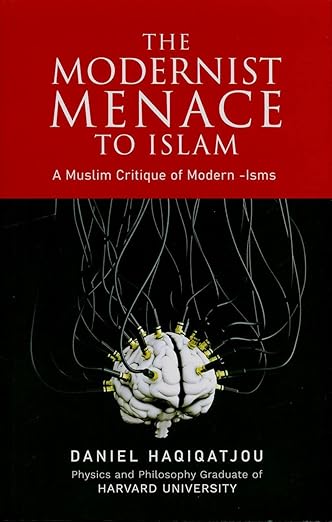
About The Modernist Menace To Islam by Daniel Haqiqatjou: A Clear Guide to Modern Ideas and Faith
Many ideas around us sound good because we hear them every day. Freedom, equality, progress, science, choice, and rights are common words in school, news, films, and social media. Yet what do these words really mean? Who gives them meaning? Can a Muslim accept every modern idea without first checking it against the Quran, Sunnah, and Islamic tradition?
The Modernist Menace To Islam by Daniel Haqiqatjou takes up these hard questions. It is a work of Islamic nonfiction made from short essays and reflections. The author looks at major modern beliefs and argues that many of them are not neutral. In his view, they carry their own ideas about God, people, family, law, happiness, and right and wrong. The book asks Muslim readers to see those hidden ideas, test them, and understand where they may clash with Islam.
When popular words leave you confused
A young Muslim may hear one lesson at home, another in class, and a very different one online. One voice says religion belongs only in private life. Another says every old rule must change to fit the present day. A third says science can answer every important question. These claims may feel powerful because they are repeated often. They may also create doubt, worry, or shame.
The book offers a way to slow down. Instead of accepting a slogan because it is popular, the author breaks it into smaller questions. What is the claim? What does it assume about human nature? Does it treat desire as the highest good? Does it leave room for revelation? What happens when the idea is used in real life?
What you will find inside
The book begins with atheism and questions about God, proof, doubt, and the limits of a purely material view of life. It then moves to secularism and democracy. Here, the author challenges the claim that public life can be fully neutral about religion. He also studies how modern states speak about religious freedom while setting limits on Islamic practice.
Later parts discuss freedom, equality, and liberty. The author asks whether freedom is always good by itself or whether it needs a moral goal. He considers the difference between following desire and living under duties given by God. These chapters push readers to think about words that are praised everywhere but are not always defined with care.
The sections on feminism, family, and hijab examine modern claims about women, work, marriage, motherhood, modesty, and power. The author presents a strong criticism of feminist readings of Islam. Because these subjects are personal and debated, readers may find them challenging. Reading with notes and checking evidence can help you engage with the argument rather than only react to it.
The book also looks at science and scientism. It separates science as a method for studying the world from scientism, the larger belief that science is the only path to real knowledge. Other essays address liberalism, progressive thought, sexual ethics, media, capitalism, self-help culture, happiness, and spiritual health. Together, these topics show the wide reach of modern ideas in daily life.
Short chapters with one clear purpose
The text is arranged as a collection of essays. This means you do not always need a long reading session. You can read one piece, stop, think, and return later. Many sections focus on one claim, one public event, or one common phrase. That form works well for readers who want serious ideas in smaller parts.
The essays also make the book easy to revisit. If a class, video, or conversation raises a question about secularism, hijab, feminism, or scientism, you can return to the related part. You can mark key lines, write a reply in the margin, or list points that need more study. The book can therefore serve as both a full read and a topic-based reference.
Ideas that connect faith with daily life
Haqiqatjou links these daily moments to deeper beliefs. He argues that views about freedom, success, gender, and progress grow from a picture of what a human being is. If people are only bodies with wants, one set of answers follows. If people are servants of Allah with a soul, duties, and a final return, another set follows. Seeing that difference helps readers understand why two sides may use the same word but mean very different things.
The book also encourages confidence in Islamic sources. Its answer to doubt is not to reshape Islam until it matches every new trend. Instead, the author calls readers to study Islam well, question modern assumptions, and remain tied to revelation. This central message runs through the many subjects and gives the collection a clear direction.
Features at a glance
- A wide study of atheism, secularism, democracy, liberty, equality, feminism, hijab, science, liberalism, sexuality, media, capitalism, and spiritual life.
- Short essays that can be read in order or chosen by subject.
- A clear traditional Islamic position throughout the book.
- Direct arguments made for Muslim readers facing modern doubts and social pressure.
- Topics that can support personal study, group discussion, teaching notes, and further research.
- A useful structure for returning to one issue when a question comes up.
What this reading can give you
First, it can improve your question-making. Strong thinking begins when you ask what a claim assumes. After reading these essays, words such as progress or freedom may no longer seem simple. You may start asking who defines the word, what moral rule guides it, and what kind of life it creates.
Second, the book can give names to worries that are hard to explain. A reader may feel that some modern messages do not fit Islam but may not know why. The author supplies arguments, examples, and categories that can help that reader form a clearer thought. This does not remove the need to check sources or hear other scholars. It gives a starting map.
Finally, the book may strengthen the habit of active reading. It invites notes, questions, and comparison with Islamic sources. A careful reader can build a list with three parts: the author's claim, the evidence offered, and questions that remain. That simple practice turns reading into learning.
Who may find this book useful
This title may suit Muslim university students who meet secular, liberal, feminist, or materialist ideas in class. It may help parents and teachers who want to understand the language young people hear online. Imams, speakers, and study-circle leaders may use its topic list to plan deeper lessons with qualified sources.
The book is best for mature teens and adults because it discusses belief, politics, gender, sexual ethics, and other sensitive issues. It is not a children's introduction to Islam. New readers may want a teacher, parent, or trusted scholar nearby when a chapter raises a hard question. Readers who prefer gentle language should also know that the author's tone can be bold and polemical.
Good ways to read and use it
For personal study, choose a quiet time and read one or two essays. Underline the main claim, then write it in your own words. Check any Quran verse, hadith, historical example, or outside study that matters to the point. This keeps your reading thoughtful and fair.
For a study circle, select one theme before the meeting. Ask each person to bring one question and one useful point. Keep the talk respectful, especially on family, gender, and politics. A group leader can add context from recognised scholars so that one essay does not become the only voice on a large subject.
Parents may read selected sections before discussing online culture with older children. Teachers and speakers may use the contents page as a guide for lesson ideas. The short-essay form also makes the book suitable for a weekly reading plan. A few pages, careful notes, and one follow-up source can create a steady learning habit.
Read it with an open and careful mind
This book takes strong positions on disputed matters. It should not be sold as an even-handed academic guide to every modern ideology. It is the author's critique, written to defend a traditional understanding of Islam. That honesty is part of its appeal, but it also calls for careful reading.
You do not need to agree with every sentence to gain value. Mark the points that persuade you and the points that do not. Look at the evidence. Ask whether a claim describes all people in a group or only one form of an idea. Seek learned help when a matter of Islamic law or creed is unclear. Good reading is not blind acceptance; it is patient attention joined with honest study.
Made for regular reading and long-term keeping
Bookish Wonderland prepares this printed edition for readers who care about comfort and life on the shelf. The text comes with crystal-clear printing, so letters stay sharp and easy to follow. Premium eye-soothing cream paper gives the page a soft look during longer reading sessions. High-quality stitched and glue binding helps the pages stay secure through repeated use.
A thoughtful choice for your shelf
Buying this title is not only about finishing another book. It is about keeping a set of arguments close when modern questions return. The broad subject range means different chapters may become useful at different times. Today you may be thinking about science and faith. Later, a discussion about freedom, hijab, or family may lead you back to another essay.
The book can also be a meaningful gift for an adult reader who enjoys serious Islamic nonfiction. It may suit a university student, a young professional, a teacher, or someone building a faith-based reading list. Before giving it, remember that the style is firm and the topics are mature. It is best for a person who welcomes debate and careful thought.
For readers searching “The Modernist Menace To Islam by Daniel Haqiqatjou book price in Bangladesh,” Bookish Wonderland offers a convenient local way to order. You can shop without searching many overseas stores, and you can ask the team about available delivery choices before confirming your order.
Easy ordering from Bookish Wonderland
Bookish Wonderland delivers inside Dhaka and across the country. Cash on Delivery is available nationwide, so you can pay when your order arrives. If you need the book quickly in Dhaka, ask about the fast or urgent delivery option before placing the order. Delivery time and availability can depend on your address and current stock.
If you need help, want to confirm the edition, or have a special request, contact Bookish Wonderland through Facebook or Instagram. The team can answer order questions and help you choose from a large collection of durable English books.
Begin a deeper journey of thought
Modern ideas shape how people think about faith, family, freedom, knowledge, and morality. This book helps you look beyond common words and question the beliefs behind them. Its clear and firm arguments can guide you toward deeper study and more thoughtful conversations about Islam and modern life.
Order The Modernist Menace To Islam by Daniel Haqiqatjou from Bookish Wonderland today. Cash on Delivery is available across Bangladesh, with fast or urgent delivery options in Dhaka. For stock updates, delivery details, or special requests, contact us through Facebook or Instagram. Add this thought-provoking Islamic book to your collection and begin reading with a curious and careful mind.
If you require any customization or have any questions, please inbox us via FB or Insta.
| Primary Specification | |
| Author | Daniel Haqiqatjou |
| Genre | Religion, Islamic theology, Islamic apologetics |
| ISBN-13/ISSN | 978-9675699672 |
| ISBN-10 | 9675699671 |
| Publisher | Dakwah Corner Bookstore |
| Publishing Date | January 1, 2021 |
| Language | English |
| Reading Age | 18+ |
| Format | Printed Book |
| Physical Specification & Quality | |
| Paper Quality | Premium eye-soothing cream paper |
| Binding Quality | High quality stitched and glue binding (for longevity) |
| Print Quality | Crystal-clear print |
| Pages | 273 pages |
| Country | Malaysia |
| Logistics Information | |
| Weight | 299 gm |
| Length | 8.5 inches |
| Width | 5.6 inches |
| Height | 0.59 inch |