

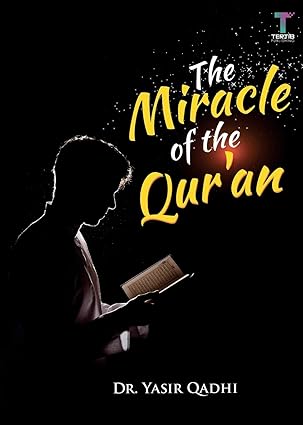
About The Miracle of the Qur'an by Yasir Qadhi – A Clear Guide to Its Lasting Signs
Muslims read the Qur’an as guidance from Allah. Why is the Qur’an called a miracle? The Miracle of the Qur'an by Yasir Qadhi gives a very short and accessible introduction to this important subject.
The book explains why Muslims understand the Qur’an as the lasting miracle given to Prophet Muhammad ﷺ. Earlier prophets were given signs witnessed by people at a certain time. The Qur’an, however, remains available to be read, heard, memorised, studied, and reflected upon across generations.
Yasir Qadhi draws attention to signs that readers may know only in part or may have overlooked. He discusses the Qur’an’s challenge, language, message, preservation, predictions, historical examples, and effect on those who hear it. The goal is not only to collect interesting facts. It is to help readers look at the Qur’an with greater thought, respect, and faith.
A Simple Question with a Deep Answer
This short book begins from that need. It introduces the idea of a mu‘jizah, or miracle, and places the Qur’an among the signs Allah gave to His prophets. It then shows why the Qur’an holds a special place in Islam.
The Qur’an is not presented as a miracle that belongs only to the past. Muslims can open it today, listen to its recitation, study its words, and see its place in worship and daily life. Its continued presence is part of the subject the book invites readers to consider.
Instead of requiring a large academic background, Yasir Qadhi uses a brief teaching style. This makes the work useful for readers taking their first steps into Qur’anic studies. It can also remind experienced readers of points they may not have thought about recently.
When Reading Becomes Routine
The Miracle of the Qur'an offers that pause. It asks the reader to move beyond saying that the Qur’an is special and begin asking how its special nature is understood. This change turns a familiar statement into an active subject of study.
The book can help readers reconnect with the purpose behind recitation. The Qur’an is recited in prayer, memorised by children and adults, studied in circles, and carried across cultures. Thinking about these facts can renew gratitude for access to the text.
For someone feeling distant from regular Qur’an study, a short book may feel easier to begin than a large reference work. It gives a focused starting point and can encourage the reader to continue with tafsir, Arabic, recitation, or the sciences of the Qur’an.
Understanding the Meaning of a Lasting Miracle
In Islamic teaching, prophets were supported by miracles that showed the truth of their message. The Qur’an is understood as the greatest miracle given to Prophet Muhammad ﷺ and as a continuing proof of his prophethood.
One reason is that the Qur’an’s message did not disappear when the first audience passed away. It remains central to Muslim belief and worship. People around the world recite the same Arabic text, study its meanings, and teach it to the next generation.
The book contrasts this lasting sign with miracles witnessed by people in earlier moments of history. A reader today did not stand beside Prophet Musa عليه السلام at the sea or witness other physical signs directly. The Qur’an can still be encountered through its recitation and text.
This idea makes the topic personal. The reader is not only learning about something that happened long ago. The reader is being asked to pay attention to a book already present in Muslim homes, mosques, schools, phones, memories, and prayers.
The Qur’anic Challenge and the Power of Language
A central part of the discussion concerns the Qur’an’s challenge to produce something like it. The first people who heard the revelation included skilled Arabic speakers, poets, and leaders who understood the force of its language.
Yasir Qadhi explains the importance of this setting. The challenge was not offered to people who had no care for speech. It came in a society that valued poetry, public words, memory, rhythm, and eloquence. Yet the Qur’an stood apart from the forms they knew.
English-speaking readers may not experience every part of Arabic style through translation. A translation gives meaning, but it cannot fully reproduce the sound, structure, word choice, and layers of the original Arabic. The book can therefore create interest in listening carefully and learning more.
No knowledge of advanced Arabic is required to benefit from this introduction. However, readers should understand that deeper study of linguistic miracles needs Arabic learning and guidance from qualified teachers. This short work opens the door rather than claiming to complete the subject.
Preservation, Memory, and a Living Recitation
The Qur’an has a special place in Muslim memory. Large numbers of Muslims, including children, memorise the complete Arabic text. Many more memorise selected surahs and verses for prayer and daily worship.
This living practice links written copies, spoken recitation, teaching, and memory. A verse is not known only from a page. It is repeated in prayers, heard in mosques, corrected by teachers, and passed from one student to another.
For a reader who has started hifz or hopes to begin, this subject may feel especially meaningful. Each memorised verse joins a worldwide practice carried by generations. The discussion can add purpose to the slow work of repetition and revision.
Predictions, History, and Signs in the Message
The work also points readers toward predictions and historical events discussed in connection with the Qur’an’s miraculous nature. One commonly studied example concerns the Romans and Persians and the Qur’anic prediction of a later change in their fortunes.
Such examples invite readers to study when verses were revealed, what people knew at the time, and how later events were understood. They show why context matters. A claim becomes clearer when the reader knows the people, place, event, and timing around it.
The book also refers to other kinds of signs and arguments found within discussions of i‘jaz al-Qur’an, or the Qur’an’s inimitability. Because the work is brief, each point serves as an introduction rather than a complete academic study.
Readers who want to examine one example in depth should continue with reliable tafsir, works on the sciences of the Qur’an, and qualified scholars. The value of this book is its ability to show the range of the topic and create a desire for careful learning.
What Readers Can Gain from This Book
- A clear starting point: The short format introduces a large subject without giving beginners too much at once.
- A faith-centred explanation: The book presents why Muslims regard the Qur’an as Allah’s lasting miracle.
- Important key ideas: Readers meet the Qur’anic challenge, linguistic signs, preservation, memorisation, predictions, and historical examples.
- Renewed reflection: Familiar beliefs are explained in a way that can encourage deeper thought and gratitude.
- Easy study use: Short sections can support personal reading, family learning, Islamic classes, or a small study circle.
- A bridge to further learning: The introduction can lead readers toward tafsir, Arabic, tajwid, hifz, and ‘ulum al-Qur’an.
- Helpful discussion points: Readers can ask what makes a miracle, why language matters, and how preservation is lived today.
- A compact reading experience: The book can be finished quickly and reviewed again when needed.
- Accessible English: Readers do not need specialist training to understand the main explanation.
- A standalone work: No earlier volume is required before starting this book.
A Short Book That Can Begin a Longer Journey
Some readers may expect a full encyclopedia from the title. This is not that kind of book. Published editions are brief, and their page counts vary. The work is best understood as a compact introduction to a deep field.
That shorter length can be a benefit. A beginner may finish it without feeling lost. A busy reader can study a few pages after prayer. A teacher can use one point to begin a longer class. A family can read a section and talk about it together.
The book may also help readers identify what they want to learn next. One person may become interested in Arabic eloquence. Another may want to study preservation, qira’at, prophecy, tafsir, or the history of revelation.
Because the subject touches belief, language, history, and worship, further study should use trusted sources and qualified teachers. This book gives a simple map; deeper knowledge comes from continuing the journey with care.
Who Is This Book Best For?
The Miracle of the Qur'an is suitable for Muslim teens and adults who want a simple English introduction to the subject. It can help new learners, regular readers seeking renewal, converts building foundations, and parents looking for a short family resource.
It can be read during Ramadan, before beginning a tafsir course, beside a Qur’an study plan, or as part of an Islamic reading challenge. Study circles may use it to create questions and choose topics for later research.
The book can also be given as a thoughtful gift to a student, friend, sibling, new Muslim, or anyone who wants to strengthen their relationship with the Qur’an. Its small size makes it approachable for readers who may avoid longer academic texts.
Readers should remember that it is a supporting Islamic book, not a copy of the Qur’an, a translation of the full Qur’an, or a complete tafsir. It explains a theme about the Qur’an and should be read alongside regular recitation and reliable study.
A Premium Copy for Focused Study
Bookish Wonderland offers a reader-friendly printed copy with premium eye-soothing cream paper. The softer page colour can feel comfortable during study, note-taking, or repeated reading.
Crystal-clear print helps readers follow English explanations, Arabic terms, names, and references without unnecessary strain. High-quality stitched and glue binding supports the pages and helps the copy stay firm through regular personal or classroom use.
Keep the book away from water, direct sunlight, dust, and strong heat. Handle it with clean, dry hands and store it respectfully with other Islamic books. These simple steps can help preserve the paper, cover, and binding.
When comparing the Book price in Bangladesh for The Miracle of the Qur'an by Yasir Qadhi, consider the paper comfort, clean printing, durable binding, nationwide service, and support included with your order.
Begin a More Thoughtful Relationship with the Qur’an
This book takes one familiar belief and helps readers look at it again with care: the Qur’an is the lasting miracle given to Prophet Muhammad ﷺ. Its short lessons can renew curiosity and lead toward deeper study.
Order The Miracle of the Qur'an by Yasir Qadhi from Bookish Wonderland for delivery inside or outside Dhaka. Cash on Delivery is available nationwide, and readers in Dhaka can ask about fast or urgent delivery.
Choose it for personal study, Ramadan reading, a family shelf, an Islamic class, or a meaningful gift. For the latest price, stock, available edition, page count, or delivery time, message Bookish Wonderland through Facebook or Instagram.
Place your order today, open the first page, and begin exploring why Muslims across generations have understood the Qur’an as a sign that continues to guide hearts and minds.
If you require any customization or have any questions, please inbox us via FB or Insta.
| Primary Specification | |
| Author | Yasir Qadhi |
| Genre | Islam, Qur'anic Studies, Islamic Theology, Religion |
| ISBN-13/ISSN | 978-9672420026 |
| ISBN-10 | 9672420021 |
| Publisher | Tertib Publishing |
| Publishing Date | March 1, 2021 |
| Language | English |
| Reading Age | 16 years and above |
| Format | Printed Book |
| Physical Specification & Quality | |
| Paper Quality | Premium eye-soothing cream paper |
| Binding Quality | High quality stitched and glue binding (for longevity) |
| Print Quality | Crystal-clear print |
| Pages | 66 pages |
| Country | Malaysia |
| Logistics Information | |
| Weight | 87 gm |
| Length | 8.5 inches |
| Width | 5.6 inches |
| Height | 0.14 inch |