

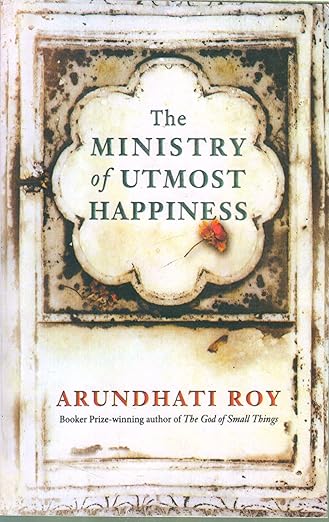
About The Ministry of Utmost Happiness by Arundhati Roy
Some people are pushed away because society does not understand them. Some lose their homes, families or sense of safety. Others live in places where fear and conflict have become part of everyday life. Yet even in these difficult conditions, people can find friendship, love and a place where they belong.
The Ministry of Utmost Happiness by Arundhati Roy tells the connected stories of people who have been hurt by the world but refuse to disappear. The novel moves through Old Delhi, New Delhi and Kashmir, bringing together characters from very different backgrounds. Each carries private pain, but each also searches for dignity, freedom and human connection.
At the heart of the story is Anjum, who was named Aftab as a child. She is born intersex and later lives as a hijra woman. After facing rejection and violence, she leaves her old home and begins living in a graveyard. Instead of allowing this lonely place to defeat her, she slowly turns it into the Jannat Guest House—a shelter for people who have nowhere else to go.
The novel also follows Tilo, an independent architect whose life is linked to three men and to the conflict in Kashmir. When an abandoned baby appears on a Delhi pavement, Tilo makes a bold choice that changes several lives. Her path eventually crosses Anjum’s, joining two large parts of the novel in a moving story about care, resistance and hope.
Published in 2017, the novel was longlisted for the 2017 Man Booker Prize and later became a finalist for the National Book Critics Circle Award. It is Roy’s second novel, published twenty years after her Booker Prize-winning debut, The God of Small Things.
When You Want a Story with Real Meaning
Many novels offer a quick escape but leave little behind once the final page is finished. This book offers something deeper. It asks readers to look closely at people whom society often ignores: transgender people, religious minorities, abandoned children, political prisoners, displaced families and citizens caught between opposing powers.
The story does not treat these people as simple examples. Roy gives them memories, flaws, humour, anger, love and personal dreams. They feel alive because they are not perfect. Their choices can be brave, confusing, kind or painful. By allowing many voices to enter the story, Roy shows that one country cannot be understood through only one type of person.
If you are tired of stories that feel too simple, this novel provides a richer reading experience. It connects private lives with public events and shows how politics can enter a home, a friendship, a love story or even a child’s future. Large social questions become personal because readers see how they affect individual lives.
The result is demanding but rewarding literary fiction. It may ask you to slow down, remember characters and think about difficult events. In return, it gives you a wide, emotional picture of modern India and the people who continue searching for happiness within it.
A Journey Across India’s Hidden Worlds
The story begins in Old Delhi, where Anjum grows up as Aftab. From childhood, she knows that the identity chosen for her does not fully express who she is. She eventually joins the Khwabgah, a home and community of hijras. There, she finds language, friendship and a way of living that feels closer to her true self.
However, safety does not last forever. Anjum survives terrible violence and carries the emotional wounds back to Delhi. Unable to return comfortably to her former life, she moves into a graveyard. What first appears to be a place of death slowly becomes a place of new life.
Anjum creates the Jannat Guest House among the graves. The name “Jannat” means paradise, yet this paradise is unusual. It is not made for powerful or wealthy people. It welcomes those who are rejected, lonely, injured or forgotten. The guest house becomes one of the book’s strongest symbols: a safe community can grow even in a place that seems empty and hopeless.
Another major part of the novel follows Tilo. She is clever, private and difficult for others to fully understand. Three men love her in different ways, but her deepest connection is with Musa, whose life becomes tied to the Kashmir conflict. Through Tilo, Musa and the people around them, the story enters a world of military control, resistance, grief, secrecy and moral uncertainty.
These parts of the book can be painful. Roy does not hide violence or its effect on ordinary families. However, the novel is not built only from sadness. It also contains humour, affection, strange beauty and moments of care. Its central characters survive not because their problems magically disappear, but because they find ways to help one another.
More Than One Hero and More Than One Story
This is not a simple novel with one hero, one goal and one straight path. It is made from many connected lives. Anjum and Tilo are central figures, but numerous other people help form the full picture.
Readers meet Musa, whose love and political beliefs shape much of Tilo’s life. They also meet Biplab Dasgupta, an intelligence officer and former admirer of Tilo. His position gives the novel another view of government, power and conflict. Saddam Hussain, despite his chosen name, is an Indian man carrying his own painful history. His life becomes connected to Anjum and the Jannat Guest House.
The two characters known as Miss Jebeen also hold special meaning. One belongs to the sorrow of Kashmir, while the other is an abandoned baby discovered in New Delhi. Their stories connect death, birth, memory and the hope of beginning again.
Because the novel contains many people, letters, memories and changes in viewpoint, it may initially seem broken into separate pieces. These pieces slowly form a larger design. The structure reflects a world in which lives are divided by caste, religion, gender, geography and political power, yet remain connected in unexpected ways.
Readers who enjoy a direct, fast-moving plot should know that this book takes a different approach. It is broad, nonlinear and layered. Paying attention to names and relationships will make the reading experience easier. Once the connections become clear, the novel’s unusual structure becomes part of its meaning.
Why This Novel Feels Important
The Ministry of Utmost Happiness explores what happens when people are told that they do not belong. Anjum faces judgment because of her gender identity. Other characters experience discrimination linked to caste, religion or political belief. Families suffer because of conflict, and people in power often control the stories that the wider public is allowed to hear.
Yet Roy also shows that official power is not the only kind of power. Anjum’s decision to build a home is an act of resistance. Tilo’s decision to care for a child is another. Friendship, shelter, memory and love become ways of protecting human life.
This balance between pain and hope gives the novel its emotional strength. It does not promise that every wrong will be corrected. Instead, it asks whether small acts of care can create happiness in a damaged world.
The title may sound like the name of a government office, but the book’s true “ministry” is created by ordinary people. They form a community without waiting for permission. Their happiness is not perfect or complete. It exists beside sorrow, fear and loss, making it feel hard-earned and real.
The novel also encourages readers to question easy labels. A person may be called an outsider, criminal, rebel, official, victim or hero depending on who tells the story. Roy moves between viewpoints so that readers can see how incomplete any single label may be.
Writing That Rewards Patient Readers
Arundhati Roy uses rich, poetic language, sharp observation and dark humour. Her writing can turn a street, graveyard, crowded room or snowy valley into a vivid scene. The beauty of the language often stands beside harsh events, creating a strong contrast.
The book is sometimes described as a mosaic because it combines many voices and narrative forms. It includes letters, personal memories, political details and stories within stories. Rather than following one smooth road, it moves through separate paths that eventually meet.
This style will appeal most to readers who enjoy literary fiction and do not mind a complex structure. It is a good choice for people who like to pause, reread a sentence or think about why a scene has been placed in a certain part of the book.
The novel is not a light romance, although love appears throughout it. It is not a simple political history, although real political tensions shape the characters’ lives. It blends social fiction, political fiction, family drama and love stories into one large narrative.
Its difficult subjects include communal violence, war, discrimination, death and loss. Mature readers should be prepared for emotionally intense material. However, kindness and human connection remain present, preventing the story from becoming only a record of suffering.
What Makes This Book Worth Owning
This Bookish Wonderland edition is prepared for readers who want a comfortable physical reading experience and a book that can remain in their collection for years.
-
Premium eye-soothing cream paper provides a soft page colour that feels comfortable during long reading sessions.
-
Crystal-clear printing keeps the text sharp and easy to follow, which is especially useful in a long and detailed literary novel.
-
High-quality stitched and glue binding helps keep the pages secure through repeated reading and careful long-term storage.
Each quality feature has a clear purpose. The cream paper helps reduce the harsh brightness often seen on very white pages. The clear print makes long paragraphs easier to read. The durable binding supports the book as it is opened and handled over time.
This is a title that many readers may want to revisit. Its large cast and layered ideas can reveal new connections during a second reading. A durable physical copy is also useful for readers who highlight meaningful passages, add notes or discuss the novel with others.
What You May Gain from Reading It
A powerful book should offer more than a way to pass the time. This novel can help readers see familiar ideas from a new angle.
-
It introduces a wide group of memorable characters from different social and political backgrounds.
-
It explores identity, caste, religion, conflict, family, belonging and resistance through personal stories.
-
It shows how people can create a chosen family when their birth family or society rejects them.
-
It encourages deeper thought about whose voices are heard and whose stories are hidden.
-
It offers a moving picture of hope that does not ignore pain or injustice.
-
It gives literary-fiction readers a complex book suitable for rereading and discussion.
The book does not provide easy answers to every question it raises. That is one of its strengths. It allows readers to sit with uncertainty and understand that large conflicts often contain many competing truths.
Who Will Enjoy This Book Most?
The Ministry of Utmost Happiness is best suited to mature readers who enjoy serious literary fiction, social issues and politically aware storytelling. It may be an especially good choice for readers interested in modern India, Kashmir, gender identity, minority experiences and unconventional families.
It is also suitable for:
-
Readers who enjoyed The God of Small Things and want to explore Roy’s second novel
-
University students studying literature, politics, gender or South Asian society
-
Book clubs seeking a novel with many discussion topics
-
Readers who appreciate poetic writing and connected narratives
-
People who prefer character-rich stories over simple, plot-driven fiction
-
Gift buyers looking for thoughtful literary fiction for an experienced reader
Because the novel includes violence, death, discrimination and political conflict, it is not designed as a children’s book. It is a better choice for older teenagers and adults who are prepared for complex themes.
A Strong Choice for Study and Book Clubs
This novel can support long and meaningful discussions. Different readers may focus on different parts of the story. One person may connect strongly with Anjum’s search for belonging, while another may be most affected by Tilo and Musa’s relationship or the book’s presentation of Kashmir.
A book club can discuss whether the Jannat Guest House truly becomes a form of paradise. Readers can also examine why Roy tells the story through many voices instead of one narrator. Other strong topics include chosen family, the meaning of home, the link between personal love and political resistance, and the way official records can differ from private memory.
Students can use the novel to study nonlinear storytelling, symbolism, voice, setting and character development. The graveyard, abandoned child and idea of a “ministry” all offer room for close analysis.
The novel was longlisted for the 2017 Man Booker Prize, while the Vintage paperback edition has 464 pages. Its length and detailed structure make it well suited to planned reading rather than a rushed session.
Best Sellers Rank of This Book
-
#51,020 in Books
-
#218 in Cultural Heritage Fiction
-
#2,504 in Family Life Fiction (Books)
-
#2,849 in Literary Fiction (Books)
The Ministry of Utmost Happiness by Arundhati Roy Book Price in Bangladesh
The Ministry of Utmost Happiness by Arundhati Roy book price in Bangladesh can be checked on the Bookish Wonderland product page. The available price may depend on the current offer, stock level and edition.
Customers can order from anywhere in the country. Cash on Delivery is available across Bangladesh, so you can place your order without making an advance online payment. Bookish Wonderland provides nationwide delivery, including service inside and outside Dhaka. Readers in Dhaka may also ask about the fast or urgent delivery option when available.
Buying from Bookish Wonderland gives you access to a large collection of English books prepared with reader-friendly paper, clean printing and durable binding. If you are building a literary-fiction collection, this novel can sit beside major works about identity, society, politics and human dignity.
Order your copy from Bookish Wonderland today and experience a story of broken lives joined by courage, love and hope. For questions, current offers, customization or urgent delivery in Dhaka, contact Bookish Wonderland through Facebook or Instagram.
If you require any customization or have any questions, please inbox us via FB or Insta.
| Primary Specification | |
| Author | Arundhati Roy |
| Narrator | Arundhati Roy |
| Editor | Iris Weinstein |
| Genre | Literary Fiction, Political Fiction, Cultural Heritage Fiction, Contemporary Fiction, Family Life Fiction, Social Fiction, LGBTQ+ Fiction, Historical Fiction |
| ISBN-13/ISSN | 978-0525434818 |
| ISBN-10 | 052543481X |
| Publisher | Vintage |
| Publishing Date | May 1, 2018 |
| Language | English |
| Reading Age | 16+ years |
| Format | Paperback |
| Physical Specification & Quality | |
| Paper Quality | Premium eye-soothing cream paper |
| Binding Quality | High quality stitched and glue binding (for longevity) |
| Print Quality | Crystal-clear print |
| Pages | 464 pages |
| Country | India |
| Logistics Information | |
| Weight | 482 gm |
| Length | 8.5 inches |
| Width | 5.6 inches |
| Height | 0.96 inch |