

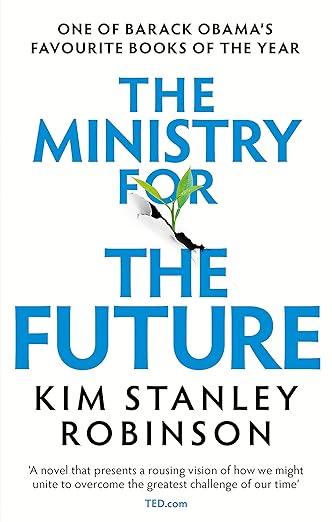
About The Ministry for the Future by Kim Stanley Robinson
What will happen if the world keeps getting hotter? Can people, governments, banks, scientists, and ordinary workers come together before it is too late? The Ministry for the Future by Kim Stanley Robinson explores these urgent questions through a bold story set in the near future.
This is not a simple tale about a hero who saves the world alone. It is a wide and thoughtful novel about millions of people trying to survive climate change and build a safer future. The story moves through different countries, voices, jobs, and lives. It shows terrible danger, but it also offers real hope.
The novel begins with a deadly heatwave in India. Frank May, an American aid worker, tries to help people as the heat becomes unbearable. Electricity fails, water grows hot, and thousands of people become trapped in a disaster they cannot escape. Frank survives, but the experience changes him forever.
Far away, Mary Murphy leads a new international group called the Ministry for the Future. Its job is to speak for people who are not yet born and protect their right to inherit a living planet. Mary and her team must work with governments, banks, scientists, activists, and many others to find ways to slow global warming.
Published by Orbit on October 6, 2020, the novel is officially presented as a near-future work about humanity’s response to the climate crisis. The publisher also lists it among its standalone science-fiction books, confirming that it is not part of a series.
A Climate Crisis That Feels Very Close
Many climate stories take place after the world has already ended. This book chooses another path. Its future is close to our own time. Cities still stand. Governments still meet. Banks still control money. People still go to work, travel, argue, love, and dream. Yet the climate is becoming more dangerous every year.
This makes the story feel urgent. The reader does not see a distant fantasy world. The reader sees a possible version of tomorrow.
Heatwaves kill people. Glaciers melt. Sea levels rise. Animals lose their homes. Farmers struggle with changing weather. Rich countries and poor countries disagree about who should pay for the damage. Some people ask for peaceful change, while others believe stronger action is needed.
Kim Stanley Robinson shows that climate change is not only about weather. It is also about money, fairness, politics, food, land, work, and human rights. A hotter world affects every part of life.
The problem is huge, so the book does not offer one magic answer. Instead, it explores many possible tools. These include cleaner energy, new money systems, protection for wildlife, better farming, less air travel, public action, changes in banking, and large scientific projects.
Some ideas are hopeful. Some are difficult. Some are morally troubling. The novel asks readers to think about what people may do when normal systems fail to protect them.
Meet Mary Murphy and Frank May
Mary Murphy is one of the central figures in the novel. She is an Irish woman who leads the Ministry for the Future from Zurich, Switzerland. Her work places her inside the world of international law, banking, diplomacy, and climate policy.
Mary believes in institutions, careful talks, and planned change. However, she soon learns that good words are not enough. Governments may agree that the climate is in danger while refusing to take fast action. Banks may understand the risk but continue supporting harmful systems. Leaders may promise change while protecting their own interests.
Frank May carries a very different kind of knowledge. He does not study climate suffering from a report. He lives through it. The deadly heatwave leaves him with deep fear, pain, anger, and guilt. He cannot return to his earlier life or forget the people who died around him.
When Frank and Mary meet, their lives become linked. Their connection is tense and unusual. Frank wants Mary to understand the human cost of slow action. Mary knows that change must involve large institutions, even when those institutions are frustrating.
Through them, the story brings together two sides of the crisis: the people who suffer and the people who have power to make change.
One World Told Through Many Voices
The novel does not follow only Mary and Frank. It uses many short sections, documents, reports, conversations, speeches, and first-person accounts. At times, the speaker may be a person, an object, a system, or even an idea.
This structure gives the book a wide view. Climate change does not have one hero, one villain, or one simple storyline. It touches everyone, but it does not hurt everyone in the same way.
Readers visit India, Switzerland, the United States, Antarctica, and other parts of the world. They meet refugees, pilots, bankers, scientists, workers, activists, officials, and ordinary families. Each voice adds another part to the larger picture.
Some chapters are emotional and personal. Others explain science, economics, law, or politics. This mix makes the novel different from a normal thriller. It is part human drama, part future history, and part collection of ideas.
The changes in voice may require careful reading, but they also make the world feel large and alive. Every chapter reminds the reader that solving climate change needs more than one nation or one leader.
A Difficult Problem with More Than One Answer
The climate crisis can feel too large to understand. News reports often show fire, floods, heat, and melting ice without explaining what people can do next. This can leave readers feeling afraid or powerless.
The Ministry for the Future turns that fear into a serious question: what would a worldwide plan for survival actually look like?
The novel explores change at many levels. Central banks consider ways to reward the removal of carbon from the air. Governments discuss laws and international agreements. Scientists work on difficult projects involving glaciers and oceans. Farmers protect soil. Communities change how they use land. Transport systems move toward cleaner choices.
The book also examines resistance. Powerful groups do not give up money and control easily. Some leaders delay action. Some companies continue harmful work. Some people turn toward violence because they believe peaceful methods are failing.
Robinson does not tell readers that every proposed idea will work exactly as shown. This is fiction, not an instruction book. Instead, he creates a large space where readers can think about choices, costs, and responsibility.
The result is serious but not empty of hope. The novel suggests that a better future may still be possible when people use science, law, money, public pressure, and shared care together.
Why This Story Feels So Powerful
The book begins with one of its darkest scenes. The Indian heatwave is frightening because it is described through the experience of people trapped inside it. Readers feel the crowding, the thirst, the fear, and the helplessness.
That opening gives the rest of the book a clear purpose. Every meeting and every new plan carries the memory of lives that could be lost if the world waits too long.
Yet this is not only a book about death or destruction. It is also about repair. People learn to protect forests, use cleaner transport, improve public spaces, and value the health of the planet. Slowly, new ways of living begin to appear.
The hope in the book is not easy or childish. It does not arrive because everyone suddenly becomes kind. It grows through hard work, conflict, fear, public pressure, planning, and many small victories.
This makes the hopeful moments feel earned. The future is not saved by luck. It is changed because people decide that the old way cannot continue.
Big Ideas in Clear Human Stories
Kim Stanley Robinson is known for fiction that connects science with social and political questions. The publisher identifies him as an award-winning writer whose honours include the Hugo, Nebula, and Locus awards.
In this novel, he uses research and imagination to explore several important ideas:
-
Climate justice and the unequal cost of global warming
-
The duty of today’s people toward future generations
-
Banking, money, debt, and economic reform
-
Refugees and the loss of safe homes
-
New technology and large climate projects
-
Wildlife protection and the return of natural habitats
-
Nonviolent protest and violent resistance
-
International law and government responsibility
-
Fear, trauma, guilt, and personal survival
-
Hope built through organised human action
These subjects are large, but the characters help readers connect them to real feelings. Mary faces pressure, doubt, and danger. Frank struggles with terrible memories. Scientists worry that time is running out. Workers and families try to live inside a changing world.
The book asks readers to care about systems without forgetting the people trapped inside those systems.
What Makes This Edition a Better Reading Choice
A long and detailed book needs a physical form that feels comfortable during extended reading. Bookish Wonderland prepares this edition for readers who care about both the story and the quality of the book in their hands.
-
Premium eye-soothing cream paper: The soft cream colour is comfortable for long reading sessions and reduces the harsh look of bright white pages.
-
Crystal-clear print: Sharp and clean text makes the different chapters, voices, and ideas easier to follow.
-
High-quality stitched and glue binding: The combined binding is made for better strength and long-term use.
-
Comfortable page layout: Clear spacing supports smooth reading through both short sections and longer chapters.
-
Durable shelf quality: The book is suitable for personal libraries, study collections, and thoughtful gifts.
These features are especially useful for a novel that readers may want to mark, revisit, discuss, or read slowly over several days.
What Readers Can Gain from This Book
This novel offers more than entertainment. It can help readers understand how climate change connects with everyday life and major world systems.
Readers may gain:
-
A clearer picture of climate change as a human problem
-
New questions about money, law, business, and political power
-
A deeper understanding of climate justice
-
Hope based on action rather than simple wishes
-
Ideas for classroom talks, reading groups, or personal study
-
A worldwide view of a crisis that affects every country
-
A memorable story about survival, responsibility, and change
The book does not ask readers to agree with every idea. It asks them to think. That is one of its greatest strengths.
Some readers will be most interested in Mary and Frank. Others will enjoy the science, policy, banking, or environmental ideas. Many will value the way the novel moves between private pain and worldwide change.
Who Should Read It?
The Ministry for the Future by Kim Stanley Robinson is a strong choice for adult readers and mature older teens who enjoy thoughtful books about real problems.
It may appeal to:
-
Readers of climate fiction and hard science fiction
-
People interested in environmental studies
-
Students of economics, politics, development, or public policy
-
Readers who enjoy near-future and dystopian stories
-
Teachers looking for discussion-rich fiction
-
Book clubs that enjoy social and moral questions
-
Fans of books that mix facts, ideas, and human stories
-
Readers who want hope without ignoring hard truths
-
Anyone worried about the future of Earth
This may not be the right choice for someone looking for a light, simple adventure. The book contains disturbing disaster scenes, political debate, technical ideas, and references to violence. It rewards patient readers who enjoy thinking about the world.
A Valuable Book for Study and Discussion
The novel can be used in many ways. A general reader can enjoy it as a large story about the near future. A student can examine its ideas about climate policy and global justice. A teacher can use selected themes for classroom discussion. A book club can debate whether the solutions in the novel are fair, possible, or dangerous.
Useful discussion questions may include:
-
Who should pay for climate damage?
-
Do future people have rights today?
-
Can banks help stop global warming?
-
When does slow political action become a moral failure?
-
Can technology solve problems created by human behaviour?
-
Is fear helpful when people need to act?
-
How can wealthy and poorer nations work together fairly?
-
What kind of hope does the novel offer?
Because the story includes many points of view, readers can return to it and notice new details. It can remain useful after the first reading as a source of questions and ideas.
Best Sellers Rank of This Book
-
#22,447 in Books
-
#34 in Post-Apocalyptic Science Fiction (Books)
-
#53 in Hard Science Fiction (Books)
-
#54 in Dystopian Fiction (Books)
Why Buy It from Bookish Wonderland?
Bookish Wonderland offers a large collection of premium and durable English books for readers across the country. You can order from inside or outside Dhaka, and Cash on Delivery is available nationwide.
Readers in Dhaka can also request a fast or urgent delivery option when available. This is helpful when buying the book for a class, book-club meeting, exam topic, birthday, or special gift.
If you are searching for The Ministry for the Future by Kim Stanley Robinson price in Bangladesh, Bookish Wonderland gives you a convenient way to order a carefully produced physical copy without making the process difficult.
You receive readable cream paper, clear printing, strong stitched-and-glue binding, and helpful ordering support in one place. This makes the book a good choice for both serious reading and long-term collection.
Order your copy from Bookish Wonderland today. Read it slowly, discuss its ideas, and discover one of modern science fiction’s most ambitious visions of how humanity might face its greatest shared challenge.
If you require any customization or have any questions, please inbox us via FB or Insta.
| Primary Specification | |
| Author | Kim Stanley Robinson |
| Narrator | Jennifer Fitzgerald, Fajer Al-Kaisi, Ramon de Ocampo, Gary Bennett, Raphael Corkhill, Barrie Kreinik, Natasha Soudek, Nikki Massoud, Joniece Abbott Pratt, Inés del Castillo, Vikas Adam |
| Genre | Climate fiction, Hard science fiction, Dystopian fiction, Post-apocalyptic science fiction, Speculative fiction, Political fiction |
| ISBN-13/ISSN | 978-0316300148 |
| ISBN-10 | 0316300144 |
| Publisher | Orbit |
| Publishing Date | October 19, 2021 |
| Language | English |
| Reading Age | 16+ years |
| Format | Paperback |
| Physical Specification & Quality | |
| Paper Quality | Premium eye-soothing cream paper |
| Binding Quality | High quality stitched and glue binding (for longevity) |
| Print Quality | Crystal-clear print |
| Pages | 576 pages |
| Country | United States of America |
| Logistics Information | |
| Weight | 595 gm |
| Length | 8.5 inches |
| Width | 5.6 inches |
| Height | 1.85 inch |