

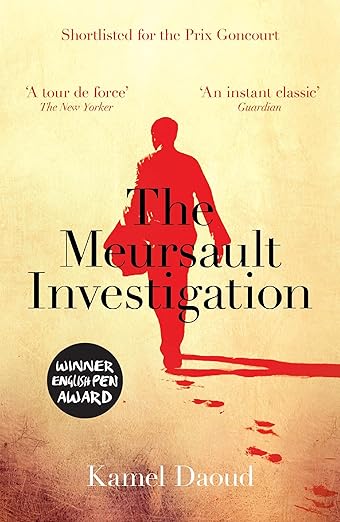
About The Meursault Investigation by Kamel Daoud: A Powerful Story of Voice, Loss and Justice
What happens when a famous story remembers the killer but forgets the victim?
The Meursault Investigation by Kamel Daoud asks this painful question through the voice of Harun, an old Algerian man whose brother was killed many years ago. The dead man appeared only as “the Arab” in Albert Camus’s famous novel The Stranger. He had no name, no history and no chance to speak. Daoud changes that by naming him Musa and giving his family a story.
Harun tells his tale to a listener in a bar in Oran. Night after night, he speaks about Musa, their mother, French rule in Algeria, the fight for independence, faith, anger and the strange path his own life followed. His words are full of pain, but they also carry sharp ideas and dark humour.
This is a short novel with a very large meaning. It looks at what can happen when powerful people control a story and others are pushed into silence. It also asks whether telling the forgotten person’s side can bring justice—or whether it creates another kind of pain.
The English translation was completed by John Cullen. The official publisher classifies it as literary fiction, and the English-language Other Press edition was published on June 2, 2015.
A Forgotten Man Finally Receives a Name
In The Stranger, Meursault shoots an unnamed Arab man on an Algerian beach. Readers learn much about Meursault, his thoughts and his trial, but almost nothing about the person who dies. The victim is not treated as a complete human being. Even his name is missing.
The Meursault Investigation begins with that silence.
Harun tells us that the dead man was his older brother, Musa. Musa was a son, a brother and a real part of a family. His death did not end on the beach. It stayed alive inside his home, shaped his mother’s life and followed Harun through childhood and old age.
By giving Musa a name, Kamel Daoud makes the reader stop and look again. A person who once stood in the background now moves to the centre of the story. The killing is no longer only an event in Meursault’s life. It becomes a family wound and a symbol of how colonial power can erase the people it controls.
This new point of view is the heart of the book. It helps readers understand that the same event can look very different depending on who is allowed to speak.
When One Story Feels Incomplete
Many readers finish a famous classic and wonder about the people who never received a voice. They may ask what happened outside the main character’s view or whether the original story left something important unseen.
This novel offers a thoughtful answer to that problem.
Rather than copying The Stranger, Daoud turns its viewpoint around. He examines the earlier novel from the side of Musa’s family. Harun tries to recover his brother from the empty label of “the Arab,” but his search becomes much more than a simple investigation.
He must live with a mother who cannot release her grief. He must also live in a country moving from French colonial rule into independence. As Algeria changes, Harun sees new forms of control, anger and disappointment. He does not feel fully at home under French power, yet he also struggles to belong in the nation that follows it.
The result is not a simple tale about a good side and a bad side. It is a story about people trapped inside memory, history and the choices of others.
Harun’s Story Begins in an Oran Bar
The book is told mostly as a long spoken account. Harun sits in a bar in Oran and talks to a quiet listener. This style makes the novel feel personal, as if the reader is sitting nearby and hearing a confession.
Harun’s voice moves between memory and argument. He speaks about Musa’s death, his mother’s search for answers and his own lonely life. Sometimes he sounds angry. Sometimes he sounds tired or playful. At other moments, he questions himself and the story he has spent years building.
His words do not move like a police report. They move like real memory. One thought brings back another. An old detail opens a fresh wound. A question about Musa leads to a question about Algeria, language, religion or Harun’s own actions.
This voice gives the book much of its power. Harun is not presented as a perfect hero. He can be bitter, unfair and difficult. Yet his flaws make him feel human. Readers are asked to listen carefully without accepting every statement as a simple final truth.
More Than a Reply to The Stranger
Knowing The Stranger can add another level to the reading experience, but it is not required. The Meursault Investigation has its own narrator, emotional journey and questions.
Readers familiar with Camus will notice reversed scenes, ideas and patterns. Daoud speaks back to the earlier novel while also showing respect for its influence. The book can therefore feel like a reply, a companion and a challenge at the same time.
However, its meaning reaches beyond one classic. It explores who receives a name in history, who remains unseen and who gets to decide which account becomes accepted as truth. These ideas can connect with many places where one group has spoken for another.
The official publisher describes the novel as both an engagement with and a criticism of The Stranger. It also identifies Arab identity and the damaging effects of colonialism in Algeria as central concerns.
A Family Changed by One Death
Musa’s death becomes the centre of Harun’s family life. His mother wants answers, proof and recognition. Because Musa’s body was never returned, grief cannot reach a clear ending. The missing body makes the loss feel unfinished.
Young Harun grows up under the shadow of the brother who is no longer there. His mother’s love becomes mixed with sorrow and duty. Harun sometimes feels that his own identity matters less than the dead son she continues to seek.
This family relationship gives the political story a deeply personal side. Colonial violence is not shown only through dates or public events. It enters a small home and changes the bond between a mother and her living child.
Readers who enjoy emotional, character-led fiction will find much to consider here. Harun wants to protect Musa’s memory, but he also wants freedom from it. He needs his brother to be remembered, yet he has spent his whole life being defined by the same loss.
That conflict makes his narration sad, complex and believable.
Algeria Is Part of Every Page
The novel’s setting is not merely a background. Algeria’s colonial past and difficult movement into independence shape Harun’s entire life.
French language and culture hold power in the world around him. Harun learns French partly because it gives him access to the story that made his brother anonymous. He uses the language of the former colonial power to challenge the version of history written through that power.
This creates a striking question: can a person use the ruler’s language to recover something the ruler’s story erased?
After independence, Harun hopes for freedom but finds that national change does not solve every human problem. New pressures appear. Public ideas about faith, duty and identity can make him feel like a stranger among his own people.
The book does not offer an easy picture of Algeria before or after independence. Instead, it shows how freedom on paper may not remove private grief, unfair power or the desire to control how others think.
A Story About Justice—and Its Limits
Giving Musa a name is an act of justice. It restores part of the human life that the earlier account ignored. Yet words cannot bring Musa back, recover his lost future or repair every wound in his family.
Harun’s own life also raises hard moral questions. His anger does not remain only inside his mind. A second violent act forms a dark mirror of the first killing, connecting the brothers’ stories in a way that is both troubling and tragic.
This part of the novel asks whether revenge can correct an old wrong. It also asks why the timing and identity of a victim may matter more to society than the loss of life itself.
Daoud gives no simple lesson. Instead, he places Harun close to the man he has spent years judging. Their histories begin to reflect one another. The forgotten victim’s brother and the famous killer are different, but they are not kept safely apart.
That moral uncertainty makes the book valuable for reading groups, literature classes and anyone who enjoys discussing difficult choices.
Clear Writing with Deep Questions
The Meursault Investigation is relatively short, but it is not empty or light. Nearly every scene holds an idea about identity, memory, language, death, belief or freedom.
John Cullen’s English translation keeps Harun’s voice direct and flowing. The speaker can move from a simple memory to a large question without making the change feel forced. The language has energy, yet readers do not need to understand difficult academic terms to follow the main story.
The book works well for readers who like slow, thoughtful fiction. It is driven more by voice and ideas than by quick action. There is a mystery in the background, but this is not a normal crime thriller with clues and a neat final answer.
Its main investigation is into memory: Who was Musa? Why was he forgotten? What did his death do to the people who loved him? Can telling his story so many years later change anything?
These questions remain with the reader after the final page.
Why This Novel Became Internationally Recognised
The book received strong literary recognition in both French and English. It won the Goncourt Prize for a First Novel, the Prix François Mauriac and the Prix des Cinq Continents de la Francophonie. It was also named a New York Times Notable Book of 2015 and appeared on several major publications’ best-books lists.
This attention came from more than its link to a famous classic. Readers and critics recognised that Daoud had created a complete literary work with its own voice and moral force.
The novel takes a bold idea and turns it into an intimate human story. It can make readers look at The Stranger differently, but it can also change how they approach other books. After hearing Harun, a reader may begin asking who is missing from every tale and whose pain remains outside the main frame.
That ability to change the reader’s way of seeing is one reason the book continues to matter.
Who Should Read This Book?
This novel is an excellent choice for readers who enjoy literary fiction, historical themes and stories told from unusual points of view.
It is especially suitable for:
- Readers of Albert Camus and The Stranger
- Students of literature, history or postcolonial writing
- People interested in Algeria and French colonial history
- Readers who enjoy strong first-person voices
- Book clubs looking for serious discussion topics
- Fans of philosophical and political fiction
- Readers interested in memory, grief and identity
- Anyone who wants to examine whose voice a famous story leaves out
The book contains murder, grief, colonial violence, religious criticism and adult ideas. It is therefore better suited to mature teenagers and adults than to young children.
You can read it without reading The Stranger first. However, reading both books close together can help you see Daoud’s reversals and literary choices more clearly.
What You Gain from Reading It
This book offers more than entertainment. It gives readers a new way to think about stories, history and human value.
You may gain:
- A deeper understanding of how point of view changes meaning
- A human look at the lasting effects of colonialism
- Insight into Algeria before and after independence
- A fresh view of Camus’s The Stranger
- A moving study of grief within a family
- Questions that can lead to rich book-club discussions
- A stronger habit of noticing silent or unnamed characters
- An example of how modern fiction can answer an older classic
The novel does not tell readers what to think. It makes room for doubt. That freedom allows each reader to form a personal response to Harun’s anger, choices and search for justice.
A Premium Reading Copy from Bookish Wonderland
A powerful literary book deserves a physical copy that feels comfortable and lasts through repeated reading. Bookish Wonderland offers this printed edition for readers who care about both the story and the reading experience.
The pages use premium, eye-soothing cream paper. The softer colour is easier on the eyes than bright white paper, especially during long reading sessions or under indoor light. Crystal-clear printing keeps every line sharp and easy to follow.
High-quality stitched and glue binding gives the book added strength. The pages are held together securely, helping the copy remain dependable through study, rereading, travel and book-club use.
These features make the book a good choice for a personal collection, academic reading or a thoughtful gift. You can underline important ideas, add notes and return to Harun’s words whenever you wish.
Customers searching for The Meursault Investigation by Kamel Daoud price in Bangladesh can order from Bookish Wonderland with nationwide delivery and Cash on Delivery available.
A Meaningful Addition to Your Shelf
Some books give you a story for one evening. Others stay in your mind and change the way you read. The Meursault Investigation belongs to the second group.
It can sit beside The Stranger as a powerful companion, but it also stands firmly on its own. It gives a forgotten man a name, allows a wounded brother to speak and asks the reader to examine how power controls memory.
The novel is compact enough to finish quickly, yet its ideas invite rereading. A second reading may reveal links, mirrored moments and small details that were easy to miss the first time.
It is also a thoughtful gift for students, teachers, literary-fiction readers and anyone interested in books that question old accounts. If someone enjoys stories about history, identity or moral conflict, this title can lead to many valuable conversations.
Order your premium printed copy from Bookish Wonderland and enjoy eye-soothing cream paper, crystal-clear printing and strong stitched and glue binding. Nationwide delivery is available across Bangladesh, including delivery inside and outside Dhaka. Cash on Delivery is also available, with fast or urgent delivery options in Dhaka.
Get your copy today and discover the story behind the man who was once left without a name.
If you require any customization or have any questions, please inbox us via FB or Insta.
| Primary Specification | |
| Author | Kamel Daoud |
| Translator | John Cullen |
| Narrator | Fajer Al-Kaisi |
| Genre | Literary fiction, postcolonial fiction, historical fiction, political fiction, psychological fiction |
| ISBN-13/ISSN | 978-1780748399 |
| ISBN-10 | 9781780748399 |
| Publisher | Oneworld Publications |
| Publishing Date | January 1, 2015 |
| Language | English |
| Reading Age | 16+ years |
| Format | Printed Book |
| Physical Specification & Quality | |
| Paper Quality | Premium eye-soothing cream paper |
| Binding Quality | High quality stitched and glue binding (for longevity) |
| Print Quality | Crystal-clear print |
| Pages | 145 pages |
| Country | United Kingdom |
| Logistics Information | |
| Weight | 167 gm |
| Length | 8.5 inches |
| Width | 5.6 inches |
| Height | 0.59 inch |