

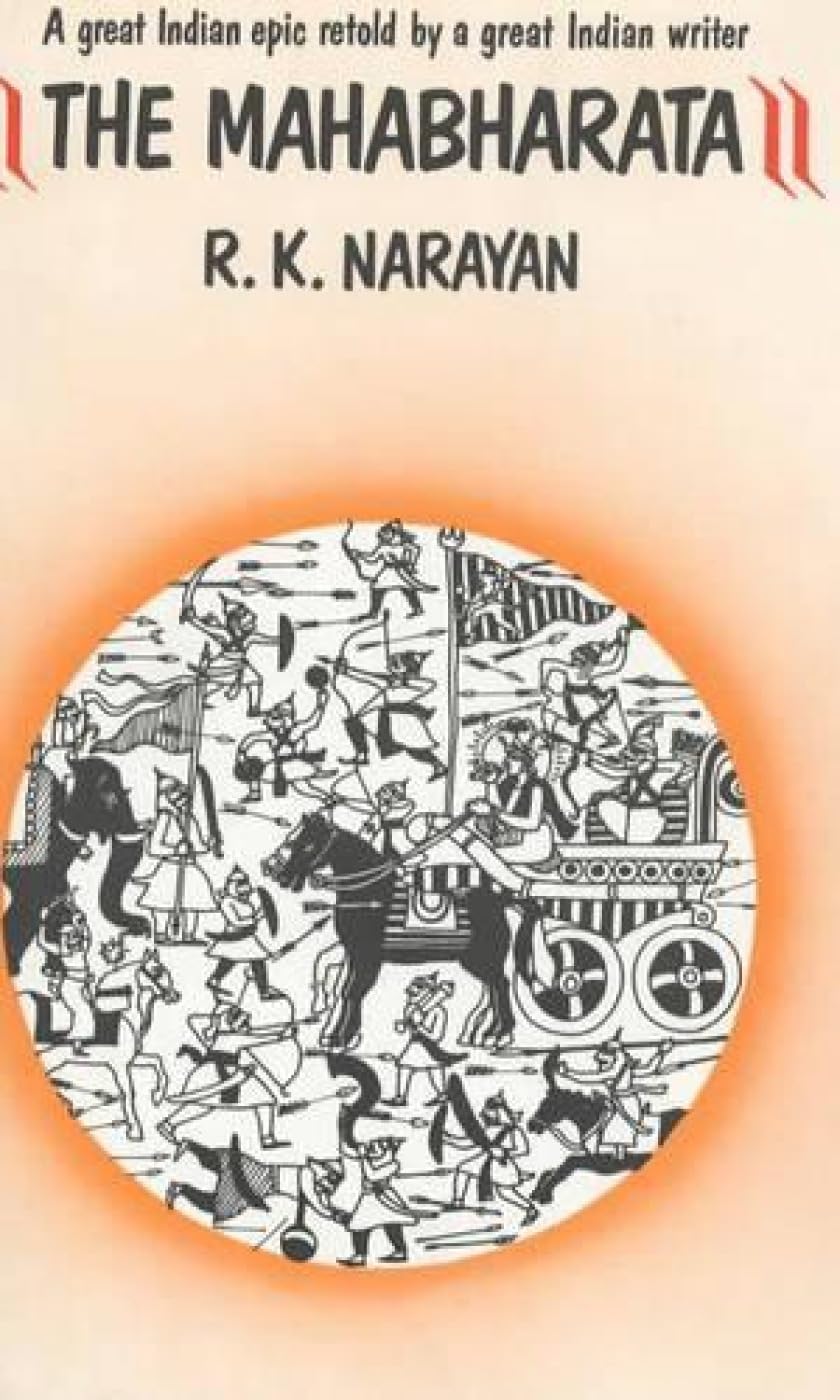
About The Mahabharata Book by R. K. Narayan
Some stories are so large that new readers do not know where to begin. The Mahabharata has many people, long family lines, great vows, hard choices, and a huge war. Its full form can feel difficult for anyone meeting the epic for the first time. The Mahabharata Book by R. K. Narayan gives you a shorter and clearer path into this great Indian story.
R. K. Narayan keeps the main tale and tells it in smooth English prose. He brings the Pandavas, the Kauravas, Draupadi, Krishna, Karna, Bhishma, Drona, and many other key people onto the page without making the reader carry every side story found in the ancient epic. The result is quick to follow but still full of courage, pride, duty, love, loss, and deep questions about right and wrong.
It is a shortened modern retelling made for general readers. That difference is one of its greatest strengths. You can understand the central family struggle, the road to the Kurukshetra war, and the painful cost of victory without starting with many large volumes.
A Great Story That Can Feel Hard to Enter
Many people want to read the Mahabharata but stop before they begin. They may know the names of Arjuna and Krishna, or they may have heard about the Bhagavad Gita, yet the size of the original epic feels frightening. New readers can also become confused by the wide family tree and the many tales inside other tales.
Narayan solves this problem by staying close to the main road. His version begins with the family past that shapes the coming conflict. It explains the rise of the Pandavas and Kauravas, their training, their growing hate, the game of dice, the long exile, the failed search for peace, the war, and what follows after it.
The story remains rich, but the reading becomes easier. You do not need to be a scholar or know Sanskrit. You do not need to study Indian history before opening the book. Narayan guides you from one major event to the next with a calm voice and clear order.
Two Sides of One Family
At the heart of the book are two groups of cousins. The five Pandava brothers are Yudhishthira, Bhima, Arjuna, Nakula, and Sahadeva. Their cousins are the Kauravas, led by Duryodhana. Both sides grow up close to power, but envy and fear slowly turn family ties into open hate.
Yudhishthira wants to follow dharma, or the right path, but even he makes choices that cause great harm. Bhima is strong and fierce. Arjuna is a gifted warrior who must face a terrible inner struggle. The younger brothers add loyalty and balance. Together, the Pandavas are brave, yet Narayan does not show them as simple, perfect heroes.
Duryodhana is proud, angry, and unwilling to share power. His choices push the family toward war, but the story also shows how advice, friendship, old promises, and wounded pride shape him. Karna stands beside him with fierce loyalty. Karna’s hidden birth and painful place in society make him one of the most moving people in the epic.
Draupadi is central to the turning of the story. Her public shame after the game of dice becomes a wound that the family cannot easily close. Bhishma carries the weight of an old vow. Drona teaches warriors on both sides. Krishna offers guidance, strategy, and a wider view of duty. Each person adds another layer to the question: what should someone do when every choice brings pain?
From Palace Games to the Field of War
The early parts of the story build the roots of the conflict. The young princes train together, compete for honour, and learn the arts of war. Jealousy grows as the Pandavas gain love and success. Danger follows them through plots, exile, and a house built to burn.
The Pandavas survive and later marry Draupadi. They build a strong kingdom, but peace does not last. Duryodhana’s envy grows after seeing their wealth and power. A game of dice is used to take away their kingdom, freedom, and honour. Yudhishthira loses almost everything, and the brothers must live away from home for years.
When the exile ends, the Pandavas ask for a fair return of their land. Peace is still possible, and Krishna tries to stop the coming bloodshed. Pride closes that door. Both sides gather their armies at Kurukshetra, where teachers, friends, cousins, sons, and grandfathers must fight people they once loved.
Before battle, Arjuna looks across the field and loses the will to fight. He sees family and teachers on both sides. Krishna speaks to him about action, duty, the soul, and the need to act without being ruled by reward. This exchange is linked to the Bhagavad Gita, although Narayan gives it only a brief place in his shortened retelling.
The war lasts eighteen days. It contains brave acts, broken rules, clever plans, grief, and terrible loss. Victory does not bring simple joy. Those who remain must face what their choices have done. The ending asks readers to think about whether any throne can repay the cost of such a war.
Clear Prose from a Master Storyteller
R. K. Narayan is loved for writing that feels simple while carrying deep meaning. In this retelling, he uses direct prose instead of trying to copy the full poetic form of the Sanskrit epic. The sentences move quickly, and the main events remain easy to see.
His tone makes old kings, warriors, sages, and gods feel close to human life. People become angry, make promises, hide truths, love their families, and regret their acts. The setting is ancient, but many feelings are familiar. A fight over power can begin inside a home. One proud choice can hurt a whole family. Silence can become as harmful as action.
The fast pace is helpful, but readers should know the trade-off. Many smaller stories, long talks, and fine details are left out. Anyone who wants the complete epic will need a longer translation later. For a first meeting with the central story, however, Narayan offers a welcoming door.
Big Ideas Told Through Human Choices
The Mahabharata is famous because it does not give easy answers. Good people can make harmful choices. A person may keep one promise and break another duty. A victory may look right from one side and cruel from the other. Narayan keeps these hard questions alive even in a shorter form.
- Dharma and duty: People must decide what is right when family love, law, honour, and personal need pull them in different ways.
- Power and envy: The wish to own more can destroy trust and turn relatives into enemies.
- Promises: Vows give strength, but an old promise can also trap a person when life changes.
- Justice: The story asks whether justice can come through war and who pays when leaders fail.
- Friendship and loyalty: Karna’s bond with Duryodhana shows both the beauty and danger of standing by someone.
- Women and dignity: Draupadi’s treatment shows how public wrong can shape the fate of a whole kingdom.
- Fate and choice: Signs and old causes matter, yet each person still chooses how to act.
- The cost of war: The winners lose people they love, making victory feel heavy rather than bright.
Why This Version Works for New Readers
The full Mahabharata is one of the longest epics in world literature. A complete version can take a long time and may include many names, teachings, and side stories. Narayan selects the main events that shape the lives of the central people and presents them within readable limits.
This makes the book a strong starting point for students, busy adults, young people moving toward classic literature, and anyone who wants the main story before reading a larger edition. It also suits readers who have seen films or television versions and want to understand how the major events connect.
Because the book is short compared with the complete epic, it works well for group reading. A family can discuss one part at a time. A reading club can compare the choices of Arjuna, Karna, Yudhishthira, Bhishma, and Duryodhana. Teachers can use the prose retelling as an opening to talks about epic literature and Indian culture.
Who Will Enjoy This Book?
Choose this retelling if you enjoy myths, family drama, classic stories, moral questions, war tales, or books about leadership. It is also a good choice if you want to meet the Mahabharata but feel unsure about starting a very long translation.
Readers who like only light stories should know that the book contains war, death, public shame, revenge, and grief. These events are important to the epic and may feel heavy. The prose is clear, but the ideas deserve slow thought.
This version is not the best choice for someone seeking every verse or every smaller tale. It is an introduction to the main path, not a replacement for the complete Sanskrit epic. That makes it honest, useful, and easy to place at the start of a longer reading journey.
Read It in the Way That Suits You
You can read the book from start to finish like a fast-moving family saga. You can also keep a simple list of names as you read. Writing down each person’s family side and main promise can make the story even easier to follow.
For deeper reading, pause after the game of dice, Arjuna’s doubt, Karna’s key choices, and the end of the war. Ask who acted fairly, who stayed silent, and whether another path was possible. These questions can turn a short reading session into a rich talk.
The book can be used for personal reading, school support, book-club discussion, cultural learning, or a thoughtful gift. It can also prepare you for a longer Mahabharata translation later. Once the main people and events feel familiar, a larger edition becomes much less difficult.
A Premium Copy for Many Returns
Bookish Wonderland offers a comfortable English copy made for readers who want to keep this classic close. Premium eye-soothing cream paper gives the page a soft background, while crystal-clear printing keeps names and lines sharp and easy to read.
High-quality stitched and glue binding helps the pages stay secure through repeated reading. This lasting build is useful for a story you may return to for family talks, study, or quiet thought. The book can sit well on a study desk, bedside table, or shelf of world classics.
Easy Ordering Across Bangladesh
Bookish Wonderland delivers inside Dhaka and throughout the country. Cash on Delivery is available nationwide, so you can pay when the book reaches you. Customers in Dhaka may also request fast or urgent delivery when the option is available for their area.
If you are comparing the Book price in Bangladesh, The Mahabharata by R. K. Narayan offers a clear way to enter one of the world’s greatest epics without beginning with a huge set. Order it for yourself, a student, a family member, or a reader who loves classic tales with deep meaning.
Best Sellers Rank of This Book
- #663,836 in Books
- #3,361 in Classic Literature & Fiction
- #26,968 in Literary Fiction (Books)
Begin the Great Journey Today
You do not need to know every name before you begin. R. K. Narayan leads you through the central story with care, speed, and clear words. The family struggle pulls you forward, while the choices of its heroes and rivals stay in your mind after the final page.
Bring home The Mahabharata Book by R. K. Narayan from Bookish Wonderland today. Read it for the action, keep it for the wisdom, and share it with someone who wants a friendly first step into this great Indian epic.
If you require any customization or have any questions, please inbox us via FB or Insta.
| Primary Specification | |
| Author | R. K. Narayan |
| Genre | Indian mythology, epic literature, classic literature, Hindu mythology, literary fiction, spiritual fiction |
| ISBN-13/ISSN | 978-0226568225 |
| ISBN-10 | 0226568229 |
| Publisher | University of Chicago Press |
| Publishing Date | October 15, 2000 |
| Edition | 1st |
| Language | English |
| Reading Age | 18+ |
| Format | Printed book |
| Physical Specification & Quality | |
| Paper Quality | Premium eye-soothing cream paper |
| Binding Quality | High quality stitched and glue binding (for longevity) |
| Print Quality | Crystal-clear print |
| Pages | 206 pages |
| Country | India |
| Logistics Information | |
| Weight | 213g |
| Length | 8.5 inch |
| Width | 5.6 inch |
| Height | 0.47 inch |