

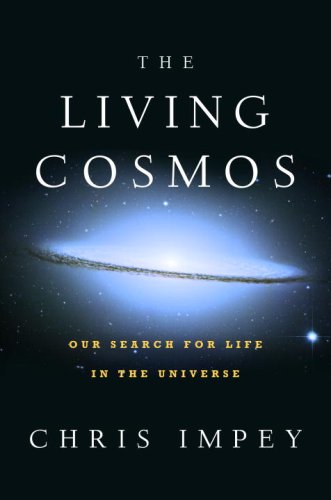
About The Living Cosmos Book by Chris Impey
Are we alone in the universe? Could tiny living things exist under the ice of a distant moon? Is there another planet where plants, animals, or smart beings look up at the sky and ask the same questions we ask? The Living Cosmos: Our Search for Life in the Universe by Chris Impey explores these great mysteries through astronomy, biology, chemistry, and the growing science of astrobiology.
This is a popular science book for readers who want to understand how life began, how it survives, and where else it may exist. Chris Impey takes a very large and difficult subject and turns it into an exciting journey. He starts with Earth, the only world where life is currently confirmed, and then looks outward to Mars, distant moons, planets around other stars, and the search for intelligent life.
The book does not promise easy answers. Instead, it shows how scientists study the question using evidence. Readers learn how telescopes, space missions, laboratory work, and discoveries on Earth help researchers search for signs of life. The result is a thoughtful book that makes the universe feel both larger and more personal.
The Question That Has Followed Humanity for Ages
People have looked at the night sky for thousands of years and wondered whether another living world exists. Today, this question is no longer only a dream found in stories. It has become a real area of scientific study.
The Living Cosmos by Chris Impey explains how astrobiology brings several fields together. Astronomers study stars and planets. Biologists examine living things. Chemists study the materials needed for life. Geologists investigate rocks, water, and the history of planets. Together, these experts try to understand where life might begin and survive.
Many readers are interested in space but feel lost when books use too many hard words or long equations. This book helps solve that problem. It presents important ideas in a story-led form and uses real scientific work to explain them. You do not need to be an astronomer to follow its central questions.
Chris Impey guides readers from what we know toward what remains unknown. That balance makes the book exciting. It gives enough science to teach the reader, but it also leaves room for curiosity, wonder, and careful thought.
A Journey from Earth to the Stars
The journey begins close to home. Before scientists can search for life on another planet, they must understand life on Earth. The book considers how life may have started and how it changed over a very long period.
Earth contains life in places that once seemed impossible. Some organisms survive in extreme heat, deep cold, darkness, salt, acid, or crushing pressure. These organisms are often called extremophiles. Their existence changes the way scientists think about habitable worlds.
If life can live in harsh places on Earth, it may also survive in difficult environments elsewhere. A cold moon, an underground ocean, or a dry planet may not be as lifeless as it first appears. This idea gives scientists new places to search and new kinds of evidence to consider.
Impey connects this biological story to the larger history of astronomy. He discusses the shift away from the old belief that Earth stood at the centre of everything. Each major discovery has changed our view of humanity’s place in nature. Finding life elsewhere would create another enormous change.
How Does Life Begin?
One of the hardest questions in science is also one of the simplest to ask: how did non-living matter become alive?
The Living Cosmos explores the conditions that may have helped early life appear on Earth. Water, energy, useful chemical elements, and a stable environment all matter, but having these things does not automatically create life. Scientists still study the steps that may connect basic chemistry to cells able to grow and reproduce.
The book helps readers see why this mystery is important. If life begins easily when the right conditions exist, the universe could contain many living worlds. If its beginning requires an extremely rare event, Earth may be unusual.
Impey does not treat a guess as a fact. He explains different possibilities and shows why scientific answers can change when better evidence becomes available. This approach teaches more than astronomy. It shows readers how science works: people ask questions, test ideas, examine results, and correct earlier beliefs.
Strange Life in Extreme Places
Life does not always need a warm field, fresh air, or bright sunshine. Some tiny organisms live deep inside rocks. Others survive near very hot vents on the ocean floor. Some can remain active in places with little food or light.
These examples expand the meaning of a habitable environment. A world may look hostile to humans and still offer a home to simple life. This is why scientists study harsh environments on Earth. Such places can act as natural models for conditions on Mars or icy moons.
The book encourages readers to move beyond the idea that alien life must look like a person, animal, or green creature from a film. The first life discovered beyond Earth may be microscopic. It may leave only chemical signs or patterns in rock.
This part of the discussion is especially useful for students. It connects biology with planetary science and shows why understanding Earth is necessary for exploring space.
Mars, Titan, and Ocean Worlds
The search then moves into our Solar System. Mars receives great attention because evidence shows that liquid water existed on its surface in the distant past. Scientists want to know whether that earlier environment could have supported life and whether signs of it may remain in rocks or below the ground.
Titan, Saturn’s largest moon, offers a very different setting. It has a thick atmosphere and lakes made from substances unlike Earth’s water-filled lakes. Studying Titan allows scientists to consider chemistry and life under unfamiliar conditions.
Other outer moons may hide liquid oceans beneath thick shells of ice. These secret oceans are exciting because liquid water is an important part of the search for habitable environments. A moon can be cold at its surface while heat inside keeps water from freezing completely.
Impey uses these worlds to show that the search for life is not limited to another Earth. Nature may create many kinds of homes. That lesson makes the Solar System feel richer and more surprising.
New Planets and New Possibilities
For a long time, people could only wonder whether stars other than the Sun had planets. Astronomers have now confirmed that planets exist around many other stars. These are known as exoplanets.
The Living Cosmos explains why this discovery changed the search for life. With more planets available to study, scientists have more chances to find places where useful conditions may exist. Some planets orbit close to their stars, while others stay far away. Some are giant balls of gas, and others may be rocky.
Scientists study the light from distant systems to learn about these worlds. They examine a planet’s size, orbit, temperature, and possible atmosphere. A planet in a suitable area around its star may be able to keep liquid water, although location alone cannot prove that life exists.
This section gives readers a clear view of how patient scientific work can turn an old dream into a real search. Every new planet adds another piece to the story.
What Would Count as Proof?
Finding life beyond Earth is not as easy as seeing an unusual mark in a photograph. Scientists must rule out other causes before they can make a strong claim.
Researchers may search for certain gases in an atmosphere, unusual chemical patterns, organic molecules, structures in ancient rock, or signals created by technology. However, one clue may have several explanations. A gas connected to life on Earth might be produced through a non-living process somewhere else.
The book helps readers understand the need for care. A major discovery needs strong evidence, repeated checks, and independent study. This protects science from exciting but weak claims.
That message is valuable in a time when surprising headlines travel quickly. The Living Cosmos teaches readers to ask where information came from, what the evidence shows, and whether another explanation is possible. It supports both curiosity and healthy doubt.
The Search for Intelligent Neighbours
Simple living cells and intelligent civilizations are very different subjects. Even if basic life is common, advanced beings able to send signals may be rare.
Chris Impey introduces the scientific search for extraterrestrial intelligence, often called SETI. Researchers listen for signals that may have an artificial source. They also consider the enormous distances between stars and the difficulty of communication across space.
The book discusses the Drake equation, a tool used to organize questions about the number of communicating civilizations that may exist. It is not a machine that gives a certain answer. Instead, it divides a huge mystery into smaller factors, such as the number of suitable stars and the chance that intelligent life develops.
This invites readers to think carefully. A quiet universe does not prove that nobody is there. Civilizations may be too far apart, exist at different times, communicate in unexpected ways, or remain impossible for present technology to detect.
Why This Book Feels Meaningful
The Living Cosmos is not only about possible aliens. It is also about humanity, Earth, and the value of life.
When readers see how many conditions support our world, Earth can feel more precious. Our planet contains oceans, a useful atmosphere, a steady source of energy, and a vast web of living things. Even if life exists elsewhere, Earth remains the only home humans currently have.
The book can change the way readers view the night sky. Stars stop being simple points of light. They become suns that may have their own worlds. Planets stop being distant objects and become possible places with histories, weather, chemistry, and perhaps biology.
This wider view creates both wonder and humility. Humans are part of a universe much older and larger than any single life. Yet we have developed the ability to study it, ask questions about it, and send machines beyond Earth.
Written for Curious Readers
This book is a good choice for people who enjoy astronomy but do not have formal scientific training. It can also support students learning about space, evolution, biology, planetary science, or scientific reasoning.
Teachers may use its ideas to begin discussions about what life needs, how planets form, why evidence matters, and how new discoveries change old theories. Book clubs can discuss whether life is likely to be common and how confirmed alien life might affect society.
Science-fiction readers may also enjoy the book because it separates real scientific possibilities from pure imagination. It offers a factual base for thinking about alien environments and future discoveries.
The writing rewards patient reading. Some ideas are large, but the central journey stays clear: understand life on Earth, examine other environments, and explore how scientists search for evidence beyond our planet.
What You Will Discover
The Living Cosmos offers a broad introduction to several connected areas of science without turning the reading experience into a dry textbook.
Key features include:
-
An accessible introduction to astrobiology and its major questions
-
An exploration of how life may have begun on Earth
-
Examples of organisms surviving in extreme environments
-
Discussion of Mars, Titan, and other possible habitats
-
An introduction to planets orbiting distant stars
-
Insight into SETI and the search for intelligent life
-
Explanations of evidence, uncertainty, and scientific testing
-
A wide view that connects astronomy, biology, chemistry, and evolution
Each topic supports the book’s central question. Readers see that searching for life requires more than pointing a telescope at the sky. It demands knowledge from many fields and careful cooperation among researchers.
What Readers Can Gain
Reading this book can help you understand popular news about space missions, habitable planets, possible biological signs, and searches for distant signals.
It may also help you:
-
Build a clear foundation in astrobiology
-
Understand why water and chemistry matter in the search for life
-
Learn how scientists study worlds they cannot visit
-
Separate scientific evidence from unsupported claims
-
Develop stronger critical-thinking skills
-
Discover new interest in astronomy and biology
-
Appreciate Earth as a rare and complex living world
-
Discuss space science with greater confidence
These benefits make the book suitable for personal reading, study, classroom support, gifting, and science-focused collections.
A Premium Reading Experience from Bookish Wonderland
A fascinating science book deserves a physical edition that feels comfortable throughout a long reading session. Bookish Wonderland provides this title with reader-friendly production quality.
The premium eye-soothing cream paper offers a softer reading surface than harsh bright-white pages. Crystal-clear printing keeps the text sharp and makes detailed explanations easier to follow. High-quality stitched and glue binding helps the pages remain secure through repeated reading, study, and shelf storage.
This combination creates a durable copy for readers who want to underline ideas, return to important sections, or keep the book in a personal science collection. It can also be a thoughtful gift for a student, teacher, space fan, or curious reader.
Customers looking for The Living Cosmos by Chris Impey book price in Bangladesh can order from Bookish Wonderland and receive delivery inside or outside Dhaka. Cash on Delivery is available nationwide, and customers in Dhaka may request a fast or urgent delivery option, subject to availability.
Is The Living Cosmos Part of a Series?
The Living Cosmos: Our Search for Life in the Universe is presented as a standalone popular-science work, not as a numbered novel or formal book series. Chris Impey has written other books about astronomy, space, and the universe, but they should not be described as volumes of one official series.
To maintain the requested product-page format, the book itself is listed below without adding unrelated titles.
Best Sellers Rank of This Book
-
#2,065,223 in Books
-
#800 in Astronomy & Astrophysics
-
#2,090 in Biology (Books)
-
#2,690 in Astronomy (Books)
Bring the Search for Life to Your Bookshelf
The Living Cosmos Book by Chris Impey is for anyone who has looked at the stars and wondered what may be waiting beyond Earth. It combines real science, major discoveries, open questions, and human curiosity in one wide-reaching journey.
Order your copy from Bookish Wonderland today and explore the science behind one of humanity’s greatest questions. Enjoy premium cream paper, crystal-clear print, durable stitched and glue binding, Cash on Delivery, and nationwide service. Whether you are buying it for study, personal discovery, or a gift, this book can open the door to a much larger view of life and the universe.
If you require any customization or have any questions, please inbox us via FB or Insta.
| Primary Specification | |
| Author | Chris Impey |
| Editor | Simon M. Sullivan |
| Genre | Popular Science, Astronomy, Astrobiology, Cosmology, and Nonfiction. |
| ISBN-13/ISSN | 978-0521173841 |
| ISBN-10 | 0521173841 |
| Publisher | Cambridge University Press |
| Publishing Date | June 2, 2011 |
| Language | English |
| Reading Age | 16+ years |
| Format | Paperback |
| Physical Specification & Quality | |
| Paper Quality | Premium eye-soothing cream paper |
| Binding Quality | High quality stitched and glue binding (for longevity) |
| Print Quality | Crystal-clear print |
| Pages | 412 pages |
| Country | United States |
| Logistics Information | |
| Weight | 426 gm |
| Length | 8.5 inches |
| Width | 5.6 inches |
| Height | 0.93 inches |