

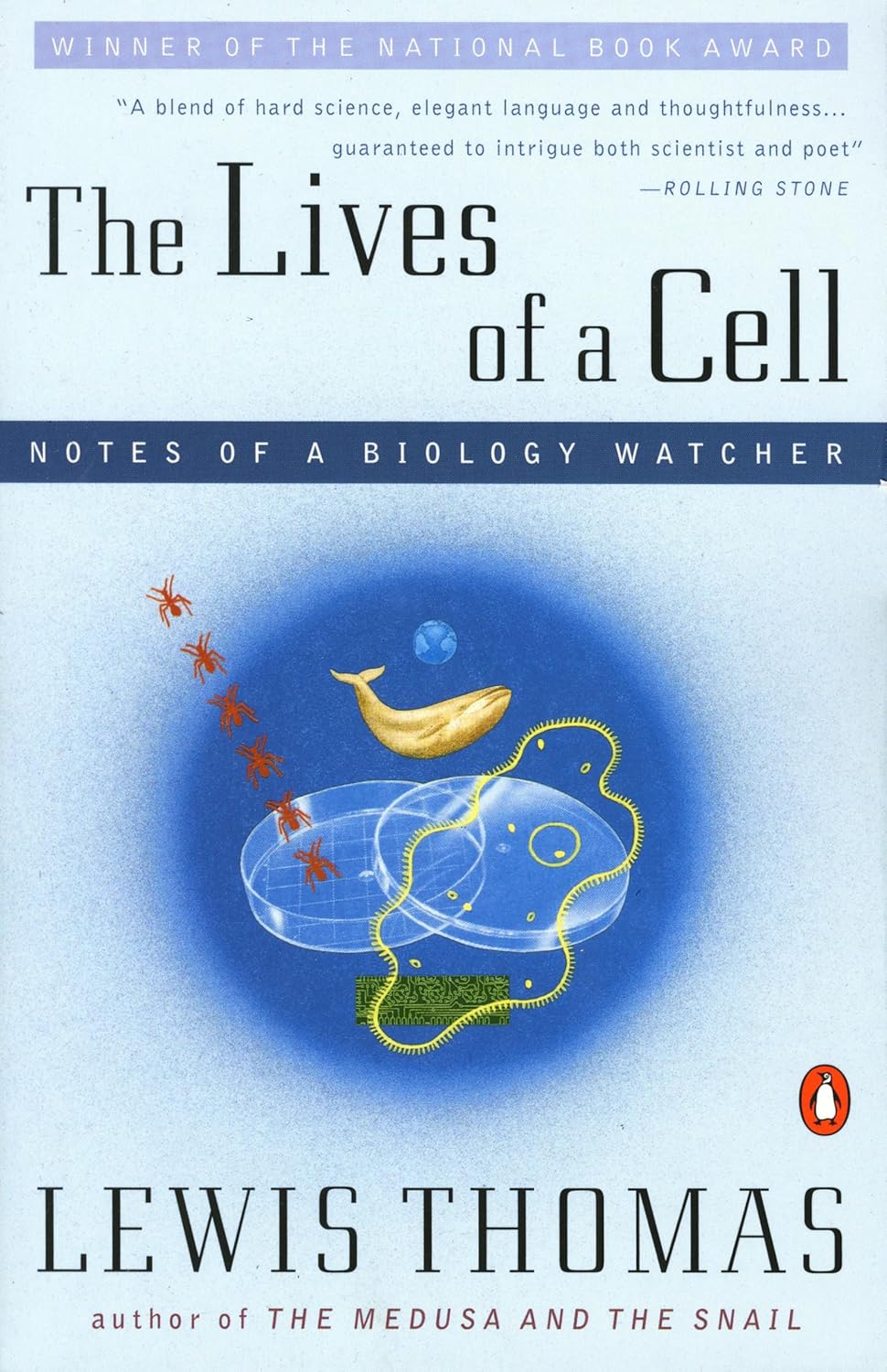
About The Lives of a Cell by Lewis Thomas – A Beautiful Journey Through Science and Life
What if your body is not one life, but a busy world made from many lives working together?
The Lives of a Cell by Lewis Thomas invites readers to look at cells, microbes, animals, people, and Earth with fresh wonder. This award-winning science book is a collection of 29 short essays. Lewis Thomas was a doctor, scientist, teacher, and gifted writer. He could take a small fact from biology and connect it to music, language, society, medicine, or the future of human life.
The title begins with the human cell. A cell is not a simple bag. It contains many working parts, and some of these parts may have begun long ago as separate living things. Thomas uses this idea to think about a much wider truth: life depends on connection. Humans need microbes, animals need plants, cells need their inner parts, and all living things depend on Earth.
The book is scientific, but it does not read like a school textbook. Its essays are thoughtful, curious, and often poetic. They help readers feel that science is not only a list of facts. It is also a way to notice how surprising life really is.
Science without the heavy textbook feeling
Many readers are interested in biology but feel tired when a book is filled with long definitions, equations, and facts to memorize. They may want to understand life without feeling as if they are preparing for an exam.
The Lives of a Cell offers a different way to learn. Lewis Thomas starts with real science, but he writes like a person thinking aloud. One idea leads naturally to another. A thought about bacteria may become a thought about human society. A cell may lead to the image of Earth as one living system. A discussion of communication may move toward language, computers, or music.
The short essay format also makes reading easier. You can read one piece, pause, and think about it before going on. You do not have to remember a long plot or follow one argument across hundreds of pages.
This makes the book a friendly bridge between science and literature. It gives curious readers important ideas while leaving room for wonder, questions, and imagination.
Your body is a community
One of the book’s most memorable ideas is that a human being is not fully alone. Our bodies contain cells, microbes, and tiny systems that work together every moment. We depend on these hidden lives for energy, digestion, protection, movement, and thought.
Thomas pays special attention to structures inside cells, including mitochondria. Mitochondria help cells make usable energy. The idea that they came from ancient independent organisms supports the book’s larger picture of life joining with life.
This changes the way a reader may think about the self. A person can feel like one clear individual, yet the body is also a group of living partnerships. We are both one and many.
Thomas does not use this only as a biology lesson. He asks what it may teach us about human communities. Just as parts of a cell depend on one another, people also depend on families, workers, neighbours, language, knowledge, and shared systems. Independence matters, but connection makes life possible.
That simple idea gives the book much of its warmth. Life is not shown only as a fight. It is also cooperation carried across time.
Earth seen as one great cell
The book moves from the tiny space inside a cell to the whole planet. Thomas suggests that Earth can be imagined as a living cell, with many different forms of life acting like connected parts.
This is not a claim that the planet is literally one ordinary cell. It is a way of seeing relationships. Air, water, plants, animals, microbes, and humans continually affect one another. Nothing living stands fully outside this system.
The image makes the planet feel both large and close. A change in one part can reach another part. The work of plants shapes the air. Tiny organisms help build and break down matter. Human choices can affect land, water, and other species.
For modern readers, this way of thinking can connect naturally with ecology and care for the environment. Thomas encourages humility. Humans are important, but we are not separate owners of nature. We are members of it.
From cells to language, music, and computers
The Lives of a Cell does not stay inside biology. Thomas writes about language, communication, insects, medicine, technology, death, and music. These subjects may seem far apart, but he finds links between them.
He is fascinated by the ways living things send information. Cells use chemical signals. Animals use sound, movement, and scent. People build language, books, machines, and networks. A group can sometimes do things that one member cannot do alone.
Thomas also writes with love for music, especially Bach. Music becomes another example of pattern and communication. It can carry order, feeling, and meaning without needing a scientific explanation for every part.
His thoughts about computers and shared information were written before today’s internet became part of daily life. Some details belong clearly to the 1970s, yet his interest in connected human knowledge can feel surprisingly close to the modern world.
These wide topics keep the collection lively. Readers never know exactly where the next essay will travel, but the main idea remains clear: life becomes richer when we notice its connections.
What you will find in these essays
-
Twenty-nine short essays that can be read one at a time
-
Clear reflections on cells, microbes, mitochondria, and genetics
-
The idea of Earth as a connected living system
-
Discussions of symbiosis and cooperation in nature
-
Thoughts about medicine, illness, healing, and scientific limits
-
Links between biology, language, music, insects, and computers
-
A doctor’s view of the mystery inside ordinary life
-
Scientific ideas explained through images and comparisons
-
Questions about human society and our place in nature
-
Writing that blends science, philosophy, and literature
This range makes the book useful for more than one kind of reader. Someone may open it for biology and stay for the writing. Other readers may enjoy its philosophy while discovering a lasting new interest in cells.
Why this small book still matters
The Lives of a Cell was first published in 1974, during a time of fast change in genetics and molecular biology. It won the 1975 National Book Award in Arts and Letters and the Sciences.
Science has continued to develop since then. Some explanations, examples, and guesses should be read as products of their time rather than the final word on current biology. This is important for students who need the newest scientific information.
The book’s lasting value comes from something more than current facts. Thomas shows how a scientist can think with curiosity, care, and imagination. He helps readers see that a good question may connect many fields. He also shows that clear writing can make science feel personal without removing its mystery.
Modern research has added much to what we know about cells, microbes, genes, and ecosystems. Even so, the central picture of deep connection remains powerful. The book can encourage readers to study newer science while keeping a sense of wonder.
That balance makes it both a classic of science writing and a starting point for further learning.
Who will enjoy The Lives of a Cell?
This book is a good choice for readers who enjoy popular science, biology, medicine, nature writing, philosophy, or thoughtful essays. It is also suitable for people who want scientific ideas presented with beauty rather than in textbook form.
You may enjoy it if you like:
-
Short essays that fit into a busy reading day
-
Science explained through everyday images
-
Books about nature and the environment
-
Questions about cooperation, society, and human identity
-
Writing that moves between facts and philosophy
-
Medical reflections written for general readers
-
Classic books that changed science communication
-
Ideas that lead to long conversations
Basic knowledge of biology can help with a few terms, but readers do not need an advanced degree. The author’s comparisons make many ideas easier to picture.
The book may not suit someone looking for a modern biology textbook, step-by-step lessons, or the latest medical advice. It is an essay collection from the 1970s, written to inspire thought rather than prepare students for a current science examination.
A premium copy for calm, thoughtful reading
Short essays are easy to revisit, underline, and discuss. Bookish Wonderland offers this printed English edition with materials designed for comfortable reading and regular use.
-
Premium eye-soothing cream paper gives the pages a soft, warm appearance.
-
Crystal-clear print keeps scientific names and detailed sentences sharp.
-
High-quality stitched and glue binding helps the pages stay secure.
-
Durable construction supports rereading, study, notes, and sharing.
-
The printed format gives readers a quiet break from screens.
These features make the copy suitable for a home library, school or university reading, a science club, or a thoughtful gift. The cream paper supports longer reading sessions, while the strong binding helps the book remain useful when favourite essays are opened again.
Easy ways to read and use the book
Read one essay during a short break, or use the collection for study and group discussion. Students can examine its science metaphors, while teachers can select essays about cells, ecology, medicine, or language. It also makes a gift for curious readers.
The Lives of a Cell by Lewis Thomas price in Bangladesh
Readers searching for The Lives of a Cell by Lewis Thomas price in Bangladesh can check the current amount on the Bookish Wonderland product page. Review the displayed price before ordering because prices and special offers may change.
Bookish Wonderland delivers inside Dhaka and throughout the country. Cash on Delivery is available nationwide, so customers can pay when the parcel arrives. Readers in Dhaka may also ask about fast or urgent delivery when they need the book sooner.
For help with an order, delivery, or special request, message Bookish Wonderland through Facebook or Instagram.
See life differently, one essay at a time
The Lives of a Cell begins with tiny structures that most people never see and opens them into a view of the whole living world. Lewis Thomas shows that every person is a community, every cell carries an ancient story, and every species belongs to a wider system.
This is the kind of book that can change the way you look at simple things. A breath, a plant, a bacterium, a song, or a group of insects may begin to feel like part of one connected story. The science brings knowledge, while the writing keeps wonder alive.
Order The Lives of a Cell from Bookish Wonderland today and discover why this short collection became a classic of science writing. Cash on Delivery is available across the country, with delivery inside and outside Dhaka. Fast or urgent delivery may be requested in Dhaka. For questions or customization, contact Bookish Wonderland on Facebook or Instagram.
If you require any customization or have any questions, please inbox us via FB or Insta.
| Primary Specification | |
| Author | Lewis Thomas |
| Narrator | Grover Gardner |
| Editor | Sabrina Bowers |
| Genre | Popular science, biology, nature writing and philosophy |
| ISBN-13/ISSN | 978-0140047431 |
| ISBN-10 | 0140047431 |
| Publisher | Penguin Books |
| Publishing Date | February 23, 1978 |
| Language | English |
| Reading Age | 15+ |
| Format | Printed Book |
| Physical Specification & Quality | |
| Paper Quality | Premium eye-soothing cream paper |
| Binding Quality | High quality stitched and glue binding (for longevity) |
| Print Quality | Crystal-clear print |
| Pages | 160 pages |
| Country | USA |
| Logistics Information | |
| Weight | 185 gm |
| Length | 8.5 inches |
| Width | 5.6 inches |
| Height | 0.47 inches |