

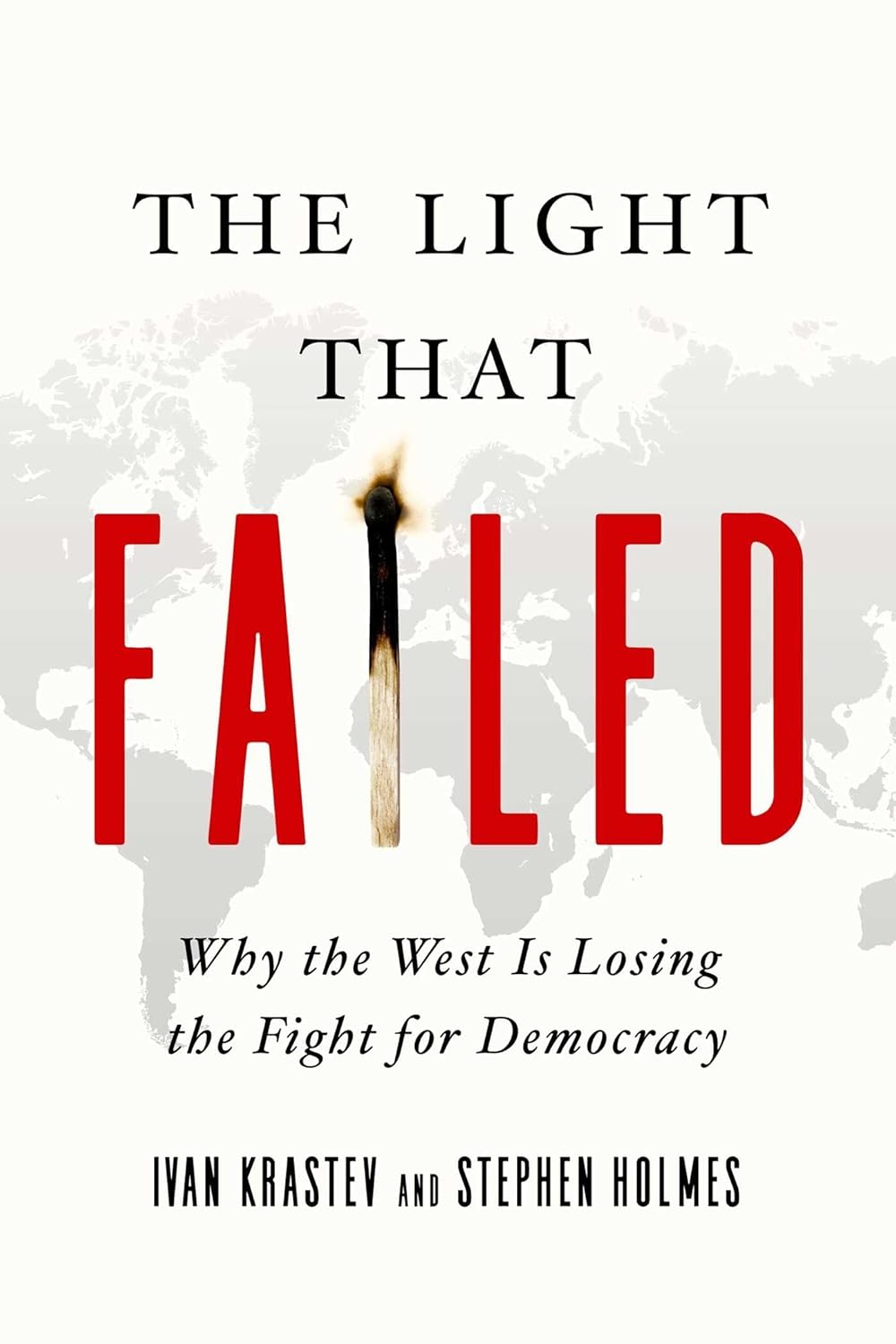
About The Light That Failed by Ivan Krastev and Stephen Holmes
Why did democracy appear to win the Cold War, yet lose so much public trust afterward? Why did countries that once wanted to copy the West later turn against Western ideas? Why did nationalism and populist politics grow in Europe, Russia, and the United States?
The Light That Failed by Ivan Krastev and Stephen Holmes explores these difficult questions through a clear and challenging study of recent political history. Its subtitle, Why the West Is Losing the Fight for Democracy, captures the central issue: the Western democratic model once seemed like the world’s certain future, but that confidence did not last.
After the fall of the Berlin Wall in 1989 and the collapse of communism in Europe, many leaders believed liberal democracy had won. Elections, free markets, open borders, civil rights, and Western institutions appeared to offer the best path forward. Countries in Central and Eastern Europe were encouraged to rebuild themselves by following Western European and American examples.
At first, this process looked hopeful. Over time, however, copying another political model began to cause resentment. Krastev and Holmes call this period the “Age of Imitation.” They argue that being told to become like someone else can create a painful feeling of being smaller, weaker, or less worthy. That feeling helped fuel anger against liberal politics and supported the rise of nationalist and populist leaders.
This is an important book for readers who want to understand the political world beyond short news reports and social media arguments. It does not simply say that voters became angry or that political leaders became more extreme. It looks deeper and asks where that anger came from, why it spread, and how the West may have helped create its own crisis.
When the Simple Political Story No Longer Works
For many years, the most common story about the Cold War had a simple ending: communism failed, the West won, and liberal democracy became the natural model for every country.
But real history did not follow that clean path.
Some post-communist countries adopted elections, laws, markets, and institutions based on Western models. Yet many people began to feel that their own culture and national identity were being treated as old, weak, or wrong. They were expected not only to learn from the West but also to become like it.
The authors help readers see why this difference matters. Learning from another society can be useful. Blindly copying it can create shame and resistance. When one country is always presented as the teacher and another as the student, the relationship does not feel equal.
The Light That Failed offers a way to understand this problem. It shows how imitation can first appear attractive and later feel humiliating. It also explains why leaders can turn that hurt into a powerful political message: “We will stop copying others and become ourselves again.”
That message has influenced politics in Hungary, Poland, Russia, the United States, and elsewhere. The book connects these cases without claiming that every country or leader is exactly the same. Its main goal is to uncover the shared feelings and historical forces behind the change.
A Fresh Look at the World After 1989
The book begins with the hope that followed the fall of communism. At that moment, many believed that more countries would naturally become democratic, open, and connected to the West.
Krastev and Holmes challenge that belief. They argue that the end of communism did not bring the final victory of democracy. Instead, it started a long period in which different countries copied, changed, resisted, or mocked Western political practices.
Central and Eastern Europe form a major part of the discussion. After decades of communist rule, joining the democratic West seemed to promise freedom, safety, wealth, and a more normal life. Western laws and institutions were therefore treated as models to follow.
But copying also created a ranking. The West appeared to be the completed model, while Eastern Europe appeared to be an unfinished copy. The authors argue that this unequal relationship produced frustration. Nationalist politicians later used that frustration to reject outside pressure and present themselves as defenders of local identity.
The discussion then turns to Russia. Rather than simply copying Western democracy in good faith, Russian power holders often copied its appearance, language, or actions for different purposes. The authors describe how Russia could point to Western behavior to challenge Western moral authority. It could use the West’s own words and examples as a mirror, suggesting that Western governments did not always obey the values they promoted.
The United States also appears in this story. The book considers how Donald Trump’s “America First” politics rejected the idea that America should remain a model for the rest of the world. In the authors’ interpretation, the country that others were told to copy began to fear that global change had weakened its own identity and power.
China provides another important contrast. Instead of accepting the full Western political model, China adopted useful technologies and economic methods while keeping its own political system. Its rise showed that economic growth and global strength did not always require Western-style liberal democracy.
The Powerful Idea at the Heart of the Book
The most memorable idea in The Light That Failed is that imitation can produce resentment.
People often copy something because they respect or desire it. A country may copy another country’s laws because they appear successful. A government may adopt foreign institutions because it wants greater trust, trade, or international support.
But imitation is not always comfortable. The person or country being copied becomes the standard. The imitator may feel judged, watched, or treated as a weaker version of someone else.
The authors use this human feeling to explain a large political change. They argue that the demand to copy the West was not only a technical plan for building courts, elections, and markets. It also affected pride, identity, memory, and belonging.
This makes the book different from a simple guide to political systems. It studies the feelings beneath public policy. It asks how humiliation can become anger, how anger can become nationalism, and how nationalism can help leaders gain power.
The argument is bold and open to debate. Readers do not need to agree with every claim to gain value from the book. In fact, some reviewers have questioned whether imitation alone can explain such a large and complex political shift. Others have argued that the authors give too little attention to economic inequality, racism, colonial history, or contradictions within Western liberalism.
These disagreements make the book useful for study and discussion. It gives readers a strong idea to test against history rather than asking them to accept an easy answer.
Clear Political History Without a Dry Textbook Feeling
Political books can feel heavy when they use too many hard terms or expect readers to know every historical event. The Light That Failed handles a large subject in a focused form.
The authors move across Europe, Russia, the United States, and China, but they connect these places through one main question: What happened when the Western model changed from one possible path into the path everyone was expected to follow?
This focus helps the reader keep track of the argument. The book brings together political history, public feeling, national identity, migration, leadership, and international power. It shows that democracy is not only a set of rules. It also depends on trust, dignity, choice, and the belief that people have a real voice in their future.
The writing is aimed at serious adult readers, but it is not limited to university teachers or political experts. Students, journalists, researchers, civil-service candidates, policy readers, and thoughtful general readers can all find useful ideas here.
Publishers Weekly described the work as an incisive analysis of Western liberalism’s decline, especially through the experience of Central and Eastern Europe after the Berlin Wall fell. The review also praised the clarity with which the authors handle a discouraging subject.
What You Will Discover While Reading
This book can help you understand why the political hope of the early 1990s did not produce the future many people expected.
You will learn how the authors define the “Age of Imitation” and why they connect it to the rise of anti-liberal politics. You will also see why copying Western institutions could first feel like freedom and later feel like a loss of identity.
The book examines how large numbers of young and educated people left parts of Central and Eastern Europe. This movement created more than an economic problem. It also increased fears about population loss, cultural survival, and national identity. Some political leaders used these fears to build support for closed borders and stronger nationalist policies.
Readers will also explore how Russia used selective imitation to challenge the West, how American politics turned against globalization, and how China gained strength without presenting itself as a copy of Western democracy.
Most importantly, the book encourages readers to question simple ideas about political progress. A country cannot become democratic only by copying another country’s laws. Institutions must fit local life, earn public trust, and allow people to feel that they are shaping their own future.
Features That Make This Book Worth Reading
-
A focused explanation of the crisis facing liberal democracy
-
A close study of post-1989 Central and Eastern Europe
-
Discussion of nationalism, populism, migration, identity, and political pride
-
Analysis of political developments in Europe, Russia, America, and China
-
A strong central idea that is easy to remember and discuss
-
Useful context for understanding the post-Cold War world
-
Arguments that can support essays, debates, research, and classroom discussion
-
A balanced opportunity to consider both the appeal and weakness of Western liberalism
-
A serious political study presented in a compact and readable form
-
Insights for readers interested in democracy, European politics, political theory, and modern history
How This Book Benefits the Reader
Reading The Light That Failed can improve the way you understand political news. Instead of viewing each election or political movement as a separate event, you can begin to see connections between history, identity, fear, pride, and power.
The book can also strengthen critical thinking. Its argument is clear enough to examine and challenge. You can ask whether imitation really explains the growth of populism, whether economic factors deserve more attention, or whether the West applied its own values fairly.
For students, it provides themes for assignments about democracy, nationalism, European integration, Russia, globalization, and the Cold War’s legacy. For teachers and discussion groups, it offers many questions that can lead to meaningful debate.
For general readers, the main benefit is understanding. Political change often appears sudden when seen through daily headlines. This book shows how resentment can build over many years before it becomes visible in elections, public movements, or government policy.
It also reminds readers that political systems need more than success. They need humility and the ability to correct mistakes. When one model believes it has no rival and nothing left to learn, it may stop seeing its own weaknesses.
Who Should Read The Light That Failed?
This book is especially suitable for adult readers interested in:
-
Democracy and its modern challenges
-
European politics and political history
-
The fall of communism and its long-term effects
-
Nationalism and populist movements
-
Russia’s relationship with the West
-
American politics after globalization
-
Political theory and international relations
-
The rise of China as a global power
-
Research, university study, essays, and public debate
A beginner can read it to build a broad understanding of recent politics, although some basic knowledge of the Cold War will be helpful. An experienced reader can use it to test a new explanation against other political and historical theories.
This is not a neutral list of events or a simple step-by-step plan for fixing democracy. It is an argument-driven book. It asks readers to think, question, compare, and sometimes disagree. That is part of its value.
A Premium Reading Copy from Bookish Wonderland
Bookish Wonderland offers this important political title in a reader-friendly physical form made for regular use.
The book features crystal-clear printing, helping readers follow its detailed arguments without struggling with faded or unclear text. Premium eye-soothing cream paper creates a softer reading surface, especially during long study sessions.
High-quality stitched and glue binding gives the book added strength and helps keep the pages secure through repeated reading. This is useful for students and researchers who may return to important sections, underline ideas, or use the book for future reference.
These qualities make it a practical choice for a personal collection, study shelf, university reading list, or thoughtful gift. Instead of treating the book as something to read once and forget, you can keep it as a lasting reference on democracy and modern politics.
Useful for Study, Research, and Serious Discussion
A university student can use the book to understand post-Cold War political change. A political-science reader can compare its “Age of Imitation” argument with other explanations for democratic decline.
Teachers can use its themes to begin classroom conversations about national identity, European integration, populism, migration, Russia, and Western power. Debate groups can discuss whether countries should copy successful foreign institutions or create systems based more strongly on local history.
Journalists and content creators may find it useful for developing background knowledge before writing about democracy or European politics. Civil-service and competitive-exam learners can use it to gain a deeper understanding of international relations.
It can also be read slowly at home. You may want to keep a pen or notebook nearby because the book raises questions that continue beyond the page.
Understand the Crisis Behind Today’s Politics
The Light That Failed by Ivan Krastev and Stephen Holmes is for readers who want more than quick political opinions. It offers a powerful explanation of how hope turned into resentment after the Cold War and why the West’s apparent victory did not create a stable democratic world.
The book does not promise a simple cure. Instead, it gives you the history and ideas needed to ask better questions. Why do people reject systems they once wanted? Can democracy spread through imitation? How can political change respect national identity without supporting intolerance? What happens when the country presented as the model begins to doubt itself?
If you are checking The Light That Failed by Ivan Krastev and Stephen Holmes price in Bangladesh, Bookish Wonderland provides a premium, durable reading copy with convenient ordering support.
Cash on Delivery is available nationwide. Customers can order from inside or outside Dhaka, while fast or urgent delivery options are available in Dhaka. If you need help, customization, or delivery information, contact Bookish Wonderland through Facebook or Instagram.
Add The Light That Failed to your shelf today and discover one of the most thought-provoking explanations of why liberal democracy lost its confidence—and what that failure means for the world we now share.
If you require any customization or have any questions, please inbox us via FB or Insta.
| Primary Specification | |
| Author | Ivan Krastev and Stephen Holmes |
| Narrator | David de Vries |
| Genre | Political Science, Political History, Democracy, International Relations, European Politics, Contemporary Politics, Nonfiction |
| ISBN-13/ISSN | 978-0141988108 |
| ISBN-10 | 014198810X |
| Publisher | Penguin |
| Publishing Date | January 1, 2020 |
| Language | English |
| Reading Age | 18+ years |
| Format | Paperback |
| Physical Specification & Quality | |
| Paper Quality | Premium eye-soothing cream paper |
| Binding Quality | High quality stitched and glue binding (for longevity) |
| Print Quality | Crystal-clear print |
| Pages | 256 pages |
| Country | United States |
| Logistics Information | |
| Weight | 274 gm |
| Length | 5.6 inches |
| Width | 8.5 inches |
| Height | 0.59 inch |