

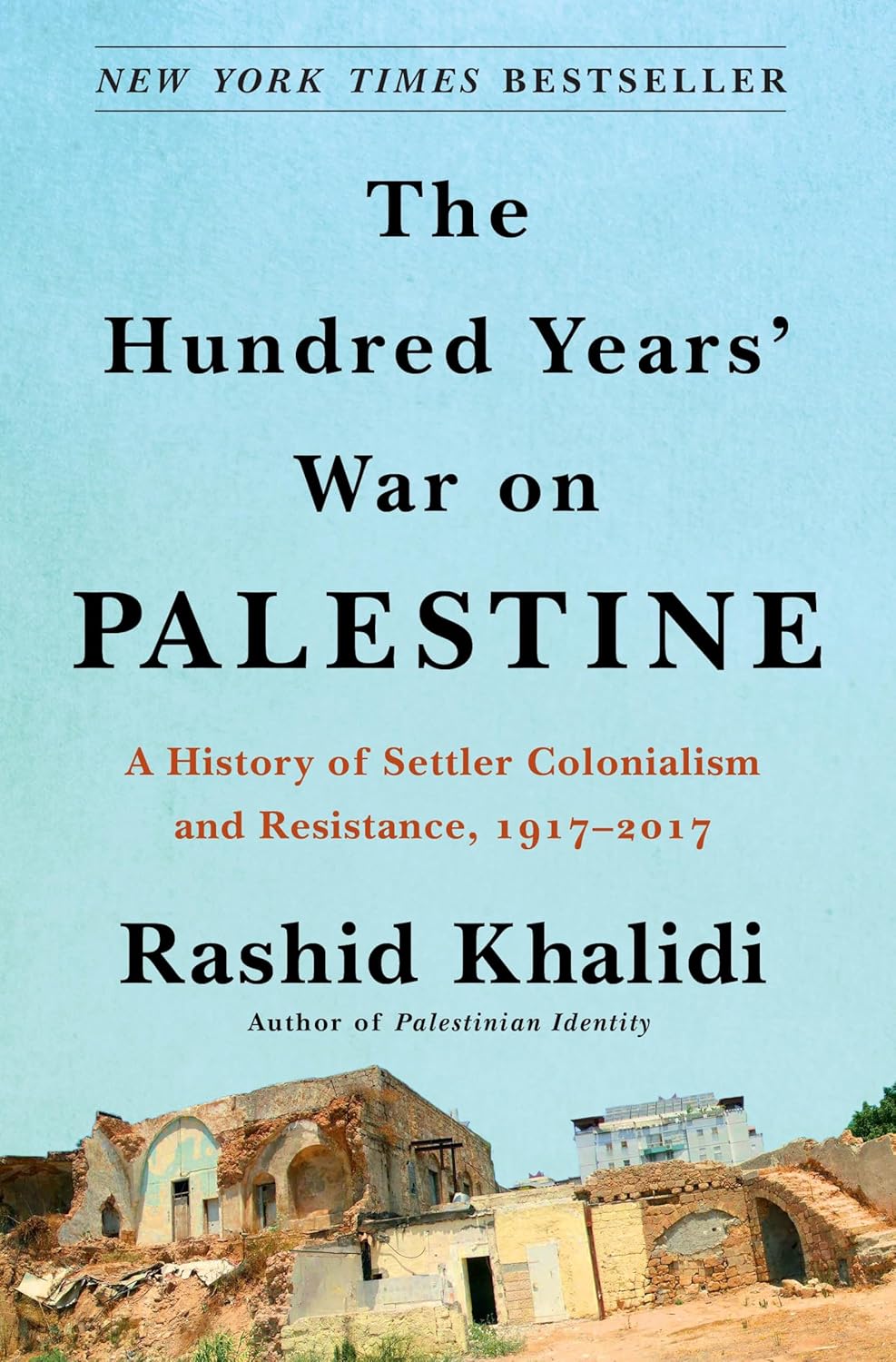
About The Hundred Years' War on Palestine by Rashid Khalidi
Some history books give dates, names, and maps. This book does more. The Hundred Years' War on Palestine by Rashid Khalidi asks readers to look at the modern history of Palestine through Palestinian eyes. It tells a long story of land, power, loss, resistance, diplomacy, and the struggle to be heard. Khalidi writes as a historian, but he also brings in the experiences of his own family. That mix makes the book feel both carefully researched and deeply human.
The story begins near the end of Ottoman rule and moves across one hundred years, from 1917 to 2017. It looks at major turning points such as the Balfour Declaration, the events of 1948, the 1967 war and occupation, the 1982 invasion of Lebanon, and the long peace process. Instead of treating these moments as separate pieces, Khalidi joins them into one clear argument. He says that the conflict should be understood as a long colonial struggle in which powerful states helped shape what happened to the Palestinian people.
This is not a light topic, and the book does not pretend that the past is simple. It asks hard questions about empire, national movements, war, leadership, and outside support. Khalidi also discusses mistakes made by Palestinian leaders. His purpose is not only to describe pain. He wants readers to understand how choices made by governments, movements, and leaders changed the lives of ordinary people.
For anyone who sees news about Palestine but feels lost in the history behind it, this book offers a strong place to begin. It gives a clear frame for events that are often explained in short, broken pieces. By the end, readers may not agree with every claim, but they will better understand an important Palestinian view of the last century.
When the News Gives You Only Part of the Story
Many people hear words such as Balfour Declaration, Nakba, occupation, intifada, Oslo, and peace process without knowing how they connect. News reports often start with the latest event. Social media may show one picture, one speech, or one argument at a time. This can leave readers with facts but no clear path through them.
The Hundred Years' War on Palestine offers a solution to that problem. Khalidi places key events in order and explains how one period led into the next. He organizes the history around six major moments that he presents as declarations of war against the Palestinian people. This structure helps readers see patterns across time instead of treating every crisis as completely new.
The book also gives space to voices that have often been missing from popular English-language accounts. Khalidi uses family papers, official records, public documents, and his own memories. Members of his family served as scholars, judges, diplomats, journalists, and public figures, so their records offer a close view of changing life in Palestine and the wider region. These personal materials do not replace historical research. They make the research easier to feel and remember.
A Century Told Through Six Major Turning Points
Khalidi opens with a warning sent in 1899 by Yusuf Diya al-Khalidi, a former mayor of Jerusalem and the author's great-great-uncle. The letter recognized the danger that political plans for Palestine could bring to the people already living there. From this family document, the book moves toward 1917 and the Balfour Declaration, when Britain supported the creation of a national home for the Jewish people in Palestine.
Khalidi argues that Britain made a promise about a land it did not own while giving too little weight to the wishes and political rights of its Arab majority. He then follows the growth of the Zionist movement, British rule, Palestinian resistance, and the rising struggle over land and political power. The book explains these developments as part of both local history and a larger age of empire.
The events of 1948 form another central point. Palestinians remember this period as the Nakba, or catastrophe, when many people were driven from or fled their homes and became refugees. Khalidi links that mass displacement to later questions about borders, citizenship, return, and national identity. Rather than presenting 1948 as an ending, he shows how it shaped every period that followed.
The book then examines the 1967 war and Israel's occupation of the West Bank, East Jerusalem, and Gaza. It also studies the rise of the Palestine Liberation Organization, the battles in Lebanon, and Israel's 1982 invasion. Khalidi was in Beirut during part of that war, so his account brings together public history and lived memory. Readers see large military and political decisions, but they also see what those decisions meant on the ground.
Later chapters address the First Intifada, the Oslo process, and the growing role of the United States. Khalidi asks why years of talks did not produce a free and fully sovereign Palestinian state. He examines the unequal power of the sides, the limits placed on Palestinian negotiators, settlement growth, and failures of leadership. This helps readers understand why words such as peace and process can mean very different things to different people.
What Makes This Book Important
The main value of this book is perspective. Many readers first learn about Palestine through accounts centered on European history, Israel, or United States policy. Khalidi changes the center of the story. He asks what the same events looked like to Palestinians and how Palestinian political life changed under repeated pressure.
He also rejects the idea that the conflict is simply an ancient fight between two equal groups. His argument focuses on modern colonial power, outside backing, unequal force, and control over land. Whether a reader fully accepts that frame or wants to test it against other works, understanding it is important. It shapes a large part of Palestinian scholarship, public debate, and political thought.
The book is also useful because Khalidi does not describe Palestinians only as silent victims. He writes about resistance, organization, diplomacy, cultural life, political action, and debate. At the same time, he is critical of poor decisions, division, weak strategy, and failures by Palestinian leaders. That balance gives the story more depth than a simple tale of heroes and villains.
For students, teachers, journalists, researchers, and careful general readers, the book can serve as a guide to names and events that appear again and again in discussions of the Middle East. For younger adult readers, it can build a base for more study. For experienced readers, its family archives and clear argument offer material to compare with other histories.
Features That Support Serious Reading
-
A wide historical path covering the years from 1917 to 2017
-
Six major turning points that give the long story a clear structure
-
A Palestinian-centered account written by a leading historian of the modern Middle East
-
Family papers and memories combined with archival and political research
-
Discussion of British and American roles in the history of the conflict
-
Attention to the Balfour Declaration, 1948, 1967, Lebanon, uprisings, and the peace process
-
Clear criticism of colonial power as well as failures in Palestinian leadership
-
Useful background for readers trying to understand present-day debates
-
A strong choice for personal study, university reading, research, or group discussion
These features make the book more than a list of events. They help the reader understand how stories are built, whose voices become central, and why the same history can look different from another point of view.
What You Gain From Reading It
After reading this book, you should have a stronger timeline of modern Palestinian history. You will know why 1917, 1948, 1967, 1982, and the Oslo years matter. You will see how Britain and the United States affected the political balance. You will also understand why questions about refugees, settlements, borders, sovereignty, resistance, and statehood remain connected.
The book can improve the way you follow news and public debate. Instead of meeting every new event without background, you will have a historical map. Names, places, and political claims will carry more meaning. You will be better able to notice when a speaker leaves out an important part of the story or presents a disputed view as the only possible one.
Reading it may also build empathy. Personal records show that history is lived by real families. Decisions made in government rooms can change where people live, whether they can return, and what future they can imagine. This human view can make difficult political ideas easier to understand without making them simple.
A Premium Copy Made for Long Reading Sessions
Bookish Wonderland offers this title as a premium printed book for readers who want comfort and durability. The eye-soothing cream paper is gentle during long reading sessions, especially when you are studying detailed chapters or making notes. The crystal-clear print keeps names, dates, and paragraphs sharp and easy to follow.
The high-quality stitched and glue binding is made for longevity. It helps the pages stay secure through repeated reading, class use, research, and shelf storage. This matters for a history book you may return to many times. It can remain part of your personal collection instead of feeling like a one-time read.
The book is also easy to place in a study routine. Read one major section at a time, mark key dates, and write a short note after each chapter. You can use it for private learning, a reading circle, a university discussion, or as a starting point for comparing several histories of Palestine.
If you are checking The Hundred Years' War on Palestine by Rashid Khalidi book price in Bangladesh, look beyond the cover alone. This Bookish Wonderland edition combines an important work with readable paper, strong binding, and clear printing, giving you lasting value for study and rereading.
Who Should Read This Book?
This book is a strong choice for readers who want to understand Palestine from a Palestinian historical view. It suits university students studying history, politics, international relations, colonialism, or Middle Eastern studies. Teachers and researchers may use it to support lessons, discussions, and further reading.
General readers can also benefit. You do not need to be an expert. If the news feels confusing, the book can help you build a timeline. If you already know the basic events, it can challenge you to look again from a different place. It is also useful for book clubs that want a serious work with many questions to discuss.
Because the subject includes war, death, displacement, and political violence, it is best suited to mature teens and adults. Parents and teachers can guide younger readers when needed. The book is especially rewarding for people willing to read patiently, check unfamiliar terms, and compare viewpoints.
This is not a neutral handbook that gives every side equal space. It is a clear, argued history from a Palestinian perspective. Readers should choose it when they want that perspective explained with depth, evidence, and personal connection.
Best Sellers Rank of This Book
-
#4,156 in Books
-
#2 in African Politics
-
#5 in Middle Eastern Politics
-
#5 in Israel & Palestine History (Books)
Bring the Full Story to Your Bookshelf
Order from Bookish Wonderland when you want a premium, durable copy made for real reading. We offer nationwide delivery across Bangladesh, service inside and outside Dhaka, and Cash on Delivery across the country. Readers in Dhaka can also ask about fast or urgent delivery when time matters.
Check The Hundred Years' War on Palestine by Rashid Khalidi book price in Bangladesh and add this major modern history to your collection today. Read it to learn, to question, and to understand why the past remains present. Whether you are beginning your study or adding a Palestinian voice to a wider reading list, this book deserves thoughtful attention, with care, patience, and open minds.
If you require any customization or have any questions, please inbox us via FB or Insta.
| Primary Specification | |
| Author | Rashid Khalidi |
| Narrator | Fajer Al-Kaisi, Rashid I. Khalidi |
| Editor | Riva Hocherman |
| Genre | History, Middle Eastern History, Israel and Palestine History, Political Science, Colonial History |
| ISBN-13/ISSN | 978-1250787651 |
| ISBN-10 | 1250787653 |
| Publisher | Metropolitan Books |
| Publishing Date | January 26, 2021 |
| Language | English |
| Reading Age | 18+ |
| Format | Printed book |
| Physical Specification & Quality | |
| Paper Quality | Premium eye-soothing cream paper |
| Binding Quality | High quality stitched and glue binding (for longevity) |
| Print Quality | Crystal-clear print |
| Pages | 336 pages |
| Country | United States |
| Logistics Information | |
| Weight | 343g |
| Length | 8.5 inch |
| Width | 5.6 inch |
| Height | 1 inch |