

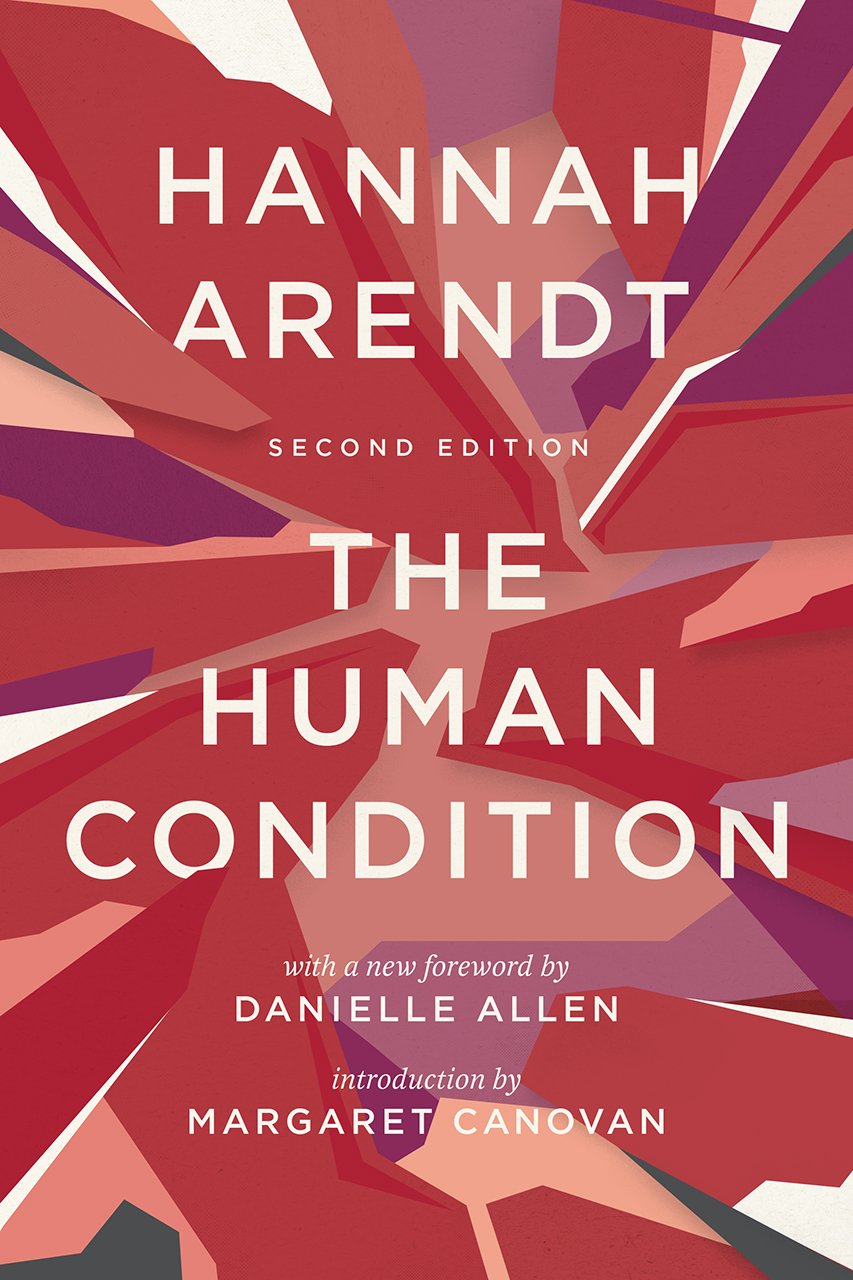
About The Human Condition by Hannah Arendt
Why do people work, build things, speak, and act together? Why do we need a shared world? What happens when daily survival becomes more important than freedom and public life? The Human Condition by Hannah Arendt asks these large questions and gives readers a new way to understand ordinary human activity.
First published in 1958, this important work of political thought studies what people do rather than trying to give one fixed meaning of human nature. Arendt calls this active side of life the “vita activa.” She separates it into three parts: labor, work, and action. These words may sound simple, but each one shows a different part of life.
Labor supports the body and keeps life going. Work makes objects and builds the human world. Action happens when people speak, meet, choose, and begin something new together. Arendt explains why these activities should not be treated as the same thing. When we mix them together, we may forget the value of freedom, shared responsibility, and public action.
This is not a medical book about the human body, and it is not a light self-help guide. It is a serious philosophy and political-theory book written for readers who want to think carefully about society, power, technology, freedom, and modern life. The ideas are deep, yet they connect with questions we still face at home, at work, online, and in public spaces.
When Modern Life Feels Busy but Empty
Many people spend each day completing tasks, earning money, buying goods, and trying to keep up. Life can become a long list of needs. We may become so busy that we stop asking what our work creates, how our choices affect others, or where real freedom can appear.
Arendt helps readers name this problem. She shows that staying alive, making useful things, and taking part in public life are different activities. All three matter, but they do not give the same kind of meaning. Food must be made again. A table may last for years. A brave public act may change how people live together.
By seeing these differences, readers can ask better questions about their own world. Are we only repeating the same cycle? Are we building something that can last? Are we speaking and acting with other people? The book does not give a quick rule for every problem. It gives a clear map for deeper thought.
Labor Keeps Life Moving
Labor is the activity linked to the needs of the body. People eat, clean, grow food, rest, and begin again. The results of labor are quickly used up because life always needs more care. Hunger returns, homes become dirty, and tomorrow brings new tasks.
Arendt does not say that labor is useless. No one can live without it. Her point is that labor follows a repeating cycle. It keeps us alive, but it does not automatically create a lasting public world. This difference becomes important when a whole society begins to judge everything by production, consumption, speed, and comfort.
Readers may see their daily routine in this idea. Modern tools can make tasks faster, but they do not remove every need. New products can save time while also creating new wants. Arendt invites us to notice when life is reduced to earning and consuming, with little room left for thought, shared purpose, or freedom.
Work Builds a Human World
Work is different from labor in Arendt’s account. Work creates things that can last longer than the act of making them. A chair, a house, a road, a painting, a law, or a book can remain after its maker stops working. These objects help form a stable world where human life can take place.
This lasting world gives people a sense of place. It connects one generation with another. We inherit buildings, tools, stories, and institutions, then repair or change them. Work therefore has a beginning and an intended end. A maker imagines something, chooses materials, and produces a result.
Yet making can also become dangerous when its logic is applied to people. A table can be planned and shaped, but human beings are not raw material. Political life cannot be safely controlled like a factory process. This warning helps readers think about leadership, planning, power, and the desire to force society into one perfect design.
Action Makes Freedom Visible
Action is the most openly political part of the book. It happens when different people appear before one another, speak, make promises, take risks, and start something that did not exist before. Action cannot be fully controlled because every person can respond in a new way.
Arendt connects action with human plurality. People share one world, but no two people are exactly the same. This mix of equality and difference makes speech and politics possible. If everyone were identical, there would be little need to explain a view. If people had nothing in common, they could not understand one another at all.
Action shows who a person is, not only what that person can produce. A public word, a courageous choice, or a shared movement can reveal character. It can also begin a chain of events that nobody can fully predict. For Arendt, this power to begin is one of the most hopeful parts of being human.
The Gift of a New Beginning
One of Arendt’s most memorable ideas is natality. It means more than physical birth. Every new person enters a world that already exists, yet each person also brings the ability to start something new. Human history is therefore never completely closed.
This idea offers hope without pretending that change is easy. People live among old rules, past mistakes, and systems built before they arrived. Still, they can speak, act, forgive, promise, and create new relationships. Freedom is not only an idea inside the mind. It becomes real through action with others.
Readers facing a fixed or unfair system may find this idea powerful. The future is not simply a copy of the past. A new beginning can appear when people gather, judge, and act. The result may be uncertain, but uncertainty is also what makes freedom possible.
Public Life, Private Life, and the Social World
The Human Condition also explores the difference between private and public life. The private home has traditionally held the needs of survival, family, and care. The public realm is where people appear before others, speak about a shared world, and take part in common decisions.
Arendt studies how these areas changed from ancient society to the modern age. She argues that the rise of the social realm blurred older lines between household needs and public action. Matters once handled privately became large public concerns, while economic thinking began to shape politics.
Her account can be debated, and many readers challenge parts of it. That is one reason the book remains useful. It pushes us to ask where important decisions happen, whose labor stays hidden, who gets to appear in public, and whether citizens are treated as active people or only as workers, buyers, and numbers.
Technology Changes More Than Tools
Arendt wrote during a time of rapid science, automation, and space travel. She saw that technology could change not only what people make but also how they understand Earth, nature, work, and themselves. These questions feel even stronger in a world shaped by artificial intelligence, social media, data, and machines.
The book helps readers ask whether faster systems always create a better life. A machine may reduce hard labor, but what will people do with the time it saves? Digital tools may connect millions, but do they create a true public space? Endless information may be available, but does it help people judge wisely and act responsibly?
Arendt does not offer a simple attack on technology. She asks readers to think about the kind of world technology builds and the human activities it may weaken or support. This makes her work valuable for students, teachers, leaders, creators, and anyone thinking about the future.
Why This Classic Still Matters
The book remains important because modern life still rewards speed, output, growth, and consumption. People are often measured by how much they produce or buy. Public discussion can become loud but empty. Shared facts may break apart, and people may feel alone even while connected to large networks.
Arendt’s ideas help readers slow down and separate survival, creation, and political action. Her framework can be used to think about employment, citizenship, climate responsibility, public debate, automation, democracy, and the design of common spaces.
The book does not need to be accepted without question. Strong reading includes agreement, doubt, and debate. Arendt’s view of ancient public life, household labor, and social questions has been challenged by later thinkers.
A Strong Choice for Study and Discussion
This standalone work is best for university students, teachers, researchers, thoughtful adult readers, and older readers interested in politics or society. It is especially useful for courses in political science, sociology, philosophy, history, cultural studies, and social theory.
New philosophy readers can also approach it with patience. You do not need to understand every page at once. Reading one section at a time, marking key terms, and writing small notes can make the argument clearer. A study group can discuss one idea, such as labor or action, and connect it with a current example.
The Human Condition by Hannah Arendt book price in Bangladesh may interest students building an academic library, teachers preparing a course, or readers seeking a classic work with lasting value. It is also a thoughtful gift for someone who enjoys serious questions about freedom, society, and the future.
What You Can Gain From Reading It
- A clear framework for understanding labor, work, and action
- A deeper view of freedom as something people practice together
- New questions about technology, consumption, and modern society
- A stronger understanding of public and private life
- Useful ideas for essays, classes, research, and group discussions
- A classic foundation for political philosophy and social theory
- A reason to think about what kind of shared world we are building
The greatest benefit is not a set of easy answers. It is a better way to ask questions. Readers learn to look past daily busyness and notice the activities, spaces, and relationships that make a common human world possible.
Made for Focused, Comfortable Reading
Bookish Wonderland prepares this printed book for readers who value comfort and durability. Premium eye-soothing cream paper creates a soft reading surface and helps reduce harsh glare during long study sessions. Crystal-clear printing keeps the detailed text sharp and easy to follow.
High-quality stitched and glue binding gives the book added strength for repeated use. This is helpful for a title that readers may underline, revisit, carry to class, or keep as a long-term reference. Careful printing and durable construction make it a dependable choice for personal and academic collections.
Best Sellers Rank of This Book
- #19,614 in Books
- #15 in Modern Western Philosophy
- #18 in Sociology of Social Theory
- #25 in Political Philosophy (Books)
Bring a Great Work of Political Thought Home
Bookish Wonderland offers a large premium and durable English book collection with delivery inside and outside Dhaka. Nationwide delivery is available across Bangladesh, and Cash on Delivery allows customers to pay when the order arrives. Fast or urgent delivery may also be requested in Dhaka when the book is needed sooner.
If you are comparing The Human Condition by Hannah Arendt book price in Bangladesh, choose a copy designed for serious reading and long-term use. This book can support study, sharpen discussion, and change how you see everyday activity. Order your copy today and begin exploring what people do, what freedom needs, and how a shared world can be built.
If you require any customization or have any questions, please inbox us via FB or Insta.
| Primary Specification | |
| Author | Hannah Arendt |
| Narrator | Elizabeth Wiley |
| Genre | Political philosophy, political theory, social theory, modern philosophy, nonfiction |
| ISBN-13/ISSN | 978-0226586601 |
| ISBN-10 | 022658660X |
| Publisher | University of Chicago Press |
| Publishing Date | October 18, 2018 |
| Edition | Second Edition |
| Language | English |
| Reading Age | 18+ |
| Format | Printed book |
| Physical Specification & Quality | |
| Paper Quality | Premium eye-soothing cream paper |
| Binding Quality | High quality stitched and glue binding (for longevity) |
| Print Quality | Crystal-clear print |
| Pages | 383 pages |
| Country | United States |
| Logistics Information | |
| Weight | 391g |
| Length | 8.5 inch |
| Width | 5.6 inch |
| Height | 1.1 inch |