

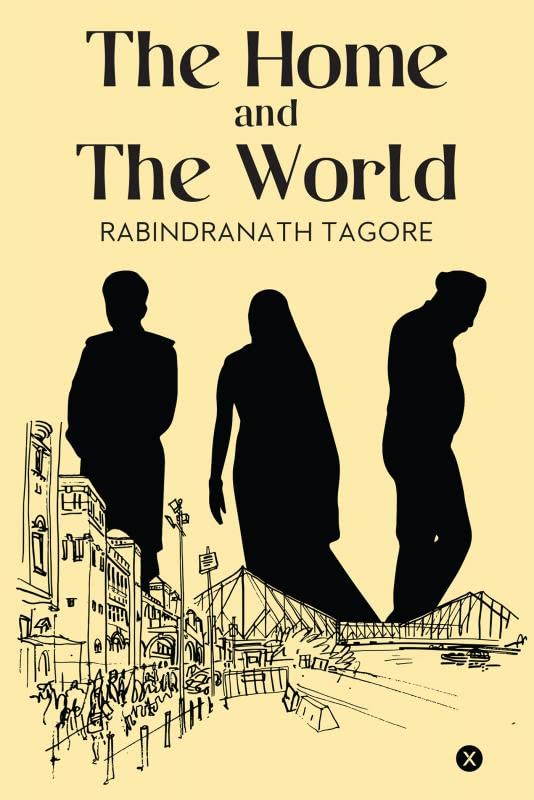
About The Home and the World by Rabindranath Tagore
The Home and the World by Rabindranath Tagore is a moving story about love, freedom, duty, and political power. The novel takes readers to Bengal in 1908, during the Swadeshi movement against British rule. It follows three people whose ideas and feelings slowly bring them into conflict.
Bimala is an educated woman who has spent most of her married life inside her home. Her husband, Nikhil, wants her to become more independent and learn about the world beyond the family house. He believes that real love must include trust and freedom.
Their quiet life changes when Nikhil’s friend Sandip arrives. Sandip is a powerful speaker and a passionate nationalist leader. His words make Bimala feel that she can serve her country and become part of something great. She is drawn to his energy, but his ideas and actions carry serious risks.
Through this emotional triangle, Rabindranath Tagore explores the difference between honest love and selfish desire, peaceful patriotism and violent nationalism, and the safety of home and the demands of the outside world.
A Woman Standing Between Two Worlds
Bimala begins the story inside her home. She loves her husband and respects the life they have built together. However, she has limited experience of the world outside the house.
Nikhil does not want Bimala to remain hidden from society. He wants her to meet people, form her own opinions, and choose her path freely. He believes that love should never become a cage.
This freedom sounds beautiful, but it also creates uncertainty.
When Sandip enters their lives, Bimala sees a new kind of world. He speaks with confidence and emotion. He presents himself as a brave leader who is ready to sacrifice everything for the country.
Bimala feels noticed and important around him. Sandip praises her and treats her as a symbol of the nation. His attention gives her a sense of power that she has not felt before.
Soon, her private feelings and political beliefs become mixed. She must decide whom to trust, what freedom means, and whether strong words always lead to good actions.
Love and Politics Meet in One Powerful Story
This novel is both a personal love story and a book about political change. The private lives of Bimala, Nikhil, and Sandip reflect the larger conflict happening in Bengal.
Bimala represents a person waking up to new choices. Nikhil represents reason, patience, and moral courage. Sandip represents strong emotion, ambition, and the dangerous side of political power.
The conflict is not shown through long history lessons. Readers experience it through conversations, choices, doubts, attraction, and broken trust.
That makes the political ideas easy to feel. The country’s struggle is not far away from the characters. It enters their home, changes their relationships, and forces each person to reveal what they truly value.
The story asks whether a noble cause can remain noble when leaders use fear, pressure, and dishonesty. It also asks whether people can love their country without hating others.
These questions give the novel lasting value. They remain important wherever politics, emotion, and identity become closely connected.
When Passion Hides the Truth
Sandip knows how to make people listen. His speeches are full of confidence, pride, and emotion. He understands what people want to hear and uses powerful language to gain support.
At first, this can make him appear brave and inspiring.
However, the novel slowly asks readers to look beyond his words. Does Sandip truly serve the country, or does he use the cause to serve himself? Is he willing to protect poor people, or does he only care about victory?
Bimala faces the same problem. She must learn that a charming voice is not always an honest voice. A person may speak about sacrifice while asking others to pay the real cost.
This part of the story feels very modern. People still face leaders, advertisements, and online messages that use emotion to influence decisions. Tagore reminds readers to ask who benefits from a movement and who suffers because of it.
The book shows that excitement can be powerful, but clear thinking is also necessary.
Nikhil’s Quiet Strength
Nikhil is very different from Sandip. He does not speak with the same fire, and he does not force people to follow him.
He believes in truth, kindness, freedom, and nonviolence. He supports his country, but he refuses to harm innocent people in the name of patriotism. He understands that poor families may depend on affordable imported goods and cannot easily join a boycott.
Some people may see his calm nature as weakness. Yet his quiet choices show a different kind of strength.
Nikhil is willing to let Bimala think for herself, even when her choices cause him pain. He does not want love that depends on control. He wants her feelings to be freely given.
His character raises an important question: is the loudest person always the bravest?
Through Nikhil, the book shows that moral courage may be calm. A person can resist injustice without losing kindness, honesty, or respect for human life.
Why Bimala Feels So Real
Bimala is not presented as a perfect woman who always makes the right choice. She is curious, emotional, intelligent, and sometimes confused.
Her mistakes make her human.
For much of her life, she has been protected inside the home. When she enters the political world, she has little experience to guide her. Sandip’s praise makes her feel important, while his cause gives her a new purpose.
Bimala wants to become more than a traditional wife. She wants to discover her own identity and take part in the life of her country. Those wishes are understandable and meaningful.
The danger begins when another person uses her hopes for his own goals.
Readers may disagree with some of Bimala’s choices, but they can understand why she makes them. Her journey shows how personal desire, public duty, love, pride, and political excitement can become difficult to separate.
This emotional honesty makes her one of the most memorable women in classic Bengali literature.
The Meaning of Home and World
The title holds the heart of the novel.
“Home” represents safety, marriage, private life, tradition, and the inner self. “World” represents politics, society, freedom, danger, and public action.
At first, these two places seem separate. Bimala lives inside the home, while men take part in the outside world. Nikhil wants to remove this wall and give his wife greater freedom.
But when the world enters their home through Sandip and the Swadeshi movement, everything changes.
The outside world brings new knowledge and purpose, but it also carries manipulation, greed, and violence. The home offers safety, but it can also limit freedom.
Tagore does not say that one side is completely good and the other is completely bad. Instead, he shows that people need both belonging and independence. The real challenge is learning how to move between them without losing truth, kindness, or personal responsibility.
A Window into Bengal’s History
The novel is set during the Swadeshi movement, which grew after the partition of Bengal in 1905. Supporters encouraged people to reject British products and buy local goods instead.
The movement gave many people a strong sense of national pride. It also created serious social and economic problems when pressure, fear, and violence entered the campaign.
Tagore uses this historical moment to explore the good and dangerous sides of nationalism. He supports freedom and dignity, but he questions any movement that treats people as tools.
The story pays close attention to poor traders and villagers. They may agree with the wish for national freedom, but they cannot always afford the choices demanded by wealthy political leaders.
This creates a clear moral problem. Is a movement truly fair if its poorest members must suffer most?
The book’s setting is historical, but this question still matters today. It encourages readers to think about how political plans affect ordinary families, not only leaders and educated groups.
Three Voices, Three Views of the Truth
The story is told through the personal voices of Bimala, Nikhil, and Sandip. Each character explains events from a different point of view.
This structure allows readers to enter three minds.
Bimala shares her emotional awakening and confusion. Nikhil explains his ideas about freedom, love, and moral duty. Sandip reveals his passion, ambition, and way of using people.
The same situation can feel very different depending on who describes it. Readers must compare their words and decide who is being honest.
This makes the novel feel close and personal. Instead of watching the characters from far away, you hear their hopes, fears, excuses, and hidden thoughts.
The changing voices also show that people often tell themselves stories to defend their choices. A person may believe an action is noble while ignoring the harm it causes.
This feature makes the book useful for studying point of view, character development, unreliable narration, and moral conflict.
A Classic That Still Feels Important
The Home and the World by Rabindranath Tagore was written more than a century ago, but its ideas remain easy to recognise.
People still disagree about the right way to love a country. Some believe strong emotion and direct action are necessary. Others worry that anger can turn into cruelty.
People also continue to face the conflict between private life and public duty. Work, politics, social causes, and public opinion can all enter the home and affect personal relationships.
The novel also explores how powerful leaders use praise, fear, and identity to influence people. These methods can now appear in political speeches, advertisements, news reports, and social media.
Tagore’s story encourages readers to pause before following a loud voice. It asks them to examine actions as carefully as words.
That is why the book is more than a historical novel. It is a guide to thinking about power, truth, and responsibility.
Who Should Read This Book?
This novel is a strong choice for:
- Readers who enjoy Bengali and Indian literature
- Fans of historical and political fiction
- Students studying Rabindranath Tagore
- Readers interested in the Swadeshi movement
- People who enjoy love stories with serious ideas
- Readers interested in women’s freedom and identity
- Book clubs looking for meaningful discussion
- Students of history, politics, society, or literature
- Readers who enjoy stories told from several viewpoints
- Anyone who wants to understand the dangers of blind nationalism
The language may require patient reading, especially in older English translations. However, the central conflict is clear and emotionally powerful.
Readers do not need deep knowledge of Indian history before beginning. The characters and their choices help explain the political situation naturally.
A Helpful Book for Students
This novel is often studied because it connects history, politics, gender, psychology, and literature.
Students can examine Bimala’s growth from a protected wife into a woman facing difficult choices. They can compare Nikhil’s calm patriotism with Sandip’s aggressive nationalism.
The title provides another important topic. Essays may explore how “home” and “world” represent tradition and modern life, private duty and public action, or safety and freedom.
The three narrators also offer useful material for writing about point of view. Each character understands truth differently, allowing students to compare what is said with what is actually done.
The book can support assignments on colonial India, the partition of Bengal, the Swadeshi movement, women’s roles, moral leadership, manipulation, and religious tension.
Because the novel combines a personal story with major social ideas, it gives students many clear paths for essays, presentations, and class discussions.
A Premium Copy for Comfortable Reading
Bookish Wonderland offers a premium reading copy made for comfort and durability.
- Premium Eye-Soothing Cream Paper: The gentle page colour creates less harsh glare than bright white paper, helping readers feel comfortable during long study sessions.
- Crystal-Clear Print: Sharp letters make the text easy to follow and help readers move smoothly between the three narrators.
- High-Quality Stitched and Glue Binding: The strong construction keeps the pages secure during regular reading, note-taking, classroom use, and shelf storage.
- Comfortable Printed Format: The physical book is suitable for home reading, university study, book-club meetings, or thoughtful gifting.
These features allow readers to focus on the story without being distracted by unclear printing or weak page attachment.
What You Can Gain from Reading It
This novel helps readers understand that good ideas can become dangerous when selfish people control them.
It teaches the value of questioning powerful speakers instead of following them blindly. It also shows that love without freedom can become control, while freedom without responsibility can cause harm.
Bimala’s journey encourages readers to think about personal growth. Entering the wider world can be exciting, but new freedom must be supported by clear judgment.
Nikhil’s choices show that kindness is not the same as weakness. His calm behaviour offers an example of moral strength.
Sandip demonstrates how charm and confidence can hide selfish goals. His character helps readers recognise manipulation and emotional pressure.
Together, these lessons make the book useful beyond the classroom. They can help readers think more carefully about relationships, leadership, patriotism, and social movements.
Perfect for Quiet Reading and Discussion
This is a good book for a thoughtful weekend, a university reading list, or a book-club meeting.
Read it slowly and pay attention to how each character explains the same conflict. Ask whether Bimala is becoming free or simply moving under a different kind of control.
Consider whether Nikhil gives too much freedom or whether his trust is the purest form of love. Think about why Sandip’s words feel so powerful and why people continue supporting him.
A group discussion can also explore whether a country should be loved like a person, a mother, or a sacred object. The novel shows how such images can inspire people while also making clear thinking difficult.
These questions help the book produce different opinions. One reader may focus on the love triangle, while another may care more about nationalism, gender, or class.
A Meaningful Gift for a Serious Reader
This novel makes a thoughtful gift for readers who value classic literature and meaningful ideas.
It is especially suitable for students, teachers, history lovers, Tagore readers, and anyone interested in Bengal’s culture and political past.
The story offers emotion without becoming a simple romance. It provides history without reading like a textbook. It raises moral questions without forcing one easy answer on the reader.
A printed copy can become part of a personal collection of Bengali classics, Nobel Prize-winning authors, Indian literature, or political fiction.
The premium paper and strong binding also make it suitable for repeated study. Readers can return to important scenes, compare the narrators, and discover new meanings during a second reading.
Order The Home and the World in BD
Bookish Wonderland makes it easy to order The Home and the World by Rabindranath Tagore from anywhere in the country.
Nationwide delivery is available, including service inside and outside Dhaka. Customers can also use Cash on Delivery, making the ordering process simple and convenient.
Readers in Dhaka may request fast or urgent delivery when the book is needed for a class, exam, presentation, or gift. Availability may depend on the location and current delivery schedule.
When checking the Book price in Bangladesh for The Home and the World by Rabindranath Tagore, consider the value of comfortable paper, clear printing, and durable binding. These qualities make the copy useful for both study and long-term collection.
Best Sellers Rank of This Book
- #167,644 in Books
- #57 in Hispanic American Literature & Fiction
- #84 in Jewish Literature & Fiction
- #2,447 in Literary Fiction (Books)
Bring Home a Story of Love, Freedom, and Truth
The Home and the World by Rabindranath Tagore is not only a story about three people. It is a powerful look at how political ideas can enter the heart and home.
Bimala’s awakening, Nikhil’s quiet courage, and Sandip’s dangerous charm create a story filled with love, doubt, desire, and moral conflict.
The novel asks readers to choose between loud passion and honest action. It shows that loving a country should never require cruelty toward its people.
Add this important Bengali classic to your bookshelf and discover why Tagore’s questions about freedom, identity, and nationalism still matter today.
Order your premium copy from Bookish Wonderland and enjoy nationwide delivery, Cash on Delivery, comfortable cream paper, crystal-clear printing, and strong binding.
If you require any customization or have any questions, please inbox us via FB or Insta.
| Primary Specification | |
| Author | Rabindranath Tagore |
| Narrator | Deepti Gupta |
| Genre | Literary fiction, political fiction, historical fiction, romance |
| ISBN-13/ISSN | 978-1098794354 |
| ISBN-10 | 1098794354 |
| Publisher | Independently published |
| Publishing Date | May 15, 2019 |
| Language | English |
| Reading Age | 18+ |
| Format | Printed book |
| Physical Specification & Quality | |
| Paper Quality | Premium eye-soothing cream paper |
| Binding Quality | High quality stitched and glue binding (for longevity) |
| Print Quality | Crystal-clear print |
| Pages | 179 pages |
| Country | India |
| Logistics Information | |
| Weight | 186g |
| Length | 8.5 inch |
| Width | 5.6 inch |
| Height | 0.45 inch |