

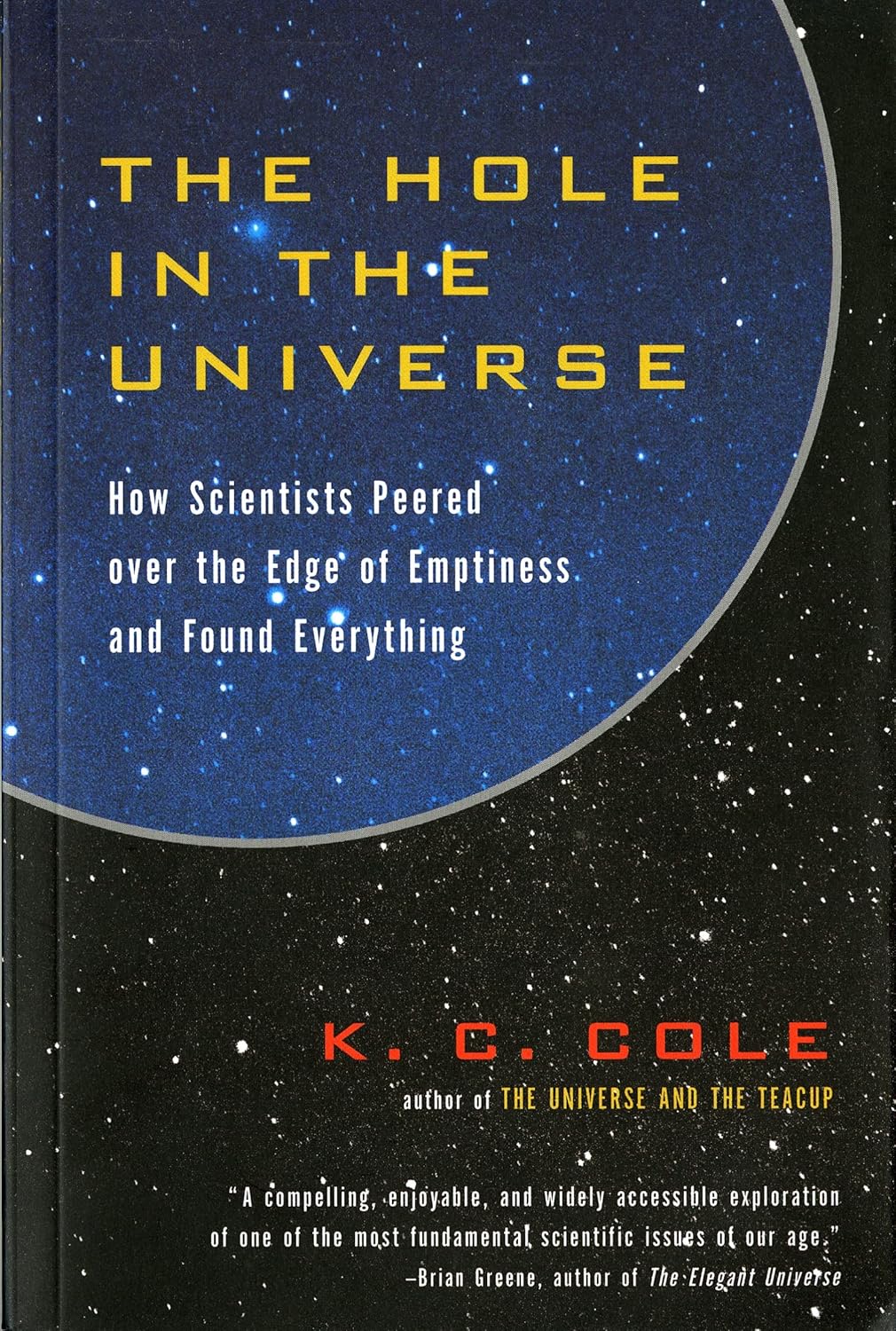
About The Hole in the Universe by K. C. Cole
What is nothing? It sounds like an easy question. A box with nothing inside is empty. Space between the stars looks empty too. But when scientists look closely, the answer becomes much harder.
The Hole in the Universe by K. C. Cole takes that small word, “nothing,” and uses it to explore some of the biggest questions in science. Cole writes about zero, empty space, black holes, the beginning of the universe, and ideas that scientists are still trying to understand. Her subject is wide, but the question at its heart is one anyone can ask: Can there ever be absolutely nothing?
This is a nonfiction book for curious readers. You do not have to be an astronomer to want to know why space exists or what might be hidden in a place that looks empty. Cole invites you to start with that curiosity and follow it wherever it leads.
What is this book about?
The book follows scientists and thinkers as they try to understand emptiness. Cole looks at what people have meant by “nothing” at different times, then turns to the questions raised by physics and the universe. The journey reaches from the number zero to ideas about black holes, the Big Bang, and the space between things.
You can think of it as a trip through one question with many doors. Open one door and you find numbers. Open another and you find stars. Open another and you find scientists asking whether an empty space is as empty as it seems.
Cole does not ask you to build a rocket or solve a long set of sums. She asks you to look again at something you may never have thought about. That makes the book appealing even if your interest in science began with a simple question while looking up at the night sky.
When science feels too hard to start
A book about the universe can sound difficult before you even turn the first page. Words like vacuum and cosmology may make you feel that you need years of study. Yet the first idea here is familiar. Everyone knows what it means to say, “There is nothing there.”
Cole uses that everyday thought as a way into much larger ideas. She is a science writer, and this book is written for general readers who want to explore physics and mathematics. Its chapters are broken into smaller parts, giving you places to pause and think as you read.
You may still meet ideas that take time to understand. That is all right. You can read a section, sit with its question, and come back later. The reward is the chance to see why scientists find an apparently empty place so interesting. You begin with a word you know and find out how much more it can mean.
Is empty space really empty?
Look at the space between two objects. It appears to hold nothing at all. In this book, Cole explores why physicists have found that “empty” is a much harder idea than it first appears. Their study of the vacuum leads to questions about forces, matter, and the shape of the universe.
That is the surprise waiting inside the title. The Hole in the Universe does not ask you to stare at a blank page for hundreds of pages. It asks what a blank space might tell us. Each new idea makes the word “nothing” feel less simple.
You do not need to agree with every theory to enjoy the search. Some of the ideas Cole describes are questions scientists were working through when she wrote the book. What matters for the reader is watching how they ask those questions. How do you study something you cannot easily see? How can you tell whether a space is truly empty? Those puzzles give the book its sense of wonder.
From the number zero to the night sky
Zero is a small mark on a page, yet it helps us count and do sums. Cole’s journey includes the history of numbers, showing how a question about “nothing” can begin with something as ordinary as a written symbol. From there, the book moves into much larger spaces and harder questions.
That change in scale is part of the fun. One moment, you are thinking about how people use a number. Soon, you are thinking about the universe. The two subjects may seem far apart, but both ask what it means for something to be missing.
If you enjoy books that connect ideas, this is a strong reason to read Cole. You can follow one thought into another without leaving the book to find a new subject. Mathematics, physics, and the history of ideas all have a place here. The result is a read that can make a familiar word feel new again.
Big questions, one at a time
The universe is too large to understand all at once. Cole gives readers smaller questions to hold onto. What is a vacuum? What do scientists mean when they speak about the start of the universe? Why do black holes make the rules we know seem harder to use?
You may have seen these subjects in a film or heard their names in a conversation. Here, they belong to a wider search. Cole is interested in what happens when scientists think they have found the edge of emptiness and another question appears. Her book ranges across physics, cosmology, and mathematics as she follows that search.
You can enjoy the ideas without treating the book like an exam. Stop when one catches your attention. Tell a friend what you have read. Look up at the sky and ask what you would like to know next. The book’s greatest pleasure may be that it makes you want to keep asking.
A lively way to read nonfiction
Some science books give you facts in a long list. Cole gives you a question to follow. “Nothing” keeps coming back, but it looks different each time. It can be a number, a space, or a problem in a theory. You get to see how one simple word can send people down many paths.
Cole also plays with language. She notices the oddness of trying to write about something that, by its name, should not be there. That sense of play helps make a large subject feel more welcoming. You can take the book seriously and still enjoy the strange turns in its question.
It is a good choice when you want nonfiction that gives you something to talk about. You might read a section and ask someone nearby, “What do you think an empty space really holds?” You do not have to know the answer to enjoy the conversation. In fact, wanting to know more is a good place to begin.
Who will enjoy The Hole in the Universe?
Choose this book if you like astronomy, space science, physics, or questions about how the universe works. It can also suit a reader who is new to those subjects but likes asking “why?” Cole starts with an idea everyone has met and follows it into the work of scientists.
A student may enjoy it as reading outside a textbook. A teacher may find questions in it that lead to a good class talk. Someone who already reads popular science may enjoy seeing several fields brought together by one theme. It is also a thoughtful gift for the person who looks at the stars and wants to know what lies between them.
This book asks for curiosity more than quick answers. If you want a step-by-step guide to one branch of science, its wide journey may surprise you. If you want to explore how people think about a deep question, that wide journey is the reason to pick it up.
A look at science from its time
The Hole in the Universe was first published in 2001. It captures the ideas and open questions Cole chose to discuss at that time. That date is useful to know when you buy a science book: research keeps moving, and later work may add to or change parts of an earlier discussion.
You can still enjoy the book for the questions it raises and the way it shows scientists thinking. A good question does not lose its pull just because more people have worked on it since. Reading Cole can help you see what made those ideas exciting and why readers wanted to follow them.
If a topic especially interests you, the book can be a starting point for learning more. Read Cole’s account, note the question that stayed with you, and explore what scientists have said since. That gives an older science book a useful place beside newer reading.
Read at your own pace
There is no need to rush through a book about such a large question. You can read one part with a cup of tea, then stop when you find an idea you want to think about. You can return the next day and see where Cole takes it. The shorter sections make that kind of reading easy.
Keep it by your desk if you like a few pages between tasks. Take it on a trip if you want something that gives your mind room to wander. Read it with a friend if you enjoy sharing the questions a book leaves behind.
You may find that different parts catch your attention at different times. Perhaps zero will interest you first. Perhaps the space between stars will. There is no single idea you must remember to get something from the book. Each visit can leave you with one new thing to wonder about.
A comfortable printed book
The words on a page matter when you are reading about a new idea. Bookish Wonderland describes its printed books as having premium, eye-soothing cream paper and crystal-clear print. That combination helps you settle in and give a difficult question your full attention.
The store also specifies high-quality stitched and glue binding for longevity. If you like to return to a chapter, lend a book, or keep your science reads together, a strong binding is a useful feature.
These are details of the printed copy offered by Bookish Wonderland. They make the physical reading experience pleasant while Cole’s questions give you a reason to turn the pages. You can sit with a topic for as long as you need, put the book aside, and pick it up again when you are ready to learn more.
A good book to give a curious reader
It can be hard to choose a gift for someone who seems to ask about everything. A book built around one surprising question gives them somewhere to begin. The Hole in the Universe can appeal to a reader who likes science but already owns books about planets and stars. Its focus on “nothing” offers a different way in.
You could give it to a friend who enjoys asking how things work, a student looking beyond class lessons, or someone who likes conversations that do not end with a quick answer. The title itself may start a discussion before they open the book.
It also makes a good choice for your own shelf. When you feel like learning something new, you will have a question waiting for you. Pick a section, follow Cole’s train of thought, and see what you want to ask next.
Book price in Bangladesh and how to order
If you are checking the Book price in Bangladesh for The Hole in the Universe by K. C. Cole, see the current price on the Bookish Wonderland product listing. You can review it before placing your order.
Bookish Wonderland offers nationwide delivery, including addresses inside and outside Dhaka. Cash on Delivery is available across Bangladesh. If you need the book soon and live in Dhaka, you can ask about the fast or urgent delivery option.
Ordering a science book should be simple. Find the title, check the listed price, and choose a delivery option that works for you. Then you can spend your time on the question that matters here: how can “nothing” hold so much to think about?
Best Sellers Rank of This Book
- #1,667,315 in Books
- #104 in Cosmology (Books)
- #111 in Astrophysics & Space Science (Books)
- #114 in Astronomy (Books)
Start with one small question
You do not have to understand the whole universe before opening this book. Start with an empty room, the number zero, or the dark space you see between stars. Ask whether it is truly empty. Then let K. C. Cole show you why that question has held the attention of scientists and thinkers.
The Hole in the Universe is for the reader who enjoys learning and does not mind saying, “I wonder.” It offers a path from a word you use every day to ideas much bigger than daily life. Some pages may make you pause. Others may send you straight to the next chapter.
If that sounds like the kind of reading you want, order your copy from Bookish Wonderland. Make time for one question, then see how far it takes you.
If you require any customization or have any questions, please inbox us via FB or Insta.
| Primary Specification | |
| Author | K. C. Cole |
| Editor | Jane Isay |
| Genre | Popular science, physics, cosmology, astronomy |
| ISBN-13/ISSN | 978-0156013178 |
| ISBN-10 | 0156013177 |
| Publisher | Mariner Books |
| Publishing Date | December 1, 2001 |
| Language | English |
| Reading Age | 18+ |
| Format | Printed book |
| Physical Specification & Quality | |
| Paper Quality | Premium eye-soothing cream paper |
| Binding Quality | High quality stitched and glue binding (for longevity) |
| Print Quality | Crystal-clear print |
| Pages | 288 pages |
| Country | United States |
| Logistics Information | |
| Weight | 294g |
| Length | 8.5 inch |
| Width | 5.6 inch |
| Height | 0.72 inch |