

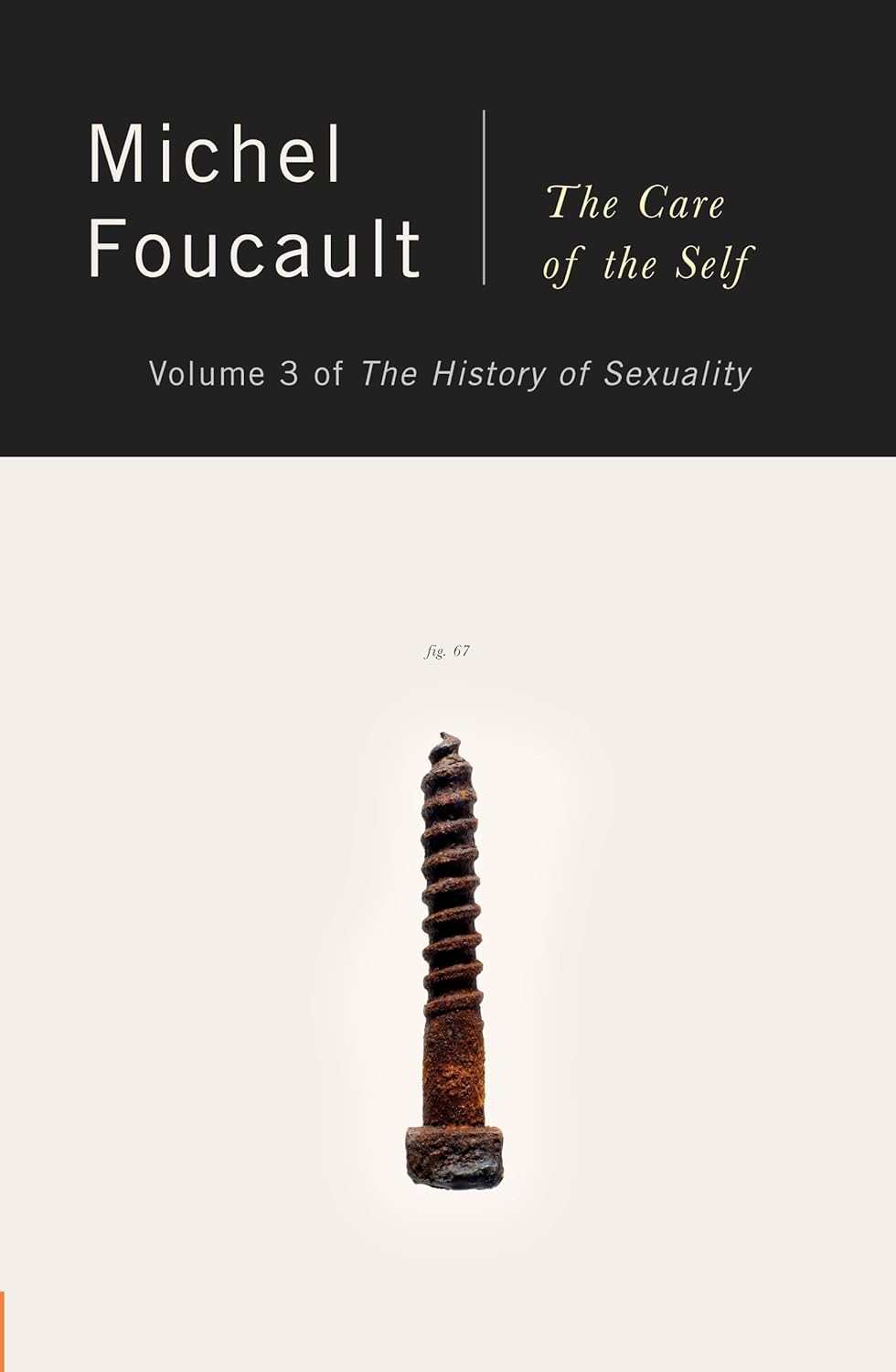
About The History of Sexuality by Michel Foucault (Volume 3 of 4): Roman Ethics, Marriage, and Caring for the Self
The History of Sexuality by Michel Foucault (Volume 3 of 4) carries the series into the first two centuries of the Roman era. Usually published with the subtitle The Care of the Self, it asks how people learned to watch, guide, and shape their own conduct. Foucault studies philosophers, doctors, dream books, and moral writings to trace an important change in Western ideas about pleasure.
The book finds a stronger concern with the body, health, marriage, desire, and the results of intimate activity. Pleasure is not simply banned, but it is treated with more caution. A person is encouraged to observe habits, test motives, control excess, and build a steady relationship with the self.
This volume offers no quick rules for modern life. It is a history of ethical thought and self-formation. Readers follow Foucault as he shows how care of the self became a daily practice involving knowledge, discipline, relationships, and choice. The result is a thoughtful bridge between the Greek ethics of Volume 2 and the early Christian world explored in Volume 4.
When self-care sounds like a modern idea
Today, self-care may mean rest, comfort, exercise, or time away from work. The phrase can sound new and personal. Foucault shows that ancient thinkers also spoke about caring for oneself, but their meaning was wider and more demanding.
For them, care could include watching thoughts, testing actions, reading philosophy, speaking with a guide, managing the body, and preparing for hardship. It was not only about feeling better. It was a way to become able to live with reason and act well toward others.
This historical view solves a common problem. It keeps readers from turning an old idea into a modern slogan. Foucault asks us to see care as work carried out over time. The self is not a hidden object waiting to be found. It is something a person helps form through repeated practice.
Enter the Roman world of moral reflection
The Care of the Self looks closely at the first and second centuries of the common era, sometimes called the Golden Age of Rome. Foucault reads writers such as Seneca, Epictetus, Plutarch, and Marcus Aurelius, along with medical and other practical texts.
These sources show people thinking hard about pleasure and its effects. They discuss strength, weakness, age, health, marriage, social duty, and the need to remain in command of oneself. The advice does not come from one single school, yet several works share a more watchful tone.
Foucault does not claim that every Roman lived by these writings. Most surviving texts came from educated men and reflect a narrow social world. He studies a pattern of moral thought, not the full daily life of an empire. Keeping that limit in mind makes the book clearer and more honest.
What care of the self really means
Care of the self begins with attention. A person should notice habits, desires, fears, physical changes, and choices. This attention is not meant to produce endless worry. Its aim is to make conduct more thoughtful and less ruled by sudden appetite.
Ancient practices could include reading, writing notes, remembering lessons, reviewing the day, speaking with a teacher or friend, and preparing the mind for events that may come. Philosophy becomes a way of life rather than a set of ideas stored in the head.
The self in this picture is not fully alone. Guidance, friendship, marriage, medicine, and public duties all matter. Learning to care for oneself can support better conduct with other people. Foucault therefore presents self-care as both personal work and a social practice.
Why pleasure receives closer attention
Compared with the classical Greek texts discussed in Volume 2, Roman-era writers often show greater anxiety about intimate activity and its effects. They worry about lost strength, poor timing, uncontrolled appetite, and conduct that weakens a person’s command of self.
This change does not mean that pleasure suddenly becomes evil. The texts still allow it a place in life. However, they ask for more observation, caution, and restraint. The proper use of pleasure becomes closely tied to physical health, moral steadiness, and responsibility.
Foucault is interested in the reason behind this change. He does not explain it as one simple step from freedom to repression. Instead, he studies how people were encouraged to build a more careful and lasting relation to themselves.
A quieter change in the history of ethics
The Care of the Self does not tell a simple story in which pagan freedom is replaced at once by Christian restriction. Foucault finds growing restraint and anxiety before Christianity becomes the main focus. This makes the history more complex.
Ancient and Christian moral advice can sometimes look similar from the outside. Both may praise restraint or faithfulness. Yet the reason for a practice and the way a person understands the self may be different. Foucault studies these forms, not only the visible rule.
That distinction is one of the book’s greatest strengths. It teaches readers to ask how a moral demand works. Is it a law obeyed because an act is forbidden? Is it training chosen to create a certain kind of life? Similar conduct can carry different meanings.
How Volume 3 continues the series
Volume 1 examines modern power, knowledge, confession, and the growth of talk about sexuality. Volume 2 moves to classical Greece and explores the proper use of pleasure. Volume 3 enters later Greek and Roman thought, where the care of the self becomes more detailed and intense.
This movement prepares the way for Volume 4, Confessions of the Flesh, which studies early Christianity. Together, the books trace changes in how people become subjects of desire and moral judgment.
Readers should not expect one straight timeline with every gap filled. Foucault changes questions and sources as the project develops. The value lies in following those changes and seeing how power, truth, ethics, and self-knowledge connect.
What this volume is not
This book is not a novel, a simple textbook, or a modern self-help guide. It does not promise a happier life through a short morning routine. Its purpose is to study old ways of thinking and the long history behind familiar moral ideas.
It is also not a full account of Roman society. Women, enslaved people, poor communities, and many local voices appear only in limited ways because the surviving elite texts shape Foucault’s evidence. Readers should treat this boundary as an important part of the analysis.
The book does not ask anyone to copy ancient practice. Its health claims, social roles, and unequal assumptions belong to their historical setting. Readers gain more by asking how the system worked than by turning it into advice.
An easier path through the argument
Begin with one simple question: what practices were meant to shape the self? Keep it beside you while reading about dreams, the body, marriage, and relationships. It will help the chapters feel connected.
Read a few pages at a time and write short notes. Record the source Foucault studies, the concern it raises, the practice it recommends, and the person it hopes to form. This small pattern can make dense sections easier to follow.
It is also useful to compare this volume with Volume 2. Notice where caution grows, where marriage receives more weight, and where self-observation becomes stronger. A reading partner, class, or guide can help with ancient names and terms.
What readers may gain
One major benefit is stronger historical thinking. Ideas such as self-care, health, marriage, and desire have not always meant the same thing. Seeing their past forms makes present beliefs easier to question.
Another key benefit is a careful way to connect freedom with discipline. Foucault shows that work on the self can create room for choice, yet it also grows inside unequal societies and accepted standards. That tension gives readers much to discuss.
Useful for study, discussion, and reflection
This volume suits courses in philosophy, classics, history, sociology, ethics, gender studies, and cultural studies. Students can use it when researching Roman moral thought, practices of the self, marriage, medicine, or Foucault’s later work.
A book club can choose one theme for each meeting. One group may discuss the body, another dreams, and another marriage. Independent readers can pair it with Seneca or Marcus Aurelius and compare Foucault’s account with the ancient text.
The book also makes a thoughtful gift for a reader who enjoys serious nonfiction and wants more than a simple guide to Stoicism or Roman life.
Who will value this book most?
Choose The Care of the Self if you enjoy idea-rich books that change how familiar words feel. It is a strong match for readers interested in philosophy as a way of life, ancient ethics, self-knowledge, sexuality, or the history of Western thought.
The writing can be demanding. New readers may need to pause, reread, or check a name. No advanced degree is required, but patience helps. The book rewards people who enjoy questions more than quick answers.
Robert Hurley translated the English edition from French. Volume 3 can stand alone, but reading Volumes 1 and 2 first makes Foucault’s changing method easier to understand for newcomers.
A study copy made for regular use
Bookish Wonderland offers a reader-friendly edition for careful reading and later review. Premium eye-soothing cream paper gives every page a soft look, while crystal-clear print helps readers follow long arguments and unfamiliar names. High-quality stitched and glue binding supports regular use, and a durable finish makes the book suitable for class, a study table, a home library, or a thoughtful gift.
What books are in the The History of Sexuality series by Michel Foucault?:
The completed History of Sexuality sequence contains four volumes. They move from modern power and knowledge to Greek, Roman, and early Christian ideas about ethics, desire, and the self.
- The History of Sexuality, Volume 1: The Will to Knowledge by Michel Foucault (The History of Sexuality, Book 1 of 4)
- The History of Sexuality, Volume 2: The Use of Pleasure by Michel Foucault (The History of Sexuality, Book 2 of 4)
- The History of Sexuality, Volume 3: The Care of the Self by Michel Foucault (The History of Sexuality, Book 3 of 4)
- The History of Sexuality, Volume 4: Confessions of the Flesh by Michel Foucault (The History of Sexuality, Book 4 of 4)
Simple ordering from Bookish Wonderland
When comparing the Book price in Bangladesh for The History of Sexuality by Michel Foucault (Volume 3 of 4), look at paper comfort, print clarity, and binding strength along with cost. This is a book made for notes, slow reading, and many returns.
Cash on Delivery is available nationwide, including delivery inside and outside Dhaka. Fast or urgent delivery is available in Dhaka when needed. Contact Bookish Wonderland through Facebook or Instagram for the latest price, stock, delivery time, or customization support.
Make room for a deeper kind of care
The Care of the Self asks what happens when a person treats life as something that can be watched, trained, and shaped. It shows self-care not as a quick comfort, but as a long ethical practice tied to health, relationships, truth, and freedom.
Read it for its journey through Roman thought. Keep it for its questions about discipline and choice. Place it beside the earlier volumes and see how Foucault turns from the systems that shape people toward the practices through which people shape themselves.
Order The History of Sexuality by Michel Foucault (Volume 3 of 4) from Bookish Wonderland today. Add The Care of the Self to your collection and continue a major exploration of ethics, desire, power, and Western ideas about being human.
If you require any customization or have any questions, please inbox us via FB or Insta.
| Primary Specification | |
| Volume | 3 of 4 |
| Author | Michel Foucault |
| Translator | Robert Hurley |
| Narrator | Elliot Fitzpatrick |
| Genre | Philosophy, Social Theory, History, Sexuality Studies, Post-Structuralist Thought |
| ISBN-13/ISSN | 978-0394741550 |
| ISBN-10 | 0394741552 |
| Publisher | Vintage |
| Publishing Date | November 28, 1988 |
| Language | English |
| Reading Age | 18+ |
| Format | Printed Book |
| Physical Specification & Quality | |
| Paper Quality | Premium eye-soothing cream paper |
| Binding Quality | High quality stitched and glue binding (for longevity) |
| Print Quality | Crystal-clear print |
| Pages | 288 pages |
| Country | France |
| Logistics Information | |
| Weight | 309 gm |
| Length | 8.5 inches |
| Width | 5.6 inches |
| Height | 0.72 inch |