

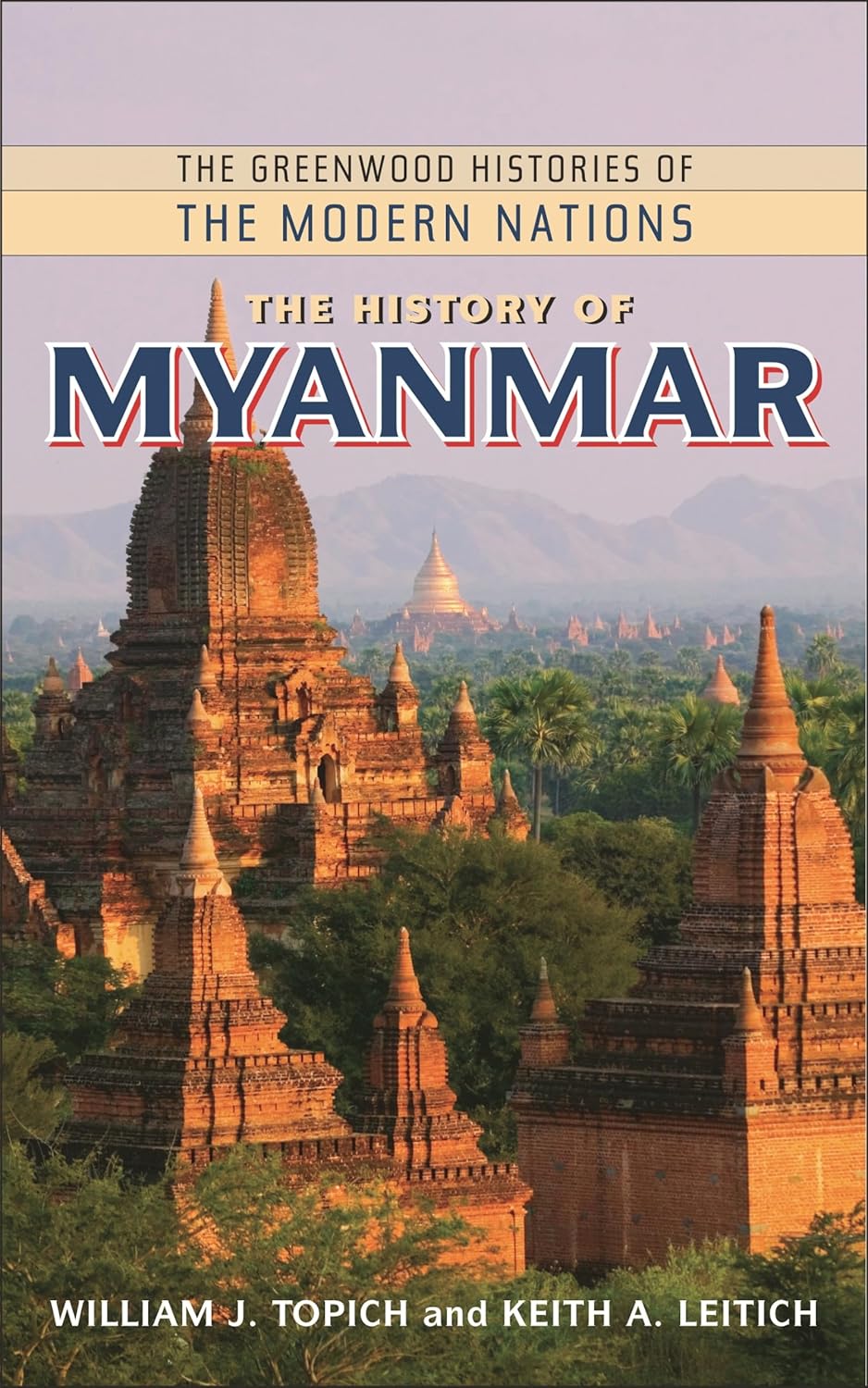
About The History of Myanmar by William J. Topich & Keith A. Leitich: From Ancient Kingdoms to a Modern Nation
The History of Myanmar by William J. Topich & Keith A. Leitich presents a country shaped by early civilizations, kingdoms, foreign conquest, colonial rule, war, independence, military power, protest, and political change. It begins in Neolithic times and moves toward the early twenty-first century.
It is useful for anyone who wants to understand Myanmar but does not know where to begin. Instead of treating one ruler or crisis as the whole story, the authors connect many periods. Readers see how geography, diversity, religion, trade, royal power, invasion, and colonial policy formed the nation.
First published in 2013, its final chapters discuss the hope and uncertainty of that time. It is a history up to its publication period, not a full account of later events.
When news gives only one small piece
Many people first hear about Myanmar through short news. A report may focus on protest, elections, the military, disaster, or a human rights crisis. These events are hard to understand without knowing what came before.
This book offers background in date order. Readers follow early settlements, rising and falling dynasties, British rule, and the hopes and conflicts after independence.
You need no expert knowledge. Begin with the timeline, read one chapter at a time, and use the index for unfamiliar people or places. Scattered facts become a connected story.
What does this book cover?
The History of Myanmar starts with the land and early civilization. It then enters Bagan, a kingdom linked with Buddhism, art, architecture, and political unity. After Bagan fell, smaller kingdoms competed for control.
The story continues through the Toungoo, Restored Toungoo, and Konbaung dynasties. These chapters show rulers joining regions, protecting borders, gaining resources, and dealing with nearby powers.
Later chapters follow British conquest, colonial rule, Japanese occupation, independence in 1948, military dictatorship, the 1988 upheaval, blocked democratic hopes, and changes visible when the book was written.
Begin with the land and early people
Myanmar lies between South Asia, China, and mainland Southeast Asia. Rivers, mountains, plains, forests, and coastal routes shaped settlement and the movement of goods, beliefs, and armies.
The opening chapter explores civilization before the famous dynasties. It shows that Myanmar’s history is older than its modern borders and name. Communities grew through local life and contact with wider Asia.
This foundation makes later kingdoms easier to place. The country becomes more than a stage for recent events. Its long story grows through movement, settlement, belief, work, and exchange.
Enter the age of Bagan
Bagan is central to Myanmar’s past. The book studies it from 1044 to 1287, then follows the smaller kingdoms that rose later. The period links royal authority, religion, farming, wealth, and great buildings.
A strong centre can unite land and people, yet still face limits. Leadership struggles, scarce resources, and outside pressure can weaken a kingdom. Mongol forces in the late thirteenth century form part of this change.
Bagan’s fall did not end history. New centres appeared, and rivals shaped later centuries. Political power may break apart, but people, traditions, and regional ties continue.
Follow the Toungoo and Konbaung dynasties
Toungoo rulers created a large realm in the sixteenth century. The authors then cover Restored Toungoo and the Konbaung Dynasty, including expansion, royal government, warfare, trade, and unity.
Myanmar enters closer contact and conflict with nearby states. Borders were not fixed like modern lines. Power depended on towns, rivers, loyal leaders, tribute, armies, and useful routes.
The Konbaung era leads toward conflict with Britain. Readers see that conquest entered a country with a deep political history and placed an older royal order inside an imperial system.
See how British conquest changed Burma
Separate chapters cover British conquest and colonial life. This helps readers distinguish the loss of independence from the longer changes that followed.
Colonial rule changed government, law, education, trade, land, labour, and community relations. Burma joined the British imperial economy and was administered for a time as part of British India. New offices replaced older authority.
Economic change brought opportunity for some and hardship for others. Migration and social divisions added tension. These chapters explain nationalism, the wish for independence, and problems that outlived foreign rule.
War brings another occupation
During World War II, Japanese forces conquered Burma. The country stood between rival empires, and towns, roads, fields, and homes became part of war in Asia.
Some nationalists first saw Japan as a possible path away from Britain. Experience showed that replacing one foreign power with another did not bring freedom. Alliances shifted as leaders judged how independence could be won.
The chapter connects global war with local history. It shows how conflict transformed Burma, caused suffering, strengthened demands for self-rule, and shaped the independence era.
Independence does not solve every problem
Burma became independent in 1948, but colonial freedom did not bring instant peace. The new state faced questions about unity, authority, ethnic relations, armed conflict, development, and the place of different groups.
The authors follow the years before the military takeover of 1962. They explain why early democratic government struggled and how conflict weakened trust. A new flag and government could not repair every older division.
Independence was both a great achievement and the start of harder work. Fair institutions, shared power, and a common future take longer to build than removing colonial rule.
Life under military government
The chapter on 1962 to 1988 examines the dictatorship of Ne Win. Military leaders claimed that strict control could protect unity and stability. Their rule changed political life, economic policy, public speech, and the country’s relation with the outside world.
The book helps readers see military government as a system, not only a list of leaders. Institutions, laws, official ideas, and control over public action all matter. Decisions made at the top can enter schools, jobs, markets, homes, and daily choices.
Over time, economic trouble and public anger grew. Understanding this period is essential before reaching the great protests of 1988. The uprising did not appear from nowhere. It came after years in which many people experienced hardship, limited freedom, and a lack of trusted ways to demand change.
Protest, lost hope, and continued rule
The book devotes chapters to the revolutionary upheaval of 1988, the aborted democratic opening of 1988–1990, and the dictatorship that continued afterward. This careful order shows how quickly hope can rise and how force can close political space again.
Students and ordinary citizens took great risks when they protested. Elections and democratic demands created hope, but military leaders kept control. The following years brought continued pressure, isolation, and conflict over the country’s political future.
The authors also cover the unrest and natural catastrophe of 2007–2008. By placing protest and disaster beside the longer history, they show how government choices affect a society’s ability to face crisis. The final chapter then considers the limited reforms and cautious optimism visible in the early 2010s.
A book with a clear learning path
The book is arranged in fourteen main chapters. A timeline helps readers see important events before entering the full story. The chapters move in date order, reducing the confusion that can come from jumping between unrelated periods.
A section on notable people gives quick help with major figures. The bibliographic essay points toward further reading, while the index makes it easier to find a kingdom, leader, conflict, or year again. These tools make the work useful for study as well as general reading.
Because the first edition appeared in 2013, readers should pair it with newer, reliable sources when studying events after that date. This limit does not reduce its value as a foundation. It simply keeps the use of the book accurate.
What makes this history useful
- A chronological journey makes a long history easier to follow.
- Coverage begins in Neolithic times and reaches the early 2010s.
- Major eras include Bagan, Toungoo, Konbaung, colonial rule, war, independence, and dictatorship.
- A timeline gives readers a quick map of important events.
- Notable-person profiles help with major historical names.
- A bibliographic essay supports deeper research.
- An index makes facts, places, and people easier to find.
- Clear national context helps readers understand later news and study.
The main benefit is connection. A reader can see how one period leads toward another instead of remembering isolated dates. The book also encourages a wider view of Myanmar than a single modern crisis can provide.
Who will enjoy and use this book?
This history suits students, teachers, researchers, travellers, journalists, policy readers, and anyone interested in South or Southeast Asia. It can support school or university work about empire, nationalism, Buddhism, military government, political change, or nation-building.
A new reader can use it as a first overview before choosing a more specialized book. A class can assign one dynasty or modern period and use the timeline to connect it with the whole story. A discussion group can compare the promises of independence with the problems that followed.
The book may not suit someone seeking a detailed account of only one ethnic community or one current issue. Its purpose is broad national history. That wide view is its strength, but focused subjects may need additional sources.
A durable copy for steady study
Bookish Wonderland offers a reader-friendly copy designed for regular use.
- Premium eye-soothing cream paper gives the pages a soft appearance.
- Crystal-clear print keeps dates, names, and chapter text easy to read.
- High-quality stitched and glue binding supports longer book life.
- A durable finish makes the copy suitable for study, travel, or a home shelf.
These features are especially helpful in a reference book that readers may open again to check a date or historical name. The strong build makes it a practical choice for students, teachers, serious readers, and gifts.
Order easily from Bookish Wonderland
When comparing the Book price in Bangladesh for The History of Myanmar by William J. Topich & Keith A. Leitich, consider print clarity, reading comfort, binding strength, and delivery service along with cost. A useful history should remain comfortable through notes, study, and repeated checking.
Cash on Delivery is available nationwide. Customers can order from inside or outside Dhaka, and a fast or urgent delivery option is available in Dhaka when the book is needed quickly. Contact Bookish Wonderland through Facebook or Instagram for the price, stock, delivery time, or customization support.
Bring Myanmar’s long story into focus
Myanmar cannot be understood through one headline, one leader, or one year. Its story reaches from early civilizations and royal capitals to colonial rule, global war, independence, dictatorship, protest, disaster, and uncertain reform.
This book places those changes in order and gives each major era room to make sense. Read it to build a strong foundation. Keep it nearby when a name, dynasty, or political event needs context. Share it with someone who wants to understand the country beyond quick news.
Order The History of Myanmar by William J. Topich & Keith A. Leitich from Bookish Wonderland today. Add a clear, wide-ranging history to your shelf and now begin your own deeper journey through the people, powers, struggles, and hopes that shaped Myanmar.
If you require any customization or have any questions, please inbox us via FB or Insta.
| Primary Specification | |
| Author | William J. Topich, Keith A. Leitich |
| Genre | History, Southeast Asian Studies, Political History, Cultural History, Nonfiction |
| ISBN-13/ISSN | 978-0313357244 |
| ISBN-10 | 0313357242 |
| Publisher | Greenwood |
| Publishing Date | January 9, 2013 |
| Edition | Illustrated |
| Language | English |
| Reading Age | 16+ |
| Format | Printed Book |
| Physical Specification & Quality | |
| Paper Quality | Premium eye-soothing cream paper |
| Binding Quality | High quality stitched and glue binding (for longevity) |
| Print Quality | Crystal-clear print |
| Pages | 208 pages |
| Country | USA |
| Logistics Information | |
| Weight | 229 gm |
| Length | 8.5 inches |
| Width | 5.6 inches |
| Height | 0.5 inch |