

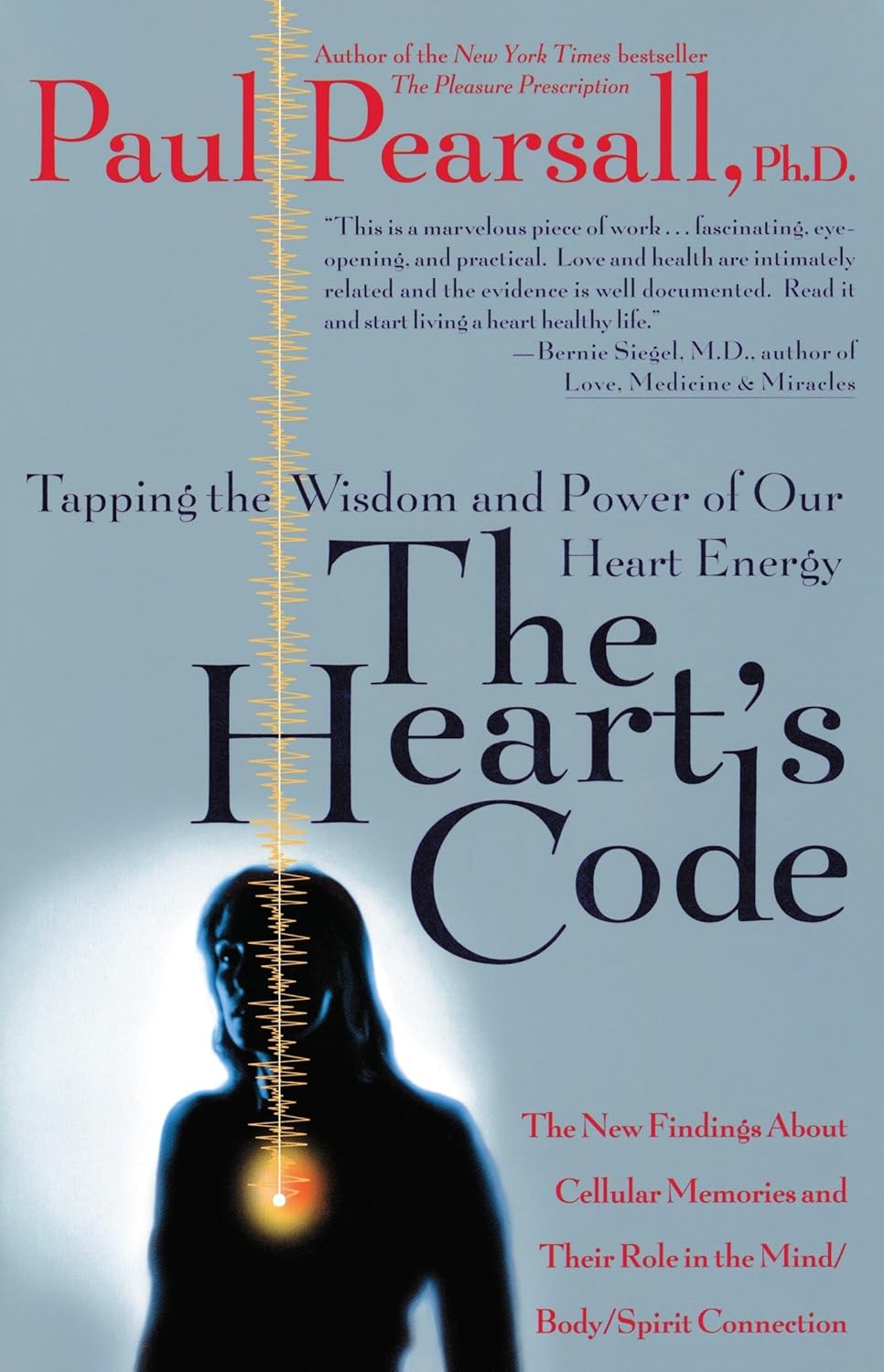
About The Heart's Code by Paul Pearsall – A Thought-Provoking Journey Into Heart, Memory and Human Connection
The Heart's Code by Paul Pearsall begins with an idea that sounds simple but quickly becomes much bigger: is the human heart only a pump, or could it play a deeper part in emotion, memory, intuition, and connection? Pearsall brings together personal experience, stories from patients, ideas from psychology, spiritual traditions, and research that interested him during his career. His purpose is to make readers look at the heart in a new way. Instead of treating it only as an organ that moves blood, he asks readers to think about the heart as part of the wider relationship between body, mind, feeling, and meaning. That makes this book especially interesting for people who enjoy questions that sit between health, psychology, spirituality, and personal growth.
Why the idea feels so personal
People often say things like “follow your heart,” “my heart knows,” or “I felt it in my heart.” Pearsall takes those familiar expressions seriously and asks whether they point to something important about human experience. He explores the possibility that the body may carry information in ways we do not fully understand. The book does not read like a normal medical textbook. It moves between explanation, personal reflection, case stories, and larger questions about consciousness. This style can make the subject easier to enter for general readers because you do not need advanced scientific training to follow the main ideas. You only need curiosity about why emotions can feel physical and why the heart has such a strong place in human language, culture, and belief.
The transplant stories that made the book famous
One of the most discussed parts of The Heart's Code is Pearsall's use of stories involving organ transplant recipients. He describes people who reported changes in taste, emotion, dreams, habits, or personal preferences after receiving a donor heart. Pearsall considers whether these experiences could support his idea of “cellular memory,” meaning that information might somehow be stored outside the brain and carried by cells or organs. These stories are memorable because they raise questions that feel mysterious and deeply human. They also explain why the book continues to attract readers interested in consciousness and mind-body theories. It is important, however, to read these accounts as part of Pearsall's argument rather than as settled proof that donor memories are transferred through a transplanted heart.
A provocative theory, not a medical rule
The most useful way to approach this book is with an open but careful mind. Pearsall presents strong claims about heart energy, cellular memory, and what he calls energy cardiology. Some transplant recipients have reported changes in identity, preferences, or feelings after surgery, and researchers continue to study the psychological and biological experience of transplantation. However, the idea that a transplanted heart literally transfers a donor's memories or personality is not established as standard medical fact. That does not make the book uninteresting. In fact, the tension between personal stories, scientific questions, and spiritual interpretation is one of the reasons it can lead to such lively discussion. Read it as a bold exploration of a theory and as an invitation to think, compare evidence, and form your own view.
Where science, spirituality and self-reflection meet
Pearsall does not keep the discussion inside one field. He brings together material from health, psychology, ancient wisdom, spirituality, and personal experience. For some readers, this wide mix is the main attraction. A scientific idea may sit beside a spiritual concept, followed by a patient story or a practical reflection about daily life. The book therefore works best for people who enjoy cross-disciplinary thinking rather than readers looking only for a conventional cardiology guide. It asks what health means beyond test results and whether emotional life can affect the way we experience the body. Even when you disagree with a claim, the book can push you to ask useful questions about stress, relationships, attention, self-awareness, and the connection between physical and emotional well-being.
What “heart energy” means in the book
Pearsall uses the language of energy to describe a form of information and connection that he believes moves through and around living systems. He argues that the heart plays a central role in this process. This is one of the more unusual parts of the book and also one of the parts readers are most likely to debate. Rather than treating the idea as something you must accept, it can help to see it as the author's framework for organizing his observations. He uses that framework to discuss intuition, emotional sensitivity, healing, relationships, and the way people respond to one another. Readers interested in alternative health ideas or spiritual views of the body may find this section especially engaging, while more skeptical readers may enjoy testing the claims against current scientific understanding.
The book also asks how we should live
The Heart's Code is not only about what the heart might be able to do. Pearsall also asks what would change if people paid closer attention to their emotional and physical signals. He encourages readers to think about the pace of life, stress, relationships, kindness, and inner awareness. This gives the book a self-development side. You may come for the transplant stories but stay for the questions about how you listen to yourself and other people. Pearsall's larger message is that human well-being is not just about fixing separate parts. He wants readers to see life as a connected system in which emotion, body, thought, relationships, and meaning influence one another. Whether or not you accept every theory, that broader question can still be useful.
Who will enjoy The Heart's Code most?
This book is a strong fit for readers who enjoy mind-body topics, psychology, spirituality, alternative health ideas, consciousness studies, and unusual medical stories. It may also appeal to readers who like books that challenge the usual division between science and spiritual thought. If you enjoyed reading about intuition, emotional intelligence, meditation, human energy, or the psychology of healing, you may find many ideas here worth discussing. The writing is aimed at general readers rather than specialists, so the core arguments are accessible without a medical degree. At the same time, because the book presents controversial ideas, it is especially rewarding for readers who are willing to question, compare, and think instead of accepting every claim automatically.
Why some readers may disagree with it
A good product page should also tell you what kind of reading experience you are buying. The Heart's Code is not a neutral medical handbook. Pearsall has a clear point of view, and some of his conclusions go beyond what mainstream medical evidence has established. Readers who want only conventional, evidence-based cardiology may find parts of the book too speculative. Others may feel that the personal stories are more persuasive emotionally than scientifically. Yet that disagreement can be part of the value. Books do not always need to give comfortable answers. Sometimes they are useful because they make readers examine what they believe, look for better evidence, and talk about difficult questions. This is a book that can create exactly that kind of conversation.
A good choice for discussion groups and reflective reading
Because the book crosses health, psychology, spirituality, and personal experience, it can work well for book clubs or small discussion groups. One reader may focus on the transplant cases. Another may be interested in the role of emotion in health. Someone else may question the scientific basis of the author's theories. These different reactions can make a group conversation richer. The book is also suitable for slower, reflective reading. You do not have to race through it. Reading a chapter, thinking about the ideas, and then returning later may be more rewarding than trying to finish it in one sitting. It is the kind of nonfiction that invites notes, questions, underlining, and conversations with other readers.
A physical copy made for comfortable reading
Bookish Wonderland offers this title for readers who prefer a durable printed book they can hold, mark, and return to. The copy uses premium eye-soothing cream paper, which gives the pages a softer appearance during long reading sessions. Crystal-clear printing keeps the text sharp and easy to follow, while high-quality stitched and glue binding helps the pages stay secure through repeated use. These features are useful for a nonfiction book that readers may revisit for particular stories or ideas. Instead of reading from a bright screen, you can move through the book at your own pace, pause on a passage, add a note, and keep the copy on your shelf for future reference.
What you may gain from reading it
The biggest benefit of The Heart's Code is not that it gives one final answer about the heart. Its value comes from the questions it opens. It may help you think more carefully about how emotions are felt in the body, how people describe intuition, how medical experiences can change identity, and why the heart has become such a powerful symbol across cultures. It can also encourage you to separate personal testimony from scientific proof, which is an important skill when reading health-related nonfiction. For some readers, the book will feel inspiring. For others, it will feel controversial. Both responses can lead to useful thinking. A book that makes you examine your assumptions can stay with you longer than one that simply repeats ideas you already know.
Looking for The Heart's Code by Paul Pearsall price in Bangladesh?
If you are comparing The Heart's Code by Paul Pearsall and Book price in Bangladesh, Bookish Wonderland gives you an easy way to order a reader-friendly English copy online. Customers can place orders from Dhaka or from other parts of the country, with Cash on Delivery available nationwide. Delivery is available both inside and outside Dhaka, and customers in Dhaka can ask about fast or urgent delivery when needed. This makes the book convenient to buy for your own reading, a personal study shelf, a discussion group, or a gift. You can focus on the ideas inside the book while Bookish Wonderland handles the printed copy and delivery process.
Read it with curiosity, not pressure to agree
You do not have to accept every claim to find The Heart's Code interesting. Ask which ideas need stronger evidence and how personal stories differ from scientific proof. Reading this way can turn Pearsall's book into an active discussion about health, emotion, intuition, and belief.
Add a different kind of health and psychology book to your shelf
The Heart's Code by Paul Pearsall is for readers who enjoy questions that do not have easy answers. It looks at the human heart through medical stories, psychological ideas, spiritual traditions, and the author's own framework of heart energy and cellular memory. Some parts may inspire you. Some may make you skeptical. The most interesting result may be that you keep thinking about the subject after closing the book. If you want a nonfiction title that can start conversations about the body, mind, emotion, identity, and consciousness, this book offers a distinctive reading experience. Order your copy from Bookish Wonderland and explore Pearsall's unusual view of what the heart may mean in human life.
If you require any customization or have any questions, please inbox us via FB or Insta.
| Primary Specification | |
| Author | Paul Pearsall |
| Editor | Pei Koey |
| Genre | Health & Fitness, Mind-Body-Spirit, Alternative Healing, Psychology |
| ISBN-13/ISSN | 978-0767900959 |
| ISBN-10 | 0767900952 |
| Publisher | Harmony |
| Publishing Date | April 6, 1999 |
| Language | English |
| Reading Age | 18+ |
| Format | Printed Book |
| Physical Specification & Quality | |
| Paper Quality | Premium eye-soothing cream paper |
| Binding Quality | High quality stitched and glue binding (for longevity) |
| Print Quality | Crystal-clear print |
| Pages | 304 pages |
| Country | USA |
| Logistics Information | |
| Weight | 324 gm |
| Length | 8.5 inches |
| Width | 5.6 inches |
| Height | 0.79 inch |