Skip to product information
1 of 1

Bookish Wonderland

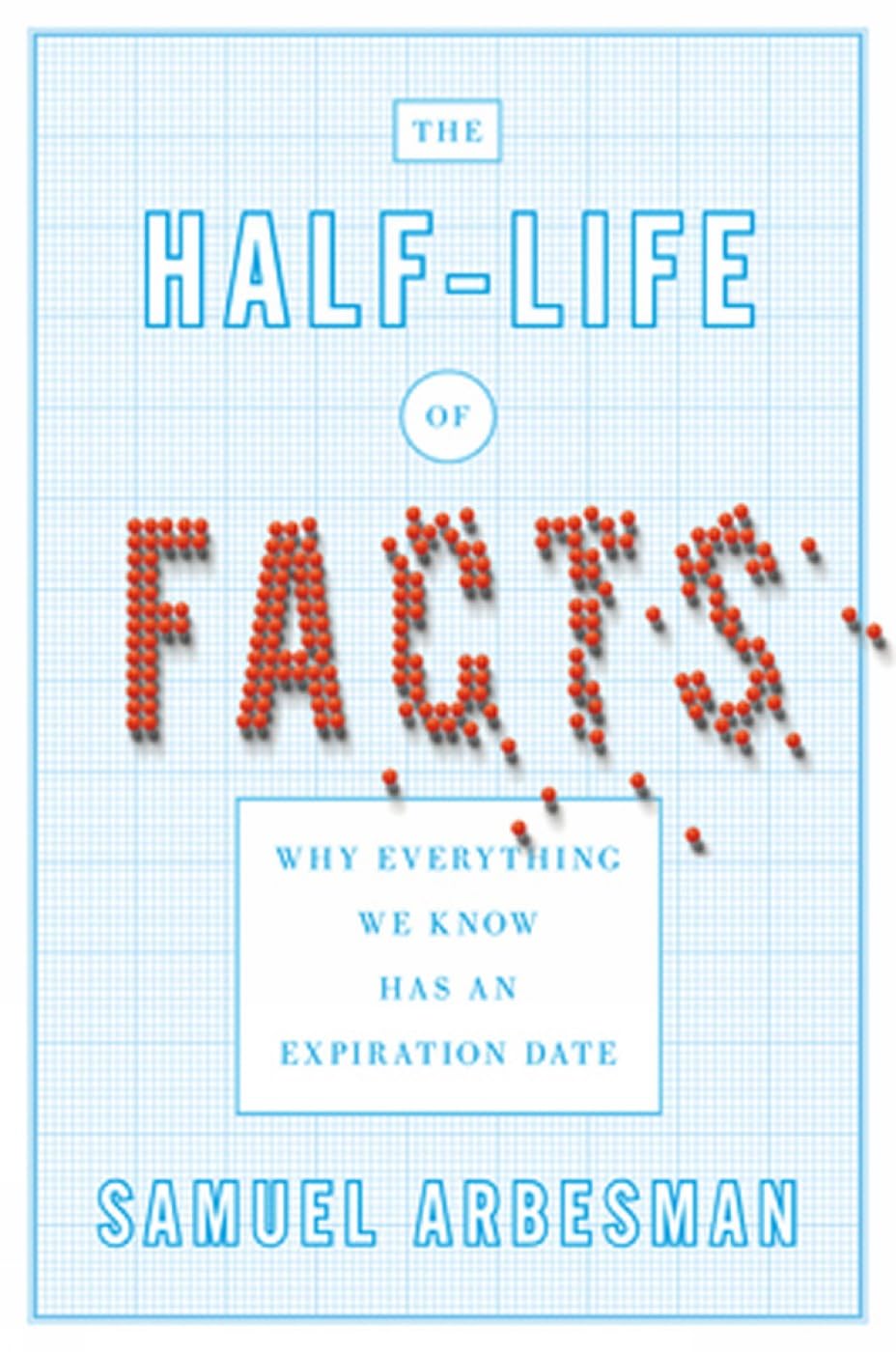
The Half-life of Facts by Samuel Arbesman

The Half-life of Facts by Samuel Arbesman

Regular price Tk 218.00 BDT
Regular price Sale price Tk 218.00 BDT
Sale Sold out
Book cover type
Quantity

The Half-life of Facts by Samuel Arbesman explores a surprising idea: knowledge does not stay fixed forever. Facts can change, become outdated, or be replaced as new discoveries appear. Arbesman compares this process to radioactive decay, showing that different fields of knowledge change at different speeds. Medicine, technology, science, and social research often update quickly, while some established facts remain useful for much longer. Through examples from mathematics, medicine, history, and scientific research, the book explains why people should expect knowledge to evolve instead of assuming that everything they learn will remain true forever. Arbesman also examines how information spreads, how errors survive, and why institutions can struggle to keep up with new evidence. The book encourages readers to become more flexible thinkers, question outdated assumptions, and understand that changing facts are not a failure of knowledge but a natural result of discovery, correction, and learning in an ever-changing world. Read More

View full details

About The Half-Life of Facts by Samuel Arbesman – Why Knowledge Changes and What That Means for You

What If Some of the Facts You Know Are Already Out of Date?

The Half-Life of Facts by Samuel Arbesman begins with a surprising idea: facts do not always stay fixed forever. New research appears, old ideas are tested again, and what people once accepted as true can change. Arbesman does not say that every fact is unreliable. Instead, he asks us to look at knowledge as something that grows, shifts, and improves over time.

Using examples from science, medicine, history, technology, and life, he explains that many kinds of knowledge change in patterns. Some areas move very quickly. Others change slowly across decades or even centuries. By studying these patterns, we can become better at judging what we know, what may change, and when it is wise to check again.

The Problem With Treating Every Fact as Permanent

Most of us learn facts at school, from books, from teachers, from the news, and from other people. Once we remember something, it can feel permanent. The problem is that the world keeps learning. A medical idea can be replaced by better evidence. A scientific name can change. A measurement can become more accurate. A theory can be improved when new tools reveal something that earlier researchers could not see.

This creates a strange problem. We need facts to understand the world, but we also need to accept that some facts may later be corrected. The Half-Life of Facts gives readers a practical way to think about this problem. Instead of becoming worried or cynical, Arbesman shows why changing knowledge is often a sign that learning is working.

Why the “Half-Life” Idea Matters

The title borrows the idea of a half-life from science. In radioactive materials, a half-life describes how long it takes for half of a substance to decay. Arbesman uses this idea as a way to think about knowledge. In some fields, a certain share of accepted information may become outdated over a measurable period of time.

This does not mean every fact has an expiry date printed on it. It means that groups of facts can show patterns when researchers study them over time. Arbesman connects this to scientometrics, the study of science and scientific knowledge itself.

That idea changes the way we think about learning. Instead of asking only, “Is this true?” we can also ask, “How old is this information? How fast does this field change? Has newer research changed the picture?”

From Pluto to Medicine, Facts Can Move

One reason the book is easy to enjoy is the range of examples. Arbesman looks at familiar changes in knowledge, such as the changing status of Pluto and old ideas about dinosaurs. He also explores more serious areas, including medicine, where new studies can change what doctors understand about disease, treatment, and health.

The book also shows why some wrong ideas can stay alive for a long time. People do not always update their beliefs as soon as new evidence appears. Old information can remain in memory, textbooks, websites, habits, and conversations. This makes the ability to update what we know an important skill.

A Better Way to Live With Changing Information

The Half-Life of Facts is useful because it does not tell readers to distrust everything. That would make learning almost impossible. Instead, it encourages a more flexible kind of confidence.

You can use good evidence while staying open to better evidence later. You can trust a strong source without believing that knowledge can never improve. You can also pay more attention to how quickly a subject changes. A fact about an ancient event may remain stable for a long time, while information about medicine, computing, or technology may need to be checked much more often.

This way of thinking is especially helpful today, when people see huge amounts of information every day. Search engines, social media, videos, news, and AI tools can all repeat information quickly. Knowing when to verify a claim is becoming as important as knowing the claim itself.

Who Should Read This Book?

This book is a strong choice for readers who enjoy popular science, critical thinking, data, research, knowledge, history of science, and big questions about how humans learn. It can also be useful for students, teachers, researchers, writers, journalists, managers, and professionals who work in fields where information changes often.

You do not need advanced mathematics to understand the main argument. Arbesman explains patterns through stories and examples, making the ideas easier to follow than a technical academic text.

Useful Lessons for Study, Work, and Everyday Decisions

Students can take an important lesson from this book: learning is not only about collecting facts. It is also about knowing how to update them. A good learner checks dates, sources, methods, and new evidence.

For professionals, the same idea can prevent outdated knowledge from becoming a habit. In fast-changing fields, a method that worked five years ago may no longer be the best choice. Managers and business owners can also use the book’s thinking when looking at market information, technology, customer behavior, or research.

Why This Book Feels Even More Relevant Now

The book first appeared in 2012, but its central question has become even more important. Information now travels faster than ever, and old information can stay online long after it has been corrected. A confident statement can be copied thousands of times before anyone checks it.

A Comfortable Copy for Careful Reading

Bookish Wonderland offers this title for readers who want a physical copy that is comfortable to use for thoughtful nonfiction reading. Premium eye-soothing cream paper gives the pages a softer look, while crystal-clear printing keeps the text sharp and easy to follow.

The stitched and glue binding is made for better longevity, which is useful for a book you may want to revisit, highlight, or keep as a reference. The physical quality supports the kind of slow, careful reading this subject deserves without repeating the same product details across the page.

The Half-Life of Facts by Samuel Arbesman Price in Bangladesh

If you are searching for The Half-Life of Facts by Samuel Arbesman price in Bangladesh, Bookish Wonderland offers nationwide delivery for readers across the country. Cash on Delivery is available inside and outside Dhaka, and fast or urgent delivery in Dhaka may also be available when requested.

When comparing the Book price in Bangladesh, it is worth thinking about both content and reading quality. This is the kind of nonfiction book that can stay useful because its main lesson is not one temporary fact. It teaches a way to think about changing knowledge.

Why This Book Deserves a Place on Your Shelf

The Half-Life of Facts can change the way you react when you hear that an old belief has been corrected. Instead of thinking, “Nothing is true,” you can ask a better question: “How does knowledge change, and what does the new evidence show?”

That is the deeper value of the book. Arbesman gives readers a way to stay curious without becoming careless, and to stay informed without pretending that learning ever truly stops.

The result is a book about facts that is really about something bigger: intellectual humility. We need enough confidence to use what we know today, but enough openness to change our minds tomorrow. For students, professionals, science readers, and anyone trying to make sense of a fast-moving world, that is a skill worth building.

If you require any customization or have any questions, please inbox us via FB or Insta.

Primary Specification
AuthorSamuel Arbesman
NarratorSean Pratt
EditorSpring Hoteling
GenreScience, Nonfictio, Philosophy of Science
ISBN-13/ISSN978-1591846512
ISBN-10159184651X
PublisherPenguin Publishing Group
Publishing DateAugust 27, 2013
LanguageEnglish
Reading Age15+
FormatPrinted book
Physical Specification & Quality
Paper QualityPremium eye-soothing cream paper
Binding QualityHigh quality stitched and glue binding (for longevity)
Print QualityCrystal-clear print
Pages256 pages
CountryUSA
Logistics Information
Weight261g
Length8.5 inch
Width5.6 inch
Height0.71 inches
What is The Half-Life of Facts by Samuel Arbesman about?

The Half-Life of Facts: Why Everything We Know Has an Expiration Date by Samuel Arbesman is a popular science and nonfiction book about how human knowledge changes over time. Arbesman explains that many things accepted as facts today may later be corrected, refined, or replaced as researchers gather better evidence. Using examples from science, medicine, mathematics, technology, history, and everyday life, he shows that changes in knowledge often follow measurable patterns. The book encourages readers to become more comfortable with uncertainty and to keep updating what they know instead of assuming every established fact will remain unchanged forever.

How many books are in The Half-Life of Facts series by Samuel Arbesman, and what are they?

There is no official The Half-Life of Facts series by Samuel Arbesman. The Half-Life of Facts: Why Everything We Know Has an Expiration Date is a standalone book and does not have an official Book 1, Book 2, or continuing numbered sequence. Samuel Arbesman has written other nonfiction books, but they are separate works rather than installments in a The Half-Life of Facts series. For this reason, unrelated titles should not be added as series books.

What does “half-life of facts” actually mean in Samuel Arbesman’s book?

The phrase is inspired by the scientific idea of radioactive half-life. Arbesman uses it as a way of describing how a portion of accepted knowledge within a particular field can eventually become outdated, corrected, or replaced. He does not mean that every fact suddenly becomes false after a fixed number of years. Instead, when large amounts of knowledge are studied together, patterns can emerge in how quickly different fields change. This idea is central to the book and helps explain why keeping our knowledge updated is important.

Does The Half-Life of Facts say that all facts eventually become false?

No. This is one of the most important misunderstandings readers have about the book. Arbesman does not argue that every fact has an expiration date or that objective truth does not exist. His focus is largely on knowledge that can change as evidence, measurements, technology, and scientific understanding improve. Some facts remain stable for extremely long periods, while others are revised much more quickly. The book therefore encourages healthy intellectual flexibility rather than distrust of facts or science.

What are “mesofacts” in The Half-Life of Facts?

“Mesofacts” are facts that change at an intermediate timescale—slowly enough that people may grow accustomed to treating them as permanent, but quickly enough that they can noticeably change during a person's lifetime. Examples might include certain population figures, medical recommendations, technological capabilities, or scientific classifications. The idea helps explain why people can continue believing information they learned years earlier even after newer research has changed the accepted understanding. It is one of the book's most memorable concepts for readers interested in how knowledge becomes outdated.

Is The Half-Life of Facts difficult to read if I do not have a science or mathematics background?

The book discusses statistics, mathematical patterns, scientometrics, and scientific research, but it was written for general readers rather than only specialists. Arbesman explains many concepts through stories and real-world examples instead of relying entirely on technical formulas. Readers should still expect some analytical and mathematical discussion, so certain sections may require more attention than a typical self-help book. However, a university-level science background is not required to understand the book's central argument about how knowledge grows, spreads, changes, and occasionally becomes obsolete.

Is The Half-Life of Facts useful for students, researchers, and professionals?
Yes. The book can be particularly useful for students, researchers, teachers, analysts, healthcare professionals, technology workers, and anyone working in a field where information changes rapidly. Its broader lesson is that learning should not stop once a fact has been memorized. Readers are encouraged to examine how reliable information is, recognize when knowledge may need updating, and remain open to stronger evidence. These ideas are increasingly relevant in environments where research, technology, data, and professional practices develop quickly.
What are some of the interesting examples discussed in The Half-Life of Facts?
Samuel Arbesman draws examples from many fields to show how accepted knowledge changes. The book discusses changing scientific beliefs, the growth and spread of knowledge, mistakes that become widely repeated, shifting measurements, and the different rates at which disciplines develop. It also examines familiar examples involving medical knowledge, scientific classification, language, historical information, and commonly repeated claims. This variety helps turn an abstract subject—the mathematics of changing knowledge—into something readers can connect with everyday experience.
Is The Half-Life of Facts a premium edition at Bookish Wonderland?

Yes. Bookish Wonderland offers The Half-Life of Facts by Samuel Arbesman as part of its premium English book collection for readers in Bangladesh. The book is produced with attention to readability and physical durability, making it suitable for personal reading, academic use, office collections, or gifting. Customers receive a reader-friendly physical copy with quality pages, clean text, and strong construction rather than a poorly printed copy that becomes uncomfortable during longer reading sessions.

What is the paper and print quality of The Half-Life of Facts from Bookish Wonderland?

The book comes with premium eye-soothing cream paper that provides a softer reading surface and helps make long nonfiction reading sessions more comfortable. Its crystal-clear printing keeps letters, numbers, headings, and detailed passages sharp and easy to follow. This is especially useful for The Half-Life of Facts because the book contains explanations involving science, statistics, research, and numerous examples where clear presentation matters. The combination of comfortable paper and clean printing creates a smoother everyday reading experience.

How durable is the binding of The Half-Life of Facts from Bookish Wonderland?

Bookish Wonderland uses high-quality stitched and glue binding to provide better strength and longevity for regular use. The binding is designed to keep the pages securely together through repeated reading, making the book suitable for readers who plan to highlight ideas, revisit chapters, or keep it as part of a long-term nonfiction collection. Proper storage away from excess moisture, direct sunlight, and rough handling will further help preserve the pages, cover, and binding over time.

Why should I buy The Half-Life of Facts by Samuel Arbesman from Bookish Wonderland in Bangladesh?

Bookish Wonderland provides a convenient option for readers looking to buy The Half-Life of Facts by Samuel Arbesman in Bangladesh while receiving a comfortable and durable physical book. Customers get premium cream paper, sharp printing, strong stitched-and-glue binding, and access to a large collection of English titles. Cash on Delivery is available across Bangladesh, with delivery available both inside and outside Dhaka. Readers in Dhaka can also request fast or urgent delivery when available, making it easier to order the book without unnecessary delays.