

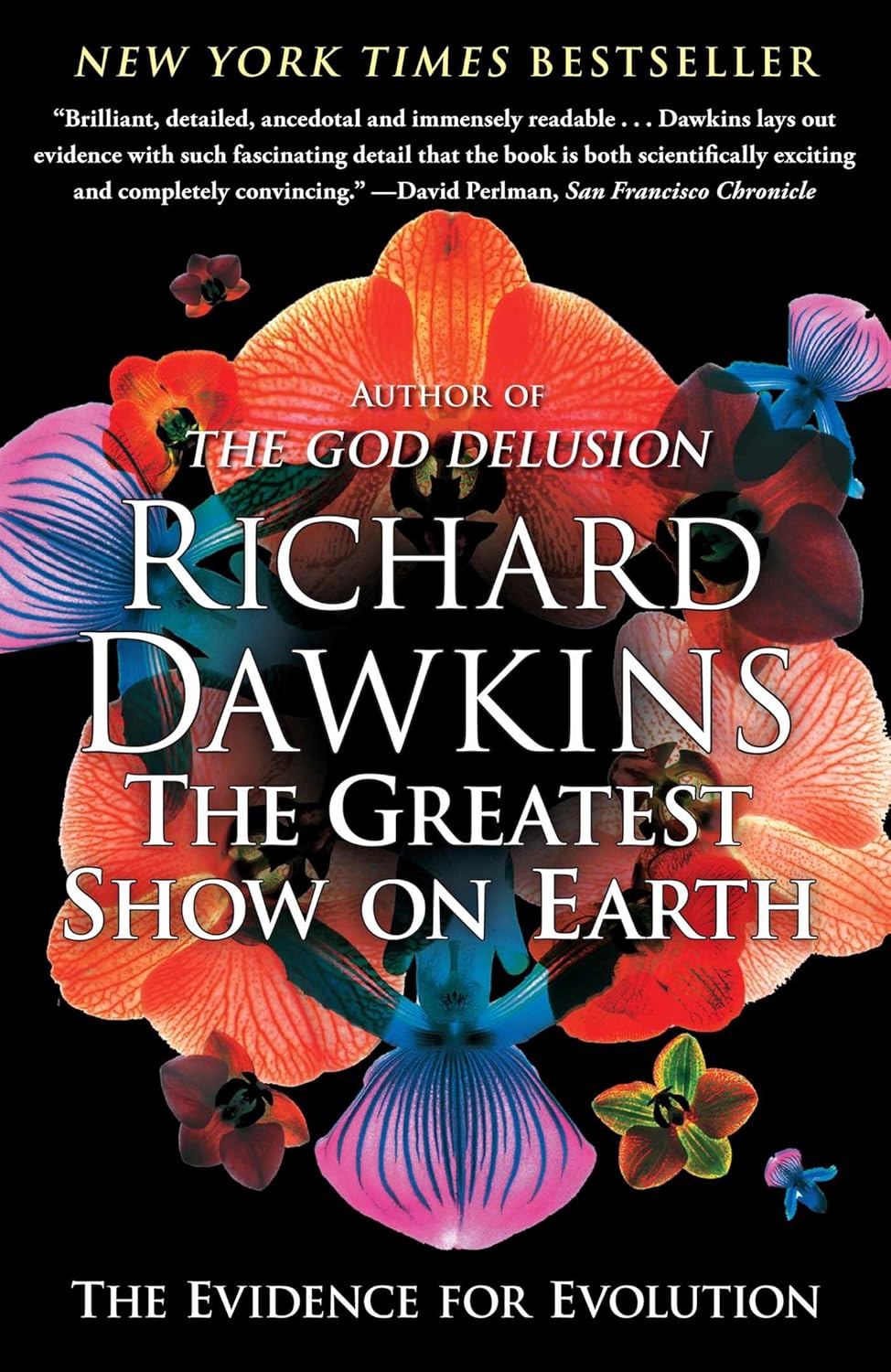
About The Greatest Show on Earth by Richard Dawkins – Discover the Powerful Evidence for Evolution
The Greatest Show on Earth by Richard Dawkins is a popular science book that explains the evidence behind evolution in a clear and detailed way. Its full title is The Greatest Show on Earth: The Evidence for Evolution. Dawkins takes readers through fossils, living animals, plants, DNA, natural selection, geology, embryos, and other parts of science to show how life has changed over very long periods of time.
The book was written for people who may have heard about evolution but want to know how scientists actually know it happened. Rather than simply saying that evolution is true, Dawkins builds his case using many kinds of evidence.
You do not need to be a professional biologist to begin reading. Some ideas require attention, but Dawkins uses examples from everyday animals and the natural world to make difficult science easier to understand.
What does the book actually explain?
A common question about evolution is simple: where is the evidence?
That question is the heart of this book. Dawkins looks at different branches of science and shows how they point toward the same broad history of life.
He discusses natural selection that can be observed in living populations. He looks at fossils that show organisms from different periods of Earth’s history. He explains how scientists estimate age using tree rings and radioactive dating. He also explores genetics, embryos, geographical patterns, and the movement of continents.
Each form of evidence tells part of the story. When those parts are placed together, readers can see why evolution is one of the central ideas in modern biology.
This approach makes the book useful for readers who do not want to accept a scientific claim only because someone tells them to. It encourages readers to look at the evidence and understand how scientific conclusions are built.
Natural selection becomes easier to picture
The phrase “natural selection” may sound difficult at first, but the basic idea can be understood through simple examples.
Living things are not exactly the same. Some differences can help an animal or plant survive and reproduce better in a certain place. Over many generations, useful inherited traits can become more common.
Dawkins discusses examples from animals, plants, breeding, and experiments to show how change can happen. He also explains why small changes over many generations can eventually produce very large differences.
This helps readers connect the small changes we can observe today with the much larger history of life on Earth.
Fossils are only one part of the evidence
Many people think the evidence for evolution depends completely on fossils. Dawkins explains why that is not the case.
Fossils are extremely useful because they give scientists information about organisms that lived in the past. They can show when certain forms appeared and how groups changed over time.
But even without a perfect fossil record, scientists have many other ways to study evolutionary history.
DNA contains clues about relationships between living things. Bodies carry features inherited from ancestors. Embryonic development can reveal shared patterns. The geographical location of species can also make sense when we understand the history of continents and populations.
The strength of the evidence comes from many different scientific fields supporting the same overall picture.
Science becomes a detective story
One of the easiest ways to understand this book is to imagine a detective working on a very old case.
Nobody was standing around millions of years ago with a camera. Scientists must study clues left behind. Fossils are clues. DNA is a clue. Rock layers are clues. Living species are clues. Even parts of our own bodies can carry information about the past.
Dawkins brings these clues together and explains what scientists can reasonably learn from them.
This makes The Greatest Show on Earth feel less like a dry textbook and more like an investigation into one of the biggest stories possible: how the diversity of life developed.
Why Dawkins wrote this book
Richard Dawkins had written about evolution for decades before publishing The Greatest Show on Earth in 2009. However, this book had a more direct goal: to gather the evidence for evolution into one accessible work.
He also responds to arguments from creationism and Intelligent Design. His position is strongly stated, so readers should know that the book is not written as a neutral debate between different religious and scientific views. It is a defence of evolutionary biology based on the scientific evidence Dawkins presents.
That makes it useful for readers who want to understand the scientific case itself, even if they later choose to compare Dawkins’ conclusions with other philosophical or religious views.
Learn without reading a university textbook
Biology textbooks can contain difficult language, diagrams, formulas, and large amounts of detail. For a general reader, that can make a fascinating subject feel harder than necessary.
The Greatest Show on Earth offers another path. It keeps the science serious but explains ideas through stories, examples, comparisons, and observations from nature.
Readers can learn about subjects such as:
- Natural selection and adaptation
- Fossils and transitional forms
- Artificial selection
- Radioactive dating
- Embryonic development
- Genetics and DNA
- Continental movement
- Common ancestry
- Observable evolutionary change
The result is a book that can support school or university learning while still being written for ordinary readers.
A premium edition for focused reading
Bookish Wonderland offers this edition for readers who want comfortable pages and a physical book made for regular use.
- Premium eye-soothing cream paper: Softer-looking pages for more comfortable reading.
- Crystal-clear print: Sharp text helps readers follow scientific explanations easily.
- High-quality stitched and glue binding: Designed for stronger page hold and greater longevity.
- Durable physical quality: Suitable for study, personal libraries, travel, and repeated reading.
A science book often needs more than one reading. You may want to return to a chapter, check an earlier example, or reread an idea after learning something new. A strong physical copy makes that easier.
Who should read The Greatest Show on Earth?
This book is a strong choice for readers interested in biology, evolution, genetics, natural history, zoology, science, and the history of life.
It can also be useful for students who want a wider explanation of evolution beyond short textbook chapters. General readers who enjoy asking “How do scientists know?” may find the book especially rewarding.
Fans of Richard Dawkins’ other books, such as The Selfish Gene, may appreciate seeing him focus directly on the evidence for evolution.
The book is also suitable for people who disagree with Dawkins but want to understand the argument he makes. Reading a detailed case directly can be more useful than relying on short online debates or second-hand descriptions.
A useful book for study and discussion
The Greatest Show on Earth can be read alone, used as extra science reading, or discussed in a study group or book club.
Its chapters can lead to conversations about how science works, what counts as evidence, how scientists estimate the age of objects, how species change, and how different branches of science support each other.
Teachers, students, science lovers, and curious adult readers can all find different reasons to explore it.
If you are checking the Book price in Bangladesh for The Greatest Show on Earth by Richard Dawkins, Bookish Wonderland offers nationwide delivery and Cash on Delivery. Readers in Dhaka can also ask about fast or urgent delivery options when available.
Why choose Bookish Wonderland?
Bookish Wonderland makes English books easier to order for readers across Bangladesh. Cash on Delivery is available nationwide, with delivery both inside and outside Dhaka. Fast or urgent delivery can also be requested in Dhaka when available.
For readers building a science collection, this book brings together evidence from many branches of biology and Earth science in one volume. It can sit comfortably beside books about genetics, human origins, natural history, or the work of Charles Darwin.
More importantly, it gives readers something valuable: a chance to understand not only what scientists conclude about evolution, but why they reached those conclusions.
If you require any customization or have any questions, please inbox us via FB or Insta.
| Primary Specification | |
| Author | Richard Dawkins |
| Narrator | Richard Dawkins, Lalla Ward |
| Genre | Science, Evolutionary Biology, Popular Science |
| ISBN-13/ISSN | 978-0552775243 |
| ISBN-10 | 9780552775243 |
| Publisher | BLACK SWAN |
| Publishing Date | November 5, 2009 |
| Language | English |
| Reading Age | 12+ years |
| Format | Printed book |
| Physical Specification & Quality | |
| Paper Quality | Premium eye-soothing cream paper |
| Binding Quality | High quality stitched and glue binding (for longevity) |
| Print Quality | Crystal-clear print |
| Pages | 470 pages |
| Country | USA |
| Logistics Information | |
| Weight | 477 g |
| Length | 8.5 inch |
| Width | 5.6 inch |
| Height | 1.18 inches |