

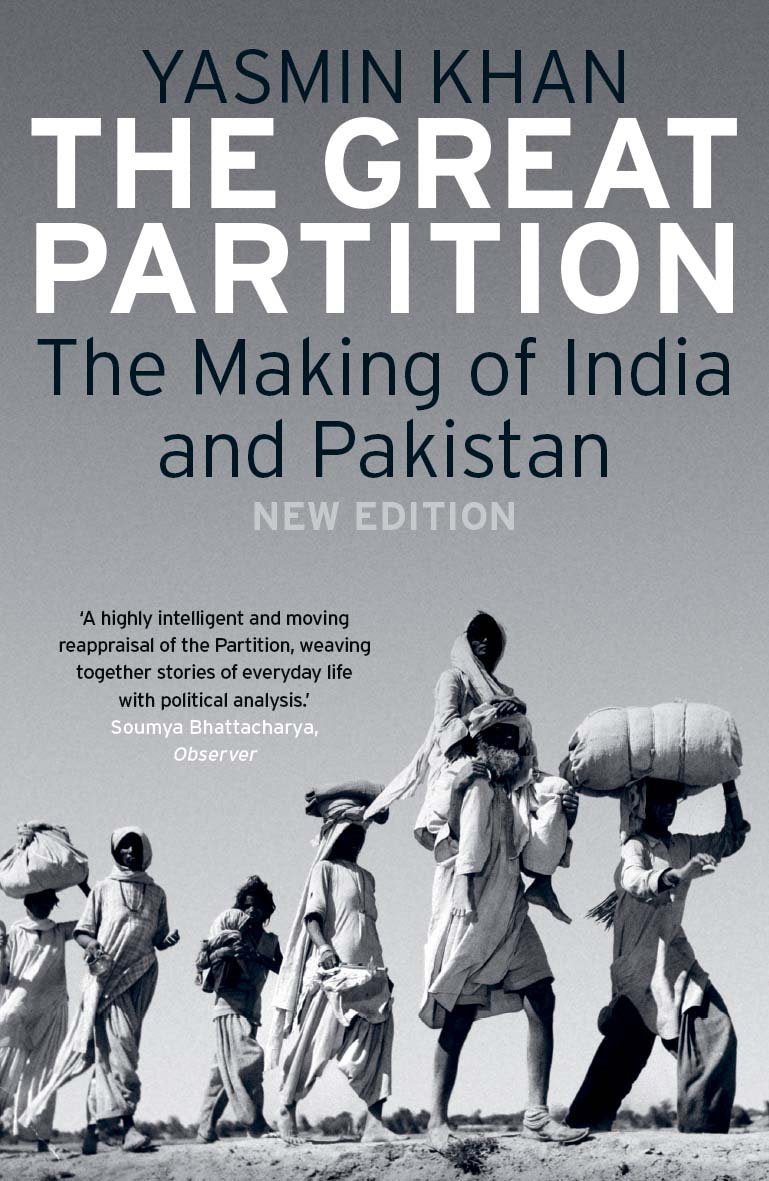
About The Great Partition by Yasmin Khan – Understand How India and Pakistan Were Divided in 1947
The Great Partition by Yasmin Khan is a powerful history book about the division of British India in 1947 and the creation of India and Pakistan. Instead of looking only at famous political leaders, meetings, and official decisions, Yasmin Khan also looks at ordinary people whose homes, families, jobs, and futures were changed by Partition.
The book explains how British rule came to an end, how borders were created, and why so many people were unprepared for what was about to happen. It follows the political choices behind Partition while also showing the fear, confusion, violence, migration, and loss experienced by people on the ground.
This mix makes the book especially useful. You learn about major historical decisions, but you also see what those decisions meant for families living through them. The result is a history that feels close to real human life rather than only a list of dates and names.
When history books feel too focused on famous leaders
Partition is often explained through a few major figures and political organizations. Those people were important, but focusing only on leaders can make it hard to understand what happened across towns, villages, railway stations, offices, and homes.
The Great Partition offers a wider view.
Khan connects national politics with local events and ordinary experiences. She examines the context, execution, and aftermath of Partition while showing how little many people understood about what division would mean in practice.
This helps readers see that the creation of two new states was not simply a line being drawn on a map. Borders affected where people could live, what country they belonged to, whether they felt safe, and whether they could remain in places their families had known for generations.
How did Partition happen so quickly?
One of the central questions in the book is how such a huge political change could happen with so much uncertainty.
British colonial rule was ending. Political pressure was growing. Different plans for the future of the subcontinent were being debated. India and Pakistan were moving toward independence, but the practical meaning of Partition was still unclear to many people.
Khan examines the speed of the British withdrawal and the problems created by weak planning and uncertainty. Decisions made at the highest political levels had to be turned into borders, governments, security systems, and new forms of citizenship in a very short period.
The book shows why this process became so dangerous. Rumours spread quickly. Fear grew. Local tensions became harder to control, and many people did not know what would happen to them until events were already moving around them.
Beyond maps and political speeches
A map can make Partition look simple: one territory becomes two states.
Real life was far more complicated.
People had families, businesses, farms, friendships, religious communities, and memories tied to particular places. A new border could suddenly change what it meant to belong there.
Khan pays close attention to these human problems. The story includes migration, refugee movements, communal violence, uncertainty, and the difficult work of creating new governments.
The book also explores how people understood events at the time. Not everyone knew what Partition would become. Many expected political change without imagining the full scale of the movement and violence that followed.
That gap between political plans and lived reality is one of the most important ideas in the book.
India and Pakistan were born through both hope and tragedy
1947 was a moment of independence after a long period of British colonial rule. For millions of people, independence carried hope and the promise of a new future.
At the same time, Partition brought enormous suffering.
Khan does not reduce the story to one simple emotion. She shows how freedom, fear, celebration, violence, political ambition, and personal loss could exist at the same time.
This balance is important because the history of 1947 cannot be understood only as independence or only as tragedy. The creation of India and Pakistan changed the political future of South Asia, while Partition also left memories and disputes that continued long after the borders were created.
Ordinary people are placed at the center
One of the strongest features of The Great Partition is its attention to ordinary lives.
Many histories begin with powerful politicians and stay there. Khan moves between high-level decisions and the people who had to live with the results.
This makes the history easier to understand. A government announcement can feel distant. A family wondering whether to leave its home feels immediate.
By looking at personal experiences alongside political history, Khan shows how large events are actually lived. Policies become journeys. Borders become decisions about where to go. Political conflict becomes fear inside neighborhoods and communities.
This human focus is one reason Oxford describes her work as combining ordinary lives with larger political forces.
A useful book for understanding South Asia today
Partition did not end in August 1947. Its effects continued.
The relationship between India and Pakistan, questions of borders, refugee memories, national identity, and debates about the colonial past all have links to what happened during this period.
The revised edition also includes a new introduction in which Khan reflects on newer research, changing ways of remembering Partition, and connections with modern refugee crises.
That makes the book useful not only for understanding the past but also for thinking about displacement, migration, borders, and state-building more generally.
It helps readers understand why Partition remains such an important subject in South Asian history.
Clear enough for general readers, detailed enough for study
You do not need to be a professional historian to read The Great Partition.
Khan is an academic historian, but the book is written for a wider audience as well. It explains political events while keeping the human story visible.
Students can use it to understand British decolonization, the creation of India and Pakistan, migration, communal violence, and refugee history. General readers can approach it as a detailed account of how one of the twentieth century’s most important political changes affected millions of lives.
It is especially useful for readers who want more depth than a short school chapter or online summary can provide.
A premium edition made for serious reading
Bookish Wonderland offers this edition for readers who want a comfortable physical book that can handle study and repeated use.
- Premium eye-soothing cream paper: Soft-looking pages that help make longer reading sessions more comfortable.
- Crystal-clear print: Sharp text keeps names, dates, and detailed historical discussion easy to follow.
- High-quality stitched and glue binding: Designed for stronger page hold and better longevity.
- Durable reading quality: Suitable for study, home libraries, research, gifting, and regular reference.
A history book is often opened more than once. Readers may return to earlier chapters, check names, compare events, or use parts of the book for research. A durable copy is useful for that kind of long-term reading.
Who should read The Great Partition?
The book is a strong choice for readers interested in Indian history, Pakistani history, British colonial history, South Asian politics, independence, migration, refugees, and decolonization.
University and college students studying history, political science, international relations, or South Asian studies may find it especially useful.
It can also help readers whose families have memories connected to Partition and who want a wider historical picture of what happened.
Readers who enjoy serious nonfiction but still want individual human experiences rather than only political analysis may find Khan’s approach particularly rewarding.
A valuable book for students, researchers, and curious readers
The Great Partition works well for personal study, academic reading, history discussions, and building a serious nonfiction collection.
It can also make a thoughtful gift for someone interested in the history of India, Pakistan, British rule, or twentieth-century South Asia.
For readers checking the Book price in Bangladesh for The Great Partition by Yasmin Khan, Bookish Wonderland offers nationwide delivery and Cash on Delivery. Customers inside and outside Dhaka can order easily, while fast or urgent delivery may also be available in Dhaka.
Why order from Bookish Wonderland?
Bookish Wonderland helps readers across Bangladesh find premium English books with easy ordering and practical delivery options. Nationwide Cash on Delivery is available, with delivery both inside and outside Dhaka. Customers in Dhaka can also ask about fast or urgent delivery when available.
For anyone who wants to understand how India and Pakistan were created and what Partition meant for the people who lived through it, The Great Partition offers an informed, human-centered account worth keeping for study and future reference.
If you require any customization or have any questions, please inbox us via FB or Insta.
| Primary Specification | |
| Author | Yasmin Khan |
| Narrator | Jeed Saddy |
| Genre | History, Political Science, South Asian History |
| ISBN-13/ISSN | 978-0300230321 |
| ISBN-10 | 030023032X |
| Publisher | Yale University Press |
| Publishing Date | 4 July 2017 |
| Language | English |
| Reading Age | 12+ years |
| Format | Printed book |
| Physical Specification & Quality | |
| Paper Quality | Premium eye-soothing cream paper |
| Binding Quality | High quality stitched and glue binding (for longevity) |
| Print Quality | Crystal-clear print |
| Pages | 288 pages |
| Country | United Kingdom |
| Logistics Information | |
| Weight | 293 g |
| Length | 8.5 inch |
| Width | 5.6 inch |
| Height | 2.54 cm |