

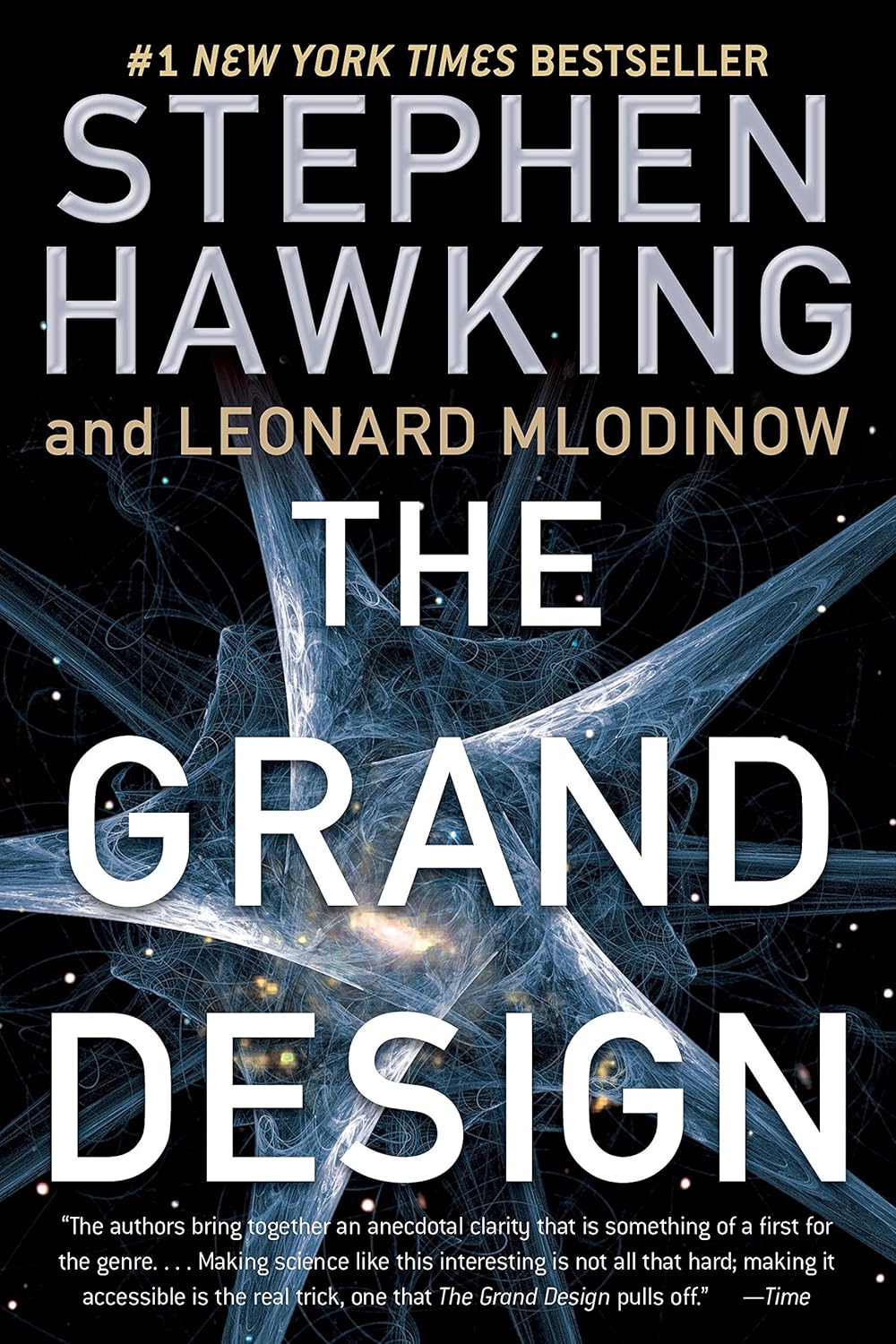
About The Grand Design by Stephen Hawking and Leonard Mlodinow – Big Questions About the Universe Made Easier
The Grand Design by Stephen Hawking and Leonard Mlodinow takes on some of the biggest questions people can ask. How did the universe begin? Why do the laws of nature work the way they do? Why is there something instead of nothing? And does the universe need a designer? Hawking and Mlodinow explore these questions through modern physics, using clear examples and illustrations to help general readers follow ideas that can otherwise feel very hard.
This is not a school textbook filled with long equations. It is a popular science book for curious readers. The authors move from classical physics to quantum theory, then explain how modern science changes the way we think about reality. The book also looks at the possibility of many universes, often called the multiverse, and discusses M-theory as a possible path toward a wider theory that could connect the laws of nature.
Big science without making you feel lost
Physics can sound scary when words like quantum theory, multiverse, and M-theory appear together. Many people want to learn about the universe but stop because the subject feels too technical. The Grand Design tries to solve that problem by focusing on ideas instead of heavy mathematics.
Stephen Hawking became famous for bringing difficult questions about space and time to general readers. Leonard Mlodinow is also a physicist and science writer known for explaining complex ideas clearly. Together, they guide the reader step by step. You do not need to be a science student to begin. Curiosity is enough.
Some parts may still make you stop and think, because the universe itself is not simple. Instead of asking you to memorize formulas, the authors ask you to think about what reality means and how science builds models to explain what we observe.
What makes this book so interesting?
One of the strongest parts of The Grand Design is the way it connects old questions with modern science. People have wondered about the beginning of the universe for thousands of years. Hawking and Mlodinow show how ideas about nature changed from early philosophy to Newton, Einstein, quantum physics, and newer theories.
A key idea is “model-dependent realism.” In simple terms, the authors argue that we understand reality through models that help explain what we see. Different models can sometimes describe the same world in useful ways. This leads to a wider discussion about how scientific theories work.
The authors also discuss quantum theory, where events do not always behave in the neat way we expect from everyday life. They explain the idea that the universe may have many possible histories. From there, the book explores the multiverse: the possibility that our universe may be one among many, each with different conditions.
The question at the heart of the book
The Grand Design became widely discussed because it asks whether the universe needs a creator in order to begin. Hawking and Mlodinow present their scientific argument that laws such as gravity, together with quantum physics, can allow a universe to arise without an outside physical cause in the way people may normally imagine one.
This part can be thought-provoking whether you agree with the authors or not. Its value is in seeing how they build their case from physics. Readers interested in science, philosophy, religion, or the origin of the universe may find this section especially engaging.
The book remains focused on cosmology and theoretical physics. It asks what science can say about why the universe has the laws it has and whether a deeper theory could explain them.
From Einstein to M-theory
The book gives readers a short journey through major scientific ideas. It touches on how Newton described motion, how Einstein changed our view of space and time, and how quantum physics opened a very different picture of nature.
Hawking and Mlodinow then move toward M-theory. They discuss it as a major candidate for a broad framework that may connect different theories and help explain the forces and particles we see. The book presents why this idea matters in the search for a deeper explanation of the universe.
That makes The Grand Design useful for readers who want a doorway into modern cosmology. You may not finish the book as a physicist, but you can finish with a clearer map of the questions physicists are trying to answer.
A premium physical edition for repeated reading
Bookish Wonderland offers a reader-friendly edition for people who want a book that feels comfortable in the hand and stays usable over time.
- Premium cream paper: Softer on the eyes than bright white paper and comfortable for longer reading.
- Crystal-clear print: Sharp text helps make difficult ideas easier to follow.
- Stitched and glue binding: Made for stronger page hold and better longevity.
- Durable everyday use: Suitable for home libraries, study desks, book clubs, and regular carrying.
These details matter for a science book because readers often move back and forth between chapters, reread an idea, or return to an earlier explanation.
Who should read The Grand Design?
This book is a good fit for anyone who enjoys asking large questions. It can suit older students, university learners, adult readers, science fans, and people who have never studied physics in depth but want to understand modern ideas about the universe.
Fans of Stephen Hawking may enjoy seeing how questions about cosmology are explored with Leonard Mlodinow.
It is not a story-driven book, so readers looking for fiction will get a different experience. The reward comes from ideas. If you like books that make you stop, wonder, and talk about what you have read, this is the kind of book that can stay open on your desk for days.
A smart choice for study, discussion, and gifting
The Grand Design works well for personal reading, class discussion, science clubs, and gifting. It can also sit beside other popular science books as a useful starting point for deeper reading. Someone who loves space, physics, astronomy, or Stephen Hawking may especially enjoy receiving it.
Because the book is only a few hundred pages long, it can fit into a busy reading schedule. You can read one chapter at a time, pause to think, and come back later without losing the main direction of the discussion.
When you check the Book price in Bangladesh for The Grand Design by Stephen Hawking and Leonard Mlodinow, Bookish Wonderland gives you an easy way to order with nationwide delivery and Cash on Delivery. Customers in Dhaka can also ask about fast or urgent delivery when available.
Why buy it from Bookish Wonderland?
Bookish Wonderland serves readers across Bangladesh who want easy access to English books with practical delivery options. Nationwide delivery and Cash on Delivery make ordering simple, while customers in Dhaka can ask about faster delivery when needed.
The Grand Design gives curious readers a clear starting point for some of the deepest questions in modern science.
If you require any customization or have any questions, please inbox us via FB or Insta.
| Primary Specification | |
| Author | Stephen Hawking and Leonard Mlodinow |
| Narrator | Steve West |
| Editor | Seamus M. Sullivan |
| Genre | Nonfiction, Popular Science, Physics, Cosmology |
| ISBN-13/ISSN | 978-0553384666 |
| ISBN-10 | 055338466X |
| Publisher | Bantam |
| Publishing Date | January 1, 2012 |
| Language | English |
| Reading Age | 15+ years |
| Format | Printed book |
| Physical Specification & Quality | |
| Paper Quality | Premium eye-soothing cream paper |
| Binding Quality | High quality stitched and glue binding (for longevity) |
| Print Quality | Crystal-clear print |
| Pages | 208 pages |
| Country | USA |
| Logistics Information | |
| Weight | 213g |
| Length | 8.5 inch |
| Width | 5.6 inch |
| Height | 0.56 inches |