

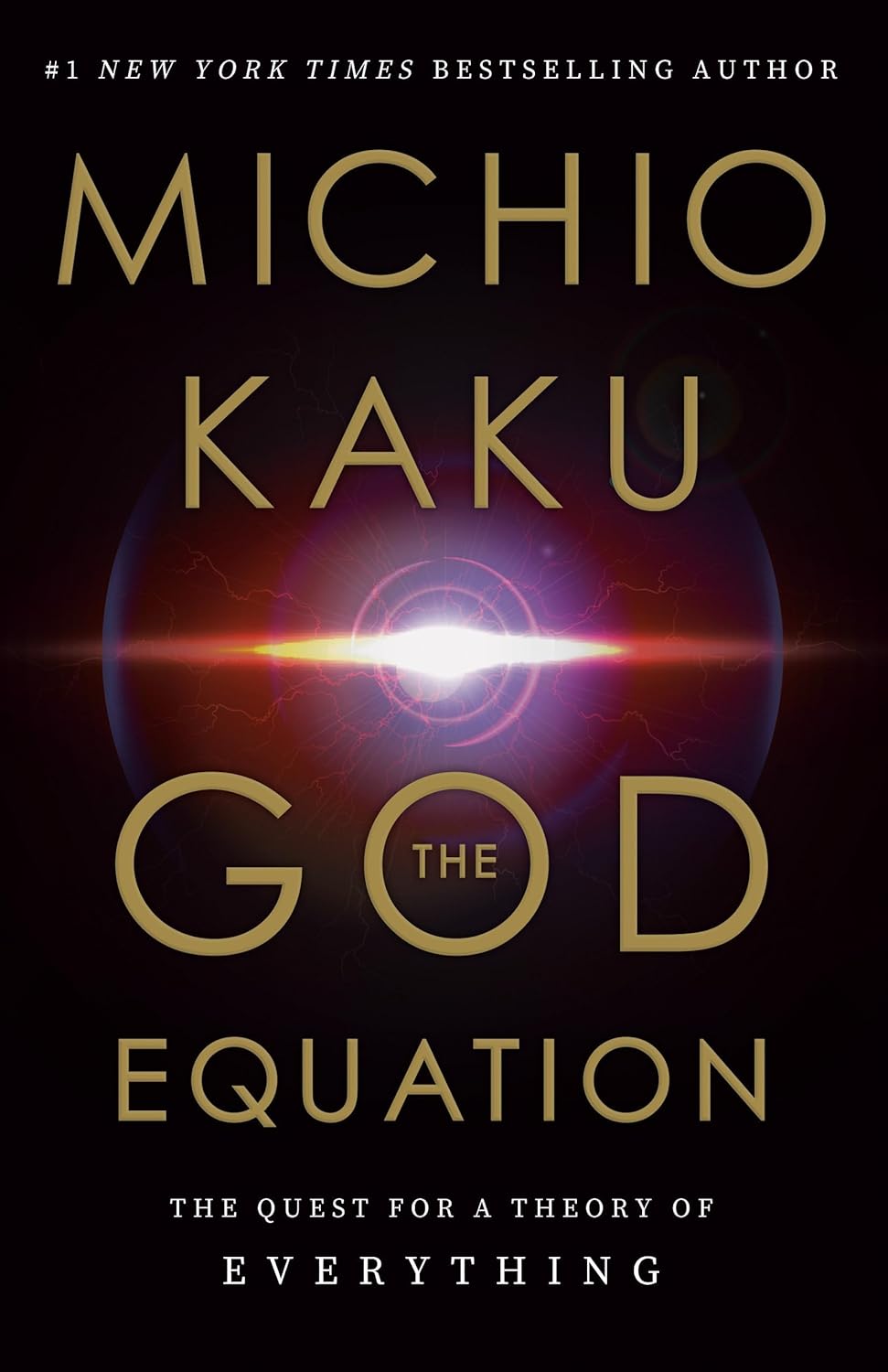
About The God Equation Book by Michio Kaku: Discover the Great Search for a Theory of Everything
What if one simple idea could explain every star, planet, atom, force, and event in the universe? This is the great dream explored in The God Equation Book by Michio Kaku. Written by one of the world’s best-known science writers, this book takes readers on an exciting trip through the history of physics and the search for a final theory of everything.
Michio Kaku explains how great thinkers tried to find the hidden rules that shape our world. He begins with Isaac Newton, moves through the discoveries of Albert Einstein and other famous scientists, and then introduces modern ideas such as quantum theory and string theory. The subject may sound difficult, but Kaku uses clear stories, simple examples, and easy comparisons to help general readers follow the discussion.
This is not a religious book, and its title does not claim that scientists have found proof of God. The “God equation” means a possible mathematical theory that could bring all the main forces of nature together. Physicists often call this dream a “theory of everything.” Scientists have not yet proved that such a final theory exists, but the search has changed the way we understand space, time, matter, energy, and the universe itself.
For students, curious readers, and anyone who has ever looked at the night sky and asked, “How does all of this work?”, The God Equation by Michio Kaku offers an inspiring place to begin.
Big Questions Made Easier to Understand
Many people want to learn about the universe but feel afraid of physics. Scientific books can be full of hard words, long equations, and ideas that seem impossible to understand. A reader may be interested in black holes, time, space, or the Big Bang but may not know where to start.
The God Equation helps solve this problem by focusing on the story behind the science. Michio Kaku does not expect every reader to be a trained physicist. Instead, he introduces major ideas step by step and explains why each discovery was important. Readers learn how one question led to another and how every new answer changed humanity’s view of the universe.
The book turns physics into a journey of discovery. It shows scientists as real people who dreamed, argued, failed, tried again, and sometimes changed history. This human side makes difficult ideas feel less distant. You may not understand every detail of advanced physics after one reading, but you can gain a clear view of what scientists are trying to achieve and why their work matters.
Instead of presenting science as a pile of facts, Kaku presents it as a living search. That makes the book easier to enjoy and gives readers a reason to keep turning the pages.
From Newton’s Laws to Einstein’s Universe
The story begins with the early effort to understand motion and gravity. Isaac Newton showed that the same rules could explain both a falling object on Earth and the movement of the Moon in the sky. This was a powerful change in human thought. Nature was no longer seen as a set of separate mysteries. It began to look like a system guided by shared laws.
Later, scientists learned more about electricity, magnetism, light, heat, and energy. Each discovery added another part to the picture. James Clerk Maxwell showed that electricity and magnetism were connected, creating one of the first great examples of different forces being joined under one theory.
Albert Einstein then changed physics again. His work on relativity showed that space and time are not fixed in the simple way people once believed. Gravity could be understood as the bending of space and time caused by matter and energy. This opened a new way to think about planets, stars, black holes, and the wider universe.
Kaku explains these major steps as parts of a long search for unity. Scientists do not only want separate rules for separate events. They hope to find a deeper idea that connects them all. This wish for one clear picture is at the heart of The God Equation.
Why the Search Is Still Unfinished
Modern physics has two highly successful foundations. Einstein’s theory of general relativity helps scientists understand gravity and very large things, including planets, stars, galaxies, and the structure of the universe. Quantum theory helps explain very small things, such as atoms and subatomic particles.
Both systems work extremely well in their own areas. The problem appears when scientists try to use them together under extreme conditions. A black hole, for example, has powerful gravity packed into a very small region. The beginning of the universe also involved tiny scales, great energy, and intense gravity. In places like these, the two major systems do not fit together neatly.
This gap is one of the biggest problems in physics. Scientists need a theory that can explain gravity while also following the strange rules of the quantum world. Finding that theory could help them study the birth of the universe, the deepest parts of black holes, and the basic nature of space and time.
Michio Kaku explains why this missing connection matters. The reader sees that science is not complete and that even the greatest experts still face questions without final answers. This makes the book exciting because it is not only about old discoveries. It is also about a mystery that remains open today.
String Theory and the Hope for One Great Theory
A major part of the book discusses string theory, the field for which Michio Kaku is well known. In a simple picture, string theory suggests that the smallest parts of nature may not be tiny points. They may instead be extremely small vibrating strings. Different ways of vibrating could appear as different particles, just as different vibrations on a musical string create different notes.
This idea may offer a way to place matter, energy, and gravity inside one mathematical framework. It is one reason some scientists see string theory as a possible path toward a theory of everything.
Kaku presents this possibility with clear excitement. However, readers should remember that string theory has not been confirmed as the final theory of nature. It remains an active and debated area of physics, and researchers continue to study other ideas as well. The book mainly presents Kaku’s view of why string theory is promising.
This balance makes the subject more useful for readers. You can enjoy the beauty of the idea while understanding that the search continues. The God Equation does not hand readers a proven final answer. It invites them into one of the boldest debates in modern science.
More Than a Lesson in Physics
This book is valuable because it also explores human curiosity. For hundreds of years, people have asked why nature follows rules and whether those rules can be joined into one simple system. Every major discovery has brought new answers, but it has also created deeper questions.
Why did the universe begin? What happened before the Big Bang? What lies inside a black hole? Are there dimensions that we cannot see? Can time travel ever be possible? Could other universes exist? What are space and time truly made of?
The God Equation introduces these questions without turning the book into a heavy textbook. It gives readers enough background to understand why scientists ask them and why simple answers are difficult. The result is a book that can expand the reader’s imagination while encouraging careful thought.
It also shows that science grows through doubt. A theory must be tested, compared with evidence, and improved when it fails. Even a beautiful idea cannot become accepted science through beauty alone. This lesson is useful far beyond physics because it teaches readers to stay curious while also asking for proof.
Why Curious Readers May Love This Book
The God Equation by Michio Kaku is a strong choice for readers who love learning how the world works. You do not need to solve equations while reading it. The main goal is to follow the ideas, understand the history, and see the connections between major discoveries.
The book may appeal to people who enjoy space documentaries, science videos, astronomy, technology, futurism, or books about great thinkers. It can also help students see the larger purpose behind topics they meet in science classes. Instead of learning separate facts, they can understand how those facts belong to a much bigger story.
Teachers and parents may use the book to begin conversations about the universe. Friends can discuss whether one final theory is possible, how scientific ideas are tested, and what future discoveries may reveal. A reader can also use it as a starting point before moving to more detailed books on relativity, quantum mechanics, cosmology, particle physics, or string theory.
Most importantly, it can bring back the feeling of wonder that often leads people to science. It reminds us that the universe is not only something to observe. It is a mystery that people are still working to understand.
What You Will Find Inside
The book offers a clear path through some of the most important ideas in physics:
- A readable history of the search for the basic laws of nature
- Simple discussions of gravity, motion, electricity, magnetism, space, and time
- An introduction to Einstein’s relativity and its effect on modern physics
- A broad explanation of quantum theory and the world of tiny particles
- The problem of bringing quantum physics and gravity together
- An accessible introduction to string theory and its main promise
- Questions about black holes, the Big Bang, extra dimensions, and the future of physics
- Stories about the scientists whose ideas changed human knowledge
These subjects are connected into one story, so readers can see how physics developed over time. The book is not a step-by-step mathematics guide and does not provide technical training. Its strength lies in explaining the goal, history, and wonder of the search.
Benefits That Last Beyond the Final Page
Reading The God Equation can help you build a clearer picture of modern physics without beginning with an advanced textbook. It introduces important scientific words and ideas in a way that can make future learning easier.
The book may also improve critical thinking. Readers see how theories are created, why evidence matters, and why unanswered questions are a normal part of science. It encourages people to separate a promising idea from a proven fact.
Another benefit is the wider view it offers. Everyday worries can feel different when placed beside the age, size, and mystery of the universe. The book invites readers to think about humanity’s place in nature and the limits of present knowledge.
It is also a useful conversation book. The chapters raise ideas that can lead to discussions with students, teachers, friends, and family members. Whether the topic is black holes, the Big Bang, hidden dimensions, or the future of science, readers will find many points worth exploring.
Made for Comfortable, Regular Reading
Bookish Wonderland offers this printed edition for readers who want a comfortable copy that can remain in their collection. The physical features are selected to support both short reading sessions and longer periods of study.
- Premium eye-soothing cream paper: The soft cream colour is gentle on the eyes and comfortable for regular reading.
- Crystal-clear print: Sharp, clean text helps every page remain easy to read.
- High-quality stitched and glue binding: The combined binding supports the pages and improves the book’s longevity.
These features make the book suitable for personal reading, study, note-taking, gifting, and display on a science or nonfiction shelf. A durable printed copy also allows readers to return to important sections without depending on a screen or battery.
Perfect for Learning, Gifting, and Discussion
This book can serve many kinds of readers. A university or college student may read it to gain a broad view of theoretical physics. A school student with a strong interest in space may use it as an introduction, though younger readers may need help with some ideas. An adult reader can enjoy it simply as a clear account of one of science’s greatest goals.
It can also make a thoughtful gift for someone who enjoys science, space, big questions, or intellectual challenges. The subject feels ambitious, yet Kaku’s writing keeps the journey welcoming. It is suitable for birthdays, academic achievements, science-club events, or any moment when you want to encourage curiosity.
For group reading, the book offers many discussion topics. Readers can debate whether nature can truly be explained by one theory, why string theory remains controversial, or what evidence might change physics in the future.
If you are comparing The God Equation by Michio Kaku price in Bangladesh, consider both the ideas inside the book and the quality of the printed copy. Bookish Wonderland combines an engaging science title with reader-friendly paper, clear printing, and durable binding.
Begin Your Journey into the Universe
The God Equation Book by Michio Kaku is for anyone who wants to understand the great dream of modern physics: finding one theory that connects every force and part of nature. It brings together scientific history, bold ideas, famous thinkers, and unanswered questions in a form made for general readers.
Order your copy from Bookish Wonderland and explore a story that reaches from falling objects and moving planets to black holes, quantum particles, hidden dimensions, and the birth of the universe. With premium eye-soothing cream paper, crystal-clear print, and high-quality stitched and glue binding, this edition is prepared for comfortable reading and long-term use.
Nationwide delivery and Cash on Delivery are available across Bangladesh. Customers in Dhaka can also request fast or urgent delivery where the service is available.
Get your copy today and discover why the search for a theory of everything remains one of humanity’s greatest intellectual adventures.
If you require any customization or have any questions, please inbox us via FB or Insta.
| Primary Specification | |
| Author | Michio Kaku |
| Narrator | Feodor Chin |
| Editor | Michael Collica |
| Genre | Popular Science, Theoretical Physics, Cosmology, Quantum Theory, String Theory |
| ISBN-13/ISSN | 978-0525434566 |
| ISBN-10 | 0525434569 |
| Publisher | Vintage |
| Publishing Date | March 29, 2022 |
| Language | English |
| Reading Age | 14+ years |
| Format | Printed book |
| Physical Specification & Quality | |
| Paper Quality | Premium eye-soothing cream paper |
| Binding Quality | High quality stitched and glue binding (for longevity) |
| Print Quality | Crystal-clear print |
| Pages | 240 pages |
| Country | United States |
| Logistics Information | |
| Weight | 259 gm |
| Length | 8.5 inches |
| Width | 5.6 inches |
| Height | 0.73 inch |